

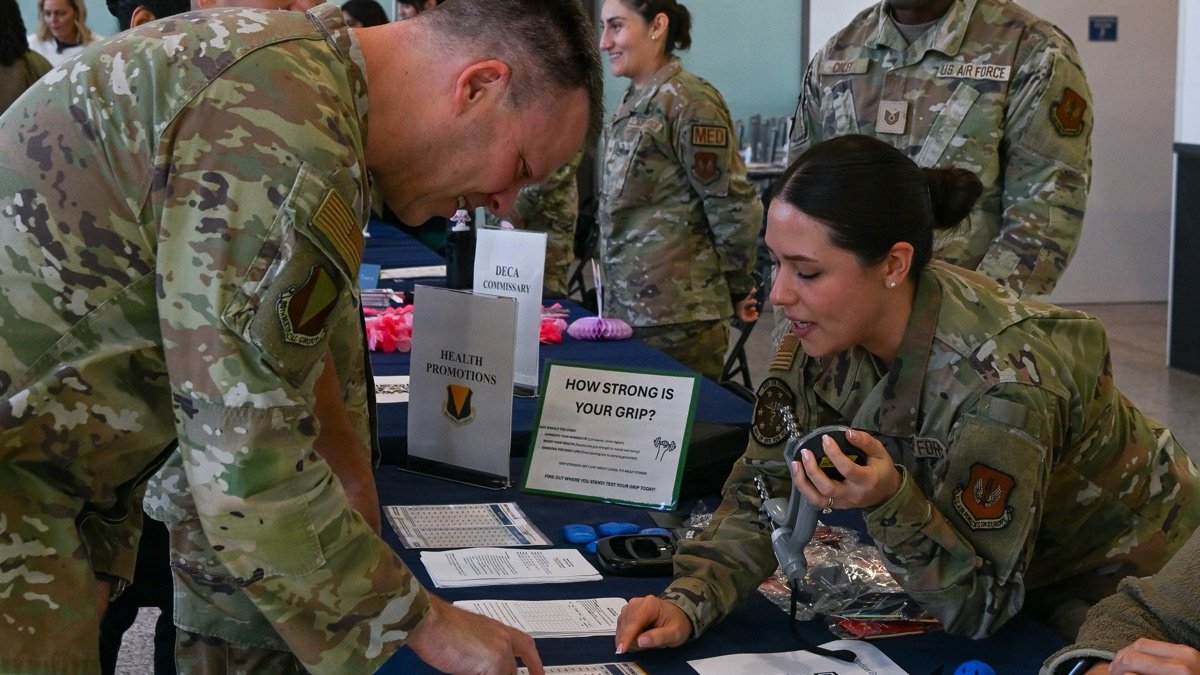
Grip strength is one of the simplest health markers researchers have: in large studies, people with a weaker grip die earlier and have more heart disease on average, but grip is a window into your overall strength and health, not a switch you can flip with a hand gripper. In the PURE study of nearly 140,000 adults in 17 countries, every 5 kg (11 lb) lower grip was linked to a 16% higher risk of death from any cause. Doctors also use grip cut-offs, such as under 27 kg (about 60 lb) for men and under 16 kg (about 35 lb) for women, to flag low muscle strength in older adults.
The useful takeaway is practical: know roughly where your grip stands for your age, and if it's low, get stronger overall. This guide covers what the research shows and doesn't show, normal values by age in pounds and kilograms, how to test your grip the way researchers do, and a simple weekly routine built around carries, hangs, heavy holds, pulls and grippers.
Why researchers use grip strength as a health marker
A grip test takes a couple of minutes, costs little and needs one handheld device, a dynamometer. That makes it practical in studies of hundreds of thousands of people, where measuring leg or whole-body strength would be slow and expensive. A European consensus on sarcopenia (age-related loss of muscle strength and mass) notes that grip "correlates moderately with strength in other body compartments, so it serves as a reliable surrogate for more complicated measures of arm and leg strength."
The PURE study (The Lancet, 2015)
The Prospective Urban Rural Epidemiology (PURE) study measured grip with a Jamar dynamometer in 139,691 adults aged 35 to 70 across 17 high-, middle- and low-income countries, then followed them for a median of four years. After adjusting for other risk factors, each 5 kg (11 lb) drop in grip strength was associated with:
- a 16% higher risk of death from any cause
- a 17% higher risk of cardiovascular death
- a 7% higher risk of heart attack and a 9% higher risk of stroke
Grip strength predicted death from any cause and cardiovascular death better than systolic blood pressure did. It was not linked to new diabetes, fall injuries or fractures in this study. The authors concluded that grip is "a simple, inexpensive risk-stratifying method," and added that more research is needed "to test whether improvement in strength reduces mortality and cardiovascular disease."
UK Biobank (BMJ, 2018)
A study of about half a million UK Biobank participants aged 40 to 69, followed for an average of 7.1 years, found the same pattern. Per 5 kg lower grip, the risk of death from any cause was 20% higher in women and 16% higher in men. Lower grip was also linked to higher rates of death from cardiovascular disease, respiratory disease, COPD and several cancers, though not prostate cancer. Adding grip strength slightly improved a standard risk score built from age, sex, diabetes, body mass index, blood pressure and smoking. Several of the links were stronger in the younger participants, which suggests grip matters well before old age.
Grip cut-offs in sarcopenia definitions
Because low grip predicts disability and poor outcomes, the main sarcopenia definitions use it as their strength test. The thresholds differ because each group derived them differently:
| Definition | Men | Women | How the cut-off was set |
|---|---|---|---|
| EWGSOP2 (European Working Group on Sarcopenia in Older People, 2019) | Under 27 kg (about 60 lb) | Under 16 kg (about 35 lb) | 2.5 standard deviations below the young-adult average in British normative data |
| FNIH Sarcopenia Project (2014, US) | Under 26 kg (about 57 lb) | Under 16 kg (about 35 lb) | Pooled data from 26,625 older adults in nine US and European data sources |
| Sarcopenia Definitions and Outcomes Consortium (SDOC, 2020, US) | Under 35.5 kg (about 78 lb) | Under 20 kg (about 44 lb) | Levels that best identified older adults with slow walking speed |
The SDOC panel concluded that both weakness (low grip) and slowness (low walking speed) belong in the definition of sarcopenia, because each independently predicted falls, mobility problems, hip fractures and death in older adults. Walking speed works the same way as a quick readout of health, as we covered in our article on whether walking speed predicts how long you live.
What grip strength does and doesn't tell you
Grip is best read as a summary signal, not as a separate organ you need to fix.
- It reflects overall strength. People with strong hands tend to be strong elsewhere. A 2019 review by physical therapist Richard Bohannon found grip consistently tracks overall strength, upper-limb function, bone density, nutrition, multimorbidity and quality of life in older adults.
- It reflects general health, too. Illness, poor nutrition, inactivity, pain and frailty all lower grip. So part of the link with mortality likely runs backwards: being unwell makes you weaker, rather than weakness making you unwell.
- The studies show association, not proof. PURE and UK Biobank were observational. They can't show that raising your grip number will add years to your life, and no trial has shown that squeezing a hand gripper extends life. The PURE authors themselves called for trials to test whether improving strength lowers mortality.
- Grip training alone has limited carryover. A 2019 meta-analysis of 24 exercise trials in adults over 60 found that training improved grip only by a small amount on average. The authors noted that grip is not a good gauge of every kind of exercise program, while task-specific and multimodal training seemed to improve it.
The practical message: treat a low grip score as a prompt to build strength across your whole body, with grip work added on top. The well-supported benefits of strength training come from training the big muscle groups, and the US Physical Activity Guidelines recommend muscle-strengthening activities that "involve all major muscle groups on 2 or more days a week." If you're short on time, our guide to how little strength training is enough shows how to meet that with short sessions.
What is a normal grip strength by age?
The most detailed life-course dataset comes from Dodds and colleagues, who pooled 60,803 grip measurements from 49,964 people in 12 British studies (PLOS One, 2014). Most studies took three tries with each hand and used the best one. Grip rose to a peak in early adulthood, held steady through midlife and declined from midlife onward. Median grip peaked at 51 kg (about 112 lb) in men between 29 and 39, and at 31 kg (about 68 lb) in women between 26 and 42.
| Age | Men, median | Men, 10th to 90th percentile | Women, median | Women, 10th to 90th percentile |
|---|---|---|---|---|
| 20 | 40 kg (88 lb) | 30–52 kg (66–115 lb) | 28 kg (62 lb) | 21–36 kg (46–79 lb) |
| 30 | 51 kg (112 lb) | 38–64 kg (84–141 lb) | 31 kg (68 lb) | 24–39 kg (53–86 lb) |
| 40 | 50 kg (110 lb) | 38–63 kg (84–139 lb) | 31 kg (68 lb) | 23–39 kg (51–86 lb) |
| 50 | 48 kg (106 lb) | 35–60 kg (77–132 lb) | 29 kg (64 lb) | 21–37 kg (46–82 lb) |
| 60 | 45 kg (99 lb) | 33–56 kg (73–123 lb) | 27 kg (60 lb) | 18–34 kg (40–75 lb) |
| 70 | 39 kg (86 lb) | 29–49 kg (64–108 lb) | 24 kg (53 lb) | 16–31 kg (35–68 lb) |
| 80 | 32 kg (71 lb) | 23–42 kg (51–93 lb) | 19 kg (42 lb) | 13–26 kg (29–57 lb) |
How to read this: the median is the middle value for that age, and 10th to 90th percentile covers most people. A 50-year-old man who squeezes 48 kg is right at the middle; one at 35 kg is at the 10th percentile. Pound values are converted from kilograms and rounded.
US data look similar. In the US NIH Toolbox norming study of 1,232 adults aged 18 to 85, average grip ranged from 49.7 kg (about 110 lb) for the dominant hand of men aged 25 to 29 down to 18.7 kg (about 41 lb) for the non-dominant hand of women aged 75 to 79.
Keep three caveats in mind. Body size matters: the US reference equations adjust for height and weight, and the SDOC also looked at grip relative to body mass index. Different dynamometers and positions can shift readings a little, although Dodds found its centiles held up across devices and seated or standing tests. And the steepest drop happens later in life. Our report on a 47-year study of fitness decline from age 35 found that most 63-year-olds were still well above the sarcopenia grip cut-offs.
How to test your grip strength
A clinic, physical therapist or gym with a hand dynamometer can test you in a minute, and home dynamometers are widely sold. For a reading you can compare with research norms, copy the protocol the CDC used for the US National Health and Nutrition Examination Survey (NHANES):
- Adjust the handle to fit your hand. NHANES examiners set the grip size to each person's hand size.
- Do one practice squeeze to check the fit and the movement.
- Stand up and squeeze as hard as you can. Breathe out while you squeeze; NHANES told participants to exhale to avoid pressure building up in the chest.
- Test each hand three times, alternating hands, so each hand rests about 60 seconds between tries.
- Record your best reading. The norms above use the highest value from either hand.
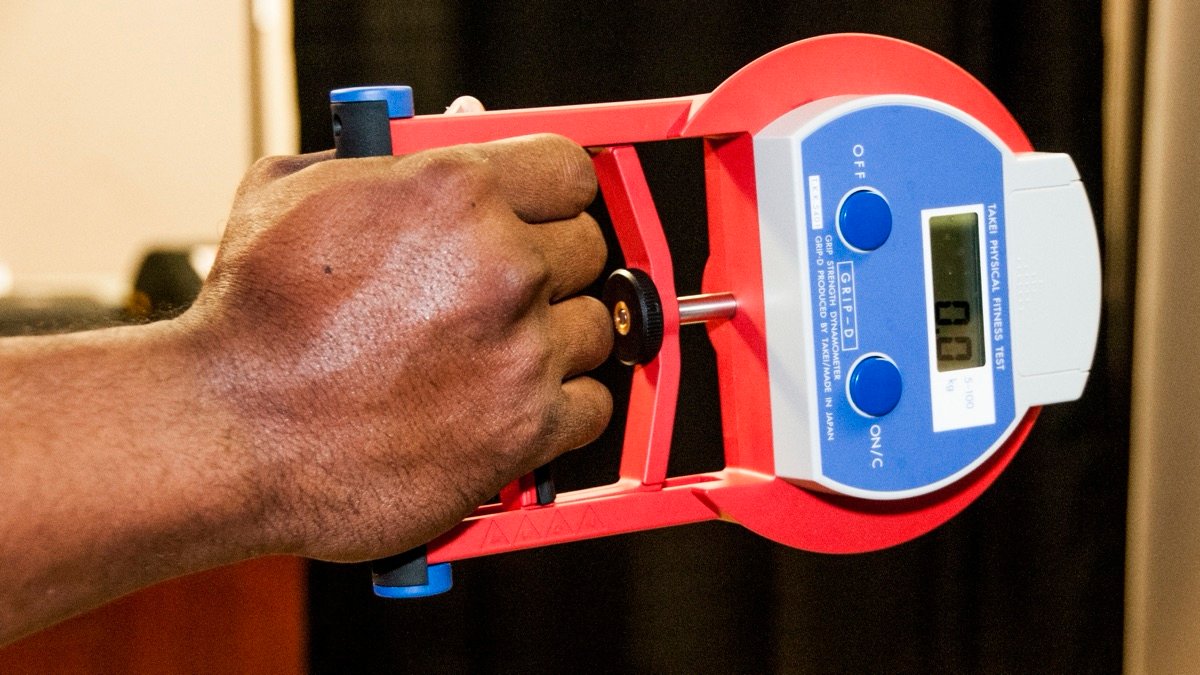
No dynamometer? You can't compare yourself with the norms, but you can still track progress with a timed dead hang from a pull-up bar or how far you can carry a pair of dumbbells. Retest every four to six weeks under the same conditions.
Skip the test on a hand or wrist that's injured or recently operated on (NHANES didn't test a hand within three months of surgery), and talk to a clinician first if you have hand arthritis, carpal tunnel symptoms or blood pressure that isn't controlled.
How to improve your grip strength
Grip responds to training like any other muscle group: hold heavier things, for longer, a few times a week, and progress gradually. Most of the work can happen inside a normal strength routine, because heavy pulling and carrying already demand a firm grip. A few habits make the biggest difference: hold the weight yourself instead of using lifting straps for most sets, and use thicker handles or towels occasionally to make holds harder.
The best exercises for grip strength
- Farmer's carry. Pick up a heavy dumbbell or kettlebell in each hand, stand tall and walk 30 to 40 yards or 30 to 45 seconds. Carrying one weight on one side (a suitcase carry) also challenges your core. Wearing a loaded backpack works your legs and endurance more than your hands; our rucking guide for beginners covers that.
- Dead hang. Hang from a pull-up bar with straight arms and your shoulders gently engaged. Start with your feet on a box to take some weight if you can't hold 20 seconds, and build toward 30 to 60 seconds. Skip it if you have a shoulder injury.
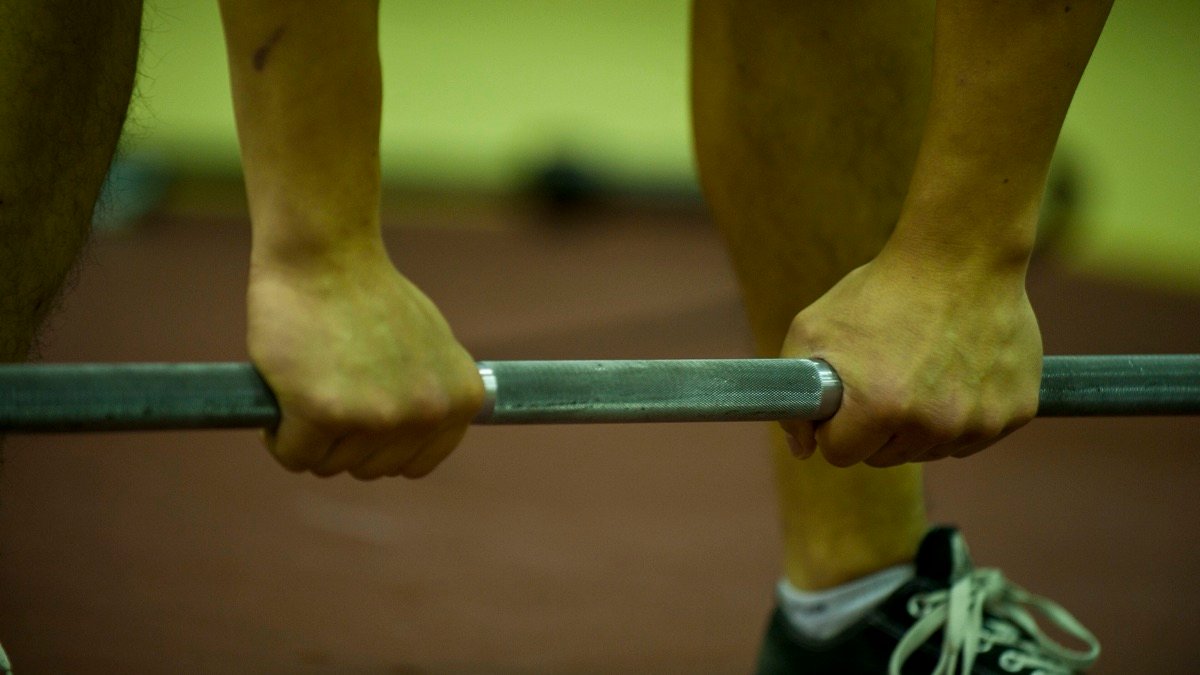
- Heavy holds. Hold a loaded barbell or heavy dumbbells at the top of a deadlift for 15 to 30 seconds. Because the weight doesn't move, you can hold more than you can lift for reps. Plate pinches (two weight plates pinched together, smooth sides out) train the thumb.
- Deadlifts and rows. Heavy pulls are the main way grip gets trained in a typical program, and they build the back and legs too. Romanian deadlifts and one-arm dumbbell rows work well at home. If you don't have a barbell, our beginner dumbbell workout at home covers the basics.
- Hand grippers. Spring grippers train the crushing grip measured by a dynamometer. Pick one you can close 8 to 12 times with full effort, and move up when that gets easy. They're a useful add-on, not a replacement for the lifts above.
A simple weekly grip strength routine
This is our example plan, not a tested program. It pairs two full-body strength sessions, which meet the US guideline of two or more days a week, with optional short grip work. Leave at least one day between the two main sessions.
| Day | Exercises | Sets and reps |
|---|---|---|
| Day 1 (e.g., Monday) | Deadlift or dumbbell Romanian deadlift; one-arm dumbbell row; push-up or dumbbell press; farmer's carry; dead hang | Lifts: 3 sets of 6 to 10. Carry: 3 trips of 30 to 40 yards. Hang: 3 holds of 20 to 45 seconds. |
| Day 2 (e.g., Thursday) | Goblet squat; lat pulldown or inverted row; overhead press; suitcase carry; heavy hold at the top of a deadlift | Lifts: 3 sets of 8 to 12. Carry: 2 trips per side. Hold: 3 holds of 15 to 30 seconds. |
| Optional (any 1 or 2 other days) | Hand gripper, plus a short dead hang | Gripper: 2 to 3 sets of 8 to 12 per hand. Hang: 2 holds. |
How to progress: when you can finish every set at the top of the range with good form, add a little weight, distance or time the next week. Stop each hold a few seconds before your grip fails completely, and rest your hands if your fingers or forearms ache the next day. Hands and forearms recover quickly from light work but can get irritated by too much heavy gripping at once, so build up over several weeks.
Older adults can follow the same principles with lighter loads. For a gentler starting point, see our strength and balance routine for seniors over 80. And if you like squeezing exercises, isometric handgrip training has been studied for lowering blood pressure, which we cover in our article on wall sits and isometric exercise for blood pressure.
FAQ
Is a 100 lb grip good?
It depends on your age and sex. 100 lb is about 45 kg. In the British norms, that is a little below the median for a man in his 30s or 40s, about average for a man around 60 and above average for men over 65. For women, 45 kg is above the 90th percentile at every adult age.
Can a hand gripper help me live longer?
There's no evidence that it can. Studies link stronger grip with longer life, but grip mostly reflects your overall strength and health. A gripper can raise your grip number without making the rest of your body stronger. Use grip work as part of a full-body strength routine.
At what age does grip strength start to decline?
In the British normative data, grip peaked in the 30s, held fairly steady into the 40s and declined from midlife onward, with steeper drops from the late 60s. The EWGSOP2 consensus notes that strength losses of 1.5% to 5% a year have been reported beyond age 50. Training still improves strength later in life: the trials in the 2019 meta-analysis above were in adults over 60.
Should I test my dominant hand or both hands?
Test both. Research protocols such as NHANES test each hand three times, and the norms in this article use the best reading from either hand. A large gap between your hands is worth mentioning to a clinician if it's new or comes with pain or numbness.
This article is general information, not medical advice. It isn't a substitute for advice from a doctor, physical therapist or other qualified health professional, especially if you have a heart condition, high blood pressure, hand or wrist problems, or are pregnant.
Sources
- Leong DP, Teo KK, Rangarajan S, et al. Prognostic value of grip strength: findings from the Prospective Urban Rural Epidemiology (PURE) study, The Lancet 2015;386(9990):266–273.
- Celis-Morales CA, Welsh P, Lyall DM, et al. Associations of grip strength with cardiovascular, respiratory, and cancer outcomes and all cause mortality: prospective cohort study of half a million UK Biobank participants, BMJ 2018;361:k1651.
- Cruz-Jentoft AJ, Bahat G, Bauer J, et al. Sarcopenia: revised European consensus on definition and diagnosis, Age and Ageing 2019;48(1):16–31.
- Studenski SA, Peters KW, Alley DE, et al. The FNIH sarcopenia project: rationale, study description, conference recommendations, and final estimates, Journals of Gerontology Series A 2014;69(5):547–558.
- Bhasin S, Travison TG, Manini TM, et al. Sarcopenia Definition: The Position Statements of the Sarcopenia Definition and Outcomes Consortium, Journal of the American Geriatrics Society 2020;68(7):1410–1418.
- Dodds RM, Syddall HE, Cooper R, et al. Grip strength across the life course: normative data from twelve British studies, PLOS One 2014;9(12):e113637.
- Wang YC, Bohannon RW, Li X, et al. Hand-Grip Strength: Normative Reference Values and Equations for Individuals 18 to 85 Years of Age Residing in the United States, Journal of Orthopaedic & Sports Physical Therapy 2018;48(9):685–693.
- Bohannon RW. Grip Strength: An Indispensable Biomarker For Older Adults, Clinical Interventions in Aging 2019;14:1681–1691.
- Labott BK, Bucht H, Morat M, et al. Effects of Exercise Training on Handgrip Strength in Older Adults: A Meta-Analytical Review, Gerontology 2019;65(6):686–698.
- CDC, National Center for Health Statistics: NHANES 2011–2012 Muscle Strength – Grip Test (MGX_G) data documentation.
- US Department of Health and Human Services: Physical Activity Guidelines for Americans, 2nd edition.
- Banner photo: 86th MDG hosts Diabetes Awareness Health Fair (10092416).jpg by U.S. Air Force / Airman 1st Class Michelle Sies, public domain, via Wikimedia Commons (cropped).
- Photo: AWC offers "common sense" approach to improving health 160802-A-EK666-641.jpg by Marcy Sanchez, U.S. Army, public domain, via Wikimedia Commons (cropped).
- Photo: Deadlift grip.JPG by U.S. Air Force / Senior Airman Clayton Lenhardt, public domain, via Wikimedia Commons (cropped).