

Yes, people in their 80s and 90s can still get stronger, steadier and better at walking. In a classic trial, nursing home residents with an average age of 87 more than doubled their muscle strength in 10 weeks. A Cochrane review found that balance-focused exercise cuts the rate of falls in older adults living at home. And a randomized trial published in August 2026 found that 24 weeks of low-intensity training improved functional fitness in women aged 85 and older.
The federal activity targets don't change in your 80s: about 150 minutes of moderate activity a week, strength work on 2 or more days, and balance training. They are scaled to your fitness and health, and if that's too much, the guidelines say to be "as physically active as their abilities and conditions allow." Below: a safe starter routine, how to progress, warning signs, and where to find help, written for older adults and the family members supporting them.
What the guidelines recommend after 80
The Physical Activity Guidelines for Americans (2nd edition, HHS) give older adults the same aerobic and strength targets as younger adults and add four points:
- Multicomponent activity. Each week should include balance training as well as aerobic and muscle-strengthening activity.
- Effort is relative. Judge effort against your own fitness on a 0–10 scale, where moderate is about 5 or 6. For a less fit person, an activity that looks easy can still count as moderate.
- Chronic conditions. Understand whether and how your conditions affect what you can do safely.
- Some is better than none. If 150 minutes isn't realistic, do what you can. The guidelines show the biggest drop in risk of early death comes from going from no activity to about 60 minutes a week.
Strength work should cover the legs, hips, back, abdomen, chest, shoulders and arms. Work each exercise until another repetition would be hard; one set of 8 to 12 repetitions is effective. For balance, the guidelines list walking heel-to-toe and practicing standing up from a chair, and note that fall-prevention programs in studies usually meet about three times a week. A 2027 supplement on steps and strength is being drafted, but these targets still apply (what the 2027 guidelines update means).
What the research shows in people over 80
| Study | Who and what | Main findings |
|---|---|---|
| Fiatarone et al., JAMA 1990 | 10 frail nursing home residents, average age 90; 8 weeks of supervised high-intensity strength training | Strength rose an average of 174% in the 9 who finished, and tandem walking speed improved 48%. Tiny study, no control group. |
| Fiatarone et al., NEJM 1994 | 100 frail nursing home residents, average age 87 (range 72–98); 10 weeks of resistance training, a nutrition supplement, both or neither | Strength rose 113% with exercise vs 3% without. Walking speed rose 11.8% in exercisers and fell 1.0% in non-exercisers. The supplement alone didn't improve the main outcomes. |
| Martínez-Velilla et al., JAMA Internal Medicine 2019 | 370 hospital patients, average age 87; two short daily sessions of resistance, balance and walking exercise during the stay | Daily-living function fell with usual care but improved slightly with exercise. No adverse effects were observed. |
| Chun et al., European Review of Aging and Physical Activity 2026 | Women aged 85+ in Busan, South Korea; 24 weeks of low-intensity aerobic or resistance training vs a control group | Both exercise groups beat controls on chair stands, arm curls and a 2-minute step test. Only resistance training improved grip strength. Adiponectin (a hormone linked to metabolic health) rose, and fasting insulin and glucose were lower than in controls. Inflammation (hs-CRP) and insulin resistance (HOMA-IR) didn't change significantly. |
Falls are a big reason strength and balance matter. According to the CDC, over 14 million adults 65 and older, about 1 in 4, report falling every year. In 2024, falls caused over 43,000 deaths in this age group, making them the leading cause of injury death, and about 4.5 million emergency department visits.
The strongest falls evidence is a 2019 Cochrane review by Sherrington and colleagues: 108 randomized trials with 23,407 people living in the community, average age 76. Exercise reduced the rate of falls by 23% (high-certainty evidence). Balance and functional exercises reduced it by 24%. Programs that combined several types, usually balance plus resistance exercise, probably reduced it by 34%, and tai chi may help too. Effects of walking-only or resistance-only programs on falls were uncertain, so the routine below combines all three.
The limits are real. A 2020 systematic review of exercise in people 90 and older found only 3 randomized trials. Strength and lower-body function improved; gait and balance results were mixed. The Fiatarone trials used closely supervised, high-intensity training, which is not a template for lifting heavy at home. For the 2026 Korean trial, only the abstract was accessible to us. It doesn't give group sizes, and biomarker changes are early signals, not proof of less disease.
Before you start: when to talk to a clinician
The guidelines say healthy older adults who build up gradually generally don't need a doctor's check first. Many people in their 80s have conditions that change what's safe, though. Talk to a doctor or physical therapist first if any of these apply:
- You have heart or lung disease, you were recently in the hospital, or you have symptoms such as chest pressure, dizziness or joint pain.
- You've fallen recently, feel unsteady or are afraid of falling. The CDC suggests asking your doctor to evaluate your fall risk and review medicines that cause dizziness or drowsiness.
- You have osteoporosis, diabetes (watch blood glucose and foot care), uncontrolled blood pressure or dementia.
A physical therapist can test strength, gait and balance and set a safe starting level. Medicare Part B helps pay for medically necessary outpatient physical therapy when a doctor or other qualified provider certifies the need. You pay 20% of the approved amount after the Part B deductible.
A safe starter routine for strength, balance and walking
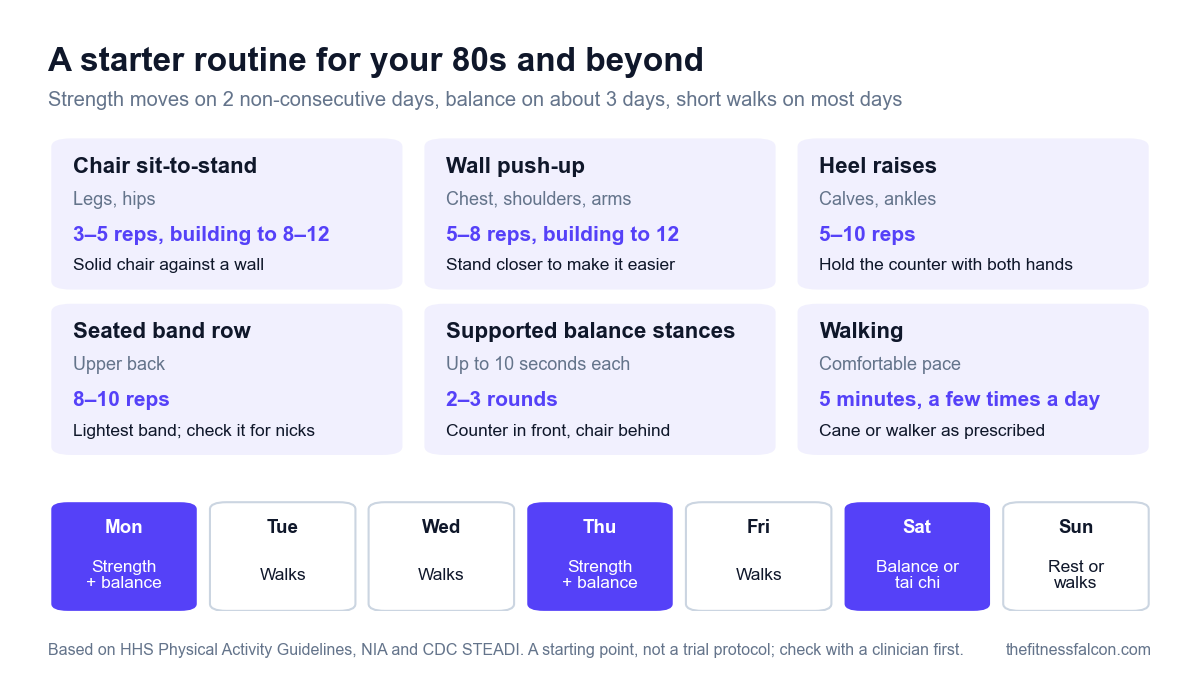
This is a conservative starting point using a sturdy chair, a wall and a kitchen counter. It follows the exercise types the guidelines and the National Institute on Aging (NIA) recommend; it isn't a protocol from a specific trial. Do the strength moves on 2 non-consecutive days a week and the balance work on about 3 days.
| Exercise | How to do it | Support and safety | Starting point |
|---|---|---|---|
| Chair sit-to-stand (legs, hips) | Sit near the front of the chair with feet flat. Lean forward slightly, stand up fully, then sit down slowly. | Solid chair without wheels, pushed against a wall. Use the armrests or your thighs if needed. Breathe out as you stand. | 3–5 reps, building to 8–12 |
| Wall push-up (chest, shoulders, arms) | With hands on the wall at shoulder height, bend your elbows to bring your chest toward the wall, then press back. | Stand closer to the wall to make it easier. Don't lock your elbows. | 5–8 reps, building to 12 |
| Heel raises (calves, ankles) | Facing the counter, rise onto the balls of your feet, pause, then lower slowly. | Hold the counter with both hands. | 5–10 reps |
| Seated band row (upper back) | Sitting tall with a light band looped around your feet, pull the handles toward your ribs. | Use the lightest band and check it for nicks first. | 8–10 reps |
| Supported balance stances | Hold up to 10 seconds each: feet side by side, one foot half a step ahead, heel-to-toe (tandem), one foot. | Stand at a counter with a chair behind you. Move on only when the current stance is steady for 10 seconds. | 2–3 rounds |
| Walking | Walk at a comfortable pace on a flat, well-lit route. | Use a cane or walker as prescribed. Walk indoors when it's icy. | 5 minutes, a few times a day |
The balance stances follow the CDC's 4-Stage Balance Test, part of its STEADI (Stopping Elderly Accidents, Deaths & Injuries) program. The CDC notes that an older adult who can't hold the heel-to-toe stand for 10 seconds is at increased risk of falling. A clinician may then suggest physical therapy or an evidence-based program such as tai chi.
A sample week: strength moves plus balance on Monday and Thursday, a balance session (the stances or a tai chi class) on Saturday, and short walks on most days.
How to progress, slowly
The guidelines advise building up over weeks to months. For someone with low fitness, reaching the full targets can take months. Change one thing at a time:
- Walking. The guidelines' example for an inactive person is 5 minutes of slow walking several times a day, 5 to 6 days a week, building to 10 minutes 3 times a day and then a faster pace. At moderate intensity, you can talk but not sing.
- Strength. Start on 1 day a week at light or moderate effort, then move to 2 days. When 12 controlled reps feel easy, make the move harder. For sit-to-stands, use your hands less, then cross your arms over your chest, or add a second set. Bands and light weights come later (see our beginner resistance band routine and how little strength training is enough).
- Balance. Gradually use less support: two hands on the counter, then one hand, then fingertips, then hands hovering just above it. Then hold longer or move to the next stance. Keep the counter within reach.
- After illness or a hospital stay. Restart at a lower level and build back up gradually.
Safety checklist and warning signs to stop
- Clear trip hazards, use good lighting, and keep a phone within reach.
- Wear non-skid, low-heeled shoes, not socks or smooth-soled slippers.
- Stand up slowly, because blood pressure can drop when you rise quickly.
- Breathe out during the effort and don't hold your breath. Drink water unless your doctor limits your fluids.
Stop and call 911 if you have chest pain or discomfort, feel weak, light-headed or faint, are short of breath, or have pain in the jaw, neck, back, arms or shoulders. The CDC lists these as heart attack symptoms.
Stop and contact your clinician if exercise brings on dizziness, nausea, new joint pain or swelling, or any new symptom as you do more. NIA says aerobic activity "should not cause dizziness, chest pain or pressure, or nausea." Mild muscle soreness a day or two later is normal; sharp or worsening pain isn't.
After any fall, NIA advises checking whether you're hurt before getting up. Call for help or 911 if you're hurt or can't get up. Tell your doctor about the fall, even if it didn't hurt.
For adult children and caregivers
- Exercise together at first. Set up the chair and counter and count the reps. NIA notes that for people with dementia, several short "mini workouts" may work better than one long session.
- Don't let fear of falling lead to inactivity. NIA notes that fear of falling can make people avoid walking and social activities, while staying active helps prevent falls.
- Cover other fall risks. The CDC recommends a fall-risk check and medicine review, a yearly eye exam, removing trip hazards and installing bathroom grab bars.
- Ask about mobility during hospital stays. Ask the care team how your parent can stay safely mobile and whether therapy is planned after discharge.
- Check protein intake. Our protein guide covers targets for adults over 65 (ask their doctor first if they have kidney disease).
Clinicians often screen leg strength with the CDC's 30-Second Chair Stand. The person sits mid-chair (a 17-inch seat without armrests) with arms crossed and stands up fully as many times as they can in 30 seconds. If they need their arms, the test stops and the score is 0. On the CDC form, scores below these numbers indicate a risk for falls:
| Age | Men | Women |
|---|---|---|
| 80–84 | Fewer than 10 | Fewer than 9 |
| 85–89 | Fewer than 8 | Fewer than 8 |
| 90–94 | Fewer than 7 | Fewer than 4 |
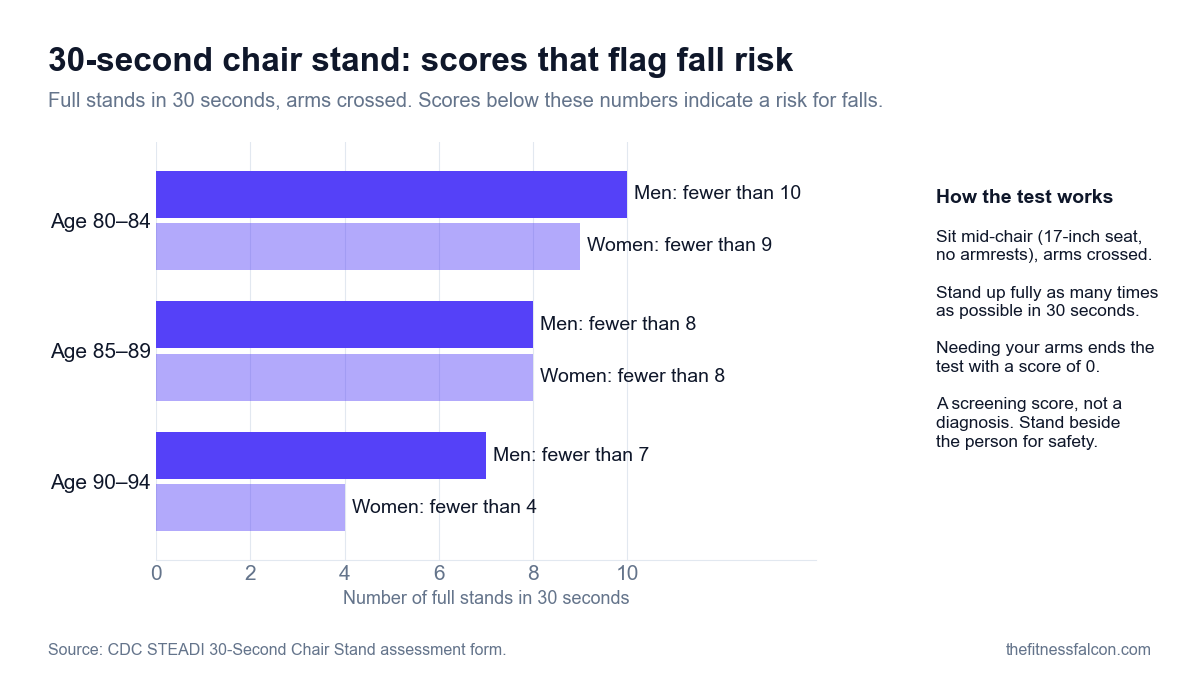
The form tells the tester to stand next to the person for safety. If you try it at home, stay beside them and share the result with their clinician; it's a screening score, not a diagnosis.
Finding a class, program or physical therapist
The National Council on Aging (NCOA) lists falls prevention programs that meet the Administration for Community Living's evidence-based criteria, including:
- A Matter of Balance: an 8-week group program that reduces fear of falling and builds activity.
- EnhanceFitness: one-hour classes 3 times a week with low-impact cardio, balance, strength and stretching.
- SAIL (Stay Active and Independent for Life): one-hour classes 3 times a week. Exercises can be done standing or sitting, and occasional cane users can join.
- Tai Ji Quan: Moving for Better Balance: two one-hour sessions a week for 24 weeks.
- Otago Exercise Program: 17 strength and balance exercises taught and progressed by a physical therapist, often at home.
To find local options, call the Eldercare Locator, a public service of the Administration for Community Living, at 1-800-677-1116, or visit eldercare.acl.gov. NCOA's online Falls Free CheckUp asks 13 questions and gives a falls risk score you can take to an appointment.
Frequently asked questions
Is it too late to start exercising at 85 or 90?
No. In the trials above, people in their late 80s and 90s, including frail nursing home residents, improved within 8 to 24 weeks. Evidence for people over 90 is still thin, so start with supported exercises, progress slowly and get guidance if you have health conditions.
Can someone who uses a walker do these exercises?
Often, with changes such as armrest-assisted sit-to-stands and counter balance work with a helper nearby. A physical therapist can tailor the routine, and SAIL can be done seated.
Is walking enough on its own?
Walking is good aerobic exercise with a low injury risk. For preventing falls, though, the Cochrane review found clear benefits for balance and functional exercise but was uncertain about walking programs alone. Pair walking with strength and balance work.
This article is general information, not medical advice. If you have chronic conditions, recent falls or new symptoms, check with a health care professional before starting. For more on healthy aging, see our guide to lifestyle habits for longevity.
Sources
- U.S. Department of Health and Human Services: Physical Activity Guidelines for Americans, 2nd edition (Chapter 5, Active Older Adults; Chapter 7, Active and Safe).
- CDC: Physical Activity Guidelines for Older Adults.
- Chun, Kim and An, Effects of low-intensity aerobic and resistance training on physical function, adiponectin, and metabolic health in oldest-old women: a randomized controlled trial, European Review of Aging and Physical Activity 2026.
- Sherrington et al., Exercise for preventing falls in older people living in the community, Cochrane Database of Systematic Reviews 2019.
- Fiatarone et al., High-intensity strength training in nonagenarians, JAMA 1990.
- Fiatarone et al., Exercise training and nutritional supplementation for physical frailty in very elderly people, New England Journal of Medicine 1994.
- Martínez-Velilla et al., Effect of exercise intervention on functional decline in very elderly patients during acute hospitalization, JAMA Internal Medicine 2019.
- Miller et al., Exercise for nonagenarians: a systematic review, Journal of Geriatric Physical Therapy 2020.
- CDC: Older Adult Falls Data; CDC: About Older Adult Fall Prevention; CDC: Older Adult Fall Prevention.
- CDC: STEADI, including the 30-Second Chair Stand and 4-Stage Balance Test forms.
- CDC: Heart Attack Symptoms, Risk, and Recovery.
- National Institute on Aging: Three Types of Exercise Can Improve Your Health and Physical Ability.
- National Institute on Aging: Exercising With Chronic Conditions.
- National Institute on Aging: Falls and Fractures in Older Adults: Causes and Prevention.
- National Council on Aging: Evidence-Based Falls Prevention Programs.
- Medicare.gov: Physical therapy services.
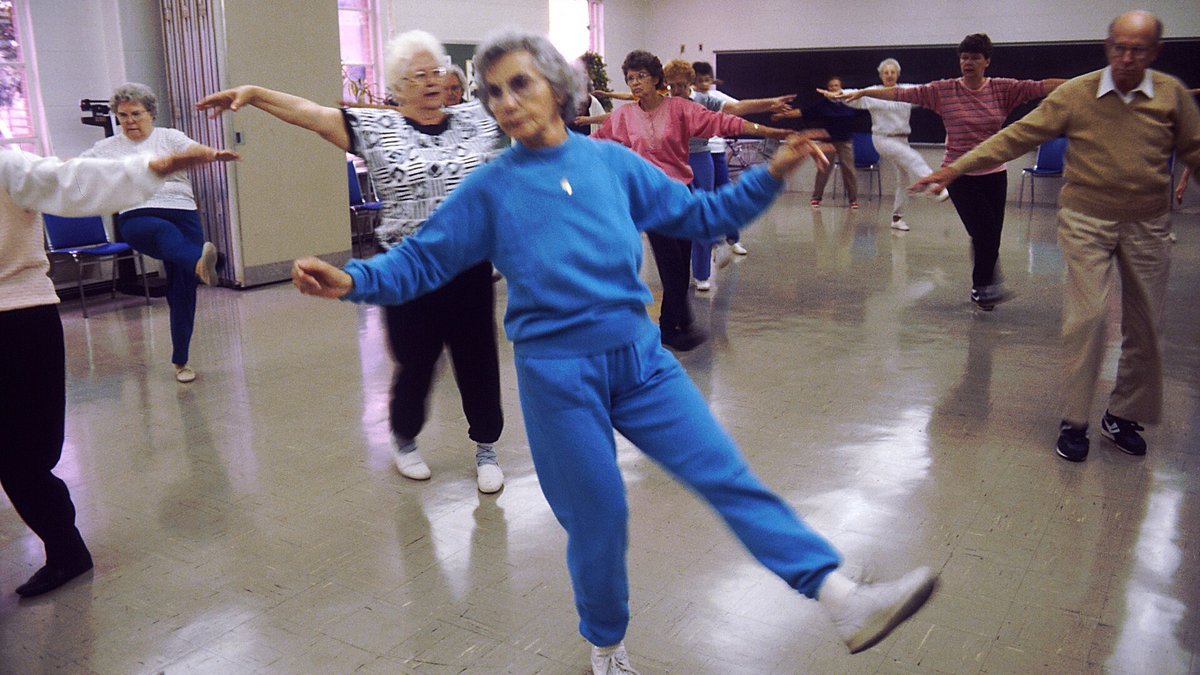
- Banner photo: Aerobics class.jpg by Bill Branson, National Cancer Institute, public domain, via Wikimedia Commons.