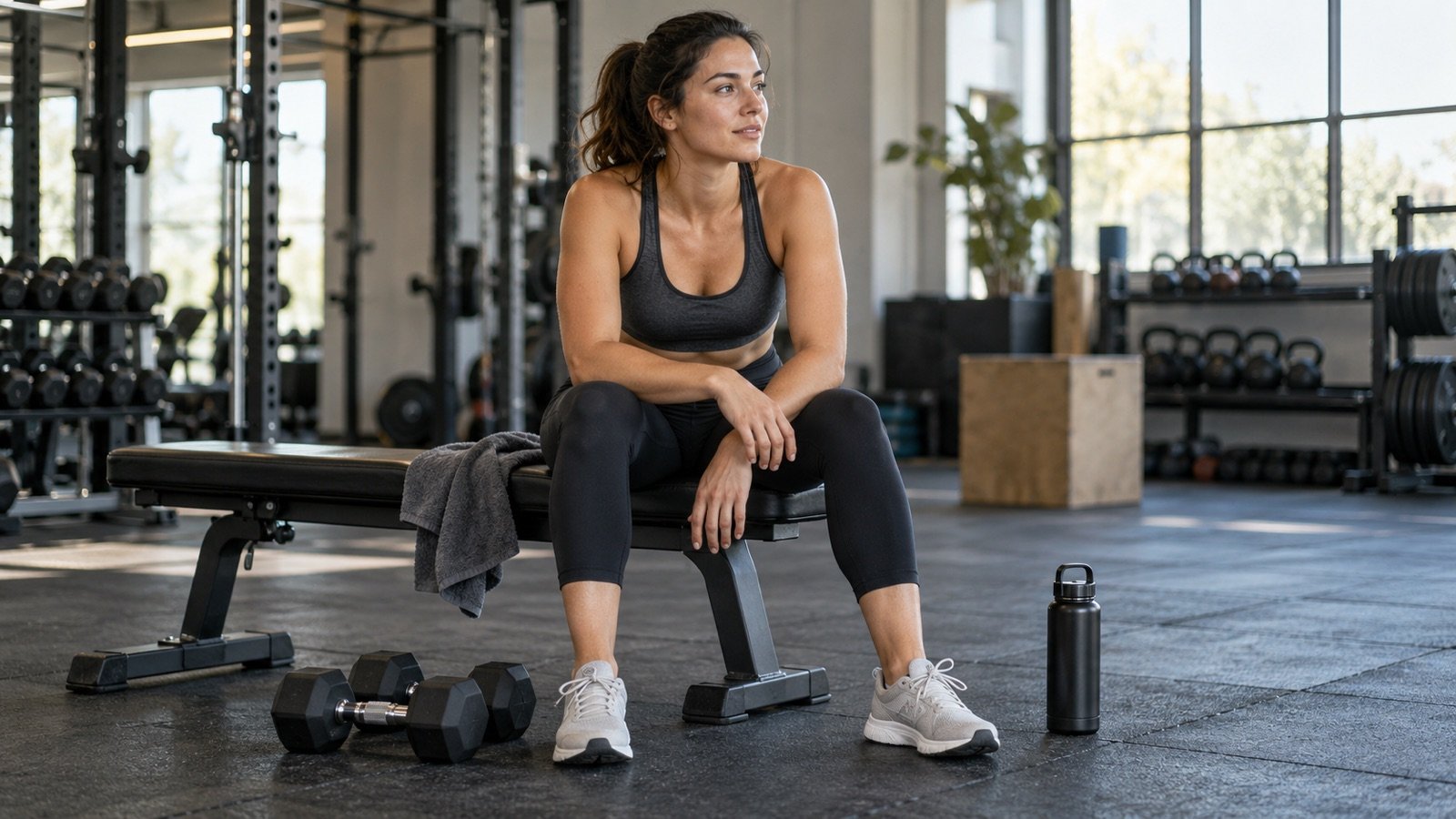


For a healthy beginner, two short full-body strength sessions a week can be a useful starting point. One challenging working set per exercise can improve strength, but it is a starting dose, not a guarantee of maximum muscle growth. Choose exercises you can perform comfortably, leave a little effort in reserve, and record what you do so the workload can progress.
A routine that fits between work and dinner is more useful than an ambitious plan you repeatedly miss. The important question is not whether a short workout looks impressive. It is whether it trains the major muscle groups, becomes gradually more challenging, and can be repeated.
What does “minimum effective dose” mean?
Minimum effective dose means the smallest amount of training that produces a worthwhile improvement for a particular person and outcome. Improving your ability to stand from a chair, increasing your squat strength, and maximizing muscle size are different outcomes. They do not necessarily require the same workload.
A 2024 overview of minimal-dose resistance exercise describes single-set routines and other ways to reduce training time. It reports strength improvements with programs using one set of several exercises, including programs performed at least twice weekly. The overview brings together varied studies; it does not establish one universal minimum for every beginner.
A larger 2023 network meta-analysis also found that the resistance-training prescriptions studied improved strength and muscle size compared with no exercise. Higher loads tended to favor maximum strength, while multiple sets were prominent among the higher-ranked muscle-building prescriptions. A minimal routine can work without being the best possible routine for every goal.
A two-day routine you can actually schedule
The following is our practical starter template, not a clinically validated prescription. Put sessions on two nonconsecutive days, such as Monday and Thursday. Allow roughly 20–30 minutes, depending on equipment setup, warm-up needs, and rest. Do the same movements at first so learning technique does not consume the entire session.
| Movement | Example | Initial working dose | Easier option |
|---|---|---|---|
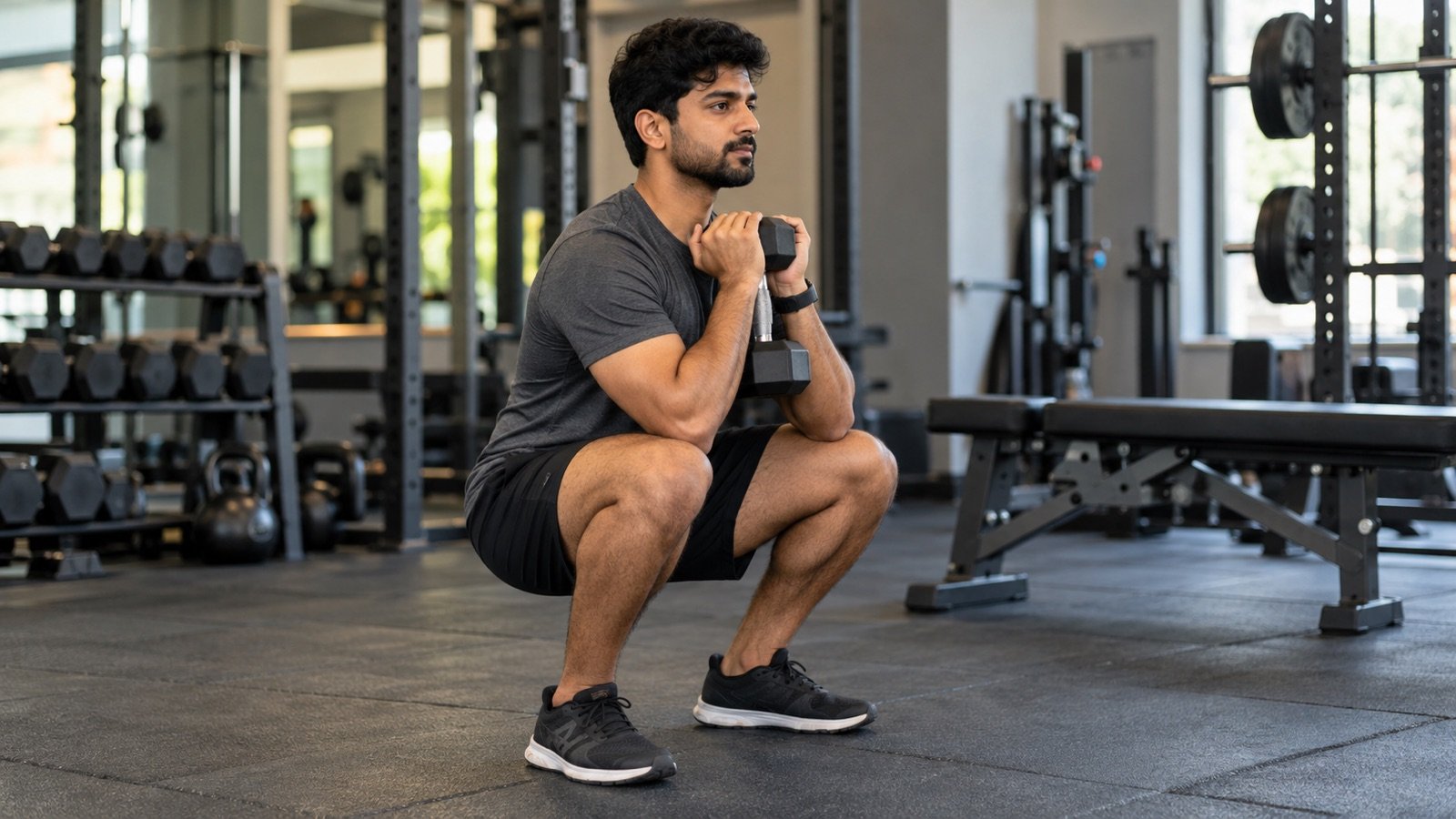
| Knee-dominant lower body | Goblet squat | 1 set of 8–12 repetitions | Controlled chair sit-to-stand |
| Hip-dominant lower body | Dumbbell Romanian deadlift | 1 set of 8–12 repetitions | Glute bridge |
| Upper-body push | Incline push-up | 1 set of 6–12 repetitions | Wall push-up |
| Upper-body pull | Supported dumbbell row | 1 set of 8–12 per side | Seated machine row |
| Trunk control | Dead bug | 1 controlled set of 5–8 per side | Shorter arm or leg reach |
Start with a few minutes of easy movement, then rehearse unfamiliar exercises without load or with a lighter load. Those practice sets are separate from the working set. Rest until your breathing settles and you feel ready for another good set; around one to two minutes is a practical starting allowance, with longer rests when needed.
If you need movement instructions and equipment alternatives, use our beginner dumbbell workout or resistance-band routine. A qualified trainer can help you select and learn movements if technique is uncertain.
How hard should the working set feel?
Use a resistance that makes the final repetitions feel challenging while your movement remains controlled. For this starter plan, aim to finish with approximately two or three good repetitions still possible. This is a coaching cue, not a precise laboratory measurement; beginners may find it difficult to estimate.
If you reach 12 repetitions and could easily do another 12, increase resistance or use a harder variation next time. If your range of motion shortens or you start jerking the weight at repetition five, reduce the load. You do not need to test a maximum lift or reach complete failure to begin.
For a supported row, completing ten controlled repetitions on both sides is more informative than choosing a weight that looks impressive. Record the equipment setting, repetitions, and an effort note such as “two more possible.” That gives the next session a clear reference point.
When should you add reps, weight, or another set?
- First, repeat the routine. Build confidence with the same movements for several sessions.
- Then add repetitions. Move within the suggested range while keeping technique consistent.
- Increase resistance modestly. Once the top of the range is comfortable on consecutive sessions, use the next manageable weight or a slightly harder variation.
- Add a second set when useful. If recovery and time allow, add it to one or two priority movements before expanding the whole workout.
For example, you might row a given dumbbell for eight, then nine, then eleven repetitions over successive sessions. After reaching twelve comfortably, a small weight increase may bring you back to eight. This is an example of progressive overload, not a promised weekly rate of improvement.
If performance stalls, check whether you missed sessions, changed technique, slept poorly, or chose a weight jump that was too large. More volume is one option, but it is not the automatic answer to every difficult week.
What if you only have ten minutes?
Keep the warm-up and pick three familiar movements: a squat or sit-to-stand, a push, and a pull. At your next session, make room for hip-dominant work and trunk control. Treat this as a fallback for an unusually busy day. It is better to preserve a repeatable habit than to compress every exercise into rushed repetitions.
If a short window is your normal situation, organize a fuller weekly plan rather than assuming three movements cover every need. Do not remove rest simply to finish faster. Exercise selection, equipment availability, and your ability to perform good repetitions matter more than a stopwatch target.
Strength training does not replace all other activity
WHO guidance recommends adults accumulate 150–300 minutes of moderate aerobic activity weekly, or an equivalent amount of vigorous activity, alongside muscle-strengthening work. Keep walking, cycling, swimming, or another enjoyable aerobic activity in your week. Our daily walking-goal guide can help you build a realistic baseline.
If you are returning after a long break, use our first-four-weeks return guide to keep expectations manageable. Seek individual guidance for recent surgery, an active injury, or a medical condition that affects exercise tolerance.
Common questions
Can one set build muscle?
Single-set training can improve muscle size, particularly when compared with doing no resistance exercise. It should not be presented as equal to every higher-volume program or as sufficient for maximal growth.
Is once a week pointless?
No. The minimal-dose overview includes once-weekly approaches that can improve strength. If that is all you can manage, start there, then work toward two weekly sessions that cover the major muscle groups.
Should I be sore afterward?
Soreness is not the target. Judge the plan by repeatable sessions and gradual performance improvements. Read how to decide whether to train when sore before using discomfort as a sign of success.
Sources and evidence notes
Evidence checked on October 8, 2026. This article draws on the studies and public guidance below; it is an editorial synthesis, not a new systematic review. Practical schedules and examples are our suggested applications, not protocols proven superior in a trial. General information for adults; individual medical needs may differ.
- Resistance Exercise Minimal Dose Strategies for Increasing Muscle Strength in the General Population (2024) — Overview of time-saving approaches; study populations and protocols vary.
- Resistance training prescription for muscle strength and hypertrophy (2023) — Network meta-analysis of randomized trials in healthy adults.
- WHO guidelines on physical activity and sedentary behaviour: at a glance (2020) — Public health guidance, not a muscle-building optimization program.