


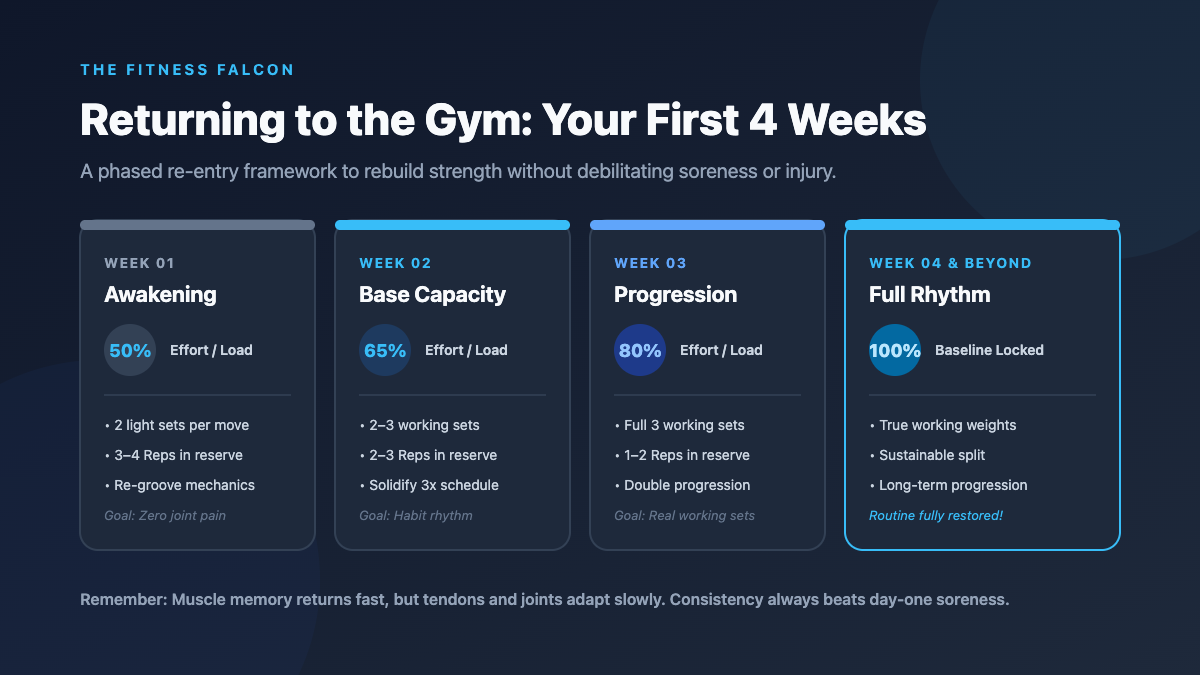
When returning to the gym after an extended break, the single biggest mistake is attempting to train at your old strength levels on Day 1. While your muscles retain cellular memory that allows rapid re-adaptation, your tendons, ligaments, and nervous system require several weeks of gradual reloading to adapt safely without injury.
Whether you stepped away for two months due to travel, or two years due to work, family, or injury, returning to the weight room brings a rush of motivation. Unfortunately, that same motivation often leads lifters straight into the "Day One Trap": crushing a high-volume leg day, waking up 48 hours later with debilitating delayed onset muscle soreness (DOMS), and being unable to walk up stairs or return to the gym for two weeks.
Re-entering the gym successfully is not about testing your limits on week one; it is about establishing a repeatable habit and preparing your joint structures for long-term progression. Here is your evidence-based 4-week re-entry blueprint to rebuild your baseline safely.
The science of detraining and muscle memory
Stepping back into training involves two distinct biological timelines running at completely different speeds:
1. The muscle memory advantage
The good news is that you never truly start from square one. Seminal muscle physiology research demonstrates that previous strength training increases the number of myonuclei (nuclei within muscle fibers). Even when muscle fibers atrophy during extended detraining, these myonuclei persist for years. When you resume resistance training, muscle protein synthesis ramps up rapidly, allowing you to regain lost muscle mass in a fraction of the time it originally took to build.
2. The connective tissue lag
While your muscle bellies respond quickly, your tendons, ligaments, and cartilage adapt far more slowly due to limited vascularity and slower collagen turnover. If you rapidly jump back to lifting heavy weights because your muscles feel ready, you risk placing intense tensile strain on underconditioned tendons—leading to patellar, Achilles, or rotator cuff tendinopathy.
The golden rule of week 1: leave the gym wanting more
The Golden Re-entry Rule: On your first week back, end every exercise set feeling like you could have easily performed 3 to 4 more repetitions. You should leave the gym feeling refreshed and invigorated, not exhausted or trembling.
Crippling muscle soreness is not a trophy of an effective workout; it is a sign of unconditioned eccentric muscle damage. Severe soreness degrades sleep, discourages consistency, and impairs movement mechanics during subsequent sessions.
Your 4-week gym re-entry blueprint
| Week & Phase | Target Effort (RPE / RIR) | Sets per Exercise | Weekly Frequency | Primary Objective |
|---|---|---|---|---|
| Week 1: Awakening | 50% effort (RIR 3–4) | 2 light sets | 2–3 sessions | Re-groove basic movement mechanics; minimize soreness; zero joint pain. |
| Week 2: Base Capacity | 65% effort (RIR 2–3) | 2–3 moderate sets | 3 sessions | Establish reliable gym schedule; adapt work capacity; test comfortable loads. |
| Week 3: Progressive Reload | 80% effort (RIR 2) | 3 working sets | 3 sessions | Introduce double progression; establish working weights; normalize rest intervals. |
| Week 4: Full Rhythm | 85–90% effort (RIR 1–2) | 3 full working sets | 3–4 sessions | Baseline fully locked; transition to long-term progressive overload split. |
The sample 3-day full-body re-entry routine
During your first month back, a 3-day full-body routine (e.g., Monday, Wednesday, Friday) is far superior to a multi-day body-part split. Full-body sessions distribute training volume evenly across the week, avoiding the concentrated muscle damage that causes severe localized soreness.
Alternate between Routine A and Routine B with at least one full day of rest in between:
Workout A
- Goblet Squat or Leg Press: 2 sets of 10 reps (Week 1), building to 3 sets of 8–10 reps by Week 3. Keep torso tall and knees tracking over toes.
- Dumbbell Flat Bench Press: 2 sets of 10 reps (Week 1), building to 3 sets of 10 reps. Focus on controlled lowering and comfortable shoulder position.
- Chest-Supported Machine Row or Cable Row: 2 sets of 12 reps (Week 1), building to 3 sets of 10–12 reps. Squeeze shoulder blades together for 1 second.
- Romanian Deadlift (Dumbbell): 2 sets of 10 reps (Week 1), building to 3 sets of 10 reps. Hinge through hips until hamstrings engage; do not round the lower back.
- Standing Calf Raise & Forearm Plank: 2 sets each for foundational stability.
Workout B
- Leg Curl (Seated or Lying Machine): 2 sets of 12 reps, building to 3 sets of 10–12 reps.
- Lat Pulldown or Assisted Pull-Up: 2 sets of 10 reps, building to 3 sets of 10 reps. Pull elbows down toward hips with steady tempo.
- Dumbbell Overhead Shoulder Press: 2 sets of 10 reps, building to 3 sets of 10 reps. Keep core tight and avoid hyperextending your spine.
- Dumbbell Walking Lunge: 2 sets of 8 reps per leg, building to 3 sets of 10 reps per leg. Focus on balance and knee control.
- Cable Face Pull & Hanging Knee Raise: 2 sets of 15 reps to protect shoulder joint health and activate core stabilizers.
For a detailed breakdown of exercise execution and gym machine setups, see our complete guide to the best full body workout gym routine.
Managing soreness, nutrition, and recovery
How you recover outside the gym directly determines how quickly you regain your baseline fitness:
1. What to do when DOMS strikes
If you experience soreness in days 2 and 3, resist the urge to sit completely still on the couch. Light active recovery—such as taking a 15-minute gentle walk, easy stationary cycling, or light mobility stretches—promotes blood flow and accelerates muscular clearance. If you wear a fitness watch, check out our guide on what a low readiness score means and when to modify a workout.
2. Prioritize dietary protein and hydration
Restarting resistance training creates an immediate spike in muscle protein turnover. Consume 1.6 to 2.0 grams of protein per kilogram of body weight per day (divided across 3 to 4 meals) to supply essential amino acids for tissue rebuilding. Pair this with adequate daily hydration and balanced complex carbohydrates to replenish glycogen. For practical meal planning, check out our gym diet plan: what to eat before and after your workout.
3. Sleep: the non-negotiable recovery tool
Growth hormone and tissue repair predominantly occur during stages of deep, slow-wave sleep. Aim for 7 to 9 hours of quality sleep nightly. Training hard on chronic sleep deprivation dramatically increases injury risk and impairs central nervous system recovery.
Transitioning to progressive overload in month two
Once you finish Week 4, your joints will have adapted to regular loading, your movement mechanics will be sharp, and your base work capacity will be restored. At that point, you are ready to apply structured progressive overload—consistently adding repetitions and modest weight increases using the double progression method.
Remember that lasting fitness is built over years, not four days. For practical tips on keeping your gym habit alive through busy work schedules, read our guide to sustainable gym resolutions.
Key takeaways for your first 30 days
- Tame your ego on Day 1: Keep 3 to 4 reps in reserve during your first week. You cannot rush tendon remodeling.
- Choose full-body over split routines: Training full body 2 to 3 times per week keeps volume manageable and prevents localized muscle soreness.
- Track your return methodically: Record your weights and how your joints feel 24 hours later.
- Consistency over intensity: Making it to the gym 12 times in your first month is an infinitely greater achievement than crushing one workout and quitting for two weeks.
Deciding whether to train when sore
Sources and further reading
Evidence reviewed on October 7, 2026. If you have been inactive due to medical treatment, cardiovascular conditions, or orthopedic surgery, obtain clearance from a physician or physical therapist prior to returning to heavy resistance training.
- Snijders, T., et al. (2020) — The role of satellite cells and myonuclei in muscle memory and resistance training adaptation. Frontiers in Physiology, 11, 87.
- Magnusson, S. P., & Kjaer, M. (2019) — The impact of physical training and detraining on tendon biomechanics and structural remodeling. Journal of Orthopaedic Research, 37(6), 1238–1248.
- American College of Sports Medicine (ACSM) — Position Stand: Detraining, Reconditioning, and Progression Models for Resistance Training (updated 2026 guidance).