


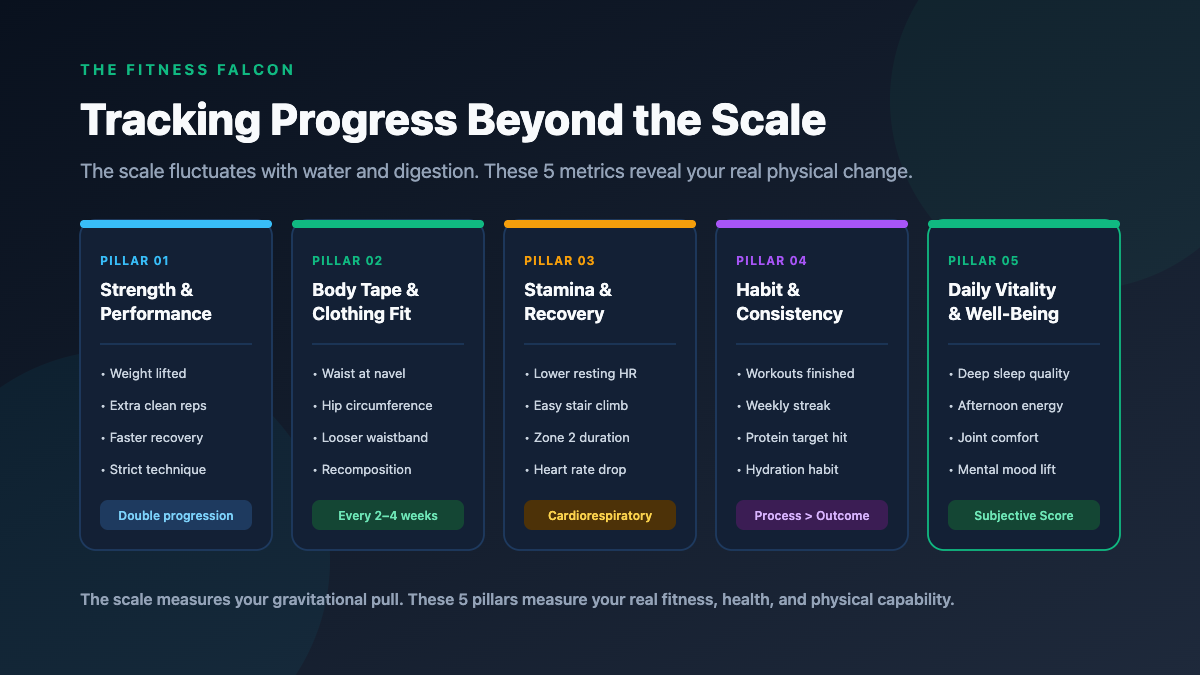
The bathroom scale only measures your total gravitational pull toward the earth; it cannot distinguish between dense muscle, visceral fat, stored glycogen, water retention, or digestive contents. Relying solely on that single number is one of the quickest ways to derail motivation and misjudge your real health progress.
It is a scenario countless lifters and runners face: you eat wholesome meals, hit your workouts consistently for three weeks, feel stronger and more energetic, and step onto the scale—only to see the dial tick up by 1.5 pounds. Discouraged, you wonder if your hard work is failing.
In reality, your body is likely undergoing positive body recomposition: building metabolically active skeletal muscle, increasing blood plasma volume, and storing intracellular hydration while shedding adipose tissue. To see your true physical trajectory, you need a multi-dimensional system. Here are five evidence-based ways to track fitness progress without relying on the scale, complete with a practical weekly tracker.
The biological reasons why scale weight fluctuates
Your scale weight can swing by 2 to 5 pounds in a single 24-hour period without gaining or losing a single gram of body fat. Understanding the physiology behind these fluctuations protects your mental momentum:
1. The glycogen-to-water ratio
When you start resistance training or replenish carbohydrates after a hard workout, your muscles store glucose as glycogen. Exercise physiology research confirms that every 1 gram of muscle glycogen binds with approximately 3 to 4 grams of water. Gaining 300 grams of stored glycogen adds over 2.5 pounds of healthy intracellular hydration to your body—a physiological adaptation that makes your muscles look fuller and perform better, yet appears as "weight gain" on a simple scale.
2. Exercise-induced inflammation
Challenging your muscles creates microscopic cellular micro-tears. In response, your immune system initiates acute localized inflammation to repair those fibers, temporarily drawing extracellular fluid into muscle tissues. This natural healing cascade often causes temporary water retention for 48 to 72 hours following an intense workout.
3. Dietary sodium and hormonal shifts
A restaurant meal or salty dinner causes your kidneys to retain extra fluid to maintain electrolyte osmolarity. Furthermore, elevated stress hormones (such as cortisol) and normal hormonal shifts during the menstrual cycle regularly cause 2 to 6 pounds of temporary water retention.
The 5 pillars of non-scale progress
| Pillar | What to measure | How often to check | Why it matters more than the scale |
|---|---|---|---|
| 1. Workout Performance | Weights lifted, reps achieved, rest time between sets, movement control. | Every session (via workout log). | Reflects true neuromuscular strength and muscle fiber development. |
| 2. Body Circumference & Fit | Waist at navel, hips, thighs; belt notch; how jeans fit around the waist. | Every 2 to 4 weeks. | Reveals true body recomposition (muscle gained while fat is lost). |
| 3. Cardiorespiratory Stamina | Resting heart rate (RHR), stair-climb ease, Zone 2 endurance time. | Weekly / Continuous wearable trends. | Measures cardiac stroke volume, arterial elasticity, and mitochondrial health. |
| 4. Habit & Process Consistency | Workouts completed out of scheduled, daily step goal, protein intake. | Weekly adherence score. | Input habits predict long-term results; scale weight is a lagging output. |
| 5. Daily Vitality & Sleep | Afternoon energy, sleep depth, mental mood, joint comfort. | Weekly subjective rating (1–10). | True wellness is about how you live and feel, not just body mass. |
Pillar 1: Workout performance and progressive overload
Your training log is the ultimate objective truth of your fitness. If you started six weeks ago struggling to squat 20-pound dumbbells for 8 reps, and today you can squat 35-pound dumbbells for 10 clean reps, your body has fundamentally transformed—regardless of what the scale claims.
Key performance markers to track include:
- Volume and Load: Applying structured progressive overload through extra reps or added resistance.
- Movement Quality: Being able to execute a deep squat or strict push-up with smooth control and zero compensatory twisting.
- Recovery Speed: Catching your breath in 60 seconds between sets instead of needing 2 full minutes.
Pillar 2: Body circumference and clothing fit
One pound of muscle occupies roughly 18% less volume than one pound of adipose fat. Because muscle is denser, your body can shrink in physical size while remaining the exact same total weight.
Use a simple vinyl tailor's tape to record measurements every 2 to 4 weeks:
- Waist: Measure horizontally directly across the belly button (navel) while relaxed. This is the single most important clinical marker of visceral fat reduction.
- Hips: Measure around the widest portion of the buttocks.
- Chest / Thighs: Measure across the fullest part of the chest and mid-thigh.
Notice how your clothes feel: sliding into a favorite pair of jeans without struggling or noticing your belt moving in one notch is undeniable proof of fat loss that a bathroom scale cannot show.
Pillar 3: Cardiorespiratory endurance and resting heart rate
As your heart becomes stronger, its stroke volume (the amount of blood pumped per beat) increases. That means your heart needs fewer beats per minute to deliver oxygen to your tissues at rest.
If you track with a smartwatch or fitness tracker, look at your resting heart rate (RHR) over a 30-day moving average. A drop from 74 bpm to 66 bpm indicates remarkable cardiovascular conditioning. For advice on wearable metric accuracy, check out our analysis of Apple Watch vs Garmin tracking accuracy and our guide to what heart rate variability (HRV) actually tells you.
Notice your real-world stamina: carrying heavy groceries without fatigue, sprinting to catch a bus without wheezing, or climbing three flights of stairs effortlessly.
Pillar 4: Habit consistency and process metrics
Scale weight is an outcome metric that you cannot directly control on any given day. You cannot force your body to weigh 0.5 pounds less tomorrow morning. But you have 100% control over your process habits:
- Did you complete your 3 planned workouts this week? (Score: 3/3).
- Did you average at least 8,000 steps per day?
- Did you hit your daily protein target to support recovery?
- Did you drink adequate water throughout the workday?
When you focus on scoring 85%+ on your weekly process habits, the physical changes take care of themselves automatically. For guidance on setting sustainable habit systems, explore our 2026 fitness goals complete guide.
Pillar 5: Daily vitality, sleep quality, and mental mood
Ask yourself three qualitative questions at the end of each week:
- How is my afternoon energy? Have 3:00 PM brain fog and caffeine crashes diminished?
- How is my sleep architecture? Am I falling asleep faster and waking up restored?
- How do my joints feel? Has chronic lower back stiffness or knee achiness improved since adding strength work?
Feeling vibrant, clear-headed, and physically capable in daily life is the ultimate goal of fitness. A lower scale number means little if you feel exhausted and miserable reaching it.
Your weekly non-scale fitness tracker log
Copy this simple, structured log into your journal or notes app to review your holistic fitness journey every Sunday evening:
| Week | Strength & Performance Highlights | Waist (Navel) | Avg Resting HR | Habit Adherence Score | Vitality & Energy (1–10) |
|---|---|---|---|---|---|
| Week 1 | Goblet Squat: 20 lbs × 8, 8, 8 reps | 34.5 in (Baseline) | 71 bpm | 3 / 3 workouts (100%) | 6 / 10 (moderate soreness) |
| Week 2 | Squat: 20 lbs × 10, 10, 10 (+6 reps) | 34.4 in | 70 bpm | 3 / 3 workouts (100%) | 7 / 10 (better sleep) |
| Week 3 | Squat: 25 lbs × 8, 8, 8 (Load increase!) | 34.1 in (-0.4 in total) | 68 bpm | 2 / 3 workouts (66%) | 8 / 10 (stair climb easy) |
| Week 4 | Squat: 25 lbs × 10, 10, 9 (+5 reps) | 33.8 in (-0.7 in total) | 67 bpm | 3 / 3 workouts (100%) | 9 / 10 (abundant energy) |
Notice how this lifter's progress is crystal clear: waist circumference dropped 0.7 inches, resting heart rate improved by 4 beats per minute, squat load jumped 5 pounds, and energy reached a 9/10—even if a bathroom scale during Week 2 or 3 showed zero change due to muscle water retention. For a deeper look at the distinction between muscle gain and fat accumulation, read our guide on weight gain and muscle gain: a practical approach.
The golden rules for standardized progress photos
If you choose to take progress photos, follow these three rules to keep them objective and reliable:
- Same lighting and location: Ambient daylight at the same window or bathroom mirror. Harsh overhead lighting exaggerates shadows; front-facing soft light provides the most honest view.
- Same time of day: Take photos first thing in the morning after using the restroom and before eating breakfast.
- Same clothing and camera angle: Position your phone at hip height rather than taking high-angle selfies.
Key takeaways for your journey
- The scale is just one data point: Never let a single morning weighing determine whether you had a successful week.
- Celebrate non-scale victories: An extra repetition, a looser waistband, climbing stairs without panting, and waking up with steady energy are the true markers of health.
- Measure process over outcome: Score your consistency. When you show up for your workouts and fuel your body well, physical adaptation follows inevitably.
Sources and further reading
Evidence reviewed on October 7, 2026. For individualized body composition testing or clinical assessments, consult a registered dietitian or certified exercise physiologist.
- Fernández-Elías, V. E., et al. (2015) — Relationship between muscle water and glycogen recovery after prolonged exercise in the heat. Applied Physiology, Nutrition, and Metabolism, 40(6), 613–619.
- Barakat, C., et al. (2020) — Body Recomposition: Can trained individuals build muscle and lose fat at the same time? Strength and Conditioning Journal, 42(5), 7–21.
- American College of Sports Medicine (ACSM) — Guidelines for Exercise Testing and Prescription: Assessing Functional and Neuromuscular Fitness Adaptations.