

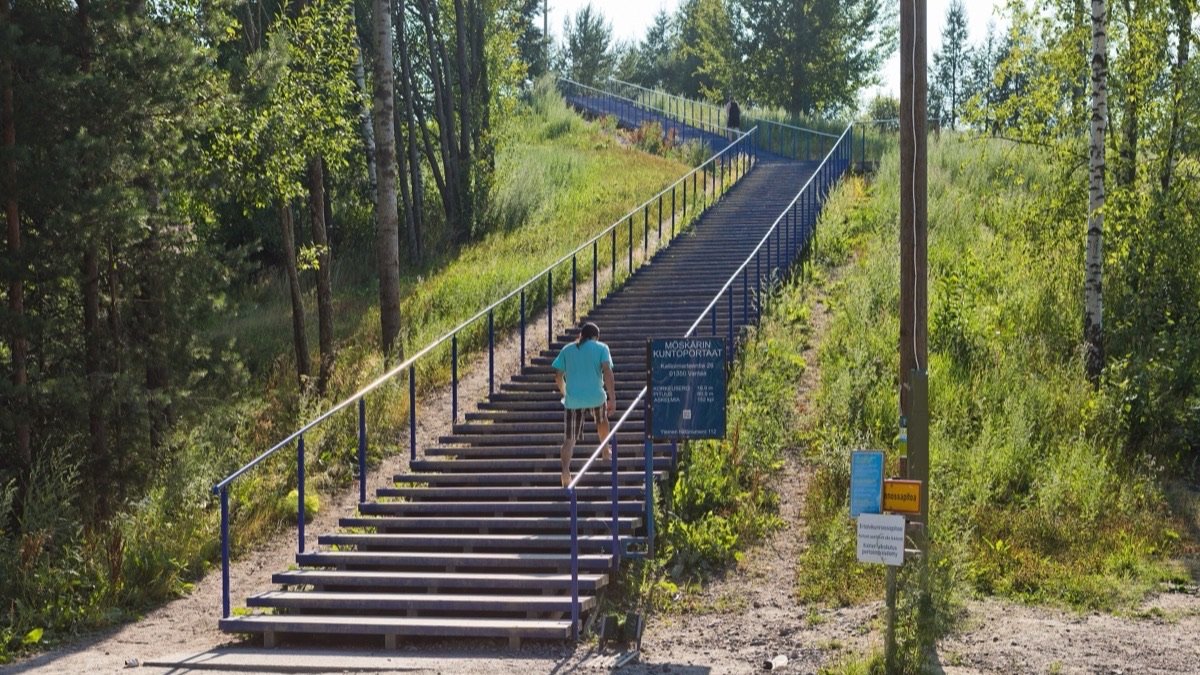
Stair climbing is one of the most efficient everyday workouts you can do: at a brisk pace it counts as vigorous exercise, it makes your legs lift your full body weight with every step, and it needs nothing more than a flight of stairs. Small trials in sedentary adults found that a few short stair bouts a day, three to five days a week, raised aerobic fitness within six to eight weeks. Large cohort studies link regular stair use with lower rates of heart disease and death, although those studies show an association, not proof of cause.
A 155-pound person burns roughly 5.5 calories a minute climbing stairs slowly and about 11.4 at a fast pace, according to the 2024 Compendium of Physical Activities. This guide walks through what the research shows, the calorie math, a cautious 6-week beginner plan, how a stair machine compares with real stairs, and how to protect your knees.
What are the benefits of stair climbing?
Climbing means lifting your whole body weight up and forward with every step. That makes it harder than walking on flat ground at the same pace, and it explains most of its benefits:
- Cardio fitness in very little time. Brisk climbing reaches vigorous intensity for most people. In the 2024 Compendium, fast stair climbing is rated at 9.3 METs, while the US Physical Activity Guidelines count anything at 6 METs or more as vigorous.
- Heart health markers. In one small trial in young women, eight weeks of stair climbing lowered LDL cholesterol by 7.7% compared with a control group. Large cohort studies tie regular stair climbing to lower rates of heart disease and cardiovascular death.
- Leg strength and power. Each step is a single-leg push from a bent knee. A 2025 trial in adults around age 70 found stair climbing improved leg power and everyday function, and improved stair performance more than gym machines did.
- It counts toward your weekly activity. The Physical Activity Guidelines for Americans say plainly that bouts of any length count, and use stairs as the example: "Even a brief episode of physical activity like climbing up a few flights of stairs counts."
What the research shows
Stair climbing and heart disease: cohort studies
The largest single study used the UK Biobank. Researchers followed 458,860 adults for a median of 12.5 years. Compared with people who reported no daily stair climbing, people who climbed 6 to 10 flights a day had a 16% lower risk of atherosclerotic cardiovascular disease (heart disease and ischemic stroke), and those climbing 11 to 15 flights had a 22% lower risk. Climbing only 1 to 5 flights a day showed no clear difference. People who climbed stairs at the start but had stopped five years later had a 32% higher risk than people who reported little or no stair climbing at both check-ins. The authors concluded that more than five flights a day (about 50 steps) was linked with lower risk (Song and colleagues, Atherosclerosis, 2023).
A systematic review and meta-analysis published in August 2026 pooled five studies with 455,619 people. Stair climbing was associated with a 39% lower risk of cardiovascular death (relative risk 0.61) and a 24% lower risk of death from any cause (relative risk 0.76) (Paddock and colleagues, American Journal of Cardiovascular Drugs, 2026).
These are associations. People who take the stairs may be fitter, healthier or more active in other ways to begin with, and the UK Biobank study relied on people's own reports of how often they climbed. So the cohort data can't prove that stairs alone lowered anyone's risk. What they do show is that stair use tracks closely with better heart outcomes across hundreds of thousands of people, and the small training trials below fill in the cause-and-effect part for fitness.
Short stair bouts and aerobic fitness: training trials
Several small randomized studies tested stair climbing in people who weren't exercising:
- Accumulated climbs (Northern Ireland, 2005). Fifteen sedentary young women were randomized to a control group or to stair climbing on a 199-step public staircase, five days a week. They started with one ascent a day and built to five a day by week 7. Each ascent took about two minutes at 90 steps a minute. After eight weeks, the climbers' VO2max rose 17.1% relative to controls and their LDL cholesterol fell 7.7% (Boreham and colleagues, British Journal of Sports Medicine, 2005).
- Stair intervals (McMaster University, 2017). Sedentary women did three 20-second all-out stair climbs, three days a week for six weeks. Peak oxygen uptake rose 12%, or about 1 MET. A second version used three 60-second bouts of going up and down one or two flights; on the one-flight version, it rose 7% (Allison and colleagues, Medicine & Science in Sports & Exercise, 2017).
- Stair "exercise snacks" (McMaster, 2019). Sedentary young adults vigorously climbed a 60-step, three-flight stairwell three times a day, 1 to 4 hours apart, three days a week. After six weeks their peak oxygen uptake was higher than a control group's, though the authors called the absolute gain modest (Jenkins and colleagues, Applied Physiology, Nutrition, and Metabolism, 2019).
These trials were small, short and mostly in young women, so the exact percentages shouldn't be read as what you'll get. The consistent message is that just a few minutes of brisk climbing, repeated through the week, is enough to move aerobic fitness in people starting from a low base. Our article on exercise snacks covers this research approach in more depth, including strength-based snacks.
Stair climbing and leg strength
A Belgian trial randomized 46 adults with an average age of about 71 to either machine-based resistance training or stair climbing, twice a week for 12 weeks, under supervision. The stair group did step-ups for the first four weeks, then fast climbs (four sets of two flights of six steps). Leg-extensor power rose 19.5% with machines and 13.7% with stairs. The difference wasn't statistically significant, but the trial couldn't confirm that stairs were "as good as" machines either. Both groups improved similarly on a fast 10-meter walk, a five-repetition sit-to-stand test and a jump test, and the stair group improved more at climbing stairs (Van Roie and colleagues, Journal of Strength and Conditioning Research, 2025).
In practice, stairs build useful leg strength and power, especially if you've been inactive. They aren't a full replacement for strength training. If you want a short routine for that, see our guide to the minimum effective dose of strength training.
How many calories does stair climbing burn?
The 2024 Adult Compendium of Physical Activities is the standard research reference for the energy cost of activities in adults aged 19 to 59. It lists these values for stairs (a MET is a multiple of your resting energy use):
- Stair climbing, slow pace: 4.5 METs (code 17133)
- Stair climbing, general: 6.8 METs (17131)
- Stair climbing, two steps at a time: 7.5 METs (17136)
- Stair climbing, ascending and descending: 7.5 METs (17138)
- Stair climbing, fast pace, one step at a time: 9.3 METs (17134)
- Stair treadmill ergometer (stair machine), general: 9.3 METs (02065)
- Descending stairs: 3.5 METs (17070)
The math for a 155-pound person. The Compendium's conversion is: calories per minute = METs × 3.5 × body weight in kg ÷ 200.
- Convert weight: 155 lb ÷ 2.2046 = 70.3 kg.
- Calories per minute at a general pace: 6.8 × 3.5 × 70.3 ÷ 200 = 8.37, or about 8.4 calories per minute.
- For 20 minutes: 8.37 × 20 ≈ 167 calories.
| Activity (MET) | Per minute | 10 min | 20 min | 30 min |
|---|---|---|---|---|
| Walking, 2.8 to 3.4 mph, level (3.8) | 4.7 | 47 | 94 | 140 |
| Stair climbing, slow pace (4.5) | 5.5 | 55 | 111 | 166 |
| Stair climbing, general (6.8) | 8.4 | 84 | 167 | 251 |
| Stairs up and down, repeated (7.5) | 9.2 | 92 | 185 | 277 |
| Stair climbing, fast pace (9.3) | 11.4 | 114 | 229 | 343 |
| Stair machine, general (9.3) | 11.4 | 114 | 229 | 343 |
How to read this: these are total calories, including the roughly 1.2 calories a minute this person would burn sitting still. Subtract that if you want the extra burn from the workout: 20 minutes at a general pace adds about 143 calories above rest, not 167. For a different body weight, multiply the per-minute figure by your weight in pounds and divide by 155.
Treat the numbers as estimates. The Compendium team notes on its corrected METs page that standard MET values usually underestimate measured energy cost, and misjudge intensity more often in people who are older, heavier, less fit, or women. Real stair sessions also include walking back down and short rests, which is why the "up and down" row is the most realistic one for a stairwell workout. For more on what a calorie is and why estimates vary, see our calorie explainer.

A 6-week stair climbing plan for beginners
This plan is our conservative example, built on the patterns that worked in the trials above (short bouts, three to five days a week, gradual increases) and the US guidelines' advice to "start low and go slow." It isn't a tested program. A "flight" here means about 10 to 12 steps, and you walk down between climbs.
| Week | Days | Session | Effort |
|---|---|---|---|
| 1 | 3 | 4 to 6 single-flight climbs, resting as long as you need | Easy: you can talk in full sentences |
| 2 | 3 | 6 to 8 flights, in climbs of 1 to 2 flights | Easy to moderate |
| 3 | 3 to 4 | 8 to 10 minutes of steady up-and-down climbing | Moderate: you can talk in short phrases |
| 4 | 3 to 4 | 12 minutes of steady up-and-down climbing | Moderate |
| 5 | 3 to 4 | 15 minutes; on 1 day, add 3 brisk climbs of 2 to 3 flights | Moderate, with short hard efforts |
| 6 | 3 to 4 | 15 to 20 minutes, or "snack" days: 3 brisk climbs of 3 flights spread through the day | Moderate to hard |
- Warm up with 3 to 5 minutes of easy walking before your first climb.
- Pace by effort, not speed. If you can't speak a short sentence at the top, slow down next time. Our guide to easy cardio without a heart rate monitor explains the talk test.
- Change one thing at a time: either more flights, more minutes or a faster pace, not all three in the same week.
- Repeat a week if you're still sore two days later or your knees ache.
- Add speed last. All-out stair intervals like those in the McMaster trial are a form of high-intensity interval training; see our HIIT guide before trying them, and leave them out if you have a heart condition unless your clinician agrees.
Short on time? The stair-snack pattern from the 2019 trial (three brisk climbs of about 60 steps, spread through the day) fits into a workday the same way short walks after meals do.
Stair machine vs real stairs
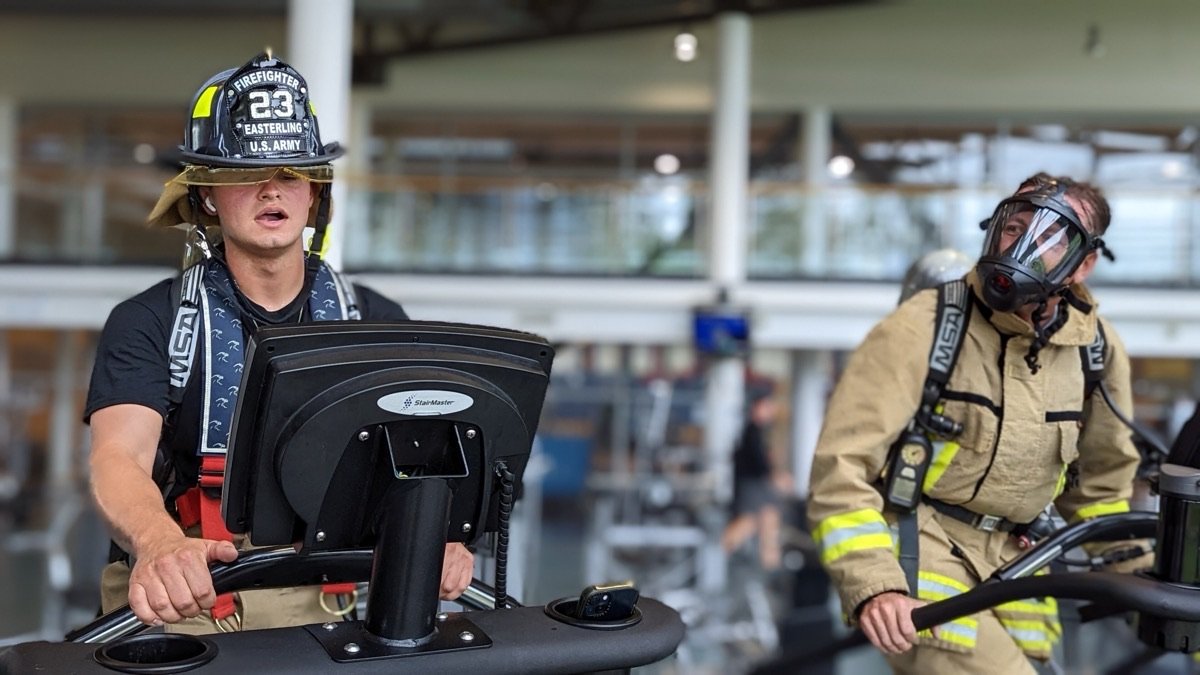
A stair machine (often called a StairMaster, after one well-known brand) and a real staircase train the same movement. The Compendium gives a general stair machine session 9.3 METs, the same as fast stair climbing. The practical differences:
| Stair machine | Real stairs | |
|---|---|---|
| Cost and access | Gym membership or a large home machine | Free: office stairwells, parking garages, stadiums, park steps |
| Going down | None: you only climb | You walk down between climbs, which gives rest but adds downhill loading |
| Pace | Set by the machine, steady and easy to track | Self-paced; naturally becomes intervals |
| Session length | Easy to do 20 to 30 continuous minutes | Limited by building height unless you repeat laps |
| Main watch-out | Leaning on the rails takes weight off your legs and makes it easier | Uneven or crowded steps, poor lighting, wet surfaces outdoors |
If going downstairs bothers your knees, a stair machine lets you train the climb without the descent. If you have no gym, a stairwell does the same job. On a machine, keep a light touch on the rails for balance and stand upright; if you need to hang on to keep up, lower the speed.
Is stair climbing bad for your knees?
For most people with healthy knees, a gradual build-up is fine; the Belgian trial had adults around 70 doing fast stair climbs under supervision. But stairs do load the front of the knee, and they're a common trigger for patellofemoral pain (sometimes called "runner's knee"). The American Academy of Orthopaedic Surgeons lists "climbing stairs" among the repeated knee-bending activities that can bring on this pain, along with sudden jumps in how often, how long or how hard you exercise (AAOS OrthoInfo).
To keep your knees comfortable:
- Build up gradually, as in the plan above. Sudden increases are a known trigger.
- Place your whole foot on each step, keep your knee in line with your toes and push through your heel.
- Use the handrail, especially on the way down, and take the descent slowly. If going down hurts, take the elevator down or use a stair machine.
- Skip "two steps at a time" until single steps feel easy.
- If stairs cause knee pain, stop the activity that hurts until it settles. AAOS suggests switching to low-impact options such as a stationary bike, elliptical or swimming in the meantime, and seeing a doctor if the pain persists or the knee becomes harder to move.
Who should check with a clinician first?
Brisk stair climbing is vigorous exercise, and the US guidelines advise that "adults with chronic conditions or symptoms should be under the care of a health care provider." Talk with your doctor or a physical therapist before starting if you have:
- Heart disease, a past heart attack or stroke, high blood pressure that isn't controlled, or a lung condition.
- Chest pain, unusual breathlessness, dizziness or fainting with exertion.
- Knee or hip arthritis, a recent joint injury or joint replacement.
- Balance problems or a history of falls.
- Pregnancy, or recent surgery.
Stop and get medical help right away if you have chest pain or pressure, severe shortness of breath, or feel faint during or after climbing.
Frequently asked questions
How many flights of stairs a day is good for you?
There's no proven target. In the UK Biobank study, the lower heart disease risk showed up from about 6 flights a day (roughly 60 steps) and was similar from 11 flights upward. If you're starting out, a few flights a day is a sensible first goal.
Is stair climbing better than walking?
It's harder, minute for minute. At a general pace, stair climbing (6.8 METs) uses about 1.8 times the energy of walking at about 3 mph (3.8 METs), so it's a quick way to add vigorous minutes. Walking is easier to keep up for long sessions and is gentler on sore knees. Many people do both.
Can I do stair workouts every day?
Short, easy climbs (taking the stairs at work, for example) are fine daily for most healthy people. For harder stair sessions, the trials used two to five days a week. Leave at least one easy day between hard sessions while you're building up.
Does stair climbing build glutes and leg muscle?
It works the quads and glutes and improved leg power in older adults in a 12-week trial. That trial measured power and function, not muscle size, so if building muscle is your main goal, pair stairs with a progressive strength routine.
This article is general information, not medical advice. It isn't a substitute for advice from a doctor or other qualified health professional, especially if you have a heart, lung or joint condition, or are pregnant.
Sources
- Song Z, Wan L, Wang W, et al. Daily stair climbing, disease susceptibility, and risk of atherosclerotic cardiovascular disease: A prospective cohort study, Atherosclerosis 2023;386:117300.
- Paddock S, Veerni R, Bhalraam U, et al. Evaluating the Impact of Stair Climbing on Cardiovascular Risk Reduction: A Systematic Review and Meta-analysis, American Journal of Cardiovascular Drugs 2026 (online August 13).
- Boreham CA, Kennedy RA, Murphy MH, et al. Training effects of short bouts of stair climbing on cardiorespiratory fitness, blood lipids, and homocysteine in sedentary young women, British Journal of Sports Medicine 2005;39(9):590–593.
- Allison MK, Baglole JH, Martin BJ, et al. Brief Intense Stair Climbing Improves Cardiorespiratory Fitness, Medicine & Science in Sports & Exercise 2017;49(2):298–307.
- Jenkins EM, Nairn LN, Skelly LE, et al. Do stair climbing exercise "snacks" improve cardiorespiratory fitness? Applied Physiology, Nutrition, and Metabolism 2019;44(6):681–684.
- Van Roie E, van Uffelen J, Delecluse C. Stair-Climbing Versus Machine-Based Resistance Exercise to Improve Muscle Power Among Older Adults: A Noninferiority Trial, Journal of Strength and Conditioning Research 2025;39(3):e496–e505.
- Herrmann SD, Willis EA, Ainsworth BE, et al. 2024 Adult Compendium of Physical Activities: A third update of the energy costs of human activities, Journal of Sport and Health Science 2024;13(1):6–12.
- 2024 Adult Compendium of Physical Activities: Walking (stair climbing codes 17070–17138), Conditioning Exercise (code 02065), Unit Conversions and Corrected METs.
- US Department of Health and Human Services: Physical Activity Guidelines for Americans, 2nd edition.
- American Academy of Orthopaedic Surgeons, OrthoInfo: Patellofemoral Pain Syndrome.
- Banner photo: Fitness stairs of Möskäri in Simonkylä, Vantaa, Finland, 2021 July.jpg by Ximonic (Simo Räsänen), CC BY 3.0, via Wikimedia Commons (cropped).
- Photo: Businessman on stairs (Unsplash).jpg by Joshua Ness, CC0, via Wikimedia Commons (cropped).
- Photo: Army firefighters commemorate Sept 11 sacrifices with 110-story climb (7417928).jpg by U.S. National Guard / Maj. Avery Schneider, public domain, via Wikimedia Commons (cropped).