

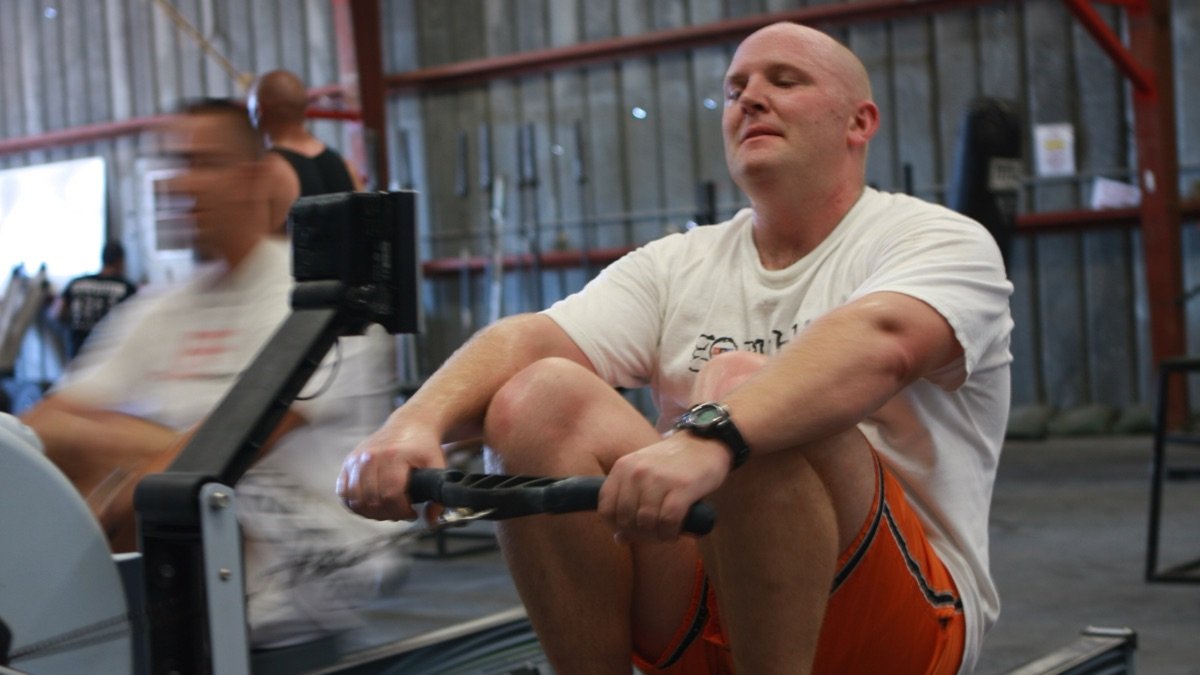
To row well on a rowing machine, push with your legs first, then swing your upper body back, then pull the handle to your lower ribs, and reverse that order on the way forward: arms, body, then legs. Set the damper (the lever on the fan housing) to 3, 4 or 5, keep your stroke rate in the low to mid 20s, and let the recovery take about twice as long as the drive. Most beginners do better with 10 to 20 minutes of easy, controlled rowing a few days a week than with hard, sloppy efforts.
Below: the muscles an indoor rower (often called an erg) works, each phase of the stroke, common form mistakes, what the damper and monitor numbers mean, calorie estimates for a 155-pound person with the math shown, a 4-week starter plan, and how to protect your lower back.
Is a rowing machine good exercise for beginners?
Yes, for most people. Rowing is seated, there's no pounding through the feet, and you control the resistance yourself: the harder you pull, the harder the machine pushes back. That makes it easy to start slowly and build up. A few points worth knowing:
- It counts as cardio at almost any effort. The 2024 Adult Compendium of Physical Activities rates easy rowing (under 100 watts) at 5.0 METs, which is moderate intensity under the US Physical Activity Guidelines, and general vigorous rowing at 7.3 METs. The guidelines count 6 METs or more as vigorous.
- It trains your heart and lungs even later in life. In a small Brazilian trial, women averaging 66 years old rowed three times a week for 30 minutes at 60% to 80% of their peak heart rate. After 10 weeks, their peak oxygen uptake, stroke volume and cardiac output had all improved, and they were handling more power on the rower at a lower heart rate within six weeks (Araujo and colleagues, International Journal of Environmental Research and Public Health, 2023).
- Technique matters more than on a bike or treadmill. Poor sequencing wastes effort, and rounding the lower back as you tire is linked to back pain in rowers.
The US guidelines ask adults for 150 to 300 minutes of moderate activity a week (or 75 to 150 vigorous), plus muscle-strengthening work on 2 or more days. Rowing can cover much of the first part, but it's mainly aerobic and doesn't replace strength training.
What muscles does a rowing machine work?
Concept2, a major maker of air rowers, describes rowing as "a coordinated muscle action that involves every large muscle group in the body." Its stroke-by-stroke breakdown (Concept2, Muscles Used While Rowing) looks like this:
- Legs (quads, glutes, hamstrings, calves): the drive starts with "the powerful muscles of your legs." The glutes and hamstrings then extend the hip, the quads and glutes are still working at the finish, and the hamstrings and calves pull you back up the slide on the recovery.
- Back: the back muscles work harder as you swing your torso open and help hold the finish position.
- Core: the abdominals stabilize you at the finish and flex your torso forward on the way back to the catch.
- Arms, shoulders and grip: the biceps and shoulders finish the pull, the triceps push the handle away on the recovery, and the finger flexors hold the handle throughout.
The practical point is that the legs start every stroke and supply the big push; the arms only finish it. If your arms or lower back tire long before your legs do, your sequence is probably off. Research on rowers without back pain also found their trunk muscle activity was led by the back extensors, with a fairly flat lower back at the finish, which is the posture to aim for (Nugent and colleagues, British Journal of Sports Medicine, 2021).
How to row: the four parts of the stroke
Before you start, strap your feet in so the strap crosses the ball of your foot. Concept2 suggests setting the feet lower if you're less flexible or carry extra weight around your midsection (Concept2, Getting Comfortable on the RowErg). Hold the handle with your fingers wrapped around it, thumbs underneath and wrists flat.
Concept2 splits the stroke into four positions (Concept2, Indoor Rowing Technique):
- The catch (start of the stroke). Arms straight, head neutral, shoulders level and relaxed. Your upper body leans forward from the hips, with shoulders in front of the hips. Shins are vertical, or as close as is comfortable, and should not go past vertical. Your heels may lift.
- The drive (the work). Press with your legs, then swing your back through vertical, then pull with your arms. The handle travels in a straight line, and your shoulders stay low.
- The finish. Legs straight, upper body leaning back slightly with your core braced, handle held lightly just below your ribs, wrists flat and shoulders down.
- The recovery (the rest). Straighten your arms first, then lean forward from the hips. Only once your hands have passed your knees do you bend your knees and slide forward to the next catch.
The easy way to remember it: legs, body, arms on the drive and arms, body, legs on the recovery. Concept2 also recommends a drive-to-recovery ratio of about 1:2: a quick, firm push and a slower, relaxed slide forward. Its "counting" drill puts the drive on count 1 and the recovery on counts 2 to 4 (Concept2, Rowing Drills).
If the sequence feels awkward, practice it in pieces at the start of each session: a few strokes with arms only, then arms and body with straight legs, then with legs added. Concept2's own advice for new rowers: "Don't pull too hard until you are comfortable with the technique fundamentals."
Common rowing machine mistakes and how to fix them
These are the errors Concept2 lists in its technique guide (Concept2, Improve Your Rowing Technique), with the fix for each:
| Mistake | What it looks like | Fix |
|---|---|---|
| Pulling with the arms first | Elbows bend at the start of the drive | Keep arms long until your legs are nearly straight; start every stroke with the legs |
| Shooting the slide | The seat moves back but the handle doesn't, so your hips push away from your shoulders | Handle and seat should move together; press with your legs while your back stays firm |
| Lifting with the back | The back opens before the legs push | Push with the legs early; legs and shoulders move together at the start of the drive |
| Bending the knees too early on the recovery | Hands have to go up and over the knees ("rowing over a barrel") | Arms out, body forward, then knees; hands clear the knees before the knees bend |
| Lunging at the catch | Diving forward and over-reaching at the front | Set your forward body angle early in the recovery and hold it as you slide in |
| Overcompression | Sliding so far forward that the shins pass vertical | Stop when your shins are vertical, or as close as is comfortable |
| Too much layback | Leaning far back at the finish | A slight lean with your core braced is enough; extra lean adds no useful length |
| Rushing the slide | Racing back to the catch, high stroke rate, little power | Drive firmly, then use the recovery to relax: about 1:2 drive to recovery |
| Death grip | Tight fists, bent wrists, sore forearms | Hook the fingers around the handle, thumbs underneath, wrists flat and loose |
To spot these, have someone watch you from the side, or film a few strokes on your phone and compare your positions with the four described above.
What damper setting should a beginner use?
Start between 3 and 5. That's Concept2's recommendation for the RowErg, and it says most records are set in that range (Concept2, What is the Best Damper Setting for Me?).
The damper is the numbered lever, 1 to 10, on the side of the fan housing. It controls how much air flows into the flywheel. It is not a resistance or difficulty dial. Concept2 compares it to bike gears: a high setting feels like rowing a heavy, slow boat, and a low setting feels like a light racing shell. Either way, "the harder you pull, the more resistance you will feel" (Concept2, All About Damper Setting and Drag Factor).
The common beginner mistake is cranking it to 10 for a "harder workout." Concept2 warns that a setting that's too high "can exhaust your muscles before you reap the full cardiovascular benefit rowing provides," and that it makes good technique harder to hold. Lower settings suit longer, aerobic rows; higher settings make rowing feel more like strength work and can suit short, hard intervals once your technique is solid.
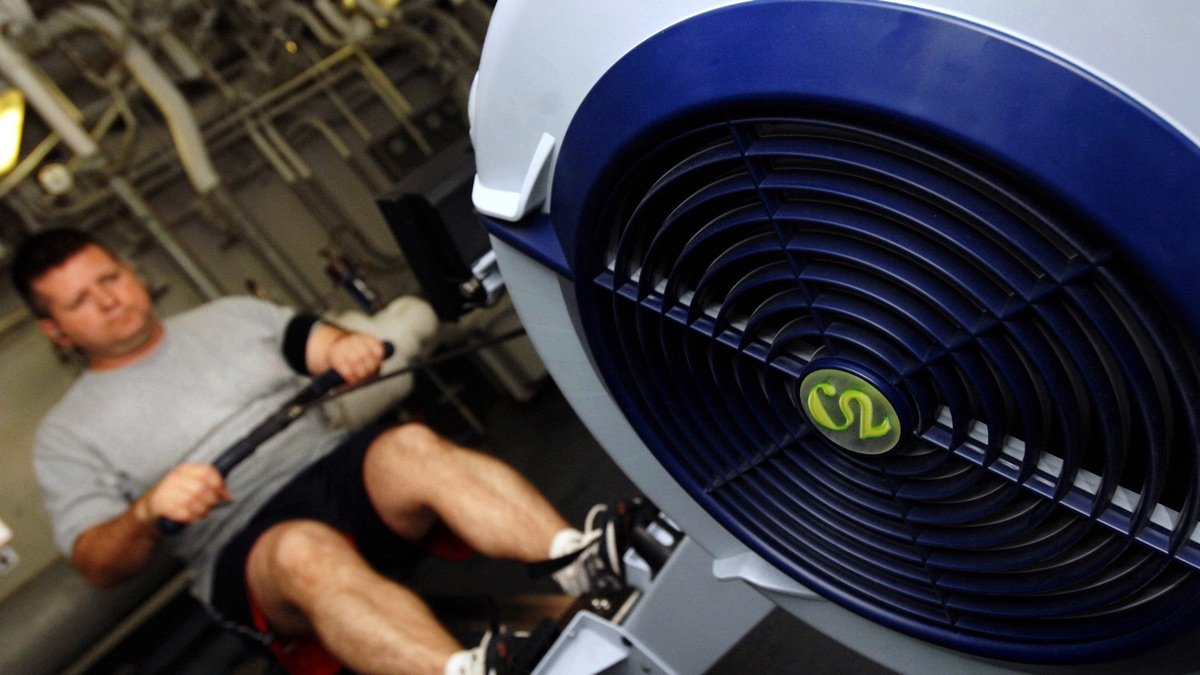
Drag factor is the more precise number. Between strokes, the monitor measures how fast the flywheel slows and uses that to calculate your actual work, so your pace and watts are comparable at any damper setting. Because temperature, altitude and even dust in the fan housing change airflow, a 4 on your gym's rower might feel like a 6 on another. Concept2 says a new RowErg reads a drag factor of about 90 or less at damper 1 and 200 or more at damper 10. On a PM5 monitor you can check it under More Options, then Display Drag Factor.
Stroke rate and split: reading the monitor
Three numbers on the monitor matter most when you start (Concept2, How to Row/Ski/Bike Harder):
- Stroke rate (spm) is strokes per minute. Working harder doesn't mean rowing faster: Concept2 suggests keeping most rowing workouts between 24 and 30 spm as intensity rises, and getting the extra speed from a stronger push rather than a quicker slide. For easy beginner rows, a rate around 20 to 24 is plenty.
- Split (pace) is the time it would take to row 500 meters at your current speed. Lower is faster: a 2:00 split means two minutes per 500 meters, quicker than 2:08 and slower than 1:48.
- Watts are your power output. Higher means faster. Concept2's conversion is watts = 2.80 ÷ pace³, with pace in seconds per meter (Concept2, Pace and Watts Calculators). By that formula, 100 watts is about a 2:32 split, 150 watts about 2:13, and 200 watts about 2:00.
Don't chase a split in your first weeks. Watch the stroke rate to stop yourself rushing; over time, the same easy effort should produce a lower split, a simple sign your fitness is improving.
How many calories does a rowing machine burn?
The 2024 Adult Compendium of Physical Activities, the standard research reference for the energy cost of activities in adults aged 19 to 59, lists these values for stationary rowing:
- Rowing, stationary ergometer, general, under 100 watts, moderate effort: 5.0 METs (code 02071)
- Rowing, stationary ergometer, general, vigorous effort: 7.3 METs (02070)
- Rowing, stationary, 100 to 149 watts, vigorous effort: 7.5 METs (02072)
- Rowing, stationary, 150 to 199 watts, vigorous effort: 11.0 METs (02073)
- Rowing, stationary, 200 watts or more, very vigorous effort: 14.0 METs (02074)
The math for a 155-pound person. The Compendium's conversion is: calories per minute = METs × 3.5 × body weight in kg ÷ 200.
- Convert weight: 155 lb ÷ 2.2046 = 70.3 kg.
- Calories per minute at an easy pace (under 100 watts): 5.0 × 3.5 × 70.3 ÷ 200 = 6.15, or about 6.2 calories per minute.
- For 20 minutes: 6.15 × 20 ≈ 123 calories.
| Effort (MET) | Approx. split | Per minute | 10 min | 20 min | 30 min |
|---|---|---|---|---|---|
| Easy, under 100 watts (5.0) | Slower than 2:32 | 6.2 | 62 | 123 | 185 |
| General, vigorous (7.3) | Not specified | 9.0 | 90 | 180 | 269 |
| 100 to 149 watts (7.5) | 2:32 to 2:13 | 9.2 | 92 | 185 | 277 |
| 150 to 199 watts (11.0) | 2:13 to 2:01 | 13.5 | 135 | 271 | 406 |
| 200 watts or more (14.0) | 2:00 or faster | 17.2 | 172 | 345 | 517 |
How to read this: most beginners rowing at an easy, conversational effort will be in the first row; sustained efforts at 150 watts or more are hard work for most newcomers. These are total calories, including the roughly 1.2 calories a minute this person would burn sitting still, so 20 easy minutes adds about 98 calories above rest, not 123. For a different body weight, multiply the per-minute figure by your weight in pounds and divide by 155. The split column is our conversion of the Compendium's watt bands using Concept2's formula.
The Compendium team notes on its corrected METs page that standard MET values usually underestimate measured energy cost, and misjudge intensity more often in people who are older, heavier, less fit, or women, so treat every number here as an estimate. The calorie count on the rower's monitor is an estimate too: Concept2's monitors use a formula based on a 175-pound person. Concept2's calorie calculator adjusts it: take the monitor's average calories per hour, subtract 300 and add 1.714 × your weight in pounds. At 155 pounds that works out to about 34 fewer calories per hour than the monitor shows. For more on why calorie estimates vary, see our calorie explainer; for how rowing compares with another indoor option, our guide to stair climbing benefits uses the same Compendium method.
A 4-week rowing machine plan for beginners
This plan is our example, not a tested program. It follows Concept2's technique-first advice and the US guidelines' advice that inactive people should "start low and go slow." Row three days a week with at least one rest or easy day between sessions. Keep the damper at 3 to 5 throughout.
| Week | Days | Main session | Stroke rate | Effort |
|---|---|---|---|---|
| 1 | 3 | 5 × 2 minutes of rowing, with 1 minute of easy rowing or rest between (10 minutes of work) | 20 to 22 spm | Easy: you can talk in full sentences |
| 2 | 3 | 3 × 5 minutes, with 1 to 2 minutes easy between (15 minutes of work) | 20 to 24 spm | Easy |
| 3 | 3 | 2 × 8 to 10 minutes, with 2 minutes easy between; on 1 day, add a firmer 10-stroke burst every 2 minutes | 22 to 24 spm (bursts may rise a little) | Easy to moderate; bursts feel firm, not all-out |
| 4 | 3 | 2 days: 15 to 20 minutes continuous. 1 day: 6 rounds of 20 seconds firmer, 1 minute 40 seconds easy | 22 to 26 spm | Moderate: you can talk in short phrases |
- Warm up every session with 3 to 5 minutes of easy rowing, including a few strokes of arms only, then arms and body, then the full stroke.
- Cool down with 2 to 3 minutes of very light rowing.
- Pace by effort, not the split. If you can't speak a full sentence on an "easy" day, slow down. Our guide to easy cardio without a heart rate monitor explains the talk test.
- Technique comes first. If your form falls apart late in a session (arms pulling early, back rounding), stop the piece or row easier. Week 3's bursts are Concept2's "power 10s," and week 4's 20-second efforts are its suggested way to start rowing harder.
- Repeat a week if your lower back is sore the next day, your hands are blistering, or the sessions feel like a struggle. Concept2 advises increasing rowing time gradually, partly to spare your hands from blisters.
- After week 4, add time to your continuous rows before adding speed. Harder interval sessions are a form of HIIT; see our HIIT guide before you try them.
Rowing covers cardio, but the US guidelines also call for muscle-strengthening work on 2 or more days a week. If you don't do any yet, our minimum effective strength training routine pairs well with this plan. If you're coming back after time off, our guide to your first four weeks back at the gym covers how to ease in.
Rowing and your back: how to stay safe
The lower back is the most commonly reported injury site in rowers. Almost all of the research comes from competitive rowers, who train far more than a beginner will, but it still points to what matters:
- Past back pain is the strongest warning sign. A 2025 meta-analysis of 10 studies with 2,082 rowers found that a history of low back pain was the only factor clearly linked to current back pain (odds ratio 2.65). Age, sex, BMI, competitive level and training volume weren't significantly associated in the pooled data (Ze and colleagues, BMC Sports Science, Medicine and Rehabilitation, 2025).
- Ergometer volume may add risk. An earlier review found that a history of lumbar spine injury and the volume of ergometer training were the most significant risk factors in the limited studies available. It also noted that novice rowers on ergs often bend through the lower back instead of rotating from the pelvis, and that technique tends to slip as sessions get harder or longer (Wilson and colleagues, British Journal of Sports Medicine, 2014).
- Fatigue rounds the back. A systematic review of rowing biomechanics found that fatigue increases lower-back flexion at the catch, and more so on the ergometer than in a boat. Rowers with back pain tended to tuck the pelvis under (posterior pelvic rotation) at the catch (Nugent and colleagues, 2021).
What that means on the machine:
- Hinge forward from the hips at the catch, sitting tall, rather than reaching by rounding your lower back. If your hamstrings are tight, a slightly shorter slide is better than a rounded spine.
- Keep the layback small and your core braced at the finish.
- Stop or ease off when form slips. Long, hard sessions are where technique breaks down.
- Build time on the rower gradually, as in the plan above, and keep the damper moderate.
- If rowing causes back pain, stop and let it settle. Pain that spreads down a leg or comes with numbness or weakness needs a medical check.
Who should check with a clinician first?
The US Physical Activity Guidelines say that "adults with chronic conditions or symptoms should be under the care of a health care provider," and that pregnant women should be under the care of a health care provider who can monitor the pregnancy and advise on adjusting activity. Talk with your doctor or a physical therapist before starting a rowing program if you have:
- Current or recurring low back pain, a disc problem, or past back surgery.
- Heart disease, a past heart attack or stroke, high blood pressure that isn't controlled, or a lung condition.
- Chest pain, unusual breathlessness, dizziness or fainting with exertion.
- A knee or hip replacement, or knee or hip arthritis that limits deep bending. Concept2 notes the seat slide can be shortened, or fixed in place, to limit knee bend, but ask what range is safe for you first.
- Osteoporosis or a past spinal fracture.
- Pregnancy, recent surgery, or a hernia.
Stop rowing and get medical help right away if you have chest pain or pressure, severe shortness of breath, or feel faint during or after a session.
Frequently asked questions
How long should a beginner row?
Ten to 15 minutes of actual rowing, broken into short pieces, is a sensible start. Build toward 20 to 30 minutes of easy continuous rowing over a few weeks. Three 20-minute moderate sessions a week add up to 60 of the 150 weekly minutes the US guidelines recommend.
Is rowing good for weight loss?
It burns a useful number of calories (roughly 120 to 185 in 20 minutes for a 155-pound person, from easy rowing up to 100 to 149 watts, by Compendium estimates), and it's low-impact, so many people can do it often. Weight loss still depends mostly on your total energy balance, including diet.
Can I row every day?
Short, easy rows are fine on most days for many healthy people once your hands and back have adapted. In the first month, three days a week with rest days between is a safer start, and back-pain research in rowers suggests piling on erg volume quickly isn't wise.
This article is general information, not medical advice. It isn't a substitute for advice from a doctor, physical therapist or other qualified health professional, especially if you have back pain, a heart or lung condition, joint problems, or are pregnant.
Sources
- Concept2: Indoor Rowing Technique on the RowErg, Improve Your Rowing Technique and Rowing Drills.
- Concept2: Muscles Used While Rowing.
- Concept2: All About Damper Setting and Drag Factor and What is the Best Damper Setting for Me? (January 3, 2025).
- Concept2: How to Row/Ski/Bike Harder, Pace and Watts Calculators and Calorie Calculator.
- Concept2: Getting Comfortable on the RowErg and Using Concept2 Ergs for Injury Rehab.
- Araujo RC, Rodrigues GD, Ferreira LF, Soares PPDS. The Time Course of Cardiorespiratory Adaptations to Rowing Indoor Training in Post-Menopausal Women, International Journal of Environmental Research and Public Health 2023;20(4):3238.
- Nugent FJ, Vinther A, McGregor A, et al. The relationship between rowing-related low back pain and rowing biomechanics: a systematic review, British Journal of Sports Medicine 2021 (online January 4).
- Ze X, Zhang S, Long X, Zhou P. Risk factors associated with low back pain in rowers: a systematic review and meta-analysis, BMC Sports Science, Medicine and Rehabilitation 2025;17(1):157.
- Wilson F, Gissane C, McGregor A. Ergometer training volume and previous injury predict back pain in rowing; strategies for injury prevention and rehabilitation, British Journal of Sports Medicine 2014;48(21):1534–1537.
- Herrmann SD, Willis EA, Ainsworth BE, et al. 2024 Adult Compendium of Physical Activities: A third update of the energy costs of human activities, Journal of Sport and Health Science 2024;13(1):6–12.
- 2024 Adult Compendium of Physical Activities: Conditioning Exercise (rowing codes 02070–02074), Unit Conversions and Corrected METs.
- US Department of Health and Human Services: Physical Activity Guidelines for Americans, 2nd edition.
- Banner photo: USMC-05209.jpg by Lance Cpl. M. C. Nerl, U.S. Marine Corps, public domain, via Wikimedia Commons (cropped).
- Photo: US Navy 070329-N-8923M-029 … on a rowing machine.jpg by U.S. Navy / Seaman Kevin T. Murray Jr., public domain, via Wikimedia Commons (cropped).
- Photo: TechnoGym Indoor-Rudergeräte Demonstration auf der FIBO 2019 in Köln, Deutschland (47952465622).jpg by dronepicr, CC BY 2.0, via Wikimedia Commons (cropped).