

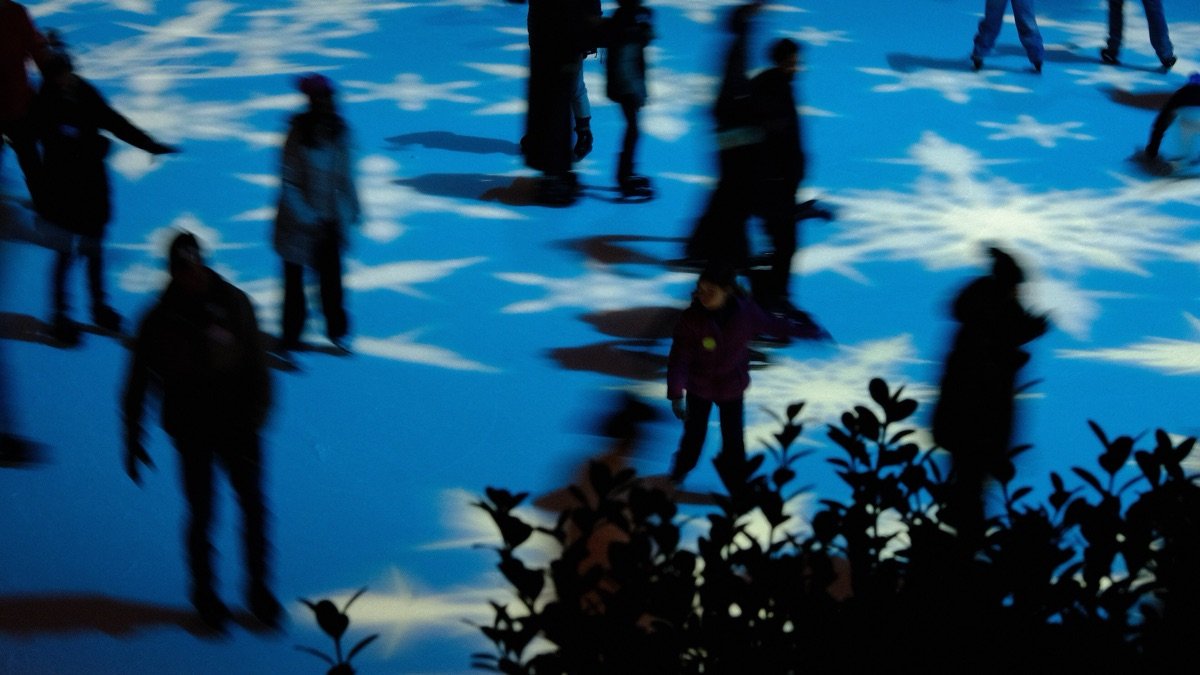
Yes, ice skating is real exercise: an hour at a relaxed pace counts as moderate-intensity cardio, a brisk pace counts as vigorous, and every stride works your legs, hips and balance. Using values from the 2024 Compendium of Physical Activities, a 155-pound adult burns about 400 calories in an hour of easy skating and roughly 500 to 660 at a general to fast pace. The evidence on balance is thinner than skating fans suggest, and falls are the main risk, so the best first session is a public session at a rink with a helmet, gloves and a plan for how to fall.
Below: what skating does for your fitness, the calorie math, a first rink session step by step, the injury data, official guidance on lakes and ponds, and a short off-ice routine.
Is ice skating good exercise?
Skating means balancing on a thin steel blade while your legs drive you forward. Here's what the evidence supports, and where it stops:
- It's genuine cardio. The 2024 Compendium of Physical Activities rates ice skating at 5.5 METs at 9 mph or less, 7.0 METs for general skating and 9.0 METs above 9 mph. The Physical Activity Guidelines for Americans count 3.0 to 5.9 METs as moderate and 6.0 or more as vigorous. So a relaxed loop of the rink is moderate exercise, and steady skating at a general pace or faster is vigorous. Both count toward the guideline of 150 to 300 minutes of moderate activity, or 75 to 150 minutes of vigorous activity, a week.
- It works the legs and hips. Each stride is a push to the side and back from a bent knee while you balance on the other leg. That loads the quads, glutes and hip muscles in a sideways pushing pattern that walking and cycling don't really train. It isn't a substitute for strength training, which the guidelines recommend on 2 or more days a week.
- It challenges balance, though the proof of benefit is limited. In a small Dutch study, 13 older adults who did ice speed skating had postural control similar to young adults and better than 10 inactive older adults (Lamoth and van Heuvelen, Gait & Posture, 2012). That was a one-time comparison, so it can't show that skating caused the better balance; people with good balance may simply be the ones who keep skating. We found no trial showing that recreational skating improves balance or prevents falls in everyday life.
- It's easy to stick with. The federal guidelines list the chance to "enjoy recreational activities, often in a social setting" among the benefits of being active. A public skate with friends is cardio that rarely feels like a workout.
What we can't tell you: there's no good research on recreational skating and heart disease, weight loss or bone density on its own. The benefits above come from what skating demands of your body and from the general evidence on moderate-to-vigorous activity.
How many calories does ice skating burn?
The Compendium is the standard research reference for the energy cost of activities in adults aged 19 to 59. Its values for skating (a MET is a multiple of your resting energy use):
- Ice skating, 9 mph or less: 5.5 METs (code 19020)
- Ice skating, general: 7.0 METs (19030)
- Ice skating, rapidly, more than 9 mph but not competitive: 9.0 METs (19040)
- Ice hockey, general: 8.0 METs (15360)
The math for a 155-pound person. The Compendium's conversion is: calories per minute = METs × 3.5 × body weight in kg ÷ 200.
- Convert weight: 155 lb ÷ 2.2046 = 70.3 kg.
- Calories per minute at a general pace: 7.0 × 3.5 × 70.3 ÷ 200 = 8.61, or about 8.6 calories per minute.
- For a 60-minute session of steady skating: 8.61 × 60 ≈ 517 calories.
| Activity (MET) | Per minute | 30 min | 45 min | 60 min |
|---|---|---|---|---|
| Walking, 2.8 to 3.4 mph, level (3.8) | 4.7 | 140 | 210 | 281 |
| Ice skating, 9 mph or less (5.5) | 6.8 | 203 | 305 | 406 |
| Ice skating, general (7.0) | 8.6 | 258 | 388 | 517 |
| Ice hockey, general (8.0) | 9.8 | 295 | 443 | 591 |
| Ice skating, more than 9 mph (9.0) | 11.1 | 332 | 498 | 664 |
How to read this:
- These are total calories, including the roughly 74 calories an hour this person would burn sitting still. An hour of general skating adds about 443 calories above rest, not 517.
- For a different body weight, scale in proportion: multiply the per-minute figure by your weight in pounds and divide by 155. An hour at a general pace comes to about 417 calories at 125 pounds and about 617 at 185 pounds.
- Count moving time, not rink time. A beginner's first hour includes lacing, resting at the boards and time spent standing still. If you skated for 30 of those minutes, use the 30-minute column.
- Treat every number as an estimate. The Compendium team notes on its corrected METs page that standard MET values usually underestimate measured energy cost, and misclassify intensity more often in people who are older, heavier, less fit, or women.
Learn to Skate USA, the beginner program endorsed by U.S. Figure Skating, USA Hockey and US Speedskating, says skating "can burn up to 650 calories per hour." By the Compendium math, that's about what a 155-pound person would burn skating fast, above 9 mph, for a full hour, so take it as an upper end rather than a typical session. Minute for minute, general skating uses close to twice the energy of walking at about 3 mph. For another winter activity with a surprisingly high energy cost, see our guide to snow shoveling calories and heart risk.
Your first time at the rink: a beginner's step-by-step
A public skating session at an indoor or managed outdoor rink is the right place to start: the ice is maintained, there are boards to hold, and staff are on hand. Many rinks also run Learn to Skate USA classes for adults as well as children. The tips below come from that program's parent handbook and basic techniques handout, which apply to beginners of any age.
What to wear and bring
- Layers you can move in. Sweatpants or warm-up pants rather than bulky snow pants, plus a jacket: the handbook notes that indoor rinks set thermostats at "a brisk 50 degrees." For an outdoor rink, dress as you would for a cold-weather run; our temperature-by-temperature clothing guide works for skating too.
- Thin socks. Thick, bulky socks reduce support and create pressure points inside the boot. One pair of lightweight socks is enough.
- Gloves or mittens. You will touch the ice when you fall and get up, and ice is rough on bare hands.
- A helmet. Learn to Skate USA "strongly" recommends helmets for all beginning skaters, whatever their age. More on why, and which kind, in the safety section below.
Rental skates: how they should fit
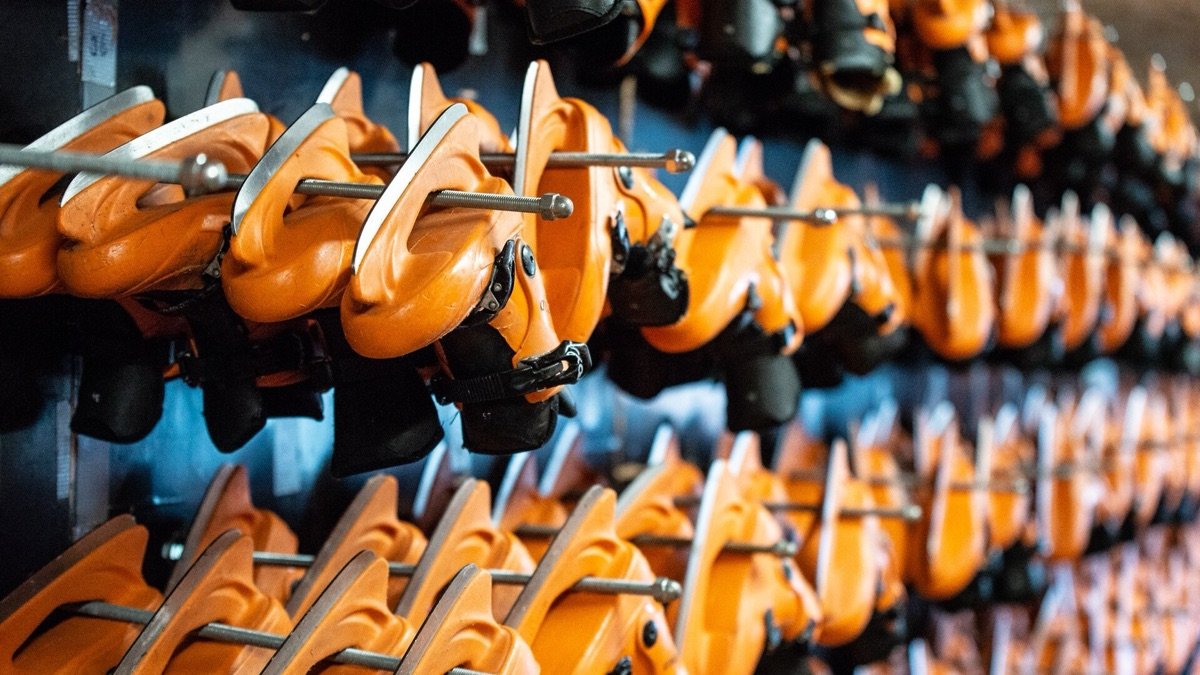
Rent first, buy later. Rinks rent skates by shoe size; start with your usual size and ask to swap if the fit is off.
- Snug, not crushing. The handbook's rule of thumb is "the closer the fit, the more control": your foot shouldn't move around in the boot, but your toes should be able to wiggle.
- Heel back first. Before lacing, tap your heel back into the boot so it sits in the heel pocket, and pull the tongue straight up before tucking it against your foot.
- Tight over the foot and ankle, a little looser at the top. Lace the lower part of the boot and the ankle area snugly. The top two hooks can be looser so your ankle can still bend. When laced, you should be able to slide one finger between the back of the boot and your leg.
- Tuck the extra lace. Don't wrap long laces around the ankle; loose, flapping bows trip skaters.
Stance and first strides
- Get on and hold the boards. Step on with your knees soft and let your weight settle over the middle of your blades. Don't walk on concrete or hard floors with uncovered blades if you've brought your own skates.
- Find the stance. Bend your knees and ankles slightly, keep your chest and head up, and hold your arms slightly in front of you, roughly parallel to the ice. Point your toes where you want to go and keep your eyes up rather than on your feet.
- March before you glide. Take small marching steps with your toes slightly turned out. After three or four steps, put both feet down and glide for a count of three. Repeat, pushing a little harder each time.
- Learn one stop early. The beginner stop is the snowplow: while gliding slowly on both feet, bend your knees, push your heels outward and press on the inside edges of the blades so they skid and shave the ice. Practice the skid while holding the boards, then standing still, then moving.
- Skate in control. Rink rules ask you to skate at a speed where you can always stop or steer around other skaters, and to leave the ice to fix a lace or adjust equipment.
How to fall, and how to get up
Every new skater falls; the goal is to fall in a way that protects your head and wrists. Learn to Skate USA teaches this on day one and suggests practicing a few falls off the ice first, on carpet or grass.
- Fall to one side. Not forward, and not backward onto your tailbone. Lower your center of gravity by bending your knees, slide onto one hip, relax and let yourself collapse onto the ice.
- Tuck your chin so your head doesn't snap back and hit the ice.
- Don't catch yourself with your hands. The program's advice is to "never use your hands to break your fall." An outstretched hand is a classic way to break a wrist.
To get up: roll onto your hands and knees, place one foot on the ice between your hands, then the other, and push up slowly with your knees bent. Do it promptly: rink rules ask fallen skaters to get up quickly so passing skaters don't run into them.
Keep the first session short
The US activity guidelines advise inactive people to "start low and go slow." Twenty to 30 minutes of actual skating with breaks is plenty for a first time, even if you feel you could keep going. Aim for easy effort at first, using the talk test from our guide to easy cardio without a heart rate monitor, and build up over a few sessions.
Is ice skating safe? What the injury data show
Falls on hard ice cause real injuries, and the head is hurt more often than many people expect. The best US data come from the National Electronic Injury Surveillance System (NEISS), the Consumer Product Safety Commission's sample of hospital emergency departments.
- How many: A Yale analysis of NEISS estimated 403,791 emergency department visits for ice skating injuries in the US from 2002 to 2021, falling from about 22,500 a year in 2002–2004 to about 14,800 a year in 2019–2021 (Dhodapkar and colleagues, Orthopaedic Journal of Sports Medicine, 2023). These are counts, not rates: the study couldn't measure how many people skated, so it can't say how risky each session is.
- Where: The head, face and neck were the most common injury site for ice skaters (34.5% of injuries), unlike roller and inline skating, where the wrist and arm led. The shoulder, arm and elbow (14.4%) and the wrist (14.1%) came next.
- What: Fractures were the most common injury type, and 60% of ice skating fractures were in the shoulder, arm, elbow or wrist. Lacerations came second. And 5.9% of injured ice skaters were diagnosed with a concussion, compared with 1.2% to 1.5% for inline and roller skaters.
- Who: In the same data, injured ice skaters averaged 22 years old, and about 42% were adults. In a Vienna hospital study of 341 injured skaters, people over 50 had more severe injuries and a higher risk of head injury than skaters aged 18 to 50 (Ostermann and colleagues, International Orthopaedics, 2015).
Studies of children point the same way. In NEISS data from 1993 to 2003, 13.3% of injured child ice skaters had head injuries and 4.3% had concussions, far higher shares than for roller or inline skaters, and children 6 and under had the highest share of head and facial injuries (Knox and colleagues, Pediatrics, 2006). The authors' conclusion was that children should wear helmets for all recreational skating, "especially ice skating." An earlier Ohio emergency department study reached the same recommendation (McGeehan and colleagues, Pediatrics, 2004).
Helmets for beginners
Learn to Skate USA strongly recommends helmets for all beginning skaters, and its rink rules say beginners "should wear ice-approved helmets." There is no helmet safety standard written specifically for ice skating, so the program points to helmets certified to ASTM F1447 or Snell B-90A, B-95 or N-94; check the label for those certifications. Whatever you use, it should sit level and low enough to protect your forehead, fit snugly with the chin strap buckled, and have nothing worn underneath it.
A helmet makes the most sense if you've never skated, are over 50 or have had a concussion. The Yale authors also suggested helmets "may be important safety gear" for some skaters to limit concussion risk.
Wrist guards
No study has tested wrist guards in recreational ice skating, so this is an inference from similar sports. In a CDC-led study of injured inline skaters, those who didn't wear wrist guards had about 10 times the odds of a wrist injury (Schieber and colleagues, New England Journal of Medicine, 1996). A systematic review in snowboarders found wrist guards cut the risk of wrist injury by about 77%, though some non-experimental data hinted at more finger, elbow or shoulder injuries in wearers (Russell and colleagues, Clinical Journal of Sport Medicine, 2007). Pediatric researchers recommend wrist guards for young skaters, and they're a reasonable choice for nervous adult beginners too, alongside the fall technique above. Our ski and snowboard prep guide covers the wrist guard research in snowboarders in more detail.
Skating on lakes and ponds: ice thickness and safety
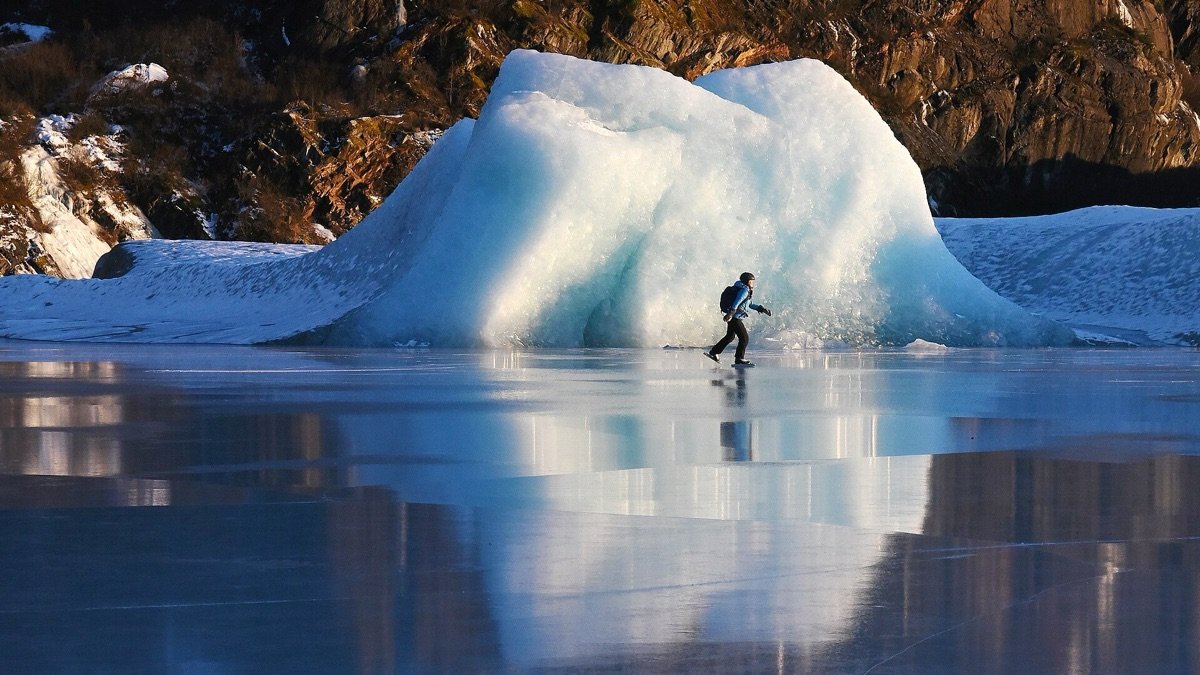
Skating on a frozen pond is a winter classic, but natural ice is a different risk from a rink. The Wisconsin Department of Natural Resources puts it plainly: there is "no such thing as 100 percent safe ice," and you can't judge ice strength by appearance, age, thickness, temperature or snow cover alone. Strength also varies across the same lake.
The National Weather Service's ice safety guidance, which points readers to the Minnesota DNR for more detail, gives these minimums for new, clear ice:
| Clear ice thickness | What the guidance says |
|---|---|
| Less than 2 inches | Stay off the ice |
| 4 inches or more | Minimum for ice skating, walking and ice fishing |
| At least 5 inches | Snowmobiles and ATVs |
| 8 to 12 inches | A car or small pickup |
White or "snow" ice is only about half as strong as new, clear ice, so the NWS says to double these numbers on white ice. Don't go out at all if you see cracks, holes or breaks, flowing water at the edges, just under or over the ice, or ice that looks like it has thawed and refrozen.
Practical rules from the Wisconsin DNR:
- Ask locally. State DNRs generally don't monitor every lake. The NWS says to check with local officials; Wisconsin's DNR says local bait shops, fishing clubs and resorts often have the most current thickness reports.
- Avoid moving water. Stay away from inlets, outlets and narrows, where current can thin the ice.
- Never skate alone, tell someone where you're going and when you'll be back, and don't go out at night or in poor visibility.
- Carry basic safety gear: ice claws or picks, a phone in a waterproof bag, a life jacket and a length of rope.
If you fall through: stay calm and keep your winter clothing on, since it traps air. Turn back toward the direction you came from, where the ice held you. Put your arms on the unbroken ice, dig in your picks and kick your feet to work your way out. Once out, don't stand up: lie flat and roll away from the hole, then get somewhere warm and dry right away. Moderate or severe hypothermia needs medical care.
Cold air is part of outdoor skating, too. If cold, dry air makes you cough or wheeze during exercise, read our guide to exercise-induced asthma in cold weather before your first outdoor session.
Off-ice prep: a simple routine for the weeks before you skate
You don't need to train before your first skate, but stronger hips and steadier ankles make the first few sessions easier. This is our example routine, not a tested program. Do it two or three times a week for two to four weeks; it takes about 15 minutes.
| Exercise | Sets and reps | Why it helps on the ice |
|---|---|---|
| Single-leg balance (near a counter) | 2 to 3 × 30 seconds each leg; progress to eyes closed or a soft cushion | Gliding is balancing on one leg |
| Bodyweight squat (or sit-to-stand from a chair) | 2 to 3 × 10 | Builds the bent-knee stance |
| Lateral lunge | 2 × 8 each side | Strength in the sideways push of a stride |
| Side-lying leg raise | 2 × 12 each side | Trains the outer hip muscles that steady each glide |
| Glute bridge | 2 × 12 | Hip extension for a stronger push |
| Calf raise | 2 × 15 | Ankle and lower-leg strength in a stiff boot |
| Skater steps (side-to-side step, then a small hop when ready) | 2 × 10 each side | Rehearses the side-to-side weight shift |
| Practice fall and get-up on carpet | 3 to 5 slow repetitions | Makes the safe fall automatic |
Hold a counter or chair for the balance work whenever you need to. If you've never done strength training, our guide to the minimum effective dose of strength training shows how to build these moves into two short sessions a week.
Warm up on the day. Learn to Skate USA's dynamic warm-up runs through movements such as a minute of easy jogging, ankle circles while balancing on one foot, knee hugs, walking lunges, straight-leg kicks and butt kickers before you lace up. It takes only a few minutes.
Who should check with a clinician first?
For most healthy people, a public skate needs no special clearance. The US guidelines advise that adults with chronic conditions or symptoms stay under the care of a health care provider, and skating adds a fall risk on a hard surface. Talk with your doctor or a physical therapist first if you have:
- Osteoporosis or a past fracture from a minor fall.
- Balance problems, dizziness or a history of falls.
- Heart disease, uncontrolled high blood pressure or chest symptoms with exertion, especially for outdoor skating in the cold.
- A recent concussion, joint surgery or joint replacement.
- Pregnancy, because of the risk of falling.
- Blood-thinning medication, since falls can cause more serious bleeding.
Older adults who want the balance benefits without the fall risk can also build balance on dry land first; our strength and balance routine for seniors is a gentle place to start.
Frequently asked questions
Is ice skating good for weight loss?
It can help, because it burns about 400 to 520 calories an hour for a 155-pound person at an easy to general pace and is enjoyable enough to repeat. But weight loss depends on your overall energy balance, and the extra burn above rest is smaller than the totals suggest. No study has tested recreational skating as a weight-loss program.
Is ice skating harder than roller skating?
Not in energy terms: the Compendium gives general ice skating and roller skating the same 7.0 METs. The difference is in the injuries. Ice skaters are more likely to hurt their head and face, while roller and inline skaters more often injure their wrists and arms.
Can adults learn to ice skate?
Yes. Learn to Skate USA runs adult classes at many rinks, including refresher courses for people who haven't skated in years. A group class is the fastest way to learn stopping and safe falling.
This article is general information, not medical advice. It isn't a substitute for advice from a doctor or other qualified health professional, especially if you have a bone, heart, balance or joint condition, or are pregnant. Ice conditions change quickly; always follow local officials' guidance.
Sources
- Dhodapkar MM, Halperin SJ, Gardner EC, Grauer JN. Orthopaedic Injury Patterns Related to Ice Skating, Inline Skating, and Roller Skating: A 20-Year Epidemiologic Analysis, Orthopaedic Journal of Sports Medicine 2023;11(9):23259671231198208.
- Knox CL, Comstock RD, McGeehan J, Smith GA. Differences in the risk associated with head injury for pediatric ice skaters, roller skaters, and in-line skaters, Pediatrics 2006;118(2):549–554.
- McGeehan J, Shields BJ, Smith GA. Children should wear helmets while ice-skating: a comparison of skating-related injuries, Pediatrics 2004;114(1):124–128.
- Ostermann RC, Hofbauer M, Tiefenböck TM, et al. Injury severity in ice skating: an epidemiologic analysis using a standardised injury classification system, International Orthopaedics 2015;39(1):119–124.
- Lamoth CJ, van Heuvelen MJ. Sports activities are reflected in the local stability and regularity of body sway: older ice-skaters have better postural control than inactive elderly, Gait & Posture 2012;35(3):489–493.
- Schieber RA, Branche-Dorsey CM, Ryan GW, et al. Risk factors for injuries from in-line skating and the effectiveness of safety gear, New England Journal of Medicine 1996;335(22):1630–1635.
- Russell K, Hagel B, Francescutti LH. The effect of wrist guards on wrist and arm injuries among snowboarders: a systematic review, Clinical Journal of Sport Medicine 2007;17(2):145–150.
- Herrmann SD, Willis EA, Ainsworth BE, et al. 2024 Adult Compendium of Physical Activities: A third update of the energy costs of human activities, Journal of Sport and Health Science 2024;13(1):6–12.
- 2024 Adult Compendium of Physical Activities: Winter Activities (codes 19020–19050), Sports (codes 15360, 15590), Walking (code 17190), Unit Conversions and Corrected METs.
- US Department of Health and Human Services: Physical Activity Guidelines for Americans, 2nd edition.
- Learn to Skate USA: Parent Handbook and Learn to Skate USA: Basic Techniques (handout hosted by Broadmoor World Arena).
- National Weather Service: Ice Safety.
- Wisconsin Department of Natural Resources: Ice Safety.
- Banner photo: Ice skating rink - Rockefeller center.jpg by Annanaïg, CC0, via Wikimedia Commons (cropped).
- Photo: Huurschaatsen.jpg by Schaatsbaan-Rotterdam, CC BY-SA 4.0, via Wikimedia Commons (cropped).
- Photo: Nordic skating on Mendenhall Lake (53009253397).jpg by Paxson Woelber, CC BY 2.0, via Wikimedia Commons (cropped).