

Good ski and snowboard season prep combines leg strength, single-leg balance, lateral power, core work and enough cardio to last a full day on the mountain. Two strength sessions and two cardio sessions a week for 4 to 6 weeks is a realistic way to get there, and the plan below gives sets and reps. Fitness is only part of staying safe, though. Properly set bindings, a helmet, wrist guards for snowboarders and an easy first day matter just as much.
Key takeaways
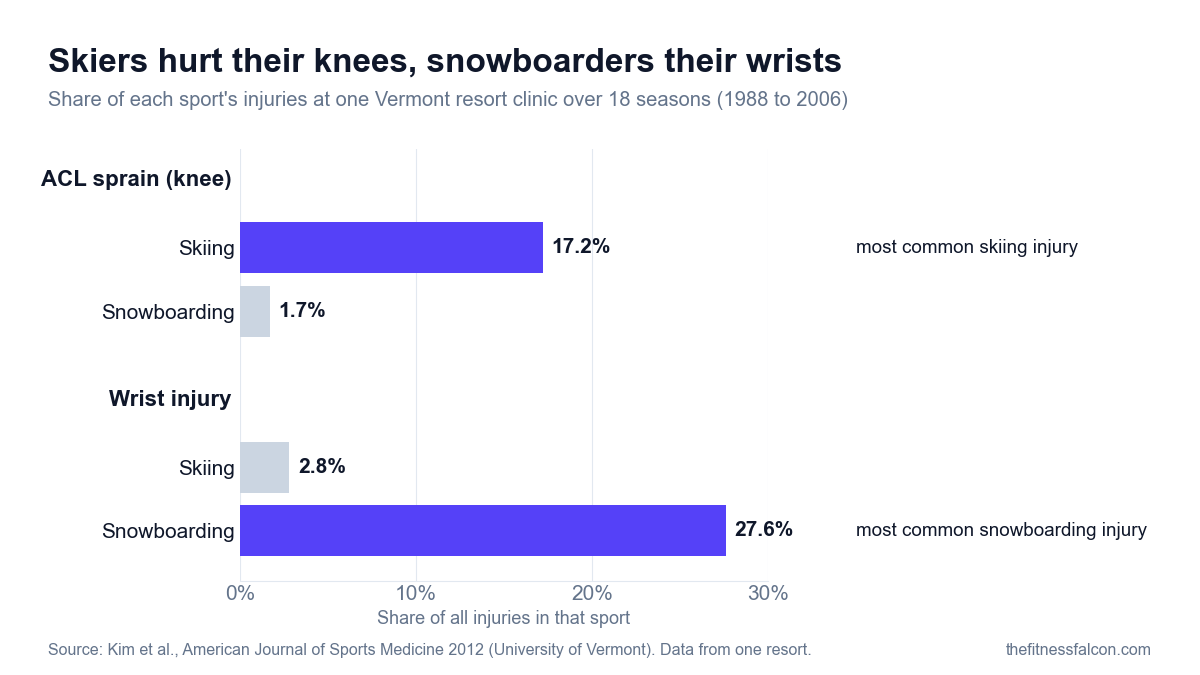
- In an 18-season Vermont study, ACL sprains were the most common skiing injury (17.2%) and wrist injuries the most common snowboarding injury (27.6%).
- Train 2 strength days and 2 cardio days a week: single-leg strength first, then lateral hops and intervals from week 3.
- Helmets were linked to lower odds of head injury in a 2010 meta-analysis. In two randomized trials, snowboarders wearing wrist protectors had fewer wrist injuries.
- Many injuries happen late in the day, on "one last run," according to the American Academy of Orthopaedic Surgeons (AAOS). Keep day one short.
- The CDC says fitness doesn't affect altitude-sickness risk, so take the first 48 hours at a high resort easy.
Where skiers and snowboarders get hurt
The AAOS cites U.S. Consumer Product Safety Commission figures of more than 76,000 snow skiing injuries treated in hospitals, doctors' offices and emergency rooms in 2018, plus about 53,000 snowboarding injuries. Knee injuries, especially to the anterior cruciate ligament (ACL), are very common, as are shoulder injuries from reaching out to break a fall.
The two sports injure different body parts. A University of Vermont study tracked injuries at one Vermont resort's base-lodge clinic over 18 seasons (1988 to 2006):
| Injury | Share of skiing injuries | Share of snowboarding injuries |
|---|---|---|
| ACL sprain (knee) | 17.2%, the most common skiing injury | 1.7% |
| Wrist injury | 2.8% | 27.6%, the most common snowboarding injury |
| Also more common | MCL and LCL knee sprains, lower-body bruises, tibia fractures | Shoulder soft-tissue injuries, ankle injuries, concussions, collarbone fractures |
Injured snowboarders were younger and less experienced than injured skiers. It's one resort's data, but the pattern is clear: skiers need to look after their knees, and snowboarders their wrists and upper body.
Does pre-season training prevent injuries?
It may help, but there's no strong proof for recreational skiers. ACL-prevention programs that combine strength, balance, jumping and landing practice have good evidence: a 2018 summary of eight meta-analyses found they cut all ACL injuries by about half, and non-contact ACL injuries in female athletes by about two-thirds. Most of that data came from female athletes, and none of it is specific to skiing. In ski racing, a 2019 review noted that ACL injury rates haven't dropped significantly despite proposed prevention methods.
One older ski study did find a benefit from a different approach. Ski patrollers and instructors at 20 ski areas watched videos of how ACL sprains happen, and their serious knee sprains fell by 62% compared with the two previous seasons. Staff at 22 ski areas without the training saw no decline. That was an awareness program for ski staff, not a gym program.
So treat the plan below as a practical template built on general strength principles, not a protocol tested in a trial. Its aim is stronger legs that are less tired late in the day, when the AAOS says many injuries happen. It also meets the federal guideline of muscle-strengthening activity at least 2 days a week.
The 6-week ski and snowboard prep plan
Train 4 days a week: two strength sessions (A and B) and two cardio sessions, with at least one rest day between the strength days. If you only have 4 weeks and already lift regularly, start at week 3. If you're new to strength training, do all 6 weeks, start with bodyweight or light dumbbells, and read our guide to progressive overload for beginners before adding weight.
| Weeks | Focus | Strength A and B | Power and lateral work | Cardio (2 days) |
|---|---|---|---|---|
| 1–2 | Foundation | 2–3 sets per exercise at a weight you could lift 2–3 more reps | None yet. Practice slow lateral lunges and balance work. | 30–40 min steady and conversational (bike, incline walk, stair climber, hike) |
| 3–4 | Build | 3–4 sets; add weight when the top of the rep range feels easy | Lateral line hops, then skater hops, at the start of Strength B | One 40–50 min steady session and one interval session (see below) |
| 5 | Peak | 3–4 sets at your heaviest good-form weights | Skater hops plus squat jumps | One long steady session (45–60 min) and one interval session |
| 6 | Taper | Cut sets by about a third and keep the weight | Half the usual volume | Shorter, easy sessions; no hard workout in the 2–3 days before your trip |
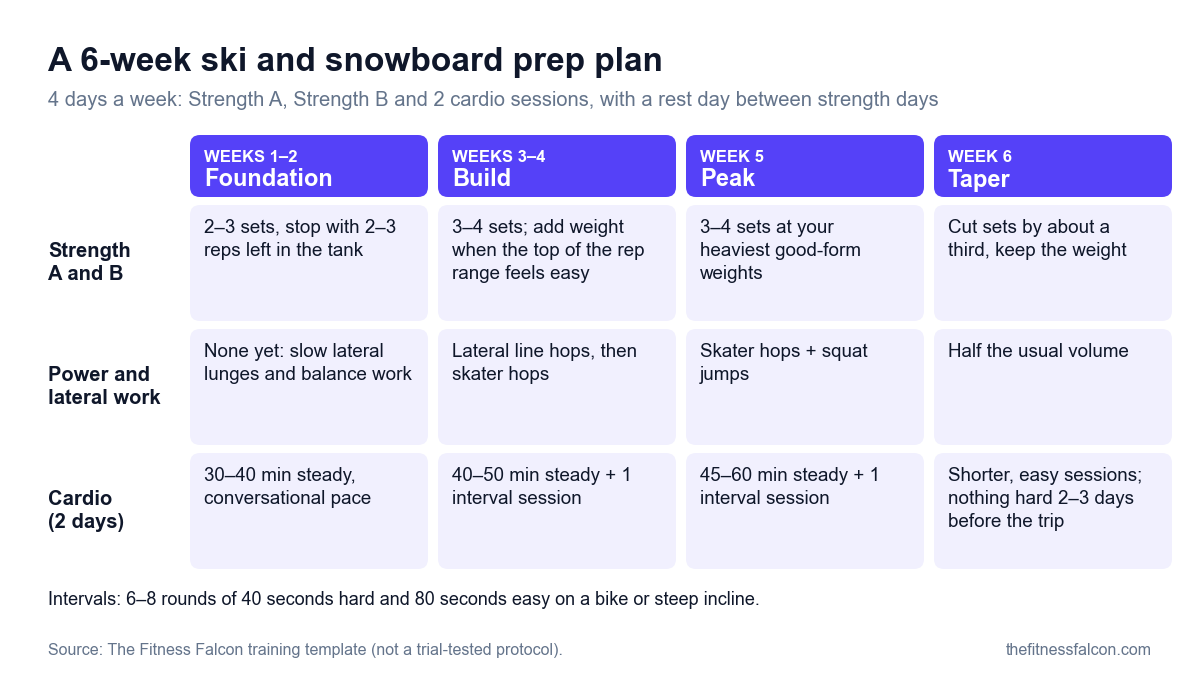
A sample week: Strength A Monday, steady cardio Tuesday, Strength B Thursday, intervals or a hike Saturday, and mobility on two other days. For intervals, try 6–8 rounds of 40 seconds hard and 80 seconds easy on a bike or steep incline, a rough stand-in for a run followed by a lift ride. For the steady sessions, our guide to zone 2 cardio without a heart rate monitor explains how to judge an easy, conversational pace.
Strength A: legs, hips and core
| Exercise | Sets x reps | Why it helps on snow | Form cues |
|---|---|---|---|
| Goblet squat | 3 x 8–10 (weeks 3–6: 4 x 6–8, heavier) | Builds quad and glute strength for holding a flexed stance | Hold a dumbbell at your chest, sit between your hips, and keep your knees in line with your toes |
| Romanian deadlift | 3 x 8–10 | Strengthens the hamstrings and glutes, the back of the leg | Push your hips back with soft knees and a flat back, and stop when your hamstrings are tight |
| Rear-foot-elevated split squat | 3 x 8 each leg | Single-leg strength, because most turns load one leg more | Back foot on a bench, front heel down, and the front knee tracks over the middle of the foot |
| Side plank | 3 x 20–40 sec each side | Builds trunk strength to stay stacked over your edges | Straight line from head to feet; don't let your hips sag |
| Dead bug | 3 x 8 each side | Teaches you to control your trunk while your arms and legs move | Keep your lower back gently pressed to the floor and move slowly |
Strength B: single leg, lateral and endurance
| Exercise | Sets x reps | Why it helps on snow | Form cues |
|---|---|---|---|
| Lateral skater hop (from week 3) | 3 x 5–6 each side | Builds side-to-side power and landing control | Hop sideways, land softly on one leg, and hold the landing for 2 seconds before the next hop. Start with small hops. |
| Lateral lunge | 3 x 8 each side | Builds strength and hip mobility in a wide, side-loaded position | Step wide, sit back into one hip, and keep the other leg straight with both feet flat |
| Single-leg Romanian deadlift | 3 x 8 each leg | Combines balance with hamstring and hip strength | Hinge on one leg with a level pelvis; hold a wall or rack at first if you need to |
| Step-up | 3 x 10 each leg | Single-leg drive, plus practice for stairs and hiking | Push through the whole foot of the top leg without bouncing off the bottom foot |
| Wall sit | 3 x 30–60 sec | Builds quad endurance for long runs | Thighs about parallel to the floor, knees over the ankles, back flat on the wall |
| Calf raise | 3 x 12–15 | Strengthens the lower leg and ankles inside the boot | Rise slowly to full height, then lower under control |
| Push-up | 3 x 8–12 (or from a bench) | Upper-body strength for poling and pushing up from the snow | Keep your body in a straight line and your elbows at about 45 degrees |
From week 5, add 3 sets of 5 squat jumps after the skater hops, landing softly with knees bent and in line with your toes. Jump early in the session while you're fresh, and end the set if landings get loud or your knees drift inward. If your legs are still sore from the last session, read should you work out when sore before you add more hops. No gym? Our beginner dumbbell workout at home covers most of these movements with one pair of dumbbells.
Mobility: 10 minutes, 2–3 times a week
- Knee-to-wall ankle stretch: 10 slow reps each side. Boots flex your ankles forward, so build that range first.
- Half-kneeling hip flexor stretch: 30–45 seconds each side.
- Open-book thoracic rotation: 8 reps each side, for upper-body rotation through turns.
- Hamstring and glute stretch: 30–45 seconds each, after workouts or a ski day.
Protect the joints that take the risk
Knees (mostly skiers)
Strong legs don't replace working bindings. The AAOS advises using boots and bindings that a shop following ASTM standards has set, adjusted, maintained and tested, and checking that each binding is adjusted for your height, weight and ability before you ski.
Wrists (mostly snowboarders)
In a Norwegian randomized trial of 5,029 snowboarders, there were 8 wrist injuries in the braced group and 29 in the unbraced group, and no injuries were linked to the braces. Beginners (first 5 days on a snowboard) and riders on rented equipment were more likely to get hurt. In an Austrian trial of 721 snowboarders, there was 1 severe wrist injury with protectors and 9 without. That fell just short of statistical significance, and 12 riders in the protector group secretly discarded theirs; counting only riders who kept them on, the difference was significant. A 2011 systematic review concluded that wrist guards may protect, but found no consensus on the best design. They're a reasonable choice for beginners and renters, and the AAOS adds that lessons and learning to fall correctly reduce injury risk.
Head (everyone)
A 2010 meta-analysis of 12 studies found that skiers and snowboarders who wore helmets had lower odds of head injury (odds ratio 0.65) and no increase in neck injuries. Most were case-control studies, which show an association rather than proof of cause. A large Norwegian study also found lower head-injury risk with helmets, and higher risk for snowboarders than skiers. The AAOS recommends a ski helmet, not a bike helmet, plus goggles.
Altitude and cold: what training won't fix
The CDC Yellow Book says unacclimatized travelers are at risk of altitude illness at sleeping elevations of about 8,000 feet or higher, and that acute mountain sickness affects about 25% of visitors sleeping above 8,000 feet in Colorado. It feels like a hangover: headache plus loss of appetite, dizziness, fatigue or nausea. The CDC advises:
- Avoid going from a low elevation straight to sleeping above 9,000 feet in one day. If you can, spend a night partway up.
- Do only mild exercise and avoid alcohol for the first 48 hours at altitude.
- Descend if your symptoms get worse despite rest at the same elevation.
The CDC also says training and physical fitness don't affect the risk, so your 6 weeks of prep won't protect you here.
For the cold, the CDC recommends several loose-fitting layers, waterproof outer gear and a scarf or knit mask over your face. Being wet, including from sweat, raises hypothermia risk. Frostbite signs include redness or pain, white or grayish-yellow skin, firm or waxy-feeling skin and numbness, most often on the nose, ears, cheeks, chin, fingers and toes. Hypothermia signs include shivering, exhaustion, confusion, fumbling hands, slurred speech and drowsiness, and it's a medical emergency. The layering ideas in what to wear running in cold weather also work for snowshoeing and cold lift rides.
Opening-day checklist: ease in on day one
- Gear: bindings set and tested by a shop, a ski helmet (not a bike helmet) and goggles. Wrist guards for beginner snowboarders and renters.
- Warm up: 3 to 5 minutes of jumping jacks or jogging in place, then a couple of slow runs (AAOS).
- Easy terrain first: runs that match your ability, a lesson if you're new or rusty, and know how to get on and off the lift.
- Drink water before, during and after. The AAOS says even mild dehydration can affect ability and endurance.
- Short day: stop when tired or in pain, and skip the hardest run of the day once you're fatigued.
- Buddy up: ski with a partner and stay within sight of each other.
- Altitude: mild exercise only and no alcohol for the first 48 hours.
- Stay dry: vent layers before you sweat through them, and check faces and fingers for frostbite signs.
Clearing the driveway before you go? Read our snow shoveling safety guide first.
Limitations of this plan
- The sets, reps and phases are a coaching template, not a program tested for preventing ski or snowboard injuries.
- The injury percentages come from one Vermont resort (1988 to 2006); gear, terrain parks and helmet use have changed since.
- The helmet evidence is mostly case-control, and the two wrist guard trials were published in 2001 and 2002.
- If you have a past knee or wrist injury, a heart or lung condition, or recent surgery, check with your doctor or a physical therapist before jump training or traveling to high altitude.
FAQ
How many weeks before ski season should I start training?
Six weeks gives you time to build strength before adding jumps and intervals. Four weeks works if you already exercise regularly. With less time, do the Strength A and B sessions at modest volume so you don't arrive sore.
Is snowboard prep different from ski prep?
The leg and core work is the same. Snowboarders get more wrist, shoulder and collarbone injuries, so add push-ups and upper-body strength. A lesson that teaches you how to fall and get up is worth it, and consider wrist guards as a beginner.
This article is general information, not medical advice. Check with a qualified health professional before starting a new training program if you have an injury or a health condition.
Sources
- American Academy of Orthopaedic Surgeons (OrthoInfo): Skiing Injury Prevention (CPSC 2018 injury figures, common injuries, warm-up, bindings, helmets, end-of-day injuries).
- Kim et al., Snowboarding injuries: trends over time and comparisons with alpine skiing injuries, American Journal of Sports Medicine 2012.
- Webster and Hewett, Meta-analysis of meta-analyses of anterior cruciate ligament injury reduction training programs, Journal of Orthopaedic Research 2018.
- Tarka et al., Alpine Ski Racing Injuries, Sports Health 2019 (full text).
- Ettlinger, Johnson and Shealy, A method to help reduce the risk of serious knee sprains incurred in alpine skiing, American Journal of Sports Medicine 1995.
- Rønning et al., The efficacy of wrist protectors in preventing snowboarding injuries, American Journal of Sports Medicine 2001.
- Machold et al., Reduction of severe wrist injuries in snowboarding by an optimized wrist protection device: a prospective randomized trial, Journal of Trauma 2002.
- Kim and Lee, Snowboard wrist guards: use, efficacy, and design. A systematic review, Bulletin of the NYU Hospital for Joint Diseases 2011.
- Russell, Christie and Hagel, The effect of helmets on the risk of head and neck injuries among skiers and snowboarders: a meta-analysis, CMAJ 2010 (full text).
- Sulheim et al., Helmet use and risk of head injuries in alpine skiers and snowboarders, JAMA 2006.
- CDC Yellow Book 2026: High-Altitude Travel and Altitude Illness.
- CDC: Preventing Frostbite.
- CDC: Preventing Hypothermia.
- HHS Office of Disease Prevention and Health Promotion: Top 10 Things to Know About the Second Edition of the Physical Activity Guidelines for Americans.
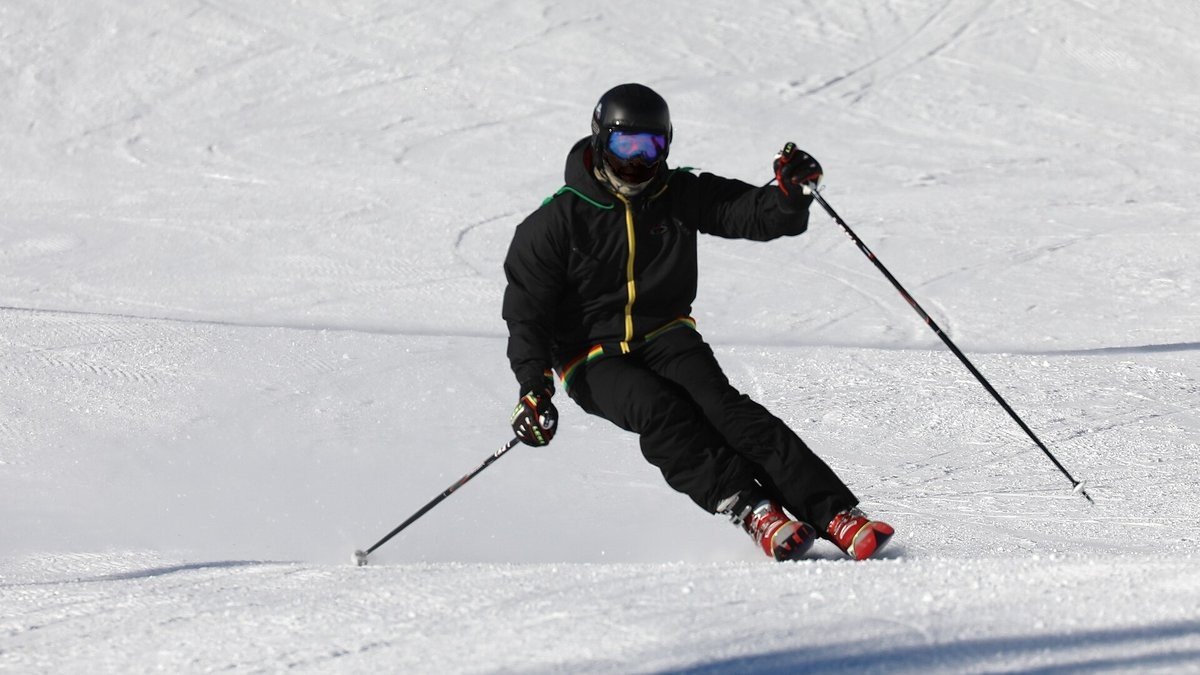
- Banner photo: Austrian Skier Demonstrating Correct carving form.jpg by woodypino, CC0 1.0, via Wikimedia Commons.