

A new US study links low daily step counts with more new cases of dementia, Parkinson's disease and stroke, but it doesn't show that walking more prevents dementia. In data presented at the American Neurological Association meeting in October 2026, adults aged 40 and older who averaged under 5,000 steps a day had about 80% higher rates of these brain conditions than adults who averaged over 12,000. After researchers adjusted for depression, obesity, diabetes and high blood pressure, the link was no longer statistically significant. The work is a conference presentation and hasn't been published in a peer-reviewed journal.
Larger published studies point the same way. In UK and US cohorts, people who took more steps were less likely to be diagnosed with dementia later, and much of the lower risk showed up well before 10,000 steps a day. Those studies are observational too. Adding steps is a sensible, low-risk habit, but treat it as one part of protecting your brain, not as a guarantee.
What the new step-count study found
The study comes from Florida Atlantic University researchers. It was led by neurology resident Dr. Meet Popatbhai Kachhadia and presented at the American Neurological Association's 151st Annual Meeting in San Diego (October 17–20, 2026). According to reports from Healio and HealthDay, it used the NIH All of Us Research Program:
- Who: 22,518 adults aged 40 and older who shared about a year of Fitbit step data.
- What was measured: new diagnoses of dementia, Parkinson's disease, stroke or transient ischemic attack (TIA, a "mini-stroke"), taken from electronic health records. Together, 343 people developed one of these conditions.
- Follow-up: HealthDay reports that medical records were checked for about five more years. Healio describes the follow-up differently. The exact window should become clear once a full abstract or paper is available.
| Group | People | Median daily steps | New dementia, Parkinson's, stroke or TIA (per 1,000 people per year) |
|---|---|---|---|
| Low activity | 8,956 | About 4,800 | About 3.8 |
| Moderate activity | 9,865 | About 8,300 | About 2.7 |
| High activity | 3,697 | About 12,600 | About 2.1 |
The headline number comes from comparing the low and high groups before adjustment: a hazard ratio of 1.8 (95% CI 1.28–2.54), or about 80% higher risk. The low-activity group also had a higher average BMI (32.1 vs 26.5) and more high blood pressure, diabetes and depression. Once the researchers accounted for demographics and those conditions, the hazard ratio fell to 1.53 (95% CI 0.93–2.53), which was no longer statistically significant. Depression was the strongest single predictor in the analysis (HR 2.47).
Kachhadia told Healio that this "does not prove there is no relationship." He said it means the study "did not establish a statistically clear association independent of those factors." His advice for readers who track their steps: "Treat sustained low activity as a conversation starter, not a diagnosis."
What this study does and doesn't prove
The study uses real-world wearable data from US adults, but a few things limit what it can tell you.
- It isn't a dementia-only result. The 80% figure covers four conditions combined. The reports don't give a separate number for dementia.
- It's preliminary. Meeting presentations haven't been through full peer review, and the exact methods aren't public yet.
- Reverse causation is possible. Brain diseases can develop for years before diagnosis, and illness tends to reduce how much people move. The 2024 Lancet Commission on dementia concluded that the link between exercise and dementia is "likely to be bidirectional." That means low activity could be an early sign of disease as well as a possible cause.
- Confounding. People who walk less differ in other ways, including weight, blood pressure, diabetes, mood, income and access to safe places to walk. Adjustment helps, but it can't remove every difference.
- The absolute difference is small. The gap between the low and high groups was about 1.7 extra diagnoses per 1,000 people per year.
- The sample may not represent everyone. People who already own and wear a fitness tracker, and who chose to share its data, may differ from the general population.
The fairest summary is that low step counts often come with other risk factors for brain and blood vessel disease. The study can't say how much walking itself matters.
How it fits with earlier research on steps and dementia
The new study builds on a small but consistent set of published studies. These studies also measured steps with devices instead of asking people to estimate.
| Study | Who was studied | Key finding | Main caveat |
|---|---|---|---|
| del Pozo Cruz et al., JAMA Neurology 2022 (UK Biobank) | 78,430 adults aged 40–79 who wore a wrist accelerometer for a week, followed for a median of 6.9 years. 866 developed dementia. | Lowest risk at about 9,800 steps/day (HR 0.49). About 3,800 steps/day gave half that benefit (HR 0.75). | Observational; 97% of participants were White |
| Ding et al., Lancet Public Health 2025 (meta-analysis) | 57 studies from 35 cohorts; the dementia analysis pooled 2 studies | 7,000 vs 2,000 steps/day: 38% lower dementia risk (HR 0.62). The risk curve began to level off around 5,000–7,000 steps. | Only 2 dementia studies; possible residual confounding |
| Yau et al., Nature Medicine 2025 (Harvard Aging Brain Study) | 296 cognitively unimpaired older adults (mean age 72) with pedometer data, followed for up to 14 years | In people with elevated brain amyloid, more steps were linked to slower cognitive decline and slower tau buildup. Benefits plateaued at 5,001–7,500 steps/day. | Small sample; observational |
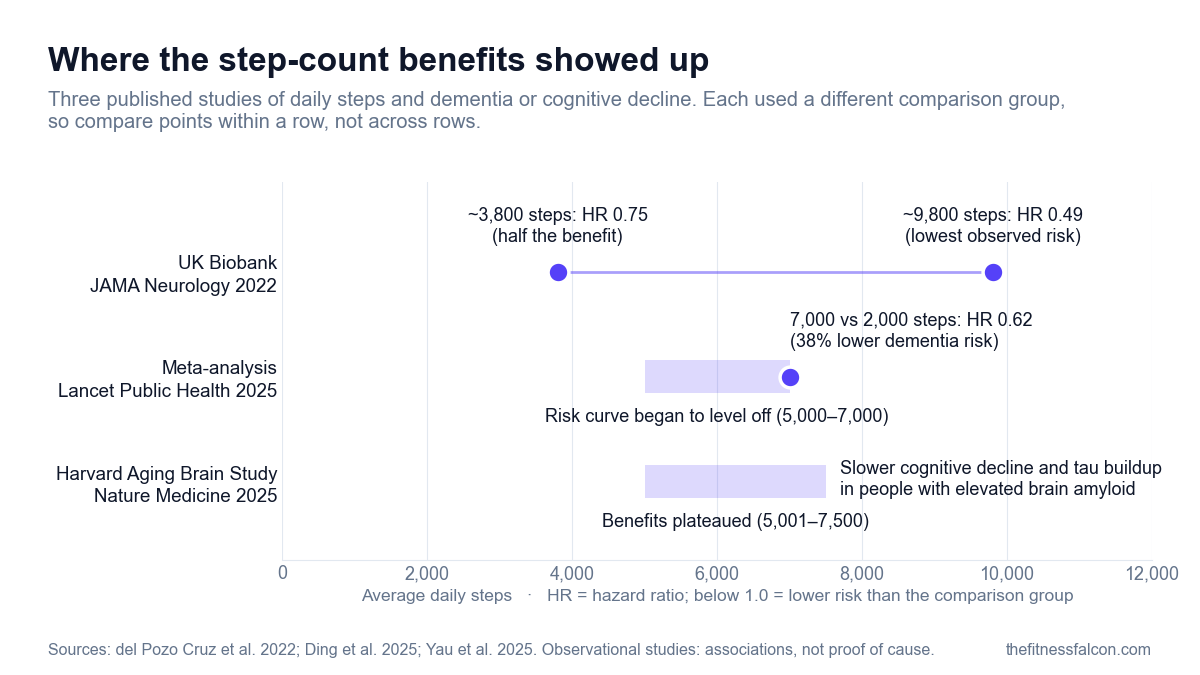
The UK Biobank study also looked at how intensely people walked. Purposeful steps, taken at 40 or more steps per minute, had a stronger association with lower risk than total steps did. The authors left out people diagnosed in the first two years of follow-up to reduce reverse causation, and the results held. They still wrote that reverse causation and residual confounding "may still be present."
The same pattern shows up for overall health. A 2022 Lancet Public Health meta-analysis of 15 cohorts (Paluch et al.) found that the risk of death kept falling with more steps until about 6,000–8,000 a day in adults 60 and older, and 8,000–10,000 in younger adults. We cover those numbers in more detail in our guide to choosing between 7,000 and 10,000 steps a day.
What randomized trials show
Trials of exercise for dementia prevention have been less clear-cut than the cohort studies. The National Institute on Aging says observational studies suggest exercise may help brain health, but "no clear link between physical activity and preventing Alzheimer's has been documented." A National Academies review it cites rated the evidence for increased physical activity as "encouraging but inconclusive." In the US POINTER trial (JAMA, 2025), 2,111 sedentary adults aged 60 to 79 who were at higher risk of cognitive decline followed a structured program that combined exercise, diet, mental activity, social activity and health checks. After two years, global cognition improved slightly more in that group than in a self-guided group. The difference was statistically significant but small, and the trial measured thinking scores, not dementia diagnoses.
How many steps a day for brain health?
No health agency has set a step target for dementia prevention. Federal guidelines are written in minutes: the CDC recommends that adults, including those 65 and older, get at least 150 minutes of moderate-intensity activity a week plus muscle-strengthening on at least 2 days. Older adults should add balance training. HHS is now working on its first step-count guidance for the 2027 guidelines update. The table below shows what the research has linked with different step ranges. These are associations, not promises.
| Average daily steps | What studies associated with it |
|---|---|
| Under about 3,000–5,000 | The comparison group in most studies, with the highest observed rates of dementia and related conditions |
| About 3,800 | UK Biobank's "minimal dose": about half of the largest observed reduction in dementia risk |
| About 5,000–7,500 | Where the benefit began to level off for dementia (Ding 2025) and for cognitive decline and tau buildup (Yau 2025) |
| About 7,000 | 38% lower dementia risk than 2,000 steps/day (pooled from 2 studies) |
| About 8,300 | Lower rates of dementia, Parkinson's, stroke or TIA than about 4,800 in the new All of Us study (not adjusted for health conditions) |
| About 9,800 | The "optimal" dose in UK Biobank: the largest observed reduction in dementia risk (HR 0.49) |
Across these studies, the biggest differences are between the least active people and everyone else. If you're under about 5,000 steps a day, moving toward 7,000 has more backing than chasing a perfect number. As the study's co-author, Dr. Marc Swerdloff, told HealthDay: "Nobody needs to reach 12,000." If you already walk 8,000 to 10,000 steps, keep it up, and make sure you also do the strength and balance work the guidelines call for.
A practical plan to add steps
The plan below is a general approach, not a protocol tested in the studies above.
- Find your baseline. Wear your phone or tracker as usual for a week and note the daily average. Trackers can miss or overcount steps, so watch the trend instead of single days. Our step-tracking accuracy guide explains why devices can disagree.
- Add a small, repeatable amount. Many people find an extra 500 to 1,000 steps a day manageable. That's roughly 5 to 10 minutes of walking. Hold that for a week or two before adding more.
- Attach walks to things you already do. A short walk after each meal adds up quickly and may also help blood sugar. Our article on 10-minute walks after meals vs one 30-minute walk compares the two.
- Use the stairs and the long way around. Park farther away, use the restroom on another floor, or get off public transit one stop early.
- Walk while you talk. Phone calls, voice meetings and podcasts are natural times to walk. If you work at a desk, a walking pad while working can add slow, steady steps.
- Make some walks brisk. In UK Biobank, purposeful steps had the strongest association with lower risk. Brisk means you can talk but not sing.
- Walk with someone. Infrequent social contact is also a dementia risk factor in the Lancet Commission's list, so a regular walk with a friend or partner covers both.
If you have heart disease, balance problems, joint pain or another health condition, or you've been inactive for a long time, ask your clinician how quickly to build up.
Other brain-health steps with strong backing
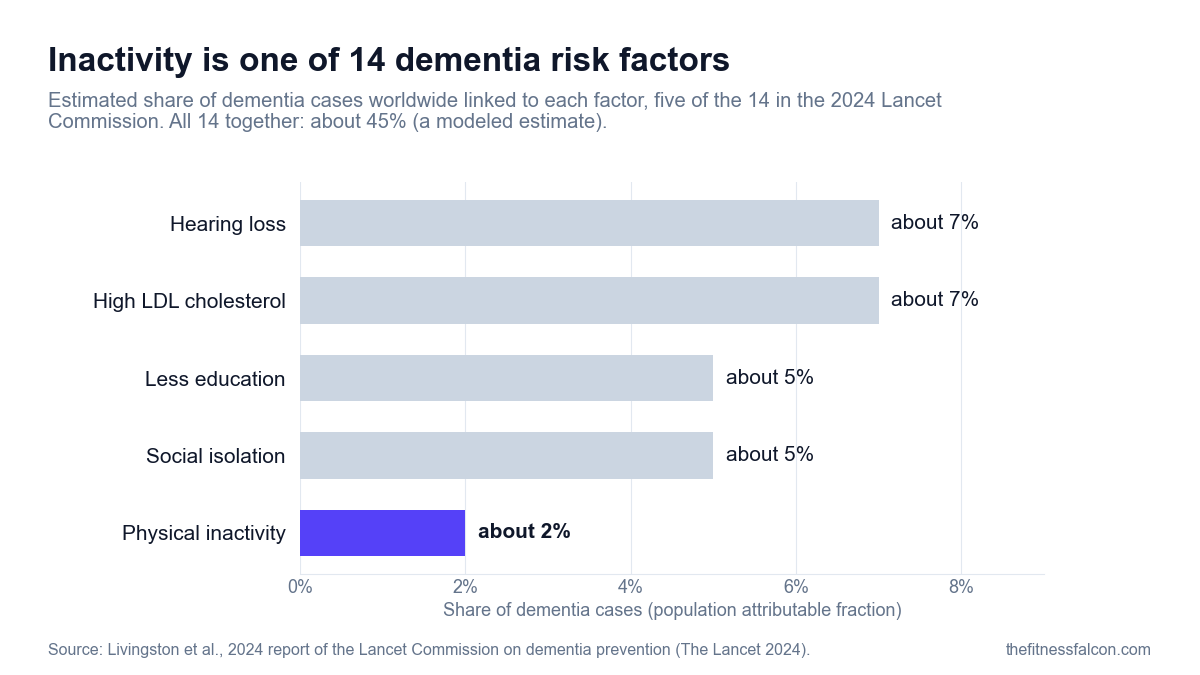
Walking is one part of reducing dementia risk. The 2024 Lancet Commission on dementia prevention named 14 potentially modifiable risk factors. It estimated that about 45% of dementia cases worldwide might be prevented or delayed if all 14 were eliminated. That figure is a modeled estimate, not a guarantee for any one person. In the Commission's model, physical inactivity accounts for about 2% of cases. Hearing loss and high LDL cholesterol in midlife account for about 7% each, and less education and social isolation about 5% each.
The Commission's recommendations include these steps you can act on:
- Get your hearing checked and use hearing aids if you need them. In the ACHIEVE trial, a hearing intervention didn't slow 3-year cognitive decline overall, but it may have helped older adults at higher risk.
- Keep blood pressure in check. The Commission recommends keeping systolic blood pressure at 130 mm Hg or lower from age 40. NIA notes that in the SPRINT MIND trial, a lower blood pressure target reduced the risk of mild cognitive impairment.
- Know your LDL cholesterol and treat it if it's high, starting in midlife.
- Treat depression, which was also the strongest predictor in the new study.
- Don't smoke. Keep a healthy weight, manage diabetes and limit alcohol.
- Protect your head with a helmet when cycling or playing contact sports.
- Get your vision checked and treated, and stay socially and mentally active.
Food is not one of the Commission's 14 factors, but diet affects blood pressure, weight and diabetes. For what the evidence says about eating patterns, see our guide to nutrition for brain health.
About 7.4 million Americans aged 65 and older are living with Alzheimer's disease in 2026, according to the Alzheimer's Association. If you notice memory or thinking changes that affect daily life, or a family member does, talk to a doctor. Don't rely on a step count to tell you.
Frequently asked questions
Do I need 10,000 steps a day to lower my dementia risk?
No. In UK Biobank, the lowest risk was seen at about 9,800 steps, but about 3,800 steps already gave half that benefit. A 2025 meta-analysis found the risk curve leveling off around 5,000–7,000 steps. If you're well below that, any increase you can sustain is a reasonable goal.
Can walking prevent Alzheimer's disease?
It hasn't been proven. Cohort studies consistently link more walking with lower dementia risk, but the National Institute on Aging says no clear link between physical activity and preventing Alzheimer's has been documented in trials. Walking has well-established benefits for the heart, weight, blood sugar and mood, so it's worth doing either way.
Can my smartwatch tell me if I'm at risk of dementia?
No. The lead researcher of the new study put it this way: "The promise is not that a watch can diagnose neurological disease." A long, unexplained drop in activity is worth mentioning to your doctor, but a step count isn't a diagnostic test.
This article is general information, not medical advice. It doesn't replace advice from a qualified health professional about your own risk or exercise plan.
Sources
- Healio: Lower step count associated with higher risk for dementia, stroke, Parkinson's disease (October 19, 2026). Reports on Kachhadia et al., presented at the American Neurological Association 151st Annual Meeting.
- HealthDay: Low Daily Step Counts Linked To Dementia, Parkinson's And Stroke (October 19, 2026).
- del Pozo Cruz et al., Association of Daily Step Count and Intensity With Incident Dementia in 78 430 Adults Living in the UK, JAMA Neurology 2022 (full text).
- Ding et al., Daily steps and health outcomes in adults: a systematic review and dose-response meta-analysis, Lancet Public Health 2025.
- Yau et al., Physical activity as a modifiable risk factor in preclinical Alzheimer's disease, Nature Medicine 2025 (full text).
- Paluch et al., Daily steps and all-cause mortality: a meta-analysis of 15 international cohorts, Lancet Public Health 2022.
- Livingston et al., Dementia prevention, intervention, and care: 2024 report of the Lancet standing Commission, The Lancet 2024.
- Baker et al., Structured vs Self-Guided Multidomain Lifestyle Interventions for Global Cognitive Function: The US POINTER Randomized Clinical Trial, JAMA 2025.
- Lin et al., Hearing intervention versus health education control to reduce cognitive decline in older adults with hearing loss in the USA (ACHIEVE), The Lancet 2023.
- National Institute on Aging: Preventing Alzheimer's Disease: What Do We Know?
- CDC: Physical Activity Guidelines for Adults and Older Adults.
- Alzheimer's Association: 2026 Alzheimer's Disease Facts and Figures.
- Banner photo: Robert Emmet Bridge, Harold's Cross Dublin D6W.jpg by William Murphy, CC BY-SA 2.0, via Wikimedia Commons (cropped).