



Yes, intensity seems to matter, but how much you move overall matters most. That's the main message of a new study of 65,028 adults who wore activity monitors for a week and were then followed for a median of 8 years. People who moved more in total had a lower risk of dying during follow-up. On top of that, people whose hardest minutes of the day were more intense had lower risk again, even after accounting for their total movement. The link was strongest for short, hard efforts and for harder activity spread across the day rather than done in one long block. The study, from the German National Cohort (NAKO), was published November 10, 2026, in BMC Medicine.
For anyone following the US Physical Activity Guidelines, the practical message is simple. Get your weekly minutes first, then fit a few harder efforts into ordinary days, such as a brisk climb up the stairs or a faster stretch on a walk. Short bursts count. Below: what the researchers measured, the key numbers, what the study can't prove, and how to use it without overreading it.
What the new study looked at
The paper, "Daily physical activity volume, intensity, and accumulation patterns in relation to all-cause mortality in the German National Cohort (NAKO)", is by Patricia Fromherz, Michael J. Stein and colleagues, led from the University of Regensburg. It's open access, so the full methods and results are public.
Researchers have long known that more physical activity goes with lower death rates. What's less clear is which part of activity carries the benefit. Is it the total amount? How hard you go? Or how you build it up over the day, in long sessions or scattered bursts? Earlier studies disagreed. This one looked at all three in the same group of people.
Participants wore an ActiGraph accelerometer on the right hip for seven straight days. From the raw data, the team calculated:
- Volume: average movement across the whole 24 hours.
- Duration: minutes per day of non-sedentary movement while awake. This includes light activity such as puttering around the house, not just exercise.
- Peak intensity: how intense a person's most active 1, 5, 15, 30, 60 and 120 minutes of the day were. These minutes could be scattered across the day or happen all at once.
- Continuous bouts: the intensity of a person's most active uninterrupted stretches of the same lengths, allowing brief pauses such as waiting at a traffic light.
- Accumulation pattern: whether those top minutes came mostly in scattered bursts or mostly in continuous blocks.
The intensity and pattern analyses were adjusted for total activity volume. That matters: it means the researchers were asking whether harder minutes add anything beyond simply moving more. They also adjusted for age, sex, region, socioeconomic and employment status, smoking, alcohol, body mass index, grip strength, sedentary time, sleep, and existing heart disease and diabetes.
Key results: total movement first, harder minutes on top
Over a median of 8.0 years, 1,634 participants died, a rate of 3.2 deaths per 1,000 person-years. That's about 2.5% of the group, so the absolute risk for any one person was low. The table compares people at the 75th percentile of each measure with people at the 25th percentile, in other words fairly active versus fairly inactive by that measure.
| Activity measure | Hazard ratio (95% CI) | What it means |
|---|---|---|
| Total activity volume | 0.73 (0.67–0.80) | 27% lower risk |
| Daily active (non-sedentary) minutes, 383 vs. 265 min/day | 0.77 (0.72–0.82) | 23% lower risk, with gains leveling off at higher amounts |
| Intensity of the most active 1 minute of the day* | 0.58 (0.53–0.63) | 42% lower risk |
| Intensity of the most active 30 minutes* | 0.67 (0.63–0.72) | 33% lower risk |
| Intensity of the most active 120 minutes* | 0.69 (0.65–0.74) | 31% lower risk |
| Intensity of the most active 1-minute continuous bout* | 0.71 (0.66–0.77) | 29% lower risk |
| Intensity of the most active 120-minute continuous bout* | 0.83 (0.76–0.91) | 17% lower risk |
*Adjusted for total activity volume, so these show the link with intensity on top of how much people moved overall.
Four findings stand out:
- Volume had the most consistent link. Risk fell steadily as total movement rose, about 7% lower for each small step up in average daily acceleration (1 milli-g, the unit the monitors record). The authors say 1 milli-g roughly corresponds to several extra minutes of brisk walking a day, though the exact translation depends on how people move and how the device is calibrated.
- Harder minutes added something. Even with total movement held equal, people whose peak minutes were more intense had lower risk. The link was strongest for the very shortest window, the single most active minute of the day, and weakened gradually for longer windows.
- Scattered looked better than sustained. When the same top minutes were measured as one continuous block, the links were weaker. When people built their hardest minutes mostly in intermittent bursts, the link held across every window from 1 to 120 minutes. When they built them mostly in continuous blocks, it was no longer statistically significant at about 60 minutes.
- Intensity mattered most for less active people. For short continuous bouts (1, 5 and 15 minutes), harder efforts were more strongly linked with lower risk among people with below-median total activity. For bouts of 30 minutes or more, the difference between more and less active people disappeared.
Daily active time showed diminishing returns. Moving from 265 to about 322 active minutes a day was linked with 15% lower risk, but gains got smaller beyond about 320 minutes a day and then leveled off. Remember that these minutes include light movement. They don't mean you need five hours of exercise.
One result is a useful brake on "harder is always better." A summary measure of how much of a person's day was spent at higher intensities (the "intensity gradient") had a shallow U-shaped link with risk. People in the middle had 7% lower risk than those at the 25th percentile, but people at the 75th percentile had no clear difference (hazard ratio 0.98, 95% CI 0.91–1.06). The authors caution that few people had very high-intensity profiles, so estimates at that end are less certain. They also note the results fit the idea that moderate intensity can bring substantial benefit when overall volume is high enough, "without requiring extreme exertion."
The results held when the researchers excluded deaths in the first two years (to reduce the chance that illness caused low activity rather than the reverse), excluded people with cancer at baseline, or dropped heart disease, diabetes and body mass index from the adjustments.
Who was in the study
NAKO is a large German population health study. It enrolled 205,415 adults aged 19 to 74 at 18 centers between 2014 and 2019, randomly selected using sampling stratified by age and sex. A subset of 72,430 wore the accelerometer, and 65,028 had enough valid data: at least two weekdays and one weekend day with 16 or more hours of wear. Their average age was 50, and 52% were women.
That's a broad, general-population sample with a wide age range, which is a strength. But only 15.6% of people invited to NAKO took part, and people who agree to join a health study and wear a monitor for a week may be healthier than average. The authors argue this is unlikely to have distorted the links between activity and death, but it limits how well the results describe Germans as a whole, let alone Americans.
What this study can't tell us
- It's observational. Nobody was assigned to exercise harder. Fitter, healthier people can move more intensely, and they may also be less likely to die for other reasons. The authors say confounding by underlying health or fitness "may also persist," even though they adjusted for grip strength, diagnosed diseases and lifestyle factors. The study can't show that adding harder minutes would extend your life.
- One week of data. Activity was measured once, at baseline. Retirement, illness, injury or new habits over the following 8 years weren't captured.
- Hip monitors miss some activity. The authors note that hip-worn accelerometers may undercount cycling, swimming and upper-body work, and the monitors were taken off for water activities longer than 30 minutes. The study didn't measure strength training separately.
- It can't tell work from exercise. The monitor records movement, not whether it came from a job, housework, commuting or a workout. Physical activity at work has been linked with worse health outcomes in some research, and the authors flag that some of the higher activity here may reflect occupational activity.
- All-cause death only. The paper didn't break results down by heart disease, cancer or other causes. It can't say whether short bursts specifically protect the heart.
- It's a German cohort. Germany and the US differ in health care, commuting and daily habits. The pattern is consistent with US data (see below), but the exact numbers may not transfer.
On funding and conflicts: the authors report no specific funding for this analysis. NAKO itself is funded by the German federal research ministry, German states, the Helmholtz Association and participating institutions. One author sits on BMC Medicine's editorial board, and another reports consulting and grants from Bayer and Siemens Healthineers.
How it fits with earlier research
The finding that total movement matters most, with intensity adding a smaller extra benefit, lines up with earlier work:
- US adults, bouts vs. scattered activity: In a nationally representative sample of 4,840 US adults aged 40 and older from the 2003–2006 National Health and Nutrition Examination Survey (NHANES), moderate-to-vigorous activity done in bouts of 5 or 10 minutes was not linked with lower mortality than the same amount done sporadically (Saint-Maurice and colleagues, Journal of the American Heart Association, 2018). The new study goes further, suggesting scattered harder activity may even have the edge.
- Volume vs. intensity across nine cohorts: A 2024 harmonized meta-analysis of 46,682 adults (average age 64) with accelerometer data found that total activity volume was more strongly linked with lower mortality than the share of activity done at moderate-to-vigorous intensity. The authors concluded that any intensity of activity may lower risk, "with a small added benefit" when the same amount is done at higher intensity (Tarp and colleagues, American Journal of Preventive Medicine, 2024).
- Everyday vigorous bursts: In 25,241 UK adults who didn't exercise, a median of three 1- to 2-minute bursts a day of vigorous activity built into daily life, rather than done as exercise, was linked with 38% to 40% lower all-cause and cancer mortality and 48% to 49% lower cardiovascular mortality over about 7 years (Stamatakis and colleagues, Nature Medicine, 2022). We covered this and newer burst research in our article on exercise snacks and short strength-training bouts.
- Walking pace: A recent JAMA Network Open study linked faster walking speed and cadence with lower mortality. See what that walking speed study found and how to check your pace.
US policy already reflects part of this. The first edition of the Physical Activity Guidelines for Americans counted only activity done in bouts of at least 10 minutes. The 2018 second edition dropped that rule, saying "any amount of physical activity has some health benefits" (HHS Office of Disease Prevention and Health Promotion). HHS is now working on the next edition, which is expected to add step-count advice; our guide to the 2027 guidelines update covers what's known so far.
What to do with this: practical takeaways
None of this changes the US guidelines. It does suggest a sensible way to apply them. This is our reading of the guidelines plus this study, not a tested program:

- Build your weekly total first. The guidelines call for at least 150 to 300 minutes a week of moderate-intensity aerobic activity, 75 to 150 minutes of vigorous activity, or an equivalent mix, preferably spread across the week (Physical Activity Guidelines for Americans, 2nd edition). They also say to "move more and sit less throughout the day." Total movement had the most consistent link with lower risk in this study, so this is the foundation.
- Add a few harder minutes to ordinary days. You don't need a structured workout to do this. Take the stairs at a brisk pace, push the pace for a minute or two on a walk, or walk up a hill. The guidelines list jogging, swimming laps, singles tennis, cycling faster than 10 mph, jumping rope and hiking uphill as vigorous activities. Our guide to stair climbing for fitness has a beginner plan built around this kind of effort.
- Use the talk test to judge effort. At moderate intensity you can talk but not sing. At vigorous intensity you can't say more than a few words without pausing for breath. Our article on zone 2 cardio without a heart rate monitor explains effort cues for easier sessions.
- Spread it out if that's easier. Short bouts count toward the guidelines, and in this study scattered harder activity was linked with lower risk at least as strongly as long continuous sessions. Short walks add up; for one example, see 10-minute walks after meals vs. one 30-minute walk.
- If you're the least active, start with more movement. The drop in risk with more daily active time was steepest at the low end, and short, harder efforts were most strongly linked with lower risk among less active people. Walking more is the easiest starting point. Our guide to choosing between 7,000 and 10,000 steps a day can help you set a realistic target.
- Keep strength training. The guidelines also call for muscle-strengthening activity that works all major muscle groups on 2 or more days a week. This study didn't measure it separately, so its absence here says nothing about its value.
- Match effort to your fitness and health. The guidelines say older adults should judge effort relative to their own fitness, and that less fit adults may start with light activity and build up gradually. Adults with chronic conditions or symptoms should be under the care of a health care provider. If you have heart disease, uncontrolled blood pressure or get chest pain, dizziness or unusual breathlessness with exertion, talk with a clinician before adding hard efforts.
FAQ
Is exercise intensity or total activity more important for living longer?
In this study and earlier ones, total activity had the most consistent link with lower risk of death. Higher intensity added a smaller extra benefit on top. If you have limited time, harder efforts give more activity per minute, but the foundation is moving more overall.
Do short bursts of activity count toward the 150 minutes?
Yes. The 2018 Physical Activity Guidelines for Americans removed the old rule that only bouts of at least 10 minutes counted. Any moderate or vigorous activity counts toward the weekly target.
How hard is "vigorous" activity?
By the talk test, vigorous activity means you can't say more than a few words without pausing for breath. Examples from the US guidelines include jogging or running, swimming laps, singles tennis, cycling faster than 10 mph, jumping rope and hiking uphill. For older or less fit adults, brisk walking may already feel vigorous.
Should I stop doing long, steady workouts?
No. Long sessions add to your total volume, which had the strongest link with lower risk. This study suggests harder minutes don't have to come in one continuous block, not that long workouts are less useful. It's an observational study and doesn't prove that changing how you split your activity changes your risk.
This article is for general information, not medical advice. It isn't a substitute for advice from a doctor or other qualified health professional, especially if you have heart disease, high blood pressure or another medical condition.
Sources
- Fromherz P, Stein MJ, Lendt C, et al. Daily physical activity volume, intensity, and accumulation patterns in relation to all-cause mortality in the German National Cohort (NAKO), BMC Medicine 2026;24(1):636, published online November 10, 2026 (journal page; full text).
- Saint-Maurice PF, Troiano RP, Matthews CE, Kraus WE. Moderate-to-Vigorous Physical Activity and All-Cause Mortality: Do Bouts Matter?, Journal of the American Heart Association 2018;7(6):e007678.
- Tarp J, Dalene KE, Fagerland MW, et al. Physical Activity Volume, Intensity, and Mortality: Harmonized Meta-Analysis of Prospective Cohort Studies, American Journal of Preventive Medicine 2024;67(6):887–896.
- Stamatakis E, Ahmadi MN, Gill JMR, et al. Association of wearable device-measured vigorous intermittent lifestyle physical activity with mortality, Nature Medicine 2022;28(12):2521–2529.
- US Department of Health and Human Services. Physical Activity Guidelines for Americans, 2nd edition (2018).
- HHS Office of Disease Prevention and Health Promotion: Top 10 Things to Know About the Second Edition of the Physical Activity Guidelines for Americans.
- Banner photo: Jogging the North Gateway by the National Park Service (NPS Photo), public domain, via Wikimedia Commons (cropped).
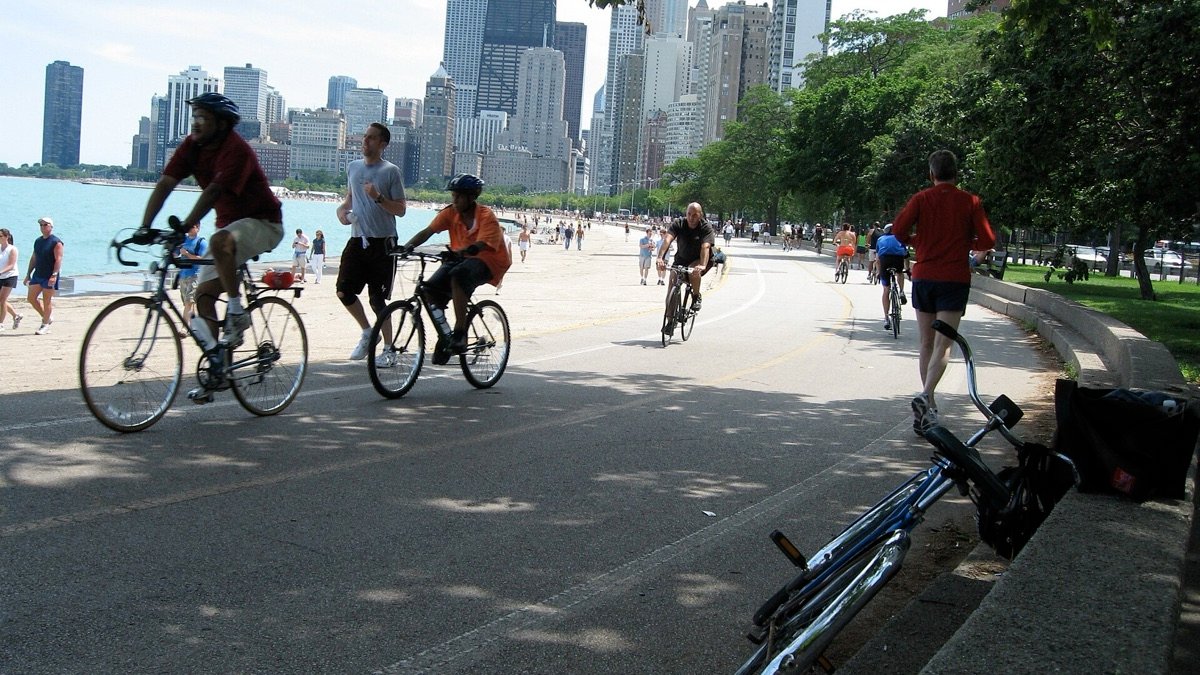
- Photo: Urban Cycling -3.jpg by Flickr user katjung, CC BY-SA 2.0, via Wikimedia Commons (cropped).
- Photo: McHugh Bluff stairs.jpg by Flickr user "Thank you for visiting my page", CC BY 2.0, via Wikimedia Commons (cropped).