


The COROS PACE 4 Pro costs $449 in the US and went on sale on September 22, 2026. It is COROS's new top-end PACE watch: a 43 g (with nylon band) multisport GPS watch with a 1.47-inch, 3,500-nit AMOLED screen under sapphire glass, a titanium bezel, up to 60 hours of GPS (40 hours in dual-frequency mode), 32 GB of storage for downloadable offline maps and music, and a built-in speaker and microphone. COROS currently lists the older PACE Pro at $299 and the PACE 4 at $249, so the buying decision comes down to whether a bigger, brighter screen, tougher materials and roughly 50% more battery are worth $150 to $200 more.
This is a price and specs summary built from COROS's US product page, its US spec sheet, its US store and the September 22 launch press release, all checked on November 16, 2026. We have not worn the PACE 4 Pro, so this is not a hands-on review. Every battery and accuracy figure below is labeled as either a COROS claim or a result from independent research.
COROS PACE 4 Pro at a glance
| Item | Official detail |
|---|---|
| US price | $449 (black or white, silicone or nylon band, same price) |
| Released | September 22, 2026 ("available today" in COROS's US press release) |
| Display | 1.47-inch LTPO AMOLED, 466 x 466 pixels, up to 3,500 nits, sapphire glass, touchscreen |
| Case | 47.6 x 47.6 x 11.8 mm (about 1.87 x 1.87 x 0.46 in); Grade 5 (TC4) titanium bezel, fiber-reinforced polymer case |
| Weight | 43 g (1.5 oz) with nylon band; 51 g (1.8 oz) with silicone band |
| Fit | 22 mm quick-release bands; silicone fits 140–220 mm wrists (about 5.5–8.7 in), nylon 135–205 mm (about 5.3–8.1 in) |
| Water rating | 5 ATM; COROS says it suits surface water activities, not diving |
| Operating temperature | -4°F to 122°F (-20°C to 50°C) |
| GPS battery (COROS claim) | Up to 60 hours all-systems GPS (45 with always-on display); up to 40 hours dual-frequency (30 with always-on display) |
| Daily-use battery (COROS claim) | Up to 21 days (7 days with always-on display) |
| Charging | About 1.5 hours to full; COROS says 30 minutes gives roughly 10 hours of GPS |
| Storage | 32 GB for offline maps, music and audiobooks |
| Satellites | Dual-frequency; GPS, GLONASS, Galileo, BeiDou and QZSS |
| Sensors | Optical heart rate, electrical heart rate sensor (for HRV and Wellness Checks), pulse oximeter, barometric altimeter, compass, gyroscope, accelerometer, thermometer |
| Audio | Speaker (alerts, hands-free calls via your phone) and microphone (voice notes, Voice Pins, voice commands) |
| Controls | Digital dial, back button and a new action button, plus touchscreen |
| Warranty and returns (US store) | 2-year warranty; 30-day money-back guarantee |
Price and availability
COROS's US store lists all four versions of the PACE 4 Pro at $449: black or white, each with a silicone or nylon band. All four showed as available when we checked on November 16, 2026. COROS's store offers free US shipping on orders over $35, though Alaska and Hawaii are excluded, and a 30-day money-back guarantee.
One small catch: COROS's "What's in the box" note says a USB-C charging cable is not included, so make sure you have one. Its FAQ says a full charge takes about 1.5 hours.
The price gap to the rest of the line is the real decision:
- PACE Pro: launched October 31, 2024 at $349; COROS's US site now lists it at $299. That is $150 less than the PACE 4 Pro.
- PACE 4: launched November 10, 2025 at $249 and still listed at $249. That is $200 less.
For outside context, Suunto's newest compact outdoor watch, the Suunto Race 3S, is listed at $599 on Suunto's US site, so the PACE 4 Pro undercuts it by $150 while offering a similar mix of AMOLED, sapphire, titanium, dual-frequency GPS and offline maps.
What's new vs. the PACE Pro and PACE 4
COROS's own press release positions the PACE 4 Pro as a step up from the PACE 4, while its product page compares it with the PACE Pro, the previous "Pro" PACE. Here are all three, from COROS's US spec sheet.
| Spec | PACE 4 Pro (2026) | PACE Pro (2024) | PACE 4 (2025) |
|---|---|---|---|
| Current US price on COROS.com | $449 | $299 (launched at $349) | $249 |
| Screen | 1.47 in AMOLED, 466 x 466 | 1.3 in AMOLED, 416 x 416 | 1.2 in AMOLED, 390 x 390 |
| Peak brightness | 3,500 nits | 1,500 nits | Not listed |
| Lens | Sapphire | Mineral glass | Mineral glass |
| Bezel | Grade 5 titanium | Fiber-reinforced polymer | Fiber-reinforced polymer |
| Case size | 47.6 x 47.6 x 11.8 mm | 46 x 46 x 12.25 mm | 43.4 x 43.4 x 11.8 mm |
| Weight (nylon / silicone band) | 43 g / 51 g | 37 g / 49 g | 32 g / 40 g |
| All-systems GPS | 60 h (45 h always-on) | 38 h (28 h always-on) | 41 h (30 h always-on) |
| Dual-frequency GPS | 40 h (30 h always-on) | 31 h (24 h always-on) | 31 h (24 h always-on) |
| Daily use | 21 days (7 always-on) | 20 days (6 always-on) | 19 days (6 always-on) |
| Storage | 32 GB | 32 GB | 4 GB |
| Speaker | Yes | No | No |
| Microphone (voice notes) | Yes | No | Yes |
| Electrical HR sensor (Wellness Check) | Yes | Yes | No |
| Action button | Yes | No | Yes |
| Water rating | 5 ATM | 5 ATM | 5 ATM |
In plain terms, compared with the PACE Pro the new watch gets a noticeably larger and more than twice as bright screen, sapphire instead of mineral glass, a titanium bezel, a speaker, a microphone and an action button. Battery goes from 38 to 60 hours in standard GPS and from 31 to 40 hours in dual-frequency mode. The trade-offs are size and weight: the case is 1.6 mm wider and the watch is 6 g heavier on the nylon band. Storage stays at 32 GB.
Compared with the PACE 4, COROS says the Pro adds "nearly 50% more battery life, and a screen that's 22.5% larger, with only an additional 11 grams of weight." Those figures match the spec sheet: 60 vs. 41 hours is about 46% more, and 1.47 vs. 1.2 inches is a 22.5% larger diagonal. The Pro also has eight times the storage (32 GB vs. 4 GB), which matters if you want offline music or maps for a lot of regions. COROS also says the Pro has "twice as much RAM as the PACE 4" for faster maps, but it does not name the processor or give the RAM amount.
Which battery number applies to you
COROS quotes two GPS modes, and its own pages are not fully consistent about them, so here is what the spec sheet says:
- All-systems (single-frequency) GPS: up to 60 hours, or 45 hours with the always-on display. Good enough for open roads, tracks and open trails.
- All-systems dual-frequency GPS: up to 40 hours, or 30 hours with the always-on display. COROS says dual-frequency reduces errors from reflections off buildings, canyon walls and dense tree cover.
- Offline music cuts it hard: COROS lists 17 hours (single-frequency) and 15 hours (dual-frequency) with music playing.
Even the 30-hour worst case (dual-frequency plus always-on display) covers a full-distance triathlon for nearly everyone; only the longest ultras push past it. For a road runner training 5 to 8 hours a week, the practical change versus a PACE Pro or PACE 4 is charging less often, not finishing races you otherwise could not.

Training, navigation and health features
COROS's US spec sheet lists the same training and daily features for the PACE 4 Pro as for the PACE Pro and PACE 4, so what you pay extra for is hardware. Here is what the spec sheet and product page list.
Training
- EvoLab metrics: training load, recovery, fatigue, VO2 max estimate, race predictor, threshold zones and a Running Fitness score.
- Effort Pace: a personalized pace metric that COROS says "represents true effort when running."
- Pace Strategy: a split-by-split race plan built around your target time and current fitness, set up in the COROS app.
- Workouts and plans: intervals, pre-planned workouts and full training plans, plus Virtual Pacer and Virtual Run.
- Multisport: dedicated triathlon and duathlon modes with transitions, a Multisport mode for stacking sessions (for example a run and a strength workout), and profiles for pool and open-water swimming, road, gravel and mountain biking, skiing, rowing, pickleball and padel.
- Running form: COROS's Running Form Test needs the separate COROS POD 2; it is not wrist-only.
- Sensors and apps: Bluetooth heart rate straps, power meters, and speed and cadence sensors; sync to Strava, TrainingPeaks, Nike Run Club, Komoot, Apple Health and others.
Maps and safety
- Offline maps: downloadable global landscape and topo maps with street and trail names, contour lines and points of interest, plus turn-by-turn navigation, back-to-start, checkpoints and off-route alerts.
- Safety Alerts and a screen flashlight: COROS says Safety Alerts "keep loved ones informed," and the flashlight uses the bright screen. It is a screen-based light, not a dedicated LED. If you run before sunrise this time of year, it is a backup, not a substitute for a headlamp and reflective gear; see our tips for walking and running safely in the dark.
- Voice: the speaker reads pace, distance and heart rate alerts out loud and lets you take hands-free calls through a paired phone; the microphone records voice notes and GPS-tagged Voice Pins that sync to the workout file.
- Music: 32 GB for music and audiobooks, played through Bluetooth headphones.
24/7 health tracking
- Sleep with REM tracking, overnight HRV, resting heart rate trends and daily stress. If you want to know what overnight HRV can and cannot tell you, see our guide to what heart rate variability actually tells you.
- SpO2 (pulse oximeter) and an Altitude Mode that checks SpO2 at high altitude.
- Wellness Check: a manual 30- to 60-second test that reports heart rate, HRV, stress, breathing rate and SpO2. COROS's spec sheet says the PACE 4 Pro's electrical heart rate sensor is used "for HRV and Wellness Checks," and the press release lists it as "ECG." COROS's own Wellness Check article says it "is not for medical purposes, and the results are for reference only."
That last point matters. We found no COROS claim of FDA clearance or of an atrial fibrillation (AFib) rhythm check for this watch. Do not treat it like a medical ECG. If you have chest pain, fainting, or a racing or irregular heartbeat, see a clinician rather than relying on a sports watch.
COROS claims vs. independent evidence
No peer-reviewed study has tested the PACE 4 Pro; it has been on sale for less than two months. A search of PubMed records through Europe PMC on November 16, 2026 also found no study validating any COROS wrist heart rate sensor against a reference monitor. Here is what research on similar watches says about the claims that matter most.
Heart rate: wrist vs. chest strap
A 2024 "living" umbrella review that pooled 24 systematic reviews found wearables had a mean heart rate bias of about ±3%, a reassuring average (Doherty and colleagues, 2024). Averages hide the hard cases, though. In a 2020 study of 21 adults on a 3.22 km (2-mile) uphill-then-downhill trail run, every optical (PPG) device showed "poor heart rate agreement" with a chest-strap reference; the Garmin Fenix 5 wrist sensor had a mean absolute percentage error of 13%, while a Suunto watch paired with its chest strap was within 2% (Navalta and colleagues, 2020). The authors recommended a chest strap for heart rate outdoors.
So if you train by heart rate zones on hills or do hard intervals, pair the PACE 4 Pro with a Bluetooth chest strap. If most of your running is steady and easy, the wrist sensor will probably be fine, and you can also learn to run easy by feel without a heart rate monitor.
GPS distance
A Swiss Federal Institute of Sport study tested eight sport watches from Apple, COROS, Garmin, Polar and Suunto in urban, forest and track settings. Mean absolute errors ranged from 3.2% to 6.1%, distances were usually recorded short, and urban and forest areas were hardest; the authors warned distances "might be underestimated by up to 9%" (Gilgen-Ammann and colleagues, 2020). Those watches predate dual-frequency GPS, which is designed to reduce exactly these errors. Whether the PACE 4 Pro does better in downtown streets or under tree cover is a fair question that only independent testing will answer.
Lactate threshold and VO2 max estimates
This is the one area with COROS-specific research, on the older PACE 3. In a Beijing Sport University study, 17 recreational runners used a PACE 3 to estimate lactate threshold and were compared against lab testing. Only 47% of single watch tests succeeded. When they did, threshold heart rate was off by about 9 beats per minute on average (5.95%), but threshold pace was overestimated by about 1.9 km/h (roughly 1.2 mph), an error of 22.6%. Huawei and Garmin watches in the same study also overestimated threshold pace (Lu and colleagues, 2025). The COROS group was small, and the PACE 4 Pro may use updated software, but the lesson is clear: treat a watch-estimated threshold pace as a starting point and check it against how real workouts feel.
For VO2 max, a meta-analysis of 14 validation studies found that watches using exercise data were close on average across groups, but "the estimation error at the individual level is large" (Molina-Garcia and colleagues, 2022). Use the trend over months, not a single reading.
Sleep and recovery numbers
The umbrella review found wearables tend to overestimate total sleep time, typically with errors above 10% (Doherty and colleagues, 2024). A review of the Fitbit Charge 4, Garmin Vivosmart 4 and WHOOP against sleep-lab testing found only moderate accuracy for sleep stages (Schyvens and colleagues, 2024). We found no COROS-specific sleep validation. Read sleep and HRV as weekly trends, not as a nightly verdict on whether to train.
Who the PACE 4 Pro is for, and who should skip it
Good fit
- Triathletes and multisport athletes who want a light watch with dedicated triathlon mode, open-water swimming and enough battery for a full-distance race with room to spare.
- Marathoners and ultrarunners on a budget who want maps, dual-frequency GPS and long battery for well under the price of flagship Garmin or Suunto watches.
- Anyone who struggles to read a small screen mid-run, in bright sun or with older eyes. The 1.47-inch, 3,500-nit display is the biggest visible upgrade.
- People hard on their gear, who want sapphire and titanium instead of mineral glass and plastic.
Probably skip it
- Current PACE Pro owners. Unless the screen, speaker or extra battery matter to you, your watch already has dual-frequency GPS, 32 GB of maps and the same training software.
- Runners with small wrists or who want the lightest watch. The PACE 4 is 4.2 mm narrower and 11 g lighter on the nylon band, and $200 cheaper.
- Beginners. If you are training for your first 5K, such as with our beginner Turkey Trot 5K plan, a basic GPS watch, or a tracker from our budget fitness trackers list, covers everything you need.
- Anyone who wants a full smartwatch. COROS's spec sheet lists no contactless payments, LTE or third-party app store.
- People who want the longest possible battery. Bigger ultra watches such as the Garmin Enduro 4 claim far longer GPS life, at a much higher price and weight.
Open questions
- Battery figures differ across COROS's own pages. The press release says 46 hours of GPS with the always-on display; the spec sheet and product page say 45. The store FAQ calls the 45-hour figure a dual-frequency "MAX GPS" number, while the spec sheet gives 40 hours for dual-frequency (30 with always-on display). We used the spec sheet.
- Weight is quoted two ways. COROS's product page says 43 g with the nylon band and 38 g for the watch body alone; with the silicone band the spec sheet says 51 g.
- Processor and RAM are not named; COROS says only that RAM is double the PACE 4's.
- Brightness of the PACE 4 is not listed on COROS's spec sheet, so we have not compared it.
- Real-world accuracy of the new heart rate sensor and dual-frequency GPS has not been independently tested yet.
Frequently asked questions
How much does the COROS PACE 4 Pro cost?
$449 on COROS's US store, in black or white with a silicone or nylon band. The PACE Pro is listed at $299 and the PACE 4 at $249.
What is the battery life of the PACE 4 Pro?
COROS claims up to 60 hours of standard GPS (45 hours with the always-on display), up to 40 hours of dual-frequency GPS (30 with always-on), and up to 21 days of daily use (7 with always-on). Music playback and navigation shorten that.
Is the PACE 4 Pro waterproof?
It is rated 5 ATM. COROS says that suits surface water activities such as pool and open-water swimming, but not diving.
Does the PACE 4 Pro have ECG?
It has an electrical heart rate sensor that COROS uses for HRV and Wellness Checks, and the press release lists "ECG" among its sensors. COROS says Wellness Check is not for medical purposes, and we found no FDA clearance or AFib feature. It is not a substitute for a medical ECG.
This article is general information about a consumer product, not medical advice. Talk to a clinician before relying on any wearable for a health decision.
Sources
- COROS: PACE 4 Pro product page (features, battery and comparison, checked November 16, 2026).
- COROS: PACE 4 Pro specifications (US spec sheet with PACE Pro and PACE 4 values, checked November 16, 2026).
- COROS US store: Buy PACE 4 Pro (prices, variants, shipping, warranty and FAQ, checked November 16, 2026).
- COROS via Endurance Sportswire: COROS Launches PACE 4 Pro, an Advanced AMOLED Sport Watch For Serious Training (press release, September 22, 2026).
- COROS: Introducing COROS PACE Pro (press release, October 31, 2024).
- COROS: COROS Unveils PACE 4 (press release, November 10, 2025).
- COROS: Introducing Wellness Check (March 21, 2024).
- Suunto US: Suunto Race 3S vs Race S: What's New (US price of the Race 3S).
- Doherty C, Baldwin M, Keogh A, Caulfield B, Argent R. Keeping Pace with Wearables: A Living Umbrella Review of Systematic Reviews Evaluating the Accuracy of Consumer Wearable Technologies in Health Measurement, Sports Medicine 2024;54(11):2907-2926.
- Navalta JW, Montes J, Bodell NG, et al. Concurrent heart rate validity of wearable technology devices during trail running, PLoS One 2020;15(8):e0238569.
- Gilgen-Ammann R, Schweizer T, Wyss T. Accuracy of Distance Recordings in Eight Positioning-Enabled Sport Watches: Instrument Validation Study, JMIR mHealth and uHealth 2020;8(6):e17118.
- Lu C, Cui W, Zhu Z, et al. Validity of smartwatch-derived estimates of lactate threshold heart rate and pace compared to graded exercise testing, Frontiers in Physiology 2025;16:1621996.
- Molina-Garcia P, Notbohm HL, Schumann M, et al. Validity of Estimating the Maximal Oxygen Consumption by Consumer Wearables: A Systematic Review with Meta-analysis and Expert Statement of the INTERLIVE Network, Sports Medicine 2022;52(7):1577-1597.
- Schyvens AM, Van Oost NC, Aerts JM, et al. Accuracy of Fitbit Charge 4, Garmin Vivosmart 4, and WHOOP Versus Polysomnography: Systematic Review, JMIR mHealth and uHealth 2024;12:e52192.
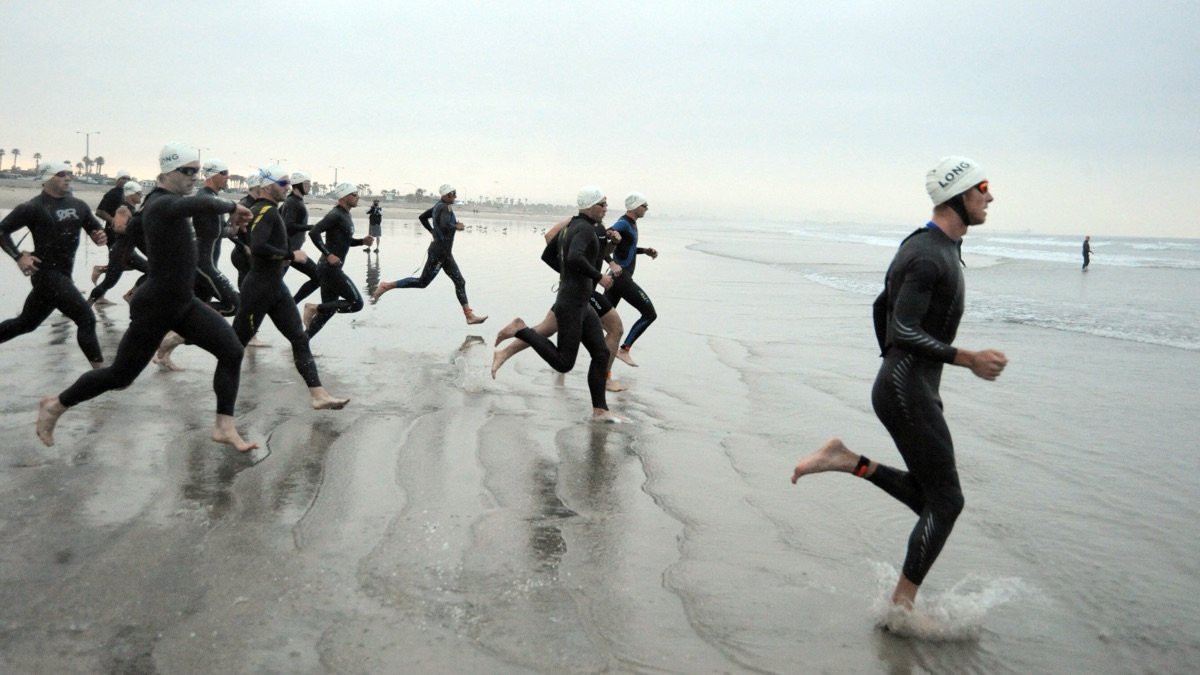
- Banner photo: US Navy 090329-N-2959L-169 Athletes race to the water to begin the swim portion of the 31st annual Superfrog Triathlon at Silver Strand State Beach.jpg by Mass Communication Specialist 2nd Class Dominique M. Lasco, U.S. Navy, public domain, via Wikimedia Commons (cropped).
- Photo: Joggers Running in Winter - Morning in Des Moines, Iowa (23938101133).jpg by Tony Webster, CC BY-SA 2.0, via Wikimedia Commons (cropped).
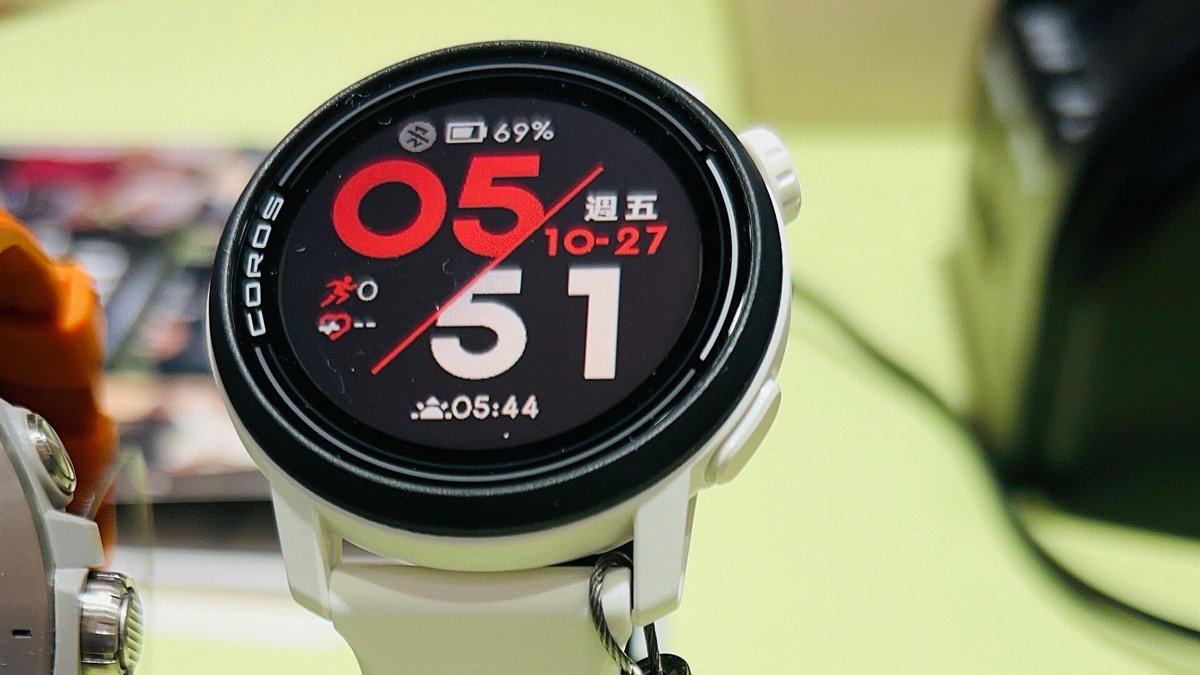
- Photo: Coros Pace 3.jpeg by SUNSmania41, CC BY-SA 4.0, via Wikimedia Commons (cropped).