

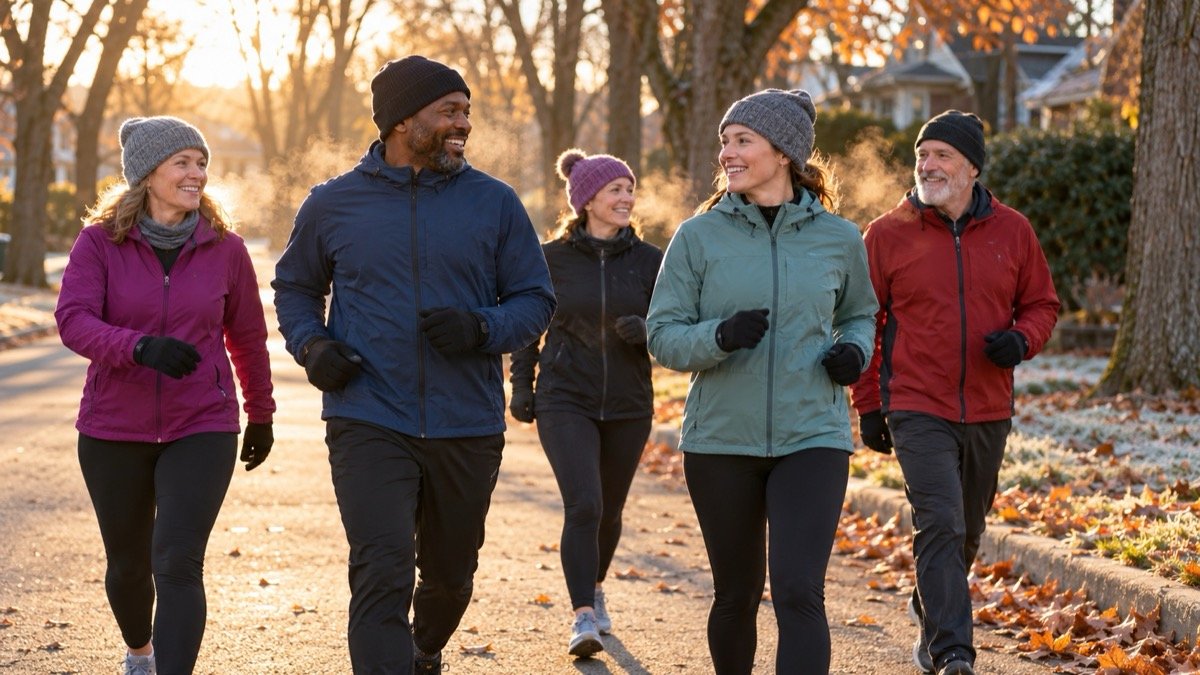
Four weeks is enough time for most healthy beginners to finish a Thanksgiving Turkey Trot 5K, as long as you plan to walk some or all of it. A 5K is 3.1 miles. At a brisk 3 miles per hour, walking it takes about an hour, and nearly every beginner can build up to that by Thanksgiving Day with three short sessions a week. What four weeks won't safely do is take you from no exercise to running the whole distance. So the plan below uses walking, or a walk/run mix, and keeps the running parts short.
Thanksgiving is Thursday, November 26, 2026. Start the week of October 26 and you get four training weeks plus a short race week.
Can you really get ready for a 5K in four weeks?
Yes, if "ready" means finishing comfortably rather than running every step. The federal Physical Activity Guidelines for Americans tell inactive people to "start low and go slow": begin with lower-intensity activity, then slowly increase how often and how long you're active. The guidelines specifically say people starting from a low level should "avoid relatively vigorous-intensity activity, such as shoveling heavy snow or running" at first. They note that walking carries a third or less of the injury risk of running, and that injury risk is "directly related to the gap between a person's usual level of activity and a new level of activity." Older and less-fit adults generally need slower increases.
Recent running research points the same way. In a 2025 study of 5,205 adult runners who logged their runs on GPS watches, the rate of overuse injury went up when a single run was more than 10% longer than the runner's longest run in the previous 30 days. The study was observational, and its runners were already running regularly (average age 46, about 113 logged runs each over 18 months), not people starting from zero. The lesson still applies: the riskiest session can be the race itself, if 3.1 miles is far longer than anything you've done lately. So the plan has you cover most of the distance, mostly by walking, before race day.
You may have heard of the "10% rule" (add no more than 10% a week). When it was tested in a randomized trial of 532 novice runners, the 10%-rule group got injured about as often as a group on a faster plan (20.8% versus 20.3%). Treat it as a rough guide: what matters most is avoiding sudden jumps and backing off when something hurts.
Check with a doctor first if this applies to you
The federal guidelines say healthy adults who increase activity gradually generally don't need to see a health care provider first, but adults with chronic conditions or symptoms should be under a provider's care. The American College of Sports Medicine's screening recommendations weigh how active you are now, whether you have heart, metabolic or kidney disease or symptoms of it, and how hard you plan to exercise. Talk to your provider before starting if you:
- have heart disease, diabetes or kidney disease, or have been told you're at high risk for them;
- get chest discomfort, unusual shortness of breath, dizziness or fainting when you exert yourself;
- are pregnant, recovering from surgery, or managing a joint or bone injury;
- have asthma that flares with exercise or cold air.
The 4-week Turkey Trot 5K training plan
Pick the track that matches where you are today:
- Track A (walk-first): you're mostly inactive, or you can't yet walk briskly for 20 to 30 minutes without stopping. You'll walk the 5K, which is completely normal at a turkey trot.
- Track B (walk/run): you can already walk briskly for 30 minutes and want to add some jogging. "Jog" means a slow, easy run, slow enough that you can still say a short sentence.
Do three sessions a week with a rest or easy day between them, for example Tuesday, Thursday and Saturday or Sunday. Start every session with 5 minutes of easy walking and finish with a few minutes of slow walking; both are included in the times below. A short easy walk on other days is fine, and two brief strength sessions a week (chair squats, step-ups, calf raises) fit the guidelines' muscle-strengthening advice.
| Week | Track A: walk-first | Track B: walk/run |
|---|---|---|
| Week 1 (Oct 26 to Nov 1) | Two walks of 15 to 20 minutes at a comfortable brisk pace; one walk of 25 minutes | Two sessions: 5 min walk, then 6 rounds of 1 min jog + 2 min walk, then 4 min walk (27 min). One 30-minute brisk walk |
| Week 2 (Nov 2 to 8) | Two walks of 20 to 25 minutes; one walk of 30 minutes | Two sessions: 5 min walk, 6 rounds of 90 sec jog + 2 min walk, 4 min walk (30 min). One 35-minute session, mostly walking, with 4 or 5 one-minute jogs |
| Week 3 (Nov 9 to 15) | Two walks of 25 minutes; one walk of 35 to 40 minutes | Two sessions: 5 min walk, 6 rounds of 2 min jog + 2 min walk, 4 min walk (33 min). One 40-minute session of 1 min jog + 2 min walk |
| Week 4 (Nov 16 to 22) | Two walks of 25 to 30 minutes; one walk of 45 to 50 minutes, about 2.5 miles at 3 mph | Two sessions as in Week 3, or 2 min jog + 1 min walk if Week 3 felt easy. One 45-minute session at the walk/run mix you'll use on race day |
| Race week (Nov 23 to 26) | Monday or Tuesday: one easy 20-minute walk. Wednesday: rest. Thursday: race | Monday or Tuesday: one easy 20-minute session with 3 or 4 short jogs. Wednesday: rest. Thursday: race at your practiced mix |
Two rules matter more than the exact minutes:
- Repeat a week instead of forcing the next one. If a week felt hard, or you lost sessions to work, travel or a cold, do it again and walk more on race day. Cramming extra miles into the last few days is the opposite of what the research supports.
- Let walking carry the extra distance. Starting from zero, any running is a big jump, so the jogs start at a minute and grow slowly while walking adds time on your feet. If your shins, knees or feet complain, swap a jog round for walking.
Track A's longest walk stops about half a mile short of 3.1 miles on purpose. Walking is low-impact, and that last half-mile is well within reach on race day. If Week 4 feels easy, stretch the long walk to 55 or 60 minutes, and add nothing elsewhere.
How to pace your first Turkey Trot
The classic beginner mistake is starting too fast in an excited crowd. Use the CDC's talk test instead of a watch. At moderate intensity you "can talk, but not sing." At vigorous intensity you can't say more than a few words without pausing for breath. For a first 5K, stay in the talking zone for the first mile at least.
- Start near the back. Walkers and families usually line up behind the runners. Starting at the back keeps you from getting swept along too fast.
- Plan your walk breaks. On Track B, use the same jog/walk ratio you practiced in Week 4, starting from the first minute. A planned walk break isn't failure. Waiting until you're exhausted and then walking is what feels bad.
- Save any push for the last half-mile. If you still feel good then, speed up a little. If not, an even pace is a good result.
- Know which time counts. Many races use timing chips, often on the bib. Your "chip time" starts when you cross the start line, so standing at the back doesn't cost you anything.
Some races set a course time limit. If you expect to finish in more than an hour, check the race website before you sign up.
What to wear for a cold Thanksgiving morning race
Turkey trots usually start in the morning, and late-November weather across much of the US can be anything from mild to below freezing. Check the forecast the night before and again when you wake up, including the wind chill. The National Weather Service defines wind chill as how cold it feels on exposed skin once wind is factored in. Its example: at 0°F with a 15 mph wind, the wind chill is −19°F and exposed skin can freeze in 30 minutes.
For runners, a common rule of thumb is to dress for about 20 degrees warmer than the actual temperature, because running produces so much heat. Dr. David Smith of The University of Kansas Health System puts it as "Dress as if it were 20 degrees warmer than the true outdoor temperature," and adds "Layer your clothing, but do not overdo it." Two important exceptions apply on Thanksgiving morning:
- Walkers make less heat than runners. If you're on Track A, dress for something closer to the real temperature, with a layer you can unzip.
- You'll stand still before the start. Big races can mean a long wait in the start area. A warm hat, gloves and an old sweatshirt or jacket help, but only discard the old layer if your race says it collects discarded clothing. Otherwise wear something you're happy to tie around your waist.
Choose sweat-wicking fabric next to your skin rather than cotton. Wet clothing pulls heat away fast once you stop, and the CDC notes that hypothermia "can occur even at cool temperatures (above 40°F)" if you're chilled by rain, sweat or cold water. Wear the shoes and socks you trained in, not something new. A festive turkey hat or costume is part of the fun, but try it on a training walk first so you know it won't chafe or slip. For outfits by temperature, see our guide to what to wear running in cold weather.
Race-day logistics checklist
Your race's website and pre-race emails are the final word, but most turkey trots involve some version of this:
- Packet pickup: find out whether bibs are mailed, picked up in the days before, or available on race morning, and what ID you need.
- Bib: pin it on the front of your outermost layer so it stays visible if you take off a jacket. If the timing chip is on the bib, don't fold or cover it.
- Arrival: road closures, parking and restroom lines all take time on a holiday morning. Plan to arrive well before the start.
- Breakfast: eat something you've already had before a training session, a couple of hours before the start if you can. Race morning isn't the time to try anything new.
- Kids, dogs and strollers: policies differ from race to race, so check before you bring them.
- After the finish: keep walking for a few minutes, then put on a dry, warm layer quickly. Your sweat will chill you fast.
If you're wondering how the morning's effort compares with the meal later, we did the math in how many calories are in a Thanksgiving dinner, in walking minutes. It's a way to picture the numbers, not a reason to skip dessert.
Injury caution: soreness versus pain
Some muscle soreness a day or two after a new kind of workout is normal. Pain that is sharp, gets worse as you keep going, makes you limp, or is still there the next morning is a signal to stop and rest.
Shin splints are a classic new-runner problem. The American Academy of Orthopaedic Surgeons says they "often occur after sudden changes in physical activity," that runners and people starting a fitness program are at risk, and that worn-out or unsuitable shoes can contribute. AAOS recommends increasing training slowly and mixing in lower-impact activity like cycling or swimming. If shin pain doesn't improve with rest, see a doctor to rule out a stress fracture or another cause. If you need shoes, buy them early in the plan, not race week; our guide to choosing running shoes for flat feet may help if that applies to you.
Cold, dry air can trigger exercise-induced bronchoconstriction: wheezing, chest tightness or coughing within a few minutes of starting. The American College of Allergy, Asthma and Immunology suggests warming up gently and covering your mouth and nose with a scarf or mask in cold weather. If you use an inhaler, ask your doctor how to use it before exercise.
Stop and call 911 if you have chest pain, pressure or discomfort, pain spreading to your arm, back, neck or jaw, unusual shortness of breath, a cold sweat, or sudden light-headedness. These are heart attack warning signs listed by the National Heart, Lung, and Blood Institute, which advises calling 911 even if you're not sure, rather than driving yourself. At the race, tell a volunteer or course marshal right away if you or someone near you needs help.
FAQ
Can I walk the whole Turkey Trot?
Yes. Many turkey trots are family events, and plenty of people walk the whole way. If you expect to take longer than about an hour, check whether your race has a course time limit and start near the back.
How long does it take a beginner to walk a 5K?
About 62 minutes at 3 mph and about 75 minutes at 2.5 mph. If your walk/run mix averages about 4 mph, it takes about 47 minutes.
What if I've never run at all?
Follow Track A and walk the race. The federal guidelines advise inactive people to start with moderate activity like walking and add more vigorous activity, such as running, only later. You can start a walk/run plan after Thanksgiving, once walking 30 minutes feels easy.
I got sick or missed a week. Should I make up the sessions?
No. Pick up where you left off, or repeat the last week you finished, and walk more of the race if needed. Doubling up sessions creates exactly the kind of sudden jump the research links to injury.
This article is general information for healthy adults, not medical advice. If you have a health condition, symptoms or an injury, ask a health care professional what's right for you.
Sources
- US Department of Health and Human Services: Physical Activity Guidelines for Americans, 2nd edition (PDF): "start low and go slow," gradual increases, walking vs running injury risk, when to see a provider.
- Frandsen et al., British Journal of Sports Medicine 2025: single-session spikes in running distance and overuse injury in 5,205 runners.
- Buist et al., American Journal of Sports Medicine 2008: randomized trial of the 10% rule in 532 novice runners.
- Riebe et al., Medicine & Science in Sports & Exercise 2015: ACSM exercise preparticipation health screening recommendations.
- CDC: Measuring physical activity intensity: the talk test.
- National Weather Service: Wind chill chart.
- CDC: Preventing cold-related illness and injury: hypothermia above 40°F, layering.
- The University of Kansas Health System: Winter running tips.
- American Academy of Orthopaedic Surgeons (OrthoInfo): Shin splints.
- American College of Allergy, Asthma and Immunology: Exercise-induced bronchoconstriction.
- National Heart, Lung, and Blood Institute: Heart attack symptoms.