

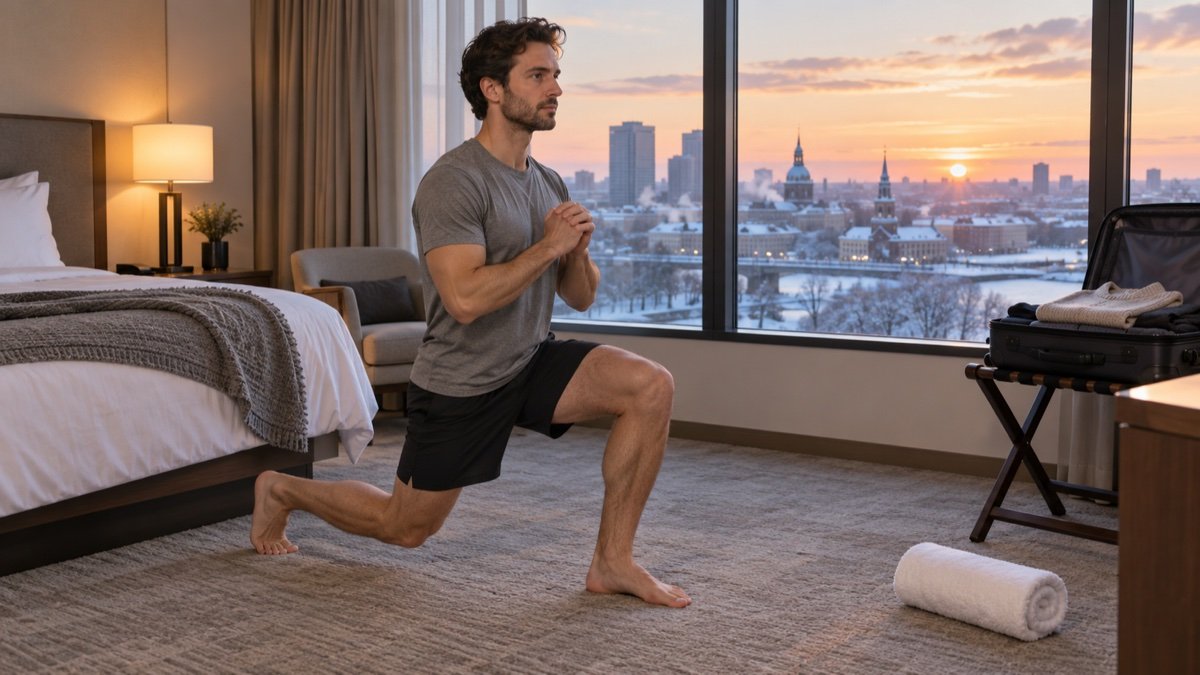
You can get a real full-body strength session in a hotel room with no equipment in about 20 minutes. Warm up for 2 minutes, then do 3 rounds of six moves: squat, push-up, reverse lunge, prone Y-raise, glute bridge and plank. Work for 40 seconds and rest for 20 between moves. Two of these sessions a week covers the U.S. muscle-strengthening guideline, which asks adults to work all major muscle groups on at least 2 days a week. Brisk walking through airports and around your destination adds to the separate weekly target of 150 minutes of moderate aerobic activity.
Below you'll find the full circuit, a 10-minute version, a quiet version for a relatives' guest room, form cues, and advice for long flights and drives. All you need is a towel and a patch of floor about the length of your body. Thanksgiving is Thursday, November 26, 2026.
How this maps to the HHS Physical Activity Guidelines
The Physical Activity Guidelines for Americans, 2nd edition (HHS, 2018) set two separate weekly targets for adults:
- Aerobic activity: 150 to 300 minutes a week of moderate-intensity activity, or 75 to 150 minutes of vigorous activity, or a mix. The guidelines suggest spreading it across the week.
- Muscle strengthening: activity of "moderate or greater intensity" that involves all major muscle groups, on 2 or more days a week. The guidelines name the groups: legs, hips, back, chest, abdomen, shoulders and arms.
The guidelines list "calisthenics that use body weight for resistance (such as push-ups, pull-ups, and planks)" as muscle-strengthening activity. No set session length is required. The exercises should be done "to the point at which it would be difficult to do another repetition," and the guidelines note that one set of 8 to 12 repetitions is effective, while 2 or 3 sets may be more effective.
Since 2018, aerobic activity of any length counts, because HHS dropped the old 10-minute minimum bout, so even a 6-minute walk to a far gate adds up.
The American College of Sports Medicine's 2026 position stand, an overview of 137 systematic reviews, backs bodyweight training too. ACSM's summary says "traditional gym settings are not needed to see results" and that "consistency and effort drive results." HHS is also preparing a 2027 supplement on steps and strength, covered in our explainer on the 2027 update.
| Exercise | Main muscle groups worked |
|---|---|
| Squat | Legs, hips |
| Push-up (floor or incline) | Chest, shoulders, arms; abdomen holds the body straight |
| Reverse lunge | Legs, hips |
| Prone Y-raise | Upper back, shoulders; lower back |
| Glute bridge | Hips, back of the legs |
| Plank / side plank | Abdomen, shoulders |
The weak spot of any no-equipment plan is pulling work for the back. The prone Y-raise covers it, but more lightly than a row would, so treat this as a travel maintenance plan, not a replacement for your usual training. Don't loop towels around hotel doors to make a row.
The 20-minute hotel room workout
Format: 2-minute warm-up, then 3 rounds of the six exercises below. Do each one for 40 seconds, rest 20 seconds, then move to the next. Each round takes 6 minutes. Rest an extra minute between rounds if you need it. A phone timer set to repeating 40/20 intervals is all you need.
Warm-up (2 minutes): 30 seconds of marching in place, 30 seconds of arm circles, 30 seconds of slow half-depth squats, and 30 seconds of hip hinges with your hands on your hips. The guidelines note that a warm-up for strength work commonly means doing the same kind of exercise more lightly.
- Squat: 40 seconds.
- Push-up: 40 seconds. Use the floor, or put your hands on the desk or the edge of the bed frame (not the soft mattress) for an easier incline.
- Reverse lunge: 40 seconds, alternating legs.
- Prone Y-raise: 40 seconds, face down on a towel.
- Glute bridge: 40 seconds.
- Plank: 40 seconds. In round 2, swap in a side plank (20 seconds each side).
How hard? By the last 10 seconds of each move, a few more good reps should feel like a struggle. That's the guidelines' "difficult to do another repetition" standard, applied to a timed set. If it feels easy, use the harder version below. If your form breaks down before 40 seconds, use the easier one.
| Exercise | Easier | Harder |
|---|---|---|
| Squat | Sit-to-stand from the edge of a chair or bed | 3-second lowering, or a split squat |
| Push-up | Hands on a wall or desk | Floor push-up with a 3-second lowering |
| Reverse lunge | Hold the desk or a wall for balance, shorter step | Pause 2 seconds at the bottom |
| Prone Y-raise | Arms only, short range | Hold each raise 3 seconds; alternate Y and T arm shapes |
| Glute bridge | Smaller range | Single-leg bridge, alternating sides |
| Plank | Knees down, or hands on the desk | Lift one foot for a few seconds at a time |
If the hotel gym has a rack of dumbbells, our no-bench beginner dumbbell workout fits a small fitness room too.
Form cues for each exercise
Squat
- Feet about shoulder-width apart, toes slightly out. Sit your hips back and down as if reaching for a chair.
- Keep your chest up, knees in line with your toes, and your whole foot on the floor. Go only as low as you can control.
Push-up
- Hands a little wider than your shoulders, body in one straight line from head to heels (or knees), stomach braced so your hips don't sag.
- Elbows angle back about 45 degrees, not straight out. For an incline, use a sturdy desk, not a rolling chair or the mattress.
Reverse lunge
- Step one foot back and lower until the back knee hovers just above the towel. Keep most of your weight on the front foot and your torso tall.
- Push through the front foot to return. Stepping back instead of forward is easier for many people to control in a tight space.
Prone Y-raise
- Lie face down on a towel with your arms overhead in a Y and your thumbs up.
- Draw your shoulder blades back and down, and lift your arms a few inches. Keep your neck long and your eyes on the floor. Move slowly.
Glute bridge
- Lie on your back with your knees bent and feet flat. Press through your heels until your shoulders, hips and knees line up.
- Squeeze your glutes at the top. Don't arch your lower back to get higher.
Plank and side plank
- Forearms under your shoulders, body straight, glutes squeezed, and breathe normally.
- For a side plank, stack your feet (or bend your bottom knee) and keep your hips lifted.
Stop any exercise that causes sharp or joint pain, as opposed to the effort burn of working muscles.
The 10-minute version for packed days
On travel days or the morning of a big family meal, do the short version:
- 1 minute: march in place and do slow squats to warm up.
- 8 minutes: as many rounds as you can, with good form, of 10 squats, 8 push-ups (any version), 6 reverse lunges per leg, and a 20-second plank.
- 1 minute: easy walking around the room or down the hallway.
If it takes your muscles close to the "hard to do another rep" point, it still counts as muscle-strengthening activity, because the guidelines set no minimum session length. For how little strength training is enough, see our guide for busy beginners.
The quiet "relatives' guest room" version
For upper floors, a sleeping toddler next door or a creaky old house, this version swaps speed for slow tempo and holds. They make bodyweight work harder without making noise:
- Tempo squat: 3 seconds down, 1-second pause, normal speed up. 8 to 12 reps.
- Wall push-up or desk push-up: 3 seconds down. 8 to 12 reps.
- Split squat: feet stay planted in a staggered stance, and you lower and rise without stepping. 8 to 10 reps per leg.
- Wall sit: back against the wall, knees bent, hold for 30 to 45 seconds.
- Glute bridge with a 2-second hold at the top: 10 to 12 reps.
- Bird dog: on hands and knees, extend the opposite arm and leg, hold for 2 seconds, then switch. 8 per side.
- Side plank: 20 to 30 seconds per side.
Do 2 or 3 rounds, with a folded towel under your knees and hands. Work on a rug or carpet if the floor creaks. It's also the version to use if you're sharing a room.
Staying active at airports and on long drives
At the airport
After security, walk the concourse before you sit down at the gate, take the stairs where there are any, and spend layovers on your feet. A brisk walk of any length counts toward the weekly 150 minutes. Moderate intensity means you can talk but not sing, according to the guidelines' rule of thumb.
On a long flight
The CDC says that anyone traveling more than 4 hours by air, car, bus or train can be at risk of blood clots in the legs (deep vein thrombosis, or DVT). The risk is generally small. According to the CDC Yellow Book, most travel-related clots happen in people who already have risk factors such as a previous clot, recent surgery, cancer, estrogen use or obesity. The CDC's travel guidance is simple:
- Move your legs often and walk around every 1 to 2 hours, when it's safe and the seatbelt sign is off.
- Exercise your calf muscles and flex your ankles. In your seat, raise and lower your heels and pull your toes toward you.
- If you're at higher risk (the CDC's list also includes pregnancy, recent injury and a family history of clots), talk with your doctor before the trip, including about graduated compression stockings. The Yellow Book notes that one major guideline group advises against them for travelers who have no risk factors.
The Yellow Book adds that an aisle seat may help. In one study, window-seat travelers had about twice the risk.
On a long drive
The Yellow Book notes a similar rise in clot risk on long car, bus and train trips, mainly because people sit still for so long. Stop every 1 to 2 hours and spend 3 to 5 minutes moving. Walk a lap of the rest area, then do 15 calf raises holding a railing and 10 bodyweight squats. Passengers can do ankle circles and heel raises between stops.
Know the warning signs
The CDC says about half of people with DVT have no symptoms. Possible signs in a leg or arm are swelling, unexplained pain or tenderness, warm skin, and redness or discoloration. Contact a doctor as soon as possible if you notice these during or after a trip. A clot in the lungs (pulmonary embolism) can cause difficulty breathing, a fast or irregular heartbeat, chest pain that worsens with a deep breath or cough, coughing up blood, or lightheadedness or fainting. Seek medical help immediately for any of these.
A sample holiday travel week
This example fits a Wednesday-to-Sunday Thanksgiving trip. Shift the days to fit your plans.
| Day | Strength | Walking / aerobic |
|---|---|---|
| Wednesday (travel) | None | Airport or rest-stop walking; move every 1–2 hours en route |
| Thursday (Thanksgiving) | 10-minute version before the house wakes up | A family walk after the meal |
| Friday | None | 30-minute brisk walk, or walk while shopping or sightseeing |
| Saturday | 20-minute circuit or the quiet version | A short walk if you feel like it |
| Sunday (travel) | None | Airport or rest-stop walking |
That meets the twice-weekly strength guideline and keeps you moving daily. For the walking math on the big meal, see our Thanksgiving dinner calories breakdown. It's context, not a to-do list.
How to keep the habit without stressing about it
- Pick the minimum before you leave. For example, two short strength sessions and a walk most days. Anything more is a bonus.
- Attach it to something that already happens, such as before breakfast, while the coffee brews, or right after you check in.
- Make walking social. A walk with relatives after a meal counts, and it's time together.
- Don't try to "earn" or "burn off" food. A holiday meal doesn't need to be paid back with exercise.
- Missing a few days changes very little. As ACSM's summary puts it, "the best resistance training program is the one you'll actually stick with." Picking your routine back up at home matters more than a perfect week away.
- Rest when you're sick or worn out. After a red-eye or a short night, a walk is enough.
Frequently asked questions
Does a bodyweight hotel workout count as strength training?
Yes, if it's hard enough. The HHS guidelines list bodyweight calisthenics such as push-ups and planks as muscle-strengthening activity, as long as they are done at moderate or greater effort and cover all major muscle groups. The 20-minute circuit does that. Use the harder versions if the standard moves feel easy.
Should I do the circuit every day of my trip?
You don't need to. The guideline minimum is 2 days a week, and ACSM's review found strength improved with 2 or more sessions a week. Walking on the days in between gives the same muscles a break.
What if I have a health condition or I'm pregnant?
The guidelines say adults with chronic conditions or disabilities should be active according to their abilities, and that pregnant women can ask their health care provider whether or how to adjust. If you have clot risk factors, check with your doctor before a long trip. This article is general information, not medical advice.
Sources
- U.S. Department of Health and Human Services: Physical Activity Guidelines for Americans, 2nd edition (PDF, 2018). Key guidelines for adults are on p. 8, relative intensity and the talk test on pp. 59–60, muscle-strengthening on p. 61, and warm-up on p. 62.
- ODPHP: Current Physical Activity Guidelines.
- CDC: Adult Activity: An Overview.
- CDC: Understanding Your Risk for Blood Clots with Travel.
- CDC Yellow Book 2026: Deep Vein Thrombosis and Pulmonary Embolism.
- Currier et al., American College of Sports Medicine Position Stand: Resistance Training Prescription for Muscle Function, Hypertrophy, and Physical Performance in Healthy Adults: An Overview of Reviews, Medicine & Science in Sports & Exercise 2026.
- ACSM: summary of the 2026 resistance training guidelines.