
A beginner dumbbell workout at home should answer four practical questions: what to do, how light to start, when to rest, and what to change next time. You do not need a weight bench or a complicated split to begin.
Start here: try the five-movement routine below on two non-consecutive days. Begin with one working set per exercise, use bodyweight alternatives while learning, and record the repetitions you complete with control. Allow roughly 20–30 minutes including preparation; take longer if you need it.
This is an editorial starting example for generally healthy adults, not an individually assessed exercise prescription. The exercise instructions and training principles link to their sources. Text cannot check your technique; a qualified trainer can help if a movement is unfamiliar.
Who this no-bench plan is for
This guide suits someone who owns light dumbbells, has a small clear space, and wants a repeatable introduction to strength training. It combines three dumbbell movements with a wall press-up and a bodyweight core exercise. The unweighted options are part of the plan, not a failed version of it.
If you have an injury, a condition that affects exercise, or have been told to restrict activity, ask your treating professional which movements and loads fit your situation. This routine is not a rehabilitation programme.
The CDC adult activity guidelines recommend muscle-strengthening work covering the major muscle groups on at least two days each week, alongside aerobic activity. The ACSM's 2026 resistance-training guidance also supports home-based and bodyweight training. Neither source prescribes this exact five-exercise schedule.
Equipment and choosing a starting weight
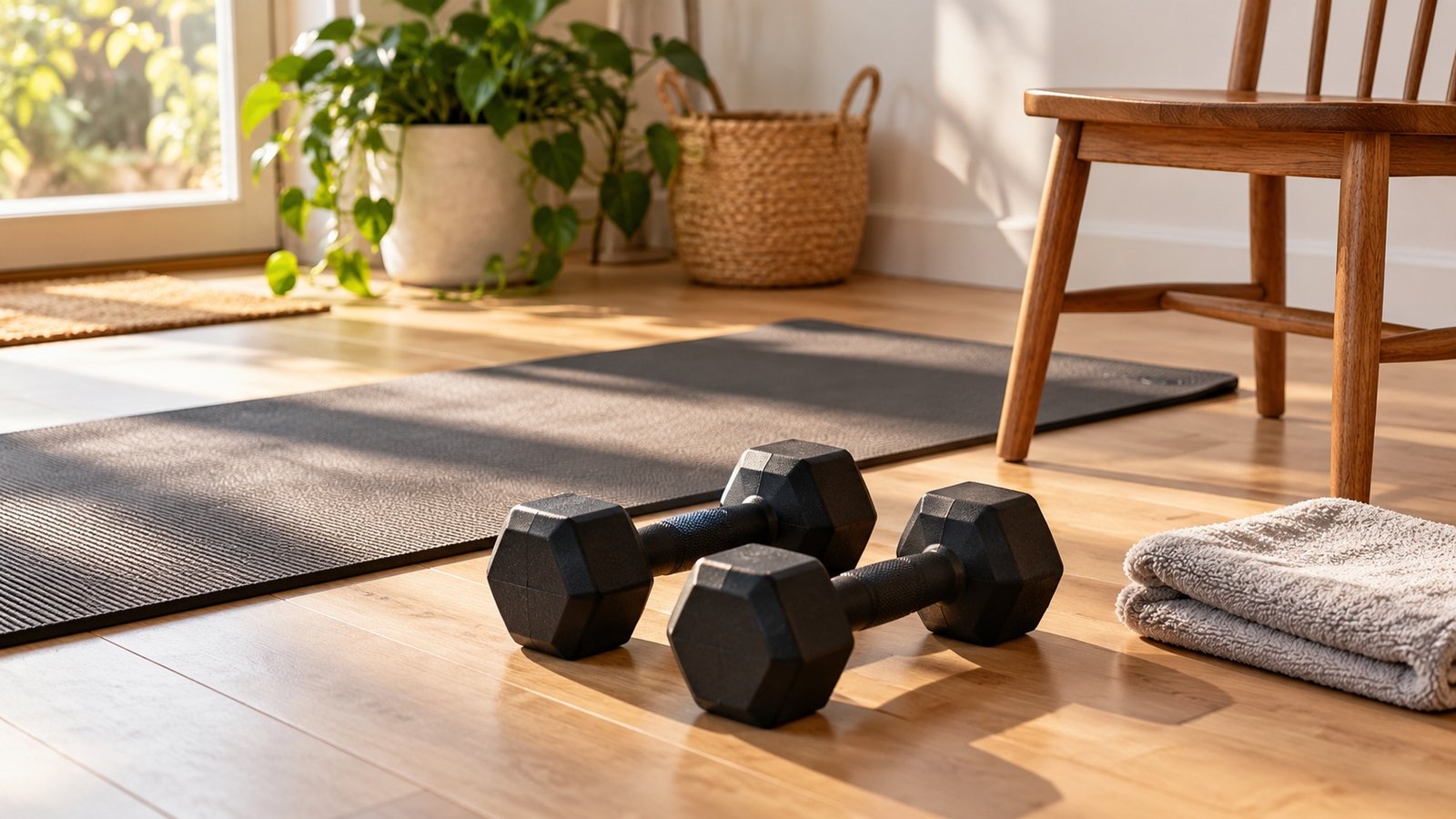
- A pair of dumbbells, ideally adjustable so different exercises can use different loads.
- A clear, non-slip floor and a mat for the final exercise.
- A solid chair or fixed support for balance. Avoid wheels, folding furniture, or anything that tips or slides when you lean on it.
- A notebook or phone note. No workout app or subscription is required.
There is no universal beginner weight in kilograms. A load that feels manageable for a row can be too much for another exercise. Mayo Clinic's technique guidance suggests starting with a weight you can lift comfortably 12–15 times. For this example, aim initially for 12 controlled repetitions; reduce the load or stop earlier when control breaks down.
If your only pair is too heavy for a movement, use its unweighted option. Do not force a matching weight across the entire workout just because the dumbbells came as a pair.
The beginner dumbbell workout at a glance
How to read the table: a set is one group of repetitions. “Per side” means completing the stated number on each side, not dividing it between them. Finish a movement, rest, then move to the next. This is not a timed circuit.
| Movement | Starting target | Learning option |
|---|---|---|
| Goblet squat | 1 set of up to 12 repetitions | Unweighted sit-to-stand from a stable chair |
| Wall press-up | 1 set of 5–10 repetitions | Stand closer to the wall |
| Dumbbell Romanian deadlift | 1 set of up to 12 repetitions | Learn the unweighted hip hinge, or use a floor bridge |
| Supported single-arm row | 1 set of up to 12 repetitions per side | Use a lighter dumbbell and a secure support |
| Dead bug | 1 set of 5 slow repetitions per side | Use a shorter arm and leg reach |
Warm up with 5–10 minutes of comfortable walking or similar activity, then rehearse the unfamiliar movements without weight. Rest about a minute between movements, and longer if necessary. These preparation principles follow Mayo Clinic's guidance. The repetition targets above are starting options, not a requirement to finish through fatigue or pain.
How to perform the five movements
1. Goblet squat
Stand with your feet about shoulder-width apart and hold one dumbbell vertically near your chest. Bend your hips and knees together, keeping your feet planted. Lower only as far as you can control comfortably, then stand. Avoid collapsing your knees inward or pitching onto your toes. See the ACE goblet squat instructions.
Before adding weight: practise standing up from a solid chair with your feet flat, then sitting down slowly. The NHS sit-to-stand guide provides a useful demonstration. If you need your hands for support, that is a sign to work on the easier version first.
2. Wall press-up
Place your hands against a wall at chest height. Keep your body aligned as you bend your elbows and move toward the wall, then press away. Do not let your hips sag forward. Start close enough to keep the movement controlled. The NHS wall press-up guide shows the setup.
This gives the session a pushing movement without requiring you to get heavy dumbbells into a floor-press position. When the wall version becomes easy, get help choosing your next pressing variation rather than jumping straight to a difficult floor push-up.
3. Dumbbell Romanian deadlift, after learning the hip hinge
Hold the dumbbells in front of your thighs with a small bend in your knees. Move your hips backward while the weights travel close to your legs. Keep your back position steady. Stop before you need to round your back, then return to standing. You do not need to touch the floor. ACE recommends learning the unweighted hip hinge before adding load.
If the hinge is unfamiliar: use a bodyweight floor bridge while you arrange a technique check. Lie with knees bent and feet flat; raise your hips with control and lower again, avoiding a large lower-back arch. Follow the NASM floor bridge demonstration. This is an alternative exercise, not treatment for back pain.
4. Supported single-arm row
With both feet on the floor, hinge forward and rest your free hand on a fixed, stable support. Let the weighted arm hang. Draw your elbow back close to your side, then lower the dumbbell slowly. Keep your torso still instead of twisting to lift it. Switch sides. The ACE row guide explains the arm movement and body control using a bench; here the secure support replaces the bench.
Test the support before holding a weight. If it shifts, do not use it. If you cannot hold the bent-over position comfortably, leave this movement out and ask a trainer for a suitable pulling alternative.
5. Dead bug
Lie on your back with your knees bent above your hips and arms reaching upward. Slowly extend one arm and the opposite leg, return, then change sides. Keep breathing and shorten the reach if your lower back arches away from the floor. The NASM dead bug guide demonstrates the movement.
The low starting count is intentional: this is a control exercise. Five clean repetitions on each side are more useful for this practice session than a hurried set that you cannot stabilise.
How to progress without changing everything
Use the following as a decision aid, not a week-by-week promise. Repeat the same basic session so your notes are comparable. The ACSM guidance emphasises adapting training to your goals and building gradually; this table is our practical example of applying those principles.
| What happened? | What to do next time |
|---|---|
| The movement still feels unfamiliar | Repeat the learning option; do not add load. |
| You completed fewer repetitions but stayed controlled | Keep the same setup and practise; the target is not a deadline. |
| All planned repetitions felt comfortable in two sessions | For that dumbbell exercise, try the smallest available load increase and accept fewer repetitions while learning the new load. |
| The next dumbbell jump is too large | Keep the current load. Consider a second controlled set only after recovery and technique are comfortable, or obtain a smaller weight increment. |
| You felt sharp pain or your technique deteriorated | Stop the movement; reassess the exercise and load rather than pushing through. |
Do not add weight, sets, and another weekly session all at once. A single change makes it easier to identify what you can manage. An example schedule is Monday and Thursday; if you miss Monday, move the session rather than squeezing two full-body workouts into consecutive days.
A simple log you can copy
Write one line for each exercise: date — movement — weight per dumbbell — completed repetitions — one technique note. For a goblet squat, record the weight of the one dumbbell; for a deadlift, record the weight in each hand. “12 left, 10 right” is more informative for a row than “done.” For unweighted movements, record the variation.
For example: “6 Oct — goblet squat — 4 kg total — 10 repetitions — last two became rushed.” This is an illustrative entry, not a recommended starting weight. Its next step is to repeat with better control, not automatically buy heavier dumbbells.
Common questions
Can I train with only one pair of dumbbells?
Yes, but the same pair may not suit every movement. Use lighter or bodyweight options where necessary. If you already own one pair, try it before making an equipment purchase.
Should I do this workout every day?
No. This example uses two non-consecutive strength days. Use other days for suitable walking or other activity and recovery. For an approachable aerobic starting point, see our guide to comfortable cardio without a heart-rate monitor.
Will this burn belly fat or deliver visible results in a month?
This guide does not promise either outcome. Its first useful milestones are learning the movements, keeping two appointments each week, and seeing controlled repetitions improve. Your longer-term programme should reflect your goals, available equipment, and individual response.
Sources and editorial notes
Sources checked on 6 October 2026. The session, substitutions, logging example, and progression decision table were assembled for this article; they are not a named programme tested in a clinical trial. No independent clinical review is claimed. Read our editorial and corrections policy.