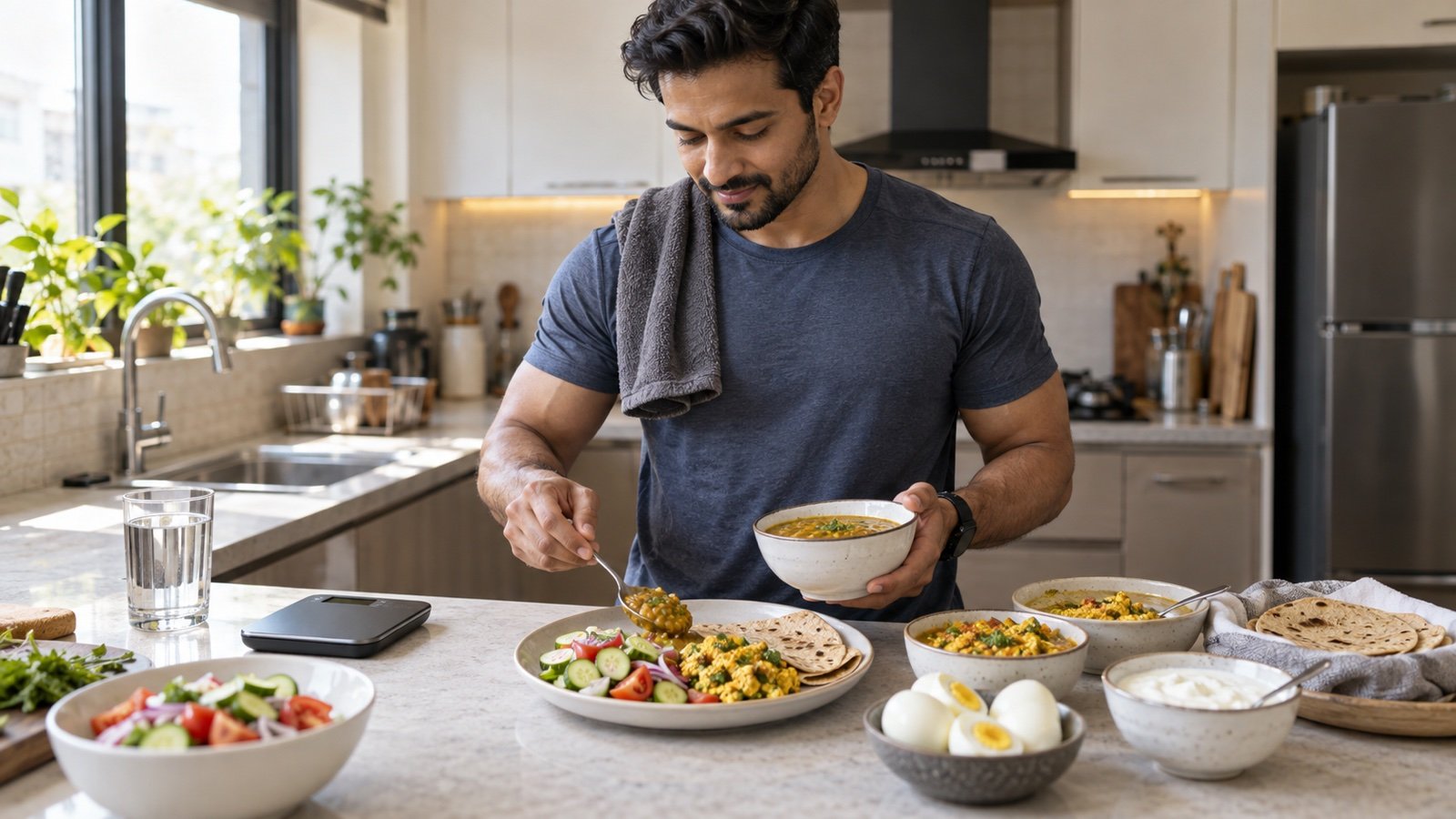



A typical Thanksgiving plate comes to about 1,612 calories by our count: turkey, stuffing, mashed potatoes and gravy, sweet potato and green bean casseroles, cranberry sauce and a buttered roll (1,110 calories), plus one slice of pumpkin pie and a glass of wine. Add a slice of pecan pie and a cup of cider and the total reaches 2,400. Every number comes from USDA FoodData Central, using the serving sizes listed below.
Walking off 1,612 calories at a moderate 3 mph would take a 155-pound adult about 6 h 2 min and a 200-pound adult about 4 h 41 min. That figure shows how much energy is in the meal; it isn't a to-do list. Your body balances energy over days and weeks, not meal by meal, and a short walk after dinner does something useful that has little to do with calories. Thanksgiving falls on Thursday, November 26, 2026.
How we built the plate
We took each dish from the USDA's Food and Nutrient Database for Dietary Studies (FNDDS), which is published in FoodData Central (2024-10-31 release). FNDDS describes foods as Americans actually report eating them, so it has entries for dishes like "Green bean casserole" and "Bread stuffing" as well as single ingredients. For most dishes we used the portion USDA assigns when people don't say how much they ate, usually ½ cup for sides and 3 ounces for turkey. For pie we used ⅛ of a 9-inch pie, and for wine a 5-ounce glass, which is one standard drink at 12% alcohol.
Recipes vary a lot. A sweet potato casserole topped with marshmallows or a brown-sugar crust will usually come in higher than the USDA's "casserole or mashed" entry; the USDA's candied sweet potato entry is 234 calories per ½ cup, against 124. Treat these figures as a reasonable middle, not as your aunt's exact recipe.
Thanksgiving dinner calories by dish
Walking minutes assume a moderate 2.8–3.4 mph pace on level ground (3.8 METs). The next section shows the formula.
| Dish | Serving | Calories | Protein (g) | Walking minutes, 155 lb | Walking minutes, 200 lb |
|---|---|---|---|---|---|
| Turkey, white meat, roasted, no skin | 3 oz (85 g) | 118 | 24.5 | 27 | 21 |
| Turkey, dark meat, roasted, with skin | 3 oz (85 g) | 172 | 22.5 | 39 | 30 |
| Bread stuffing | ½ cup (100 g) | 177 | 3.1 | 40 | 31 |
| Mashed potatoes, made with milk | ½ cup (125 g) | 143 | 2.7 | 32 | 25 |
| Poultry gravy | ¼ cup (60 g) | 29 | 0.4 | 7 | 5 |
| Sweet potato casserole | ½ cup (125 g) | 124 | 2.4 | 28 | 22 |
| Green bean casserole | ½ cup (115 g) | 64 | 2.3 | 14 | 11 |
| Cranberry sauce | ¼ cup (70 g) | 111 | 0.6 | 25 | 19 |
| Dinner roll, white | 1 medium roll (43 g) | 120 | 4.2 | 27 | 21 |
| Butter for the roll | 1 pat (7 g) | 52 | 0.1 | 12 | 9 |
| Pumpkin pie | ⅛ of a 9-inch pie (150 g) | 374 | 7.1 | 84 | 65 |
| Pecan pie | ⅛ of a 9-inch pie (150 g) | 674 | 9.0 | 151 | 117 |
| Red wine | 5 fl oz glass (150 g) | 128 | 0.1 | 29 | 22 |
| Apple cider | 1 cup, 8 fl oz (248 g) | 114 | 0.2 | 26 | 20 |
FoodData Central IDs, so you can look up each entry yourself: Turkey, white meat, roasted, no skin 2706109; Turkey, dark meat, roasted, with skin 2706112; bread stuffing 2707687; mashed potatoes, made with milk 2709496; poultry gravy 2707144; sweet potato casserole 2709708; green bean casserole 2710040; cranberry sauce 2709280; dinner roll, white 2707654; butter for the roll 2710154; pumpkin pie 2708011; pecan pie 2708015; red wine 2710688; apple cider 2709319. Values are calculated from USDA's per-100-gram figures and rounded.
Three ways the plate adds up
| Plate | Calories | Protein (g) | 155 lb | 200 lb |
|---|---|---|---|---|
| Dinner only (turkey through buttered roll) | 1,110 | 62.8 | 4 h 9 min | 3 h 13 min |
| Dinner + pumpkin pie + one glass of wine | 1,612 | 70.0 | 6 h 2 min | 4 h 41 min |
| Everything in the table (both pies, wine and cider) | 2,400 | 79.2 | 8 h 59 min | 6 h 58 min |
A few patterns stand out:
- Dessert is the biggest single swing. One slice of pecan pie (674) has about 300 more calories than pumpkin pie (374) and more than the entire turkey portion.
- Turkey gives you the most protein for the calories. Three ounces of white meat without skin provide 24.5 g of protein for 118 calories. The sides, the roll and a slice of pumpkin pie add about 23 g combined.
- Skin makes less difference than people think. By USDA values, skipping the skin saves about 26 calories per 3 ounces of white meat and 30 per 3 ounces of dark meat.
- Some of the classic sides are fairly light. Green bean casserole (64) and gravy (29) are among the smallest numbers on the plate.
For a sense of scale, the Dietary Guidelines set their serving goals around a 2,000-calorie reference pattern, but say your actual needs depend on age, sex, height, weight and activity. Our guide to what calories are explains the basics.
How the walking minutes were calculated
A MET (metabolic equivalent) compares an activity's energy cost with sitting quietly. The 2024 Adult Compendium of Physical Activities defines 1 MET as 1 kcal per kilogram of body weight per hour. That gives a simple formula:
Calories per minute = METs × body weight in kg ÷ 60
Minutes to burn a dish = dish calories ÷ calories per minute
We used two walking values from the Compendium's walking list:
- Moderate, 2.8–3.4 mph on level ground (code 17190): 3.8 METs. This works out to 4.45 calories per minute at 155 lb (70.3 kg) and 5.75 at 200 lb (90.7 kg).
- Brisk, 3.5–3.9 mph, walking for exercise (code 17200): 4.8 METs. This works out to 5.62 and 7.26 calories per minute.
Worked example: a slice of pumpkin pie (374 calories) ÷ 4.45 calories per minute = about 84 minutes of moderate walking for a 155-pound person.
We picked 155 pounds because it is the middle weight in Harvard Health's calories-burned table, and 200 pounds because it is close to the average weight of U.S. men (199.0 lb in CDC data for 2021–2023). Our figures roughly match Harvard's: it lists 133 calories for 30 minutes of walking at 3.5 mph for a 155-pound person, and our moderate-pace formula gives 134. The 2024 Compendium rates 3.5–3.9 mph as brisk walking at 4.8 METs, which works out to about 169 calories in 30 minutes at 155 lb, so brisk-pace times are shorter:
| Pace | 155 lb | 200 lb |
|---|---|---|
| Moderate, 2.8–3.4 mph (3.8 METs) | 6 h 2 min | 4 h 41 min |
| Brisk, 3.5–3.9 mph (4.8 METs) | 4 h 47 min | 3 h 42 min |
Why "walking off" a meal oversimplifies things
The table makes it look as though every bite needs to be cancelled out with exercise. Real life doesn't work that way, for several reasons:
- The minutes include calories you'd burn anyway. MET math counts your resting energy use too. If you count only the extra calories from walking (3.8 − 1 = 2.8 METs), the 1,612-calorie plate works out to about 8 h 11 min at 155 lb, not 6 h 2 min. Either way, it's a measure of how much energy is in the meal, not a target.
- METs are averages. Your own burn varies with fitness, body composition, terrain and pace. The Compendium's 2024 update covers adults aged 19–59; there is a separate compendium for older adults.
- Weight changes over weeks, not after one dinner. In a National Institutes of Health study of 195 adults, average weight gain from mid-November to early January was 0.37 kg (about 0.8 lb), far less than the 5 pounds often claimed. The researchers noted that the small gain tended to stay, which points to habits over the whole season, not a single meal.
- Exercise does more than burn calories. A walk after eating has benefits that have nothing to do with calories, as the next section shows.
Practical, guilt-free ways to enjoy the meal
Build the plate around protein and vegetables
The Dietary Guidelines for Americans, 2025–2030 advise prioritizing protein foods at every meal and set a goal of 1.2–1.6 g of protein per kilogram of body weight per day. For a 155-pound adult, that is about 84–112 g a day. Six ounces of turkey covers 47 g. Start with turkey and a vegetable side, then add the dishes you look forward to most. Our protein-by-weight guide has the full calculation.
Choose favorites instead of a bit of everything
- Pick one pie, or have two thin slivers. Half a slice of pecan pie is about 337 calories, roughly the same as a full slice of pumpkin.
- Take smaller scoops of the dishes you're only so-so about. That leaves room for the ones you'd actually miss.
- Alternate drinks with water or seltzer. A 5-ounce glass of wine is 128 calories, and a cup of cider is 114. The Guidelines recommend water and unsweetened drinks, and advise drinking less alcohol for better overall health.
- Serve plain green beans next to the casserole. This adds a lighter vegetable option and helps you toward the Guidelines' goal of three vegetable servings a day.
Take a short walk after the meal
A walk after dinner won't cancel the meal, but there is good evidence that it helps your body handle it. A 2022 meta-analysis in Sports Medicine found that light-intensity walking breaks significantly reduced post-meal glucose and insulin compared with sitting continuously, and worked better than standing breaks. In a randomized crossover study in Diabetologia, 41 adults with type 2 diabetes who walked for 10 minutes after each main meal had about 12% lower post-meal blood sugar than when they walked 30 minutes at a single time each day, with the biggest difference after the evening meal.
So a 10–20 minute family walk between dinner and pie is useful, and much more realistic than six hours. Our comparison of 10-minute walks after meals vs one 30-minute walk covers the research in more detail, and our guide to 7,000 vs 10,000 steps a day can help you set a daily walking goal for the rest of the holiday season. If you have diabetes, follow your care team's advice on meals, medication and activity timing.
Return to your usual routine the next day
You don't need to skip breakfast or do a punishing workout the day after. Going back to your regular meals and activity is what matters. For year-round habits, see our healthy eating tips. If counting calories or exercise minutes makes you anxious or feels hard to stop, talk with your doctor or a registered dietitian.
Frequently asked questions
How many calories are in a Thanksgiving dinner?
By our USDA-based count, the main plate (turkey, sides and a buttered roll) is about 1,110 calories, or 1,612 with a slice of pumpkin pie and a glass of wine. Bigger helpings, appetizers and extra drinks push it higher.
How many calories are in a slice of pumpkin pie compared with pecan pie?
Using USDA values for ⅛ of a 9-inch pie, pumpkin pie has 374 calories and pecan pie has 674.
Is white or dark turkey meat better?
Both are good protein sources. Three ounces of roasted white meat without skin has 118 calories and 24.5 g of protein. Three ounces of dark meat with skin has 172 calories and 22.5 g of protein. Choose the one you enjoy.
How long should I walk after Thanksgiving dinner?
The studies above used short bouts: light walking breaks and 10-minute walks after meals. A relaxed 10–20 minute walk is a reasonable goal. The aim is to help your blood sugar after the meal, not to burn off every calorie.
This article is general information, not medical or dietary advice. The calorie and walking figures are estimates based on the stated serving sizes and body weights.
Sources
- USDA FoodData Central: FNDDS survey foods, 2024-10-31 release (FDC IDs listed under the dish table).
- 2024 Adult Compendium of Physical Activities: walking: codes 17190 (3.8 METs) and 17200 (4.8 METs).
- Herrmann et al., 2024 Adult Compendium of Physical Activities, Journal of Sport and Health Science 2024.
- Adult Compendium of Physical Activities: MET definition (1 kcal/kg/hour).
- Dietary Guidelines for Americans, 2025–2030: protein, portions, beverages and alcohol.
- NIAAA: What is a standard drink?
- Harvard Health: Calories burned in 30 minutes for people of three different weights.
- CDC FastStats: Body measurements: average adult weights, 2021–2023.
- Buffey et al., Sports Medicine 2022: light walking breaks and post-meal glucose.
- Reynolds et al., Diabetologia 2016: walking after meals in type 2 diabetes.
- Yanovski et al., New England Journal of Medicine 2000: a prospective study of holiday weight gain.