

Daylight saving time ends at 2:00 a.m. local time on Sunday, November 1, 2026, when clocks in most of the United States fall back to 1:00 a.m. Sunrise and sunset both arrive about an hour earlier on the clock. Morning workouts get lighter, after-work runs, walks and rides move into dusk or darkness, and your body clock sits an hour out of step with the new time for a few days.
The fix is simple. In the days before, nudge your bedtime, meals and workouts slightly later. After the change, get daylight soon after you wake. Plan to be seen if your evening session now ends in the dark. This guide covers each step, using official sleep and traffic-safety guidance checked on October 15, 2026.
What changes on November 1, 2026
According to NIST’s daylight saving time page, daylight saving time in 2026 runs from March 8 at 2:00 a.m. to November 1 at 2:00 a.m. local time. When it ends, the hour from 1:00 to 2:00 a.m. repeats. Under the Energy Policy Act of 2005, daylight saving time ends on the first Sunday of November. It starts again on the second Sunday of March, which is March 14, 2027.
- Who doesn’t change: Hawaii, most of Arizona, Puerto Rico, Guam, the U.S. Virgin Islands, American Samoa and the Northern Mariana Islands stay on standard time all year. The Navajo Nation in Arizona is the exception: it does observe daylight saving time.
- Is this the last time change? Not yet. The House passed the Sunshine Protection Act (H.R. 139), which would make daylight saving time permanent, by 308 to 117 on July 14, 2026. The Senate received it on July 15 and referred it to committee. As of October 15 it had not become law, so the November 1 change goes ahead as scheduled.
How falling back affects your sleep
Your body clock (circadian rhythm) is set mainly by light and darkness. Overnight, the clock on the wall moves back an hour, but your body doesn’t. For the first few days, 6:00 a.m. on the new clock can feel like 7:00 a.m., so many people wake earlier than planned and feel sleepy earlier in the evening.
The “extra hour” is real only on Saturday night. The American Academy of Sleep Medicine (AASM) says most people adjust within a few days. It also notes that both the spring and fall changes can disrupt sleep schedules and sleep quality. It names teens and night-shift workers among the groups at greatest risk.
For context, the AASM’s 2024 position statement supports ending seasonal clock changes in favor of permanent standard time, which it says aligns best with human circadian biology. That is a policy position about the clock, not a reason to worry about this one weekend.
A five-day plan to adjust
This schedule follows the AASM’s time-change sleep tips. The workout timings are our suggested application of them.
- Wednesday to Friday (October 28–30): Go to bed 15 to 20 minutes later each night. Move dinner and your workout later by a similar amount. The AASM lists meals and exercise as daily “time cues” to shift along with bedtime.
- Saturday, October 31: Set any manual clocks, including a watch or a gym-bag alarm clock, back one hour in the evening. Then go to bed at your normal bedtime on the new time.
- Sunday, November 1: Wake at your usual clock time. Keep lights low if you wake before then. Once you are up, get outside in daylight.
- Monday onward: Keep the same wake time every day, including weekends. Get morning light, and avoid extra caffeine late in the day while you adjust.
Already short on sleep? The AASM advises against shifting your bedtime later before the fall change. Instead, keep your usual bedtime and take the extra hour on Saturday night. Adults need at least seven hours a night. The CDC lists at least 7 hours for ages 18–60, 7 to 9 hours for ages 61–64, and 7 to 8 hours from age 65.
Use light to reset your body clock
For the fall change, the AASM gives two pieces of advice that fit together. Keep light dim until your target wake time, then get early-morning sunlight in the days after the change. Bright light before your target wake time tells your body to keep waking early. Bright light after you’re up anchors the day.
- Morning: Get outdoor light soon after you wake. A walk, a warm-up outside or coffee by a bright window all work. After the change, sunrise comes earlier on the clock, so a 6:30 a.m. walk is lighter than it was the week before.
- Daytime: A 2022 expert consensus in PLOS Biology recommends bright light throughout the day, at least 250 lux of “melanopic” light at eye level. A lunchtime walk or outdoor session is a simple way to add daylight.
- Evening: The same consensus recommends keeping light dim (at most 10 melanopic lux) for at least three hours before bed. At home, that means lower, warmer lighting and less bright overhead light late in the evening.
These are sensible defaults for healthy adults, not rules. If you work shifts or have a diagnosed sleep disorder, follow your clinician’s plan. Our guide on how to sleep better at night naturally covers the wider routine.
How to shift your workout time
If you train in the morning
Good news: the week after the change, the same clock time is brighter, and your body clock makes it feel an hour later. If you already wake early, you may find the alarm easier. Keep your wake time steady rather than drifting earlier just because you wake up early. An outdoor warm-up counts toward your morning light.
If you train after work
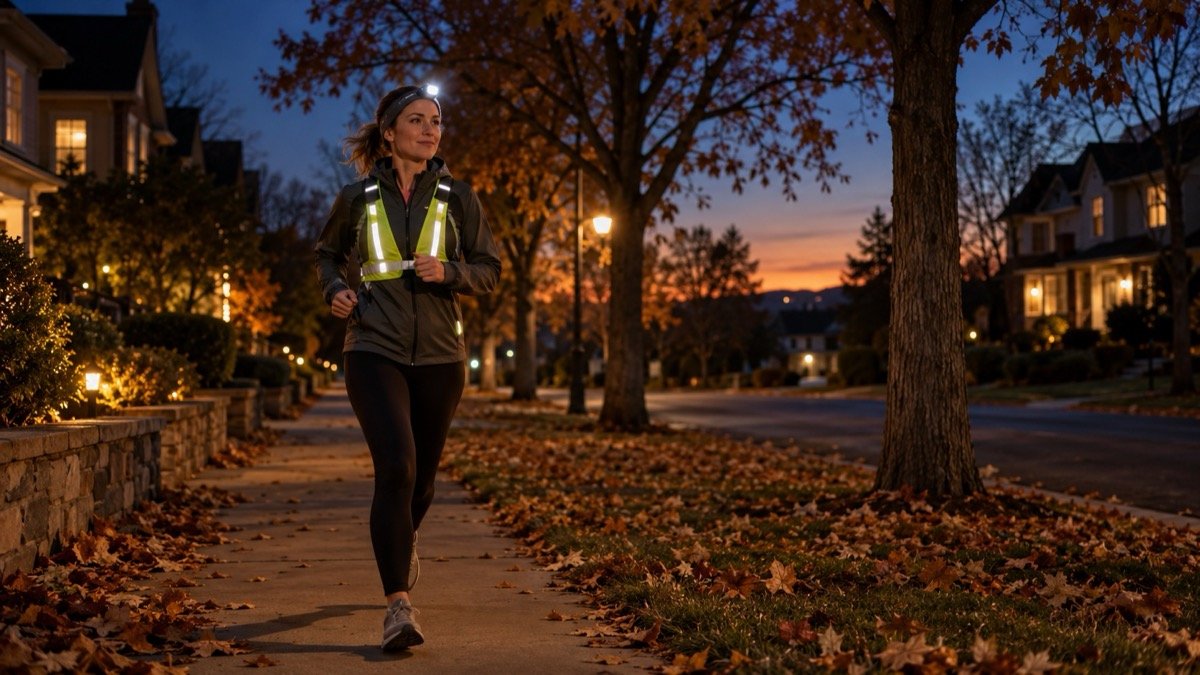
This is where the change bites. A 5:30 p.m. run or ride that ended in daylight in October may now end at or after dusk. You have three options:
| Option | Works best for | What to plan |
|---|---|---|
| Keep the session outdoors after dark | Walkers, runners and riders with lit, familiar routes | Lights and reflective gear (see the safety section), sidewalks or paths, a route you know |
| Move it to lunchtime or the weekend | Anyone with a flexible midday break | A shorter session; daylight also helps your body clock |
| Move it indoors | Strength work, intervals, steady cardio | A home routine, gym time or a walking pad |
For indoor ideas, see our home workouts that actually work, a walking pad beginner routine, or these indoor workouts written for days when you can’t train outside. Easy aerobic sessions transfer well indoors. Our guide to zone 2 cardio without a heart rate monitor explains how to judge effort.
Will a later workout hurt your sleep?
Usually not. A 2019 meta-analysis of 23 studies in Sports Medicine found no overall evidence that evening exercise worsens sleep in healthy adults. The exception was vigorous exercise ending one hour or less before bedtime, which may delay sleep onset and reduce sleep time and efficiency. Practical rule: finish hard intervals at least an hour before bed, or swap them for easier work on late nights.
Watch the extras too. If an evening session comes with a caffeinated pre-workout, the stimulant is more likely to disturb sleep than the exercise. Our guide to pre-workout caffeine and sleep explains dose and timing.
Exercise is a time cue, too
In a laboratory study in the Journal of Physiology (2019), adults did one hour of moderate treadmill exercise on three consecutive days. Sessions from 7:00 to 10:00 p.m. shifted their body clocks later, while 7:00 a.m. and 1:00 to 4:00 p.m. sessions shifted them earlier. The study wasn’t testing the clock change. Still, its findings are consistent with the AASM’s advice to move workouts along with your bedtime, rather than suddenly training much earlier the week clocks fall back.
Walking, running and cycling safely in the earlier dark
Darkness is the biggest change for outdoor exercisers, and the risk data are clear. According to NHTSA’s 2024 pedestrian fact sheet, 7,080 pedestrians were killed in U.S. traffic crashes in 2024, and 76% of those deaths happened in the dark. In fall months (September to November), the most common time was 6:00 to 8:59 p.m., with 29% of pedestrian deaths. For people on bicycles, NHTSA’s 2024 bicyclist fact sheet reports 1,103 deaths, 52% of them in the dark. The 6:00 to 8:59 p.m. window was again the most common time in fall (26%).
A study in Accident Analysis & Prevention (2002) compared U.S. fatal crashes just before and after clock changes. It found that pedestrian crashes were the most sensitive to light level, in some cases up to seven times riskier in the dark than in daylight. These are population figures, not your personal odds, but they show why the first dark evening commute deserves planning.
If you walk or run
- Be visible: NHTSA advises bright clothing by day and reflective materials or a flashlight at night. A headlamp or handheld light also helps you see uneven ground.
- Choose where you go: Use a sidewalk or path when one exists. With no sidewalk, use the shoulder and face oncoming traffic.
- Cross where drivers expect you: Use crosswalks or intersections. If you must cross elsewhere, pick a well-lit spot and wait for a long enough gap.
- Never assume a driver sees you: Make eye contact with approaching drivers, and limit headphones or phone use so you can hear traffic.
If you ride
- Lights and reflectors: At night, NHTSA advises a front light, a red reflector or flashing rear light, and retro-reflective tape or markings on your bike or clothing. Wear fluorescent or bright colors in daylight, dawn and dusk. State and local lighting laws vary, so check yours.
- Helmet every ride: NHTSA calls a properly fitted helmet the single most effective way to prevent head injury in a bike crash.
- Ride predictably: Ride in the same direction as traffic and obey the same signs and signals as drivers.
Newer riders can find more basics in our beginner’s guide to cycling. On the drive home, remember that drivers are adjusting to the darkness too. NHTSA asks drivers to look for pedestrians especially at dusk, dawn and night.
Frequently asked questions
What time do clocks change on November 1, 2026?
At 2:00 a.m. local time, clocks go back to 1:00 a.m. Phones and connected devices usually update automatically. Set manual clocks back before bed on Saturday.
Do Arizona and Hawaii change their clocks?
No. Hawaii and most of Arizona stay on standard time all year, so their clocks don’t move. The Navajo Nation in Arizona does change. Puerto Rico, Guam, the U.S. Virgin Islands, American Samoa and the Northern Mariana Islands also stay on standard time.
How long does it take to adjust?
The AASM says most people adjust within a few days. If you regularly have trouble sleeping or feel tired during the day well after the change, talk to a doctor.
Should I work out the morning after the time change?
Yes, if you feel well. A Sunday-morning session outdoors combines daylight, a regular wake time and activity, which all help you adjust. Keep it at your normal clock time rather than starting earlier because you woke early.
This article is general information for healthy adults, not medical advice. It is based on the published guidance and research listed below; we did not run our own tests.
Sources
- NIST: Daylight Saving Time: 2026 dates, 2:00 a.m. rule and places that don’t observe DST.
- U.S. House Clerk: Roll Call 238, H.R. 139 (July 14, 2026): House passage of the Sunshine Protection Act.
- AASM Sleep Education: How to adjust when daylight saving time ends (October 2026): fall-back tips.
- AASM Sleep Education: Daylight Saving Time: gradual 15–20 minute shift, light timing and who is most affected.
- Rishi et al., J Clin Sleep Med 2024;20(1):121–125: AASM position statement on permanent standard time.
- CDC: About Sleep: recommended sleep hours by age and sleep habits.
- Brown et al., PLOS Biology 2022: consensus recommendations for daytime, evening and nighttime light.
- Stutz et al., Sports Medicine 2019: meta-analysis of evening exercise and sleep.
- Youngstedt et al., Journal of Physiology 2019: human circadian phase-response curves for exercise.
- NHTSA: Pedestrians, 2024 Data (DOT HS 813 818): fatalities, light conditions, timing and safety reminders.
- NHTSA: Bicyclists and Other Cyclists, 2024 Data (DOT HS 813 822): fatalities, light conditions, timing and safety reminders.
- Sullivan & Flannagan, Accident Analysis & Prevention 2002: ambient light and fatal crashes around DST transitions.