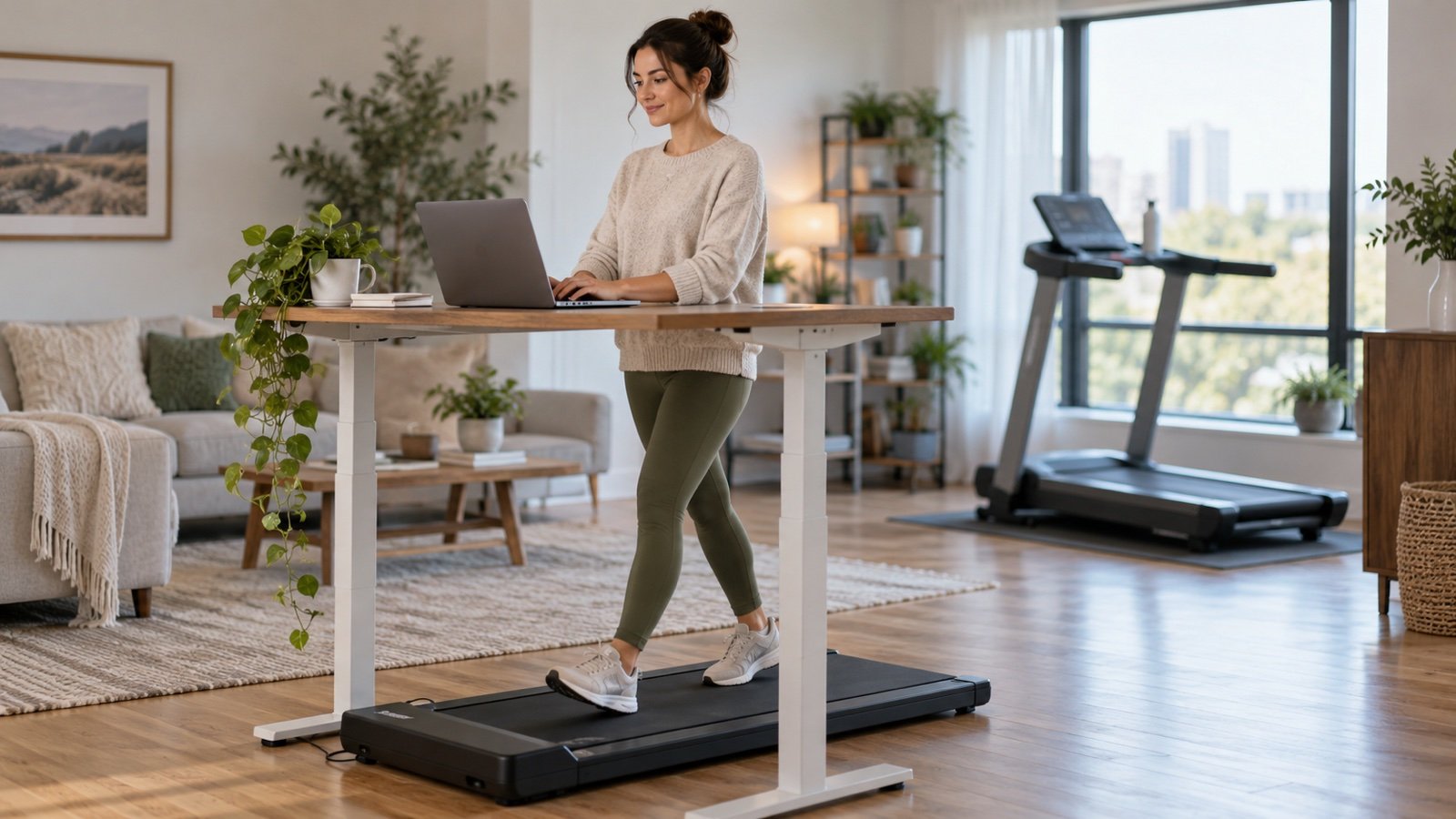


A beginner walking-pad routine should start with a short, comfortable session that fits your day, then grow only when your footing, recovery, and work remain manageable. Learn to use the machine without working first. Minutes are a simpler early target than steps or calories.
The two-week example below is a flexible habit trial for generally healthy adults who can use their equipment comfortably. It is not a clinical program, an individual exercise prescription, or a promise of weight loss. If your balance, mobility, or health affects walking, obtain advice on whether a moving desk setup is suitable before following a schedule.
Complete the setup before starting a schedule
Read the exact model's manual, check floor and room clearance, and learn how to stop. Keep children and pets away from the moving belt. Use the required support features; leaning on a desk is not a substitute for a handrail you need.
Our desk setup guide helps check keyboard height, screen position, and cables. Start walking with no reading or typing task. Only add work after the controls and footing feel familiar. The speed guide includes a short task comparison.
A two-week starter example
Use a comfortable permitted pace; no particular mph setting is required. End sooner if needed, repeat a stage, or take a day away from the pad. Each row describes an option, not an instruction to progress on that calendar day.
| Stage | Session option | Task | Decision before adding more |
|---|---|---|---|
| First attempt | Up to 5 minutes, or less | Walking only | Can you walk and stop with control? |
| Next comfortable attempts | Repeat the same brief session | Walking only, then familiar reading if appropriate | Does adding the task affect footing or posture? |
| Later in the first week | Try 5–10 minutes if shorter sessions remain comfortable | One low-stakes work task | Is the work accurate, with no new discomfort afterward? |
| Second week, if ready | Keep one short session, or add a second separate brief session | Use the same familiar task | Does the extra time fit the day without forcing it? |
| End-of-trial review | Repeat the amount you can use consistently | Keep a sitting option available | What should stay the same, change, or stop? |
Do not add both a longer session and a faster pace at the same time. If five minutes feels awkward, the useful next step is not ten minutes: revisit the setup or use an ordinary walking break. A smaller repeatable session is more informative than a one-off hour.
Attach the session to a cue that already exists
A cue works better when it names a real task. “Move more tomorrow” gives you many chances to postpone. “After I open the routine reading queue, I will consider a short walk” gives you a decision point. Keep it optional when work needs concentration or the equipment is not ready.
Choose one cue to test, such as reading a familiar document after a break, listening to an internal training session that requires no interaction, or reviewing non-urgent notes. Do not make the trigger a meeting where attention or microphone noise would be a problem.
Decide the endpoint before starting: a few minutes or the end of a short section. This prevents a habit cue from turning into an open-ended endurance challenge. Keep the stop control accessible and stop the belt before getting off, adjusting the desk, or answering the door.
Make a three-version plan for real workdays
- Normal day: one familiar short session in the work slot you chose.
- Busy day: shorten it or take a brief walk away from the workstation when appropriate.
- Disrupted day: skip the pad if illness, fatigue, the room setup, or work requirements make it unsuitable. Resume the familiar amount instead of “making up” missed minutes.
These versions avoid the all-or-nothing problem. A missed Tuesday does not create an obligation to double Wednesday. The log should show what actually happened, including ordinary walks, so the routine does not disappear just because you did not use the machine.
Use a log that leads to a decision
| Date / cue | Minutes | Speed / units | Task and comfort | Next time |
|---|---|---|---|---|
| Example: Monday / draft reading | 6 | 0.8 mph | Steady; reading comfortable | Repeat the same |
| Example: Wednesday / email | 4 | 0.8 mph | More typing corrections; stopped | Keep email seated; use reading for walking |
| Your entry: _____ | _____ | _____ | _____ | _____ |
The entries above are fictional examples, not results from our testing. Add a note about how you felt later if soreness or fatigue changes your next decision. If symptoms persist, seek appropriate advice rather than repeatedly changing equipment to work around them.
If the watch misses steps while your hands are still, record minutes and the workout's data source. Do not wave the watch or force a faster walk to improve the number. Our tracker troubleshooting guide separates wrist-motion limits from app settings.
Open the plain-text walking session log to copy a fresh entry for each session.
Review once a week with three questions
- Was the setup usable? Note repeated cable, screen, or control problems. Fix these before extending sessions.
- Did the session fit the work? If accuracy or concentration suffered, change the task or separate walking from computer work.
- Was it comfortable during and afterward? Keep the same amount, reduce it, or stop depending on the answer. More minutes are not automatically progress.
Count completed sessions and total minutes only after answering those questions. For instance, three comfortable six-minute sessions are 18 minutes of movement. That arithmetic does not establish intensity, calorie expenditure, or a health outcome.
Keep desk walking within a broader activity routine
CDC adult guidance includes aerobic activity and muscle-strengthening work. Slow desk walking may be light movement rather than moderate exercise. Use the intensity guidance when deciding how a separate purposeful walk contributes to your goals.
Movement also does not remove the need to rest your eyes and hands. OSHA's work-process guidance recommends task variation and breaks from repetitive computer work. Walking while continuing to type is still typing. Stop, look away, and vary what you are doing rather than treating the moving belt as a complete desk break.
Common questions
How long should I use a walking pad each day?
There is no universal daily amount. Begin with an amount you can use comfortably, review its effect on your work and recovery, and respect any equipment duty-cycle instructions. The two-week table is an example of gradual familiarization, not a minimum requirement.
Should I aim for 10,000 steps straight away?
No fixed step target is necessary for this starter trial. If you later choose a personal step goal, estimate its time using your own cadence and the steps you already get elsewhere. Our step-time guide explains that calculation.
What if I prefer walking outside?
Use that preference. A walking pad is an option for convenience, not a prerequisite for moving more. A short ordinary walk may provide a simpler break from both sitting and screen work.
Set a walking goal you can repeat
Sources and editorial notes
Researched October 6, 2026. The starter table, cues, and log are original editorial suggestions and have not been clinically tested as a program. Read our editorial policy.
- CDC: Adult activity recommendations
- CDC: Intensity
- OSHA: Work processes and breaks
- WalkingPad: Model-specific features and suitability
Explore the walking-pad desk guide
Choose the next question you want to solve:
- Walking Pad While Working: A Practical Desk-Walking Guide
- How Long Does It Take to Walk 10,000 Steps on a Walking Pad?
- Walking Pad Desk Setup: Measurements, Height and Clearance
- Walking Pad Noise in an Apartment: What to Check First
- Walking Pad Not Counting Steps? Fixes for Apple Watch and Garmin
- Walking Pad Speed While Working: Find a Pace That Fits Your Task
- Walking Pad vs Treadmill: Which Should You Buy for Home?