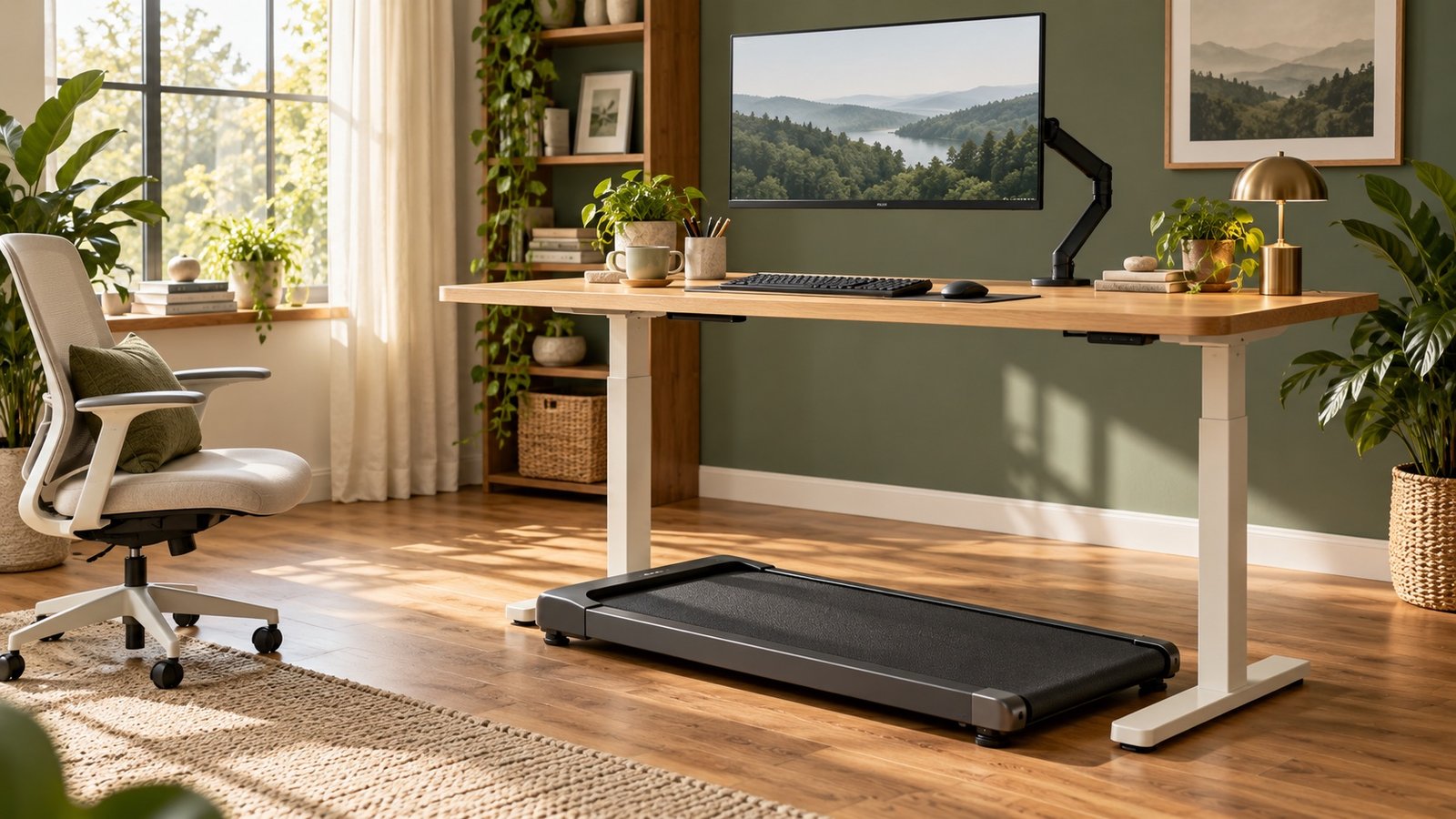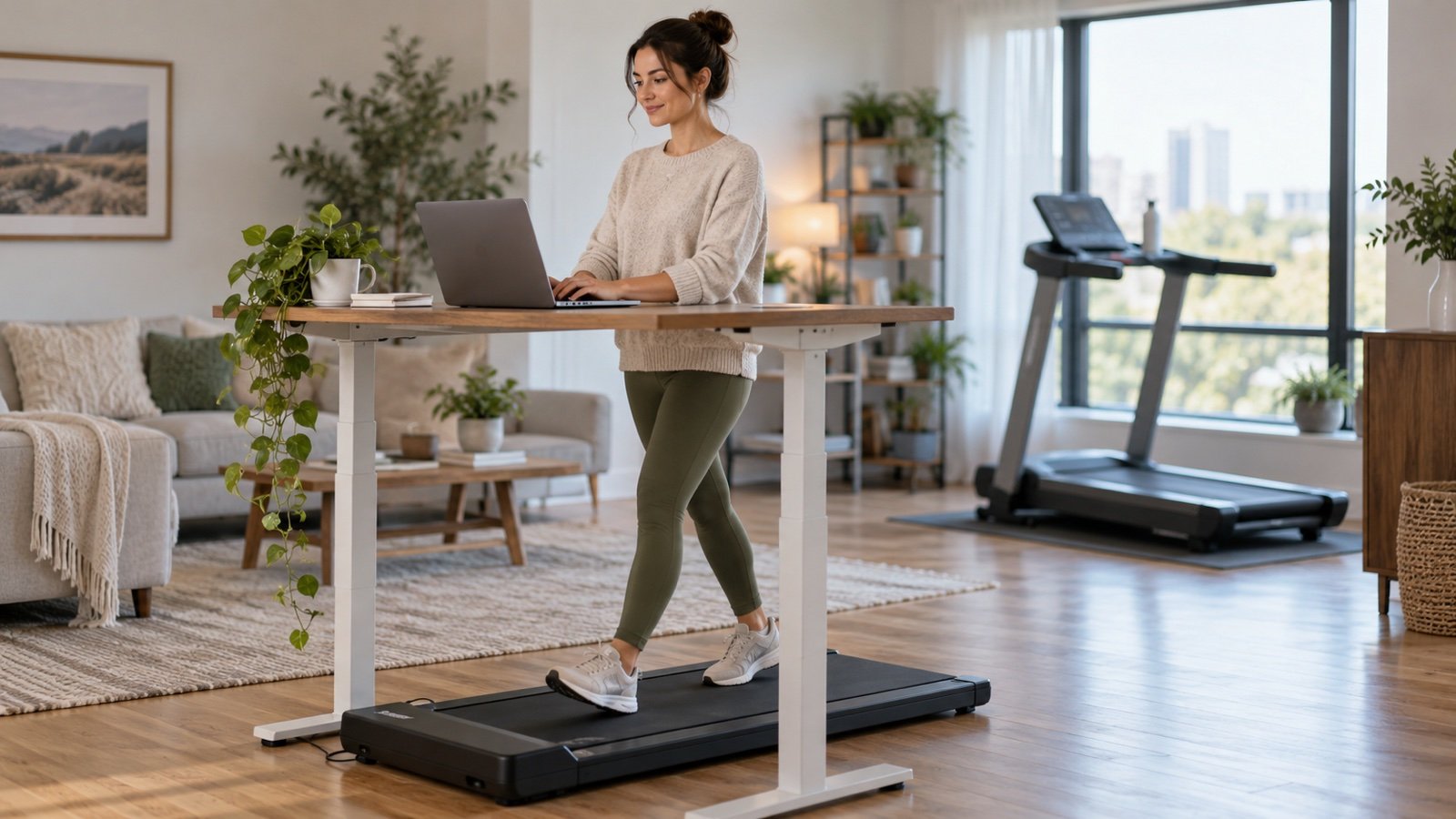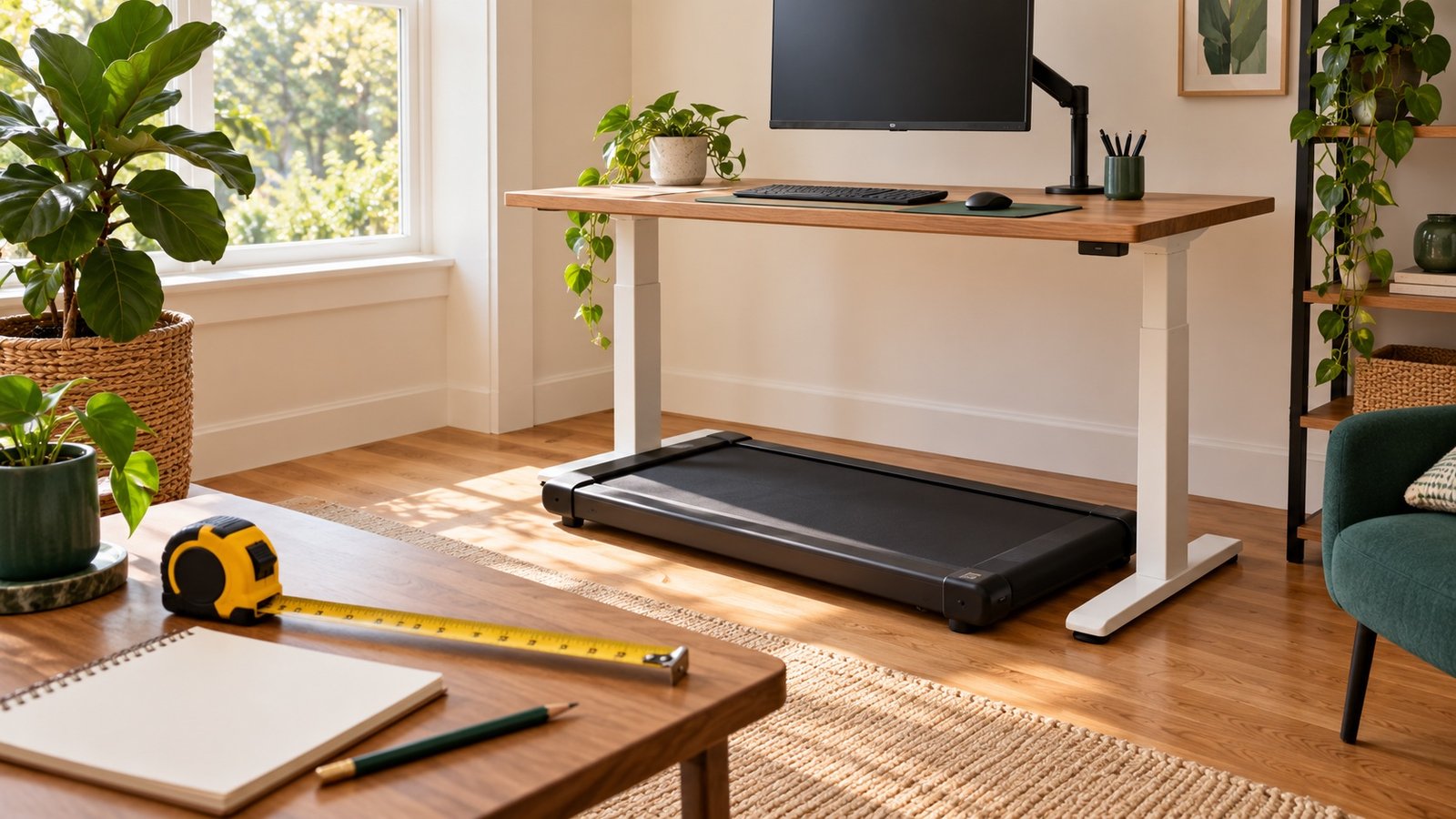


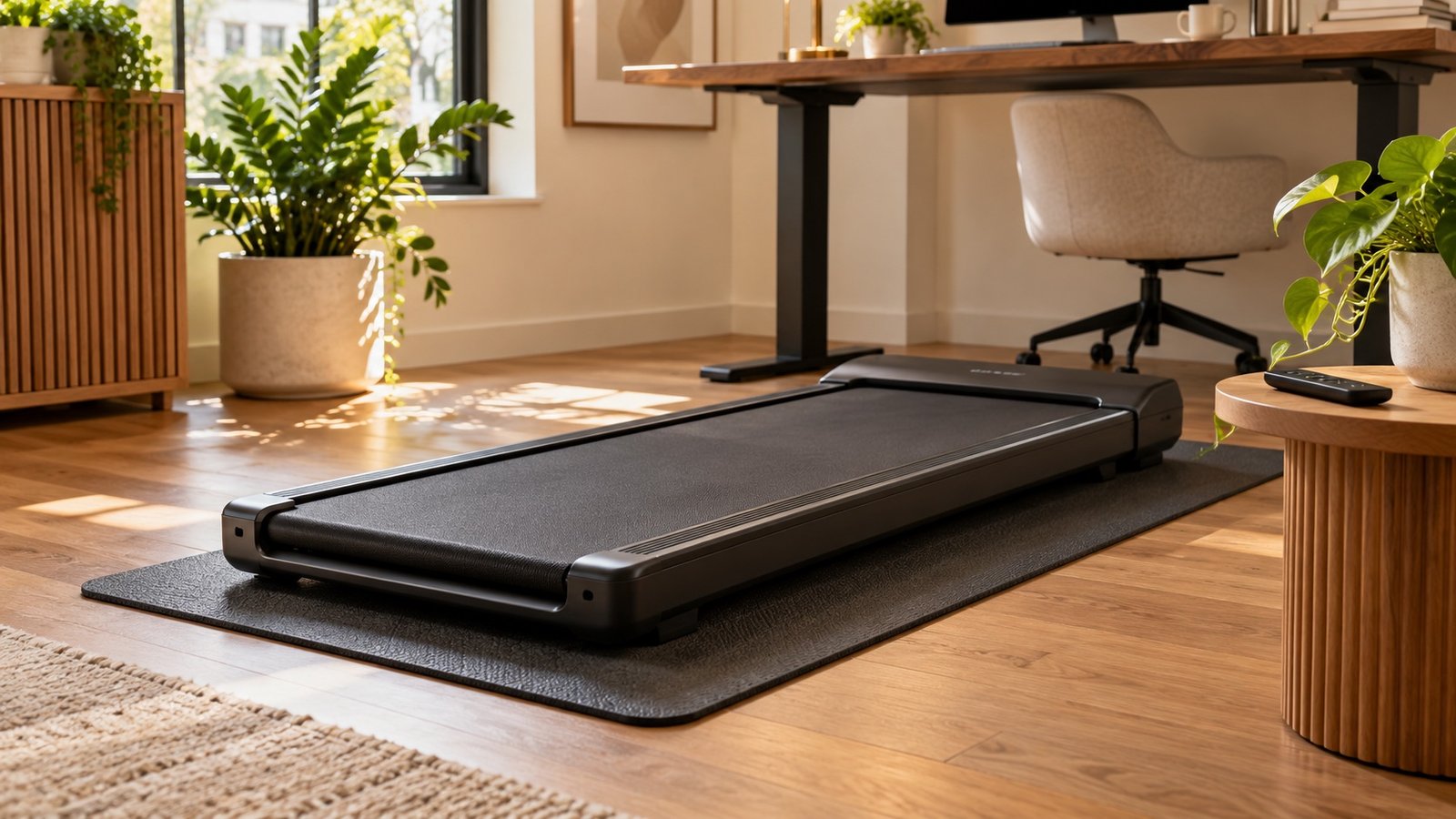
A walking pad may sound quiet beside your desk and still be noticeable in the apartment below. Motor sound, footsteps, and vibration are different parts of the problem. The most useful first check is a short, agreed listening test in the rooms that matter, followed by one setup change at a time.
This guide helps you evaluate a current machine or plan before buying. We have not measured particular models or floors, so there is no “neighbor-proof” recommendation or promised decibel reduction. Your model's placement and maintenance instructions take priority over generic mat advice.
Separate the sounds before trying to fix them
| Sound or effect | Where to listen | First question |
|---|---|---|
| Steady motor hum or belt sound | Desk position and adjacent room | Is it normal operation, or a new change? |
| Footstep thuds | Nearby room and, with permission, the room below | Does it happen primarily while someone walks? |
| Furniture or object rattling | Desk, shelves, and nearby items | Is something touching the machine or responding to vibration? |
| New grinding, scraping, slipping, or a burning smell | Do not continue the session to diagnose it | Should the machine be stopped and checked by support? |
| Call microphone picks up walking | A short local voice recording | Can the work call be done seated instead? |
These categories are practical observations, not diagnoses. WalkingPad's maintenance guidance distinguishes ordinary operating sound from noises associated with possible equipment problems. Do not open a motor cover, adjust internal parts, or lubricate an unknown component based on a sound description online.
Why an advertised decibel number cannot settle the apartment question
A sound figure needs context: distance from the machine, speed, whether a person was walking, floor type, measurement method, and background sound. A number without those conditions is hard to compare with another product. It also does not tell you what a neighbor hears through a particular floor.
The manufacturer's noise FAQ notes that sound varies with model, pace, user weight, flooring, and maintenance. Treat a “quiet” description as a starting claim to investigate, not a guarantee for your building. A quieter motor cannot by itself resolve every footstep or vibration concern.
If a listing shows a low noise value but no method, ask for the test conditions. Before buying, also confirm the practical return process, including packaging and moving a heavy machine. A favorable return policy is less useful if collection or return shipping is difficult for you.
A short listening checklist for your own apartment
Arrange a brief daytime test with anyone whose room you want to check. Do not enter or record someone else's home without permission. If access is not possible, you cannot confidently infer the downstairs experience from your own room.
- Record the setup. Note the model, floor, approved mat if any, position, time, and speed units.
- Listen to the room before use. Note other sounds such as ventilation or street traffic. A quiet evening can reveal sound masked during the day.
- Try a brief normal walk. Use your comfortable work pace and usual permitted footwear. Do not alter your gait unnaturally just to make the test quiet.
- Ask for a description. Is it a hum, distinct footfalls, a rattle, or barely noticeable? Does it interfere with a conversation, work, or rest?
- Change one suitable variable. For example, move to another manual-compliant location or test an approved equipment mat. Repeat under similar conditions.
- Choose a workable session. Agree on suitable times or use ordinary walks instead if the disturbance remains unacceptable.
A simple log might say: Tuesday, 2 p.m. — 1.0 mph — living-room hard floor — downstairs listener hears repeated thuds; no change tested yet. This is a hypothetical example. It gives you a useful next question without labeling the machine defective or claiming a noise threshold has been exceeded.
What an equipment mat can and cannot do
A compatible mat may protect flooring and may reduce some vibration transfer. It is not soundproofing, and its thickness alone does not tell you whether it is suitable. Check that the pad stays level, ventilation remains unobstructed, and the mat does not contact moving parts.
WalkingPad's carpet note identifies airflow and foot-sensing concerns. Do not turn that into a rule that a mat makes all carpets safe. Consult your exact machine's instructions, especially on soft or deep-pile flooring.
Avoid stacking yoga mats, cushions, foam blocks, or loose rugs under the machine to chase a quieter result. Those changes can affect stability and airflow. If an approved configuration is still too disruptive, choose a different location or routine rather than continuing to improvise supports.
Check maintenance without guessing
Stop the belt and disconnect power as the manual directs before cleaning or maintenance. Compare your maintenance record with the model's schedule and specified lubricant. More oil is not automatically better, and a general-purpose spray is not a substitute for the product the manual specifies.
The manufacturer advises stopping and contacting support for concerning signs such as grinding, burning smell, or slipping. Keep a concise description ready: when the sound began, whether it changes under load, and any error code. Record only a safe, stationary demonstration if support needs one; do not continue walking on a machine behaving unpredictably.
A mat is not a repair for a mechanical fault. Likewise, quieter footwear does not resolve belt rubbing, a damaged component, or an overloaded machine. Stay within the model's specified capacity and obtain support when the cause is unclear.
Check work-call sound separately
Make a short local recording of your own voice in the usual call setup: one sample seated, another during a comfortable short walk. Listen while stationary. This shows what that microphone captured; it says nothing certain about the room below.
Try a call seated if walking is audible, distracting, or affects your attention. Headphones may hide the sound from you without reducing what someone else hears. Do not assume microphone noise suppression fixes an apartment disturbance.
Can a phone app help?
The NIOSH Sound Level Meter app is an iOS tool for sound measurements, with published testing conditions and technical limits. It can help document airborne sound consistently. It does not certify your apartment's sound insulation or decide what another person finds disruptive.
For a comparison, keep the device and position unchanged and note background sound. Do not subtract random app readings from a manufacturer's listing to claim a mat has a proven reduction. Consumer recordings and numbers are supporting notes; the affected person's experience is still relevant to your practical decision.
Common questions
Can downstairs neighbors hear a walking pad?
They may. Construction, machine placement, pace, footsteps, and surrounding sound differ. A short agreed test is more useful than a universal yes or no.
Will carpet make it quieter?
It may change sound transmission, but machine suitability comes first. Do not use an unsupported surface or block cooling airflow to reduce noise. Follow the model's floor instructions.
What if no setup is acceptable in my apartment?
Use walking breaks away from the desk, a suitable shared exercise area, or another activity that fits the home. A walking pad is optional equipment; a purchase does not create an obligation to keep using a disruptive setup.
Sources and editorial notes
Researched October 6, 2026. The listening checklist and recording examples are original editorial suggestions. No product decibel testing, acoustic certification, or legal noise-limit advice is claimed. See our editorial policy.
- WalkingPad: Operating sounds and maintenance concerns
- WalkingPad: Noise variability
- WalkingPad support: Floor and airflow considerations
- NIOSH: Sound Level Meter app
Explore the walking-pad desk guide
Choose the next question you want to solve:
- Walking Pad While Working: A Practical Desk-Walking Guide
- How Long Does It Take to Walk 10,000 Steps on a Walking Pad?
- Walking Pad Beginner Routine: A Flexible Two-Week Start
- Walking Pad Desk Setup: Measurements, Height and Clearance
- Walking Pad Not Counting Steps? Fixes for Apple Watch and Garmin
- Walking Pad Speed While Working: Find a Pace That Fits Your Task
- Walking Pad vs Treadmill: Which Should You Buy for Home?