

Buy a walking pad if you mainly want slow, steady walking at a desk or in a small room and need to store the machine away. Buy a treadmill if you want to jog or run, use incline, hold a handrail, or share the machine with heavier or less steady users. In the walking pad vs treadmill decision, the right choice depends less on which machine is “better” and more on your speed, space, safety, and budget.
This guide is for adults choosing one machine for home use. It compares typical features, gives you a decision list and a buyer checklist, and explains what the research on desk walking can and cannot promise. We have not tested or ranked specific models, and we do not endorse brands. Every spec below is a typical range; the product page and manual for the exact model you are considering always take priority.
Walking pad vs treadmill: what is the actual difference?
A walking pad is a compact, low-profile motorised treadmill built mainly for walking. Most have no fixed console or uprights, are controlled by a remote or app, and slide under a sofa, bed, or desk. A conventional treadmill has a longer and often wider deck, side rails or a front handrail, a console, and a motor designed for faster speeds and sometimes incline.
The line between them is blurring. Some “2-in-1” folding pads have a fold-up handrail and allow jogging speeds. One manufacturer's FAQ, for example, separates walk-only models from running-capable ones with listed maximum speeds of roughly 7.5–11.5 mph (about 12–18.5 km/h). So compare the specifications, not the product name.
Walking pad vs treadmill comparison table
| Feature | Typical walking pad | Typical home treadmill | Why it matters |
|---|---|---|---|
| Speed range | Walk-only pads often start around 0.5–1 km/h and top out near 6 km/h; some 2-in-1 folding models list 8–12 km/h with the handrail raised | Commonly from about 1 km/h up to roughly 12–18 km/h | Running needs headroom above your planned pace, not a motor at its limit |
| Handrails | Usually none; some have a fold-up bar | Side rails and/or a front handrail are usual | Important for balance concerns, beginners, and older users |
| Belt size | Shorter and often narrower | Longer and often wider | A longer stride or running gait needs more deck length |
| Incline | Usually flat | Manual or motorised incline is common at mid-range prices | Incline adds walking intensity without needing speed |
| Motor | Smaller; listings often quote peak HP | Larger; better models state continuous HP | Continuous rating reflects sustained work; peak HP figures can look inflated |
| Footprint and storage | Low and flat; slides under furniture; some fold in half | Larger; many fold upright but stay bulky | Measure the use area and the storage spot separately |
| Noise | Often quieter at walking speeds, but footfall and vibration still travel | Louder at running speeds; impact noise is the bigger issue | Matters in flats and shared homes |
| Weight capacity | Often lower; check the stated limit | Often higher | Choose a capacity comfortably above your body weight |
| Rough price band, India | About ₹8,000–₹30,000 in online listings we observed | About ₹20,000 for basic models up to ₹70,000–₹1,50,000 for higher-end home models | Sale prices move constantly; compare the warranty, not just the discount |
| Rough price band, US | About $100–$500 | About $500–$3,000+ | Same caution; delivery and installation may be extra |
The price bands come from online listings and retailer guides we reviewed in October 2026. They are indicative, not quotes. “MRP versus sale price” gaps in India are often very large, so the sale price you see this week is the more realistic number.
Which is better for under-desk walking?
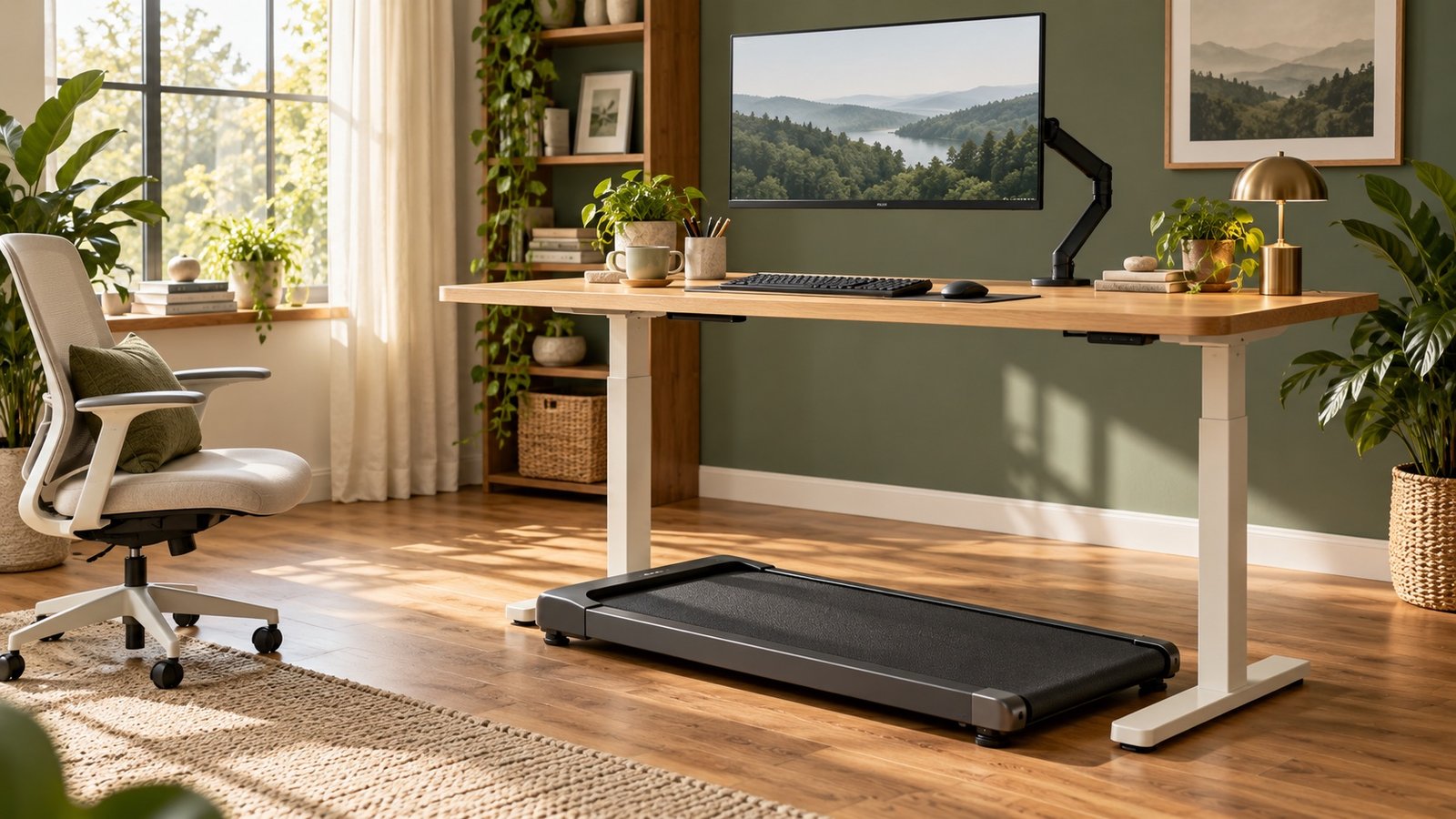
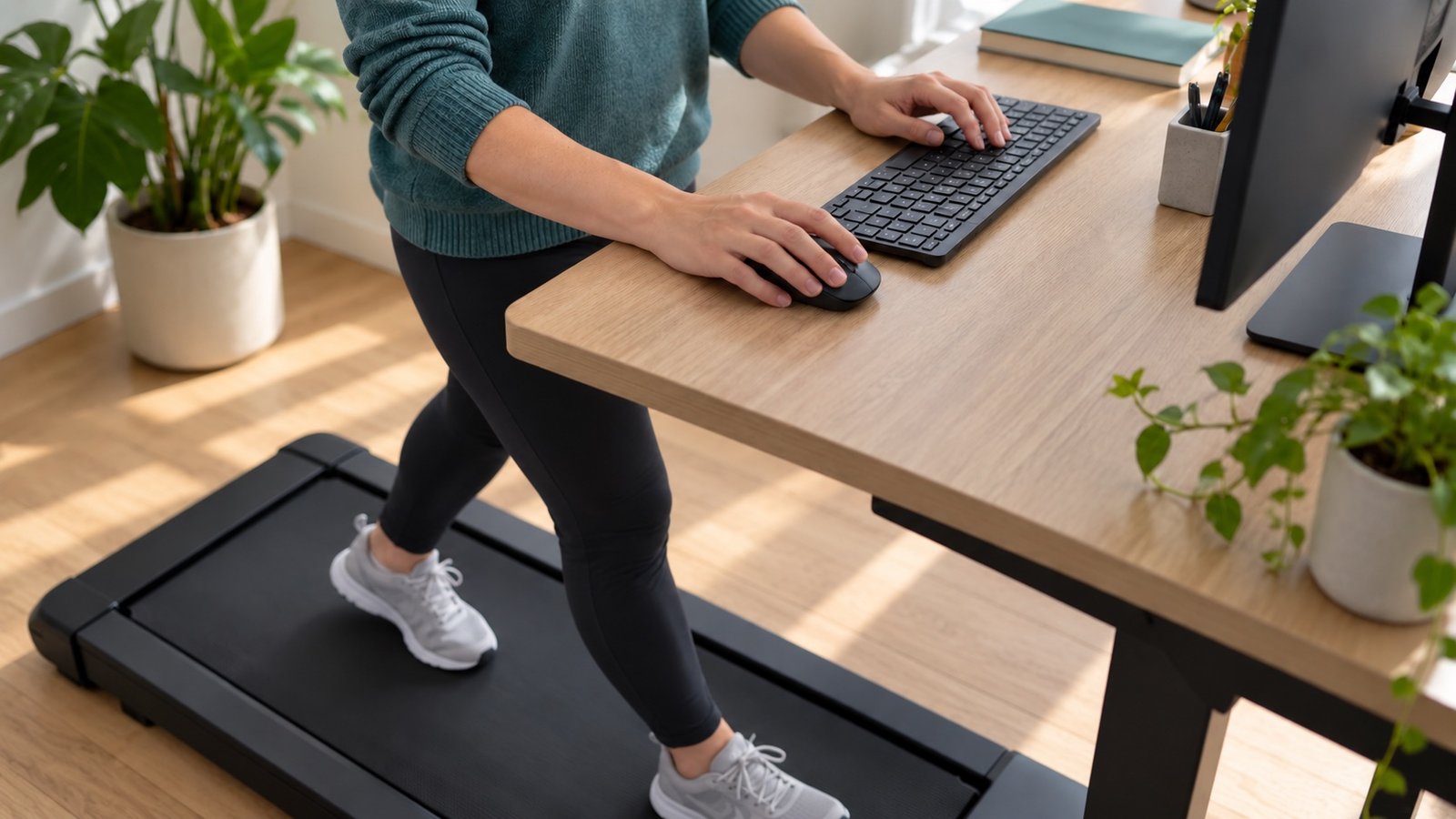
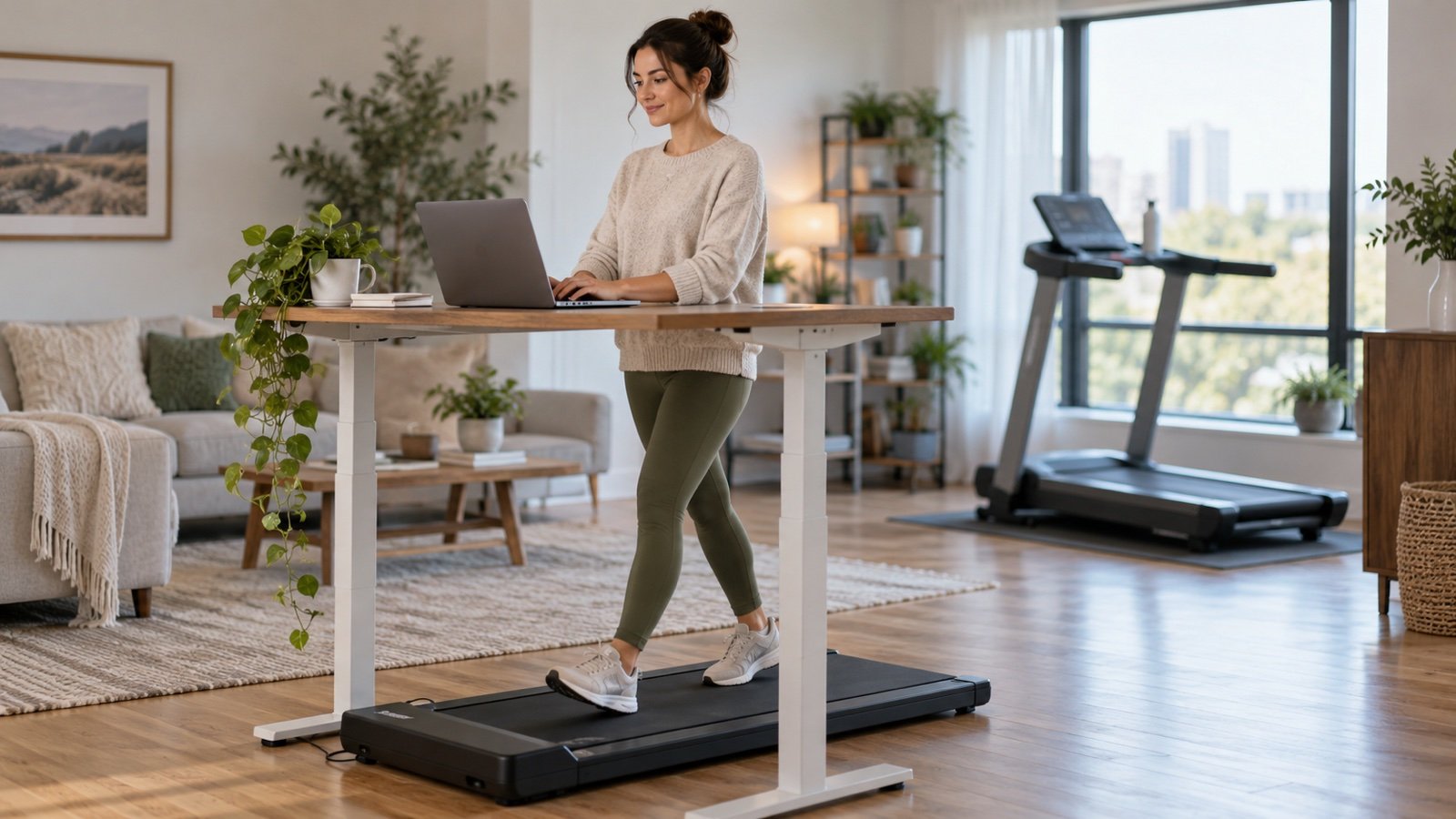
For walking while you work, a walking pad usually fits better. It is low enough to sit beneath a standing desk, has no console in the way of your keyboard, and is designed for the slow speeds most people can type at. Our guide to choosing a walking speed for work explains why slow, steady paces suit concentration tasks better than brisk walking.
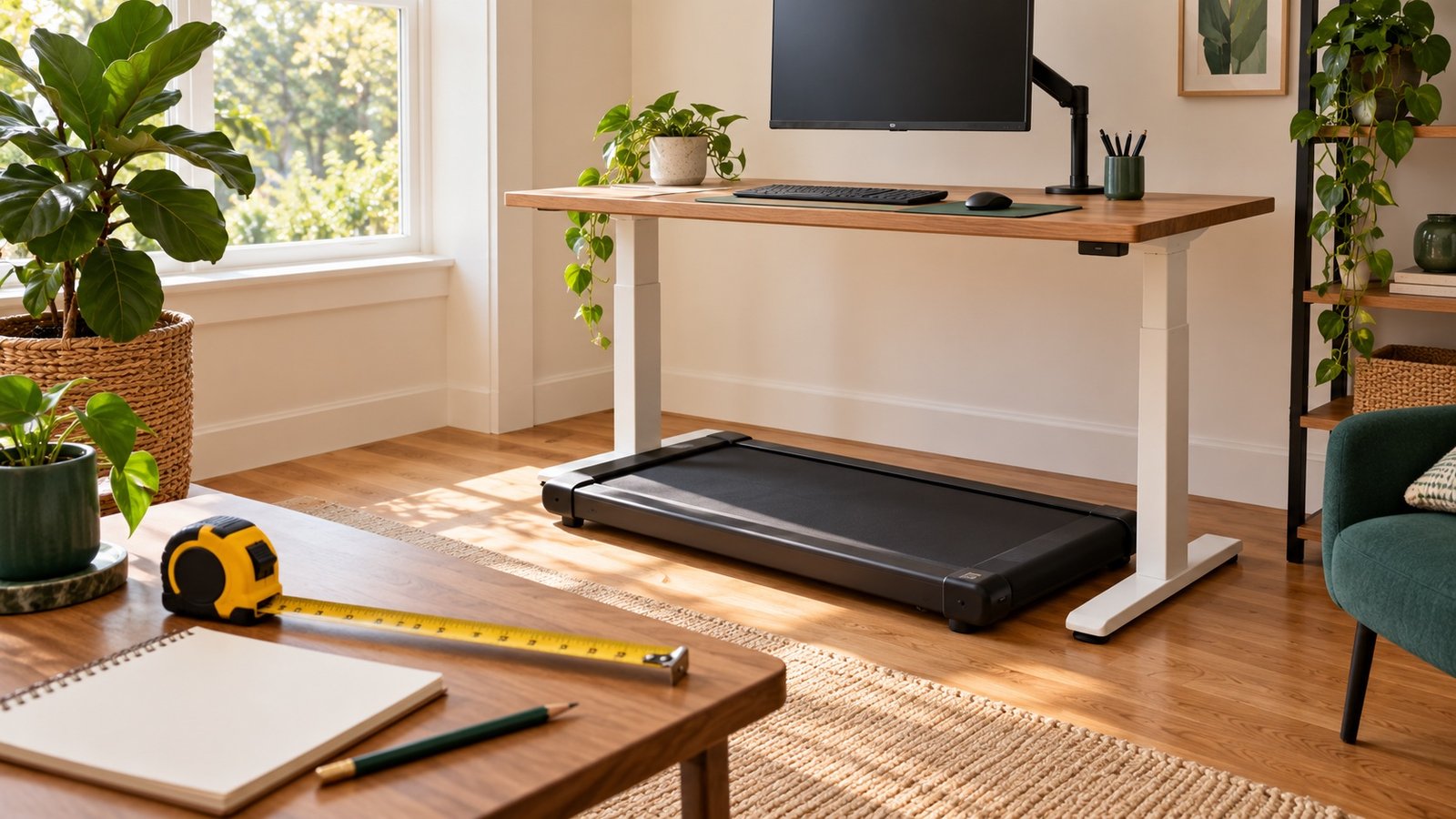
A full treadmill can work at a desk only if the console and handrail clear the desk edge, which is uncommon. Before buying either, use our walking pad desk setup measurements to check desk height, clearance, and the space between desk legs.
What does research say about treadmill desks?
The evidence supports modest benefits, not a transformation. A 2021 systematic review and meta-analysis of 13 studies (351 participants) found that laboratory treadmill-desk walking raised energy expenditure by about 105 kcal per hour compared with sitting. In workplace studies, users sat about 1.7 fewer minutes per hour across the day. The review found no clear changes in blood pressure, glucose, cholesterol, body fat, or BMI, and the authors called the cardiometabolic evidence inconclusive.
A 12-month cluster randomised trial in 66 office workers with overweight or obesity compared standard desks, sit-to-stand desks, and treadmill desks. Treadmill-desk users had longer standing and stepping bouts. They also had longer sedentary bouts at 12 months. The authors concluded that sit-to-stand desks produced potentially more favourable patterns of movement than treadmill desks. In other words, owning the machine is not the same as using it often.
The broader goal still makes sense. The World Health Organization advises adults to limit sedentary time and says any amount of physical activity is better than none, alongside its recommendation of at least 150 minutes of moderate-intensity activity per week. Slow desk walking breaks up sitting; it may not count as moderate activity. If you are not sure a machine is worth it yet, try the movement breaks in our five exercises for long sitting days first.
Buy a walking pad if… / Buy a treadmill if…
Work through this list in order. The first point that clearly applies to you usually settles the decision.
- Do you want to run or jog regularly? If yes, buy a treadmill with a speed ceiling well above your planned running pace and a deck long enough for your stride. Do not buy a walk-only pad for running.
- Do you need something to hold? If you have balance concerns, are returning after an injury, or have older family members who will use it, choose a treadmill with handrails, or at least a pad with a rigid fold-up rail rated for use.
- Is incline important to you? If you want harder walking workouts without running, a treadmill with incline is the simpler route; most walking pads are flat.
- Is the main use walking at a desk? If yes, a walking pad is usually the better match.
- Must the machine disappear after use? If you live in a small flat or rented room, a pad that slides under a bed or sofa is easier to live with.
- Do you live above neighbours? Both machines transmit vibration. Read our walking pad noise guide for apartments before buying either one.
- Is the budget tight? A walking pad usually costs less. Still, a cheap pad that does not meet your needs is not a saving.
Three quick examples
- Remote worker in a 1BHK, wants 5,000 extra steps on workdays: walking pad. Plan around the floor space under the desk and storage beneath the bed.
- Beginner runner training for a 5K in a hot city where outdoor running is hard in summer: treadmill with a running-rated motor, handrails, and enough deck length.
- Family of four where a parent walks and a teenager wants to jog: treadmill. One machine has to suit the most demanding user, and it must be secured from younger children.
Is a walking pad or treadmill safer at home?
Neither is risk-free. Any motorised belt can cause falls, friction burns, and entrapment injuries. In 2021 the US Consumer Product Safety Commission warned about one treadmill model after a child died after being pulled under the rear of the machine. Its advice included keeping children and pets away, unplugging the treadmill after use, storing the safety key out of children's reach, and keeping objects such as exercise balls clear of the machine. News coverage at the time cited a CPSC estimate of about 2,000 treadmill-related injuries to children under 8 in 2019.
- Safety key or auto-stop: Treadmills commonly use a clip-on key; many pads use a key, remote lock, or app lock. Confirm how the exact model stops and how you lock it.
- Children and pets: A low walking pad is easy for a toddler or pet to step onto. Store it unplugged and, where possible, out of reach.
- Exit space: Keep clear space behind the belt as the manual specifies. Walls and furniture behind a belt add risk.
- Session limits: Some walking-pad makers list maximum continuous use times and cooling periods. For example, the same manufacturer FAQ lists about 1 hour per session for its walking machines, then a rest of about half an hour.
Motor, deck, and build: what to compare
Continuous HP or peak HP?
Many listings, especially in India, quote peak horsepower, which is a momentary maximum. A continuous-duty rating says more about sustained use. If a listing gives only peak HP, ask the seller for the continuous rating. For running, look for a stated continuous rating suited to your speed and body weight in the manual or specification sheet.
Deck cushioning and belt size
Treadmills more often include deck cushioning, which can feel kinder to joints at higher speeds. Walking pads usually have thin decks, which is fine at slow walking speeds but not designed for repeated running impact. Measure your stride: if you are tall or have a long natural step, a short pad deck may make you shorten your walk or step near the front edge.
Warranty and maintenance
Both machines need belt tension checks, cleaning under the belt, and lubrication on the schedule in the manual. A belt that hesitates, slips, or squeals usually needs attention. Prefer sellers with local service, especially in Indian cities where parts can take weeks. Separate the frame, motor, and parts warranty terms rather than looking at a single headline number.
Buyer checklist before you pay
- Your usual and maximum speed, with a margin above it.
- Stated weight capacity comfortably above every user's body weight.
- Deck length and width compared with your stride and shoe width.
- Footprint in use, plus the clear zone behind the machine from the manual.
- Storage footprint and the weight you will need to move.
- Continuous motor rating, not only peak HP.
- How it stops: safety key, remote, app, or auto-stop.
- Handrail need for any user in the household.
- Floor type and neighbours below.
- Warranty terms, service network, and spare parts availability.
- Return window, in case the machine does not suit your desk or floor.
Common mistakes to avoid
- Buying a walk-only pad and planning to “jog a little.” If running is a goal, buy for running.
- Trusting the MRP discount. A large markdown says nothing about build quality or service.
- Ignoring the desk. A pad under a desk that cannot rise to your standing keyboard height becomes floor clutter.
- Choosing by advertised decibels. Footfall vibration in a flat often matters more than motor sound.
- Skipping maintenance. Belt lubrication and cleaning are part of ownership, not optional extras.
- Expecting weight loss from slow walking alone. The research shows modest energy use; diet, sleep, and other activity still matter.
- Starting with long sessions. Build up gradually with our walking pad beginner routine.
Common questions
Can you run on a walking pad?
Only if the manufacturer rates that specific model for running, usually a 2-in-1 with its handrail raised. Walk-only pads are not designed for running speeds or impact, and the manual's limits apply even if the belt feels fast enough.
Is a walking pad enough to reach 10,000 steps?
It can help you add steps, but the time required depends on your pace and stride. See how long 10,000 steps takes on a walking pad for worked examples.
Does walking on a walking pad count as exercise?
It counts as physical activity, and WHO guidance says any amount is better than none. Very slow desk walking may not reach moderate intensity, so it is best treated as a way to reduce sitting rather than a full replacement for brisk walks, sport, or strength training.
Which lasts longer, a walking pad or a treadmill?
No reliable comparative data exist. Lifespan depends on build quality, user weight, how close you run the motor to its limits, and maintenance. Use within rated limits and regular lubrication matter more than the category.
Is a walking pad good for older adults?
It can be, if the user is steady on their feet and starts at the lowest speed. Anyone with balance problems, a recent fall, or a heart or joint condition should speak to a clinician first and may be safer on a treadmill with handrails.
Where should I start if I already own a walking pad?
Our hub guide to using a walking pad while working links setup, speed, noise, and routine advice in one place.
Sources and evidence notes
Evidence checked on October 11, 2026. This is an editorial buying guide based on the research and public guidance below, plus observed online price listings; it is not a hands-on product test or a ranking. Price bands and spec ranges are indicative and change often. General information for adults; individual medical needs may differ.
- Systematic review and meta-analysis of treadmill desks (2021) — 13 studies; modest energy and sitting-time effects, inconclusive cardiometabolic results.
- Sit-to-stand and treadmill desk cluster randomised trial (2023) — 12-month trial in 66 office workers; movement patterns, not just totals.
- WHO: Physical activity fact sheet — Adult activity recommendations and advice to limit sedentary time.
- CPSC: 2021 treadmill warning — Rear-roller entrapment hazard and home safety advice for children and pets.
- CBS News: CPSC treadmill warning coverage (2021) — Reports the CPSC estimate of injuries to children under 8; secondary source.
- WalkingPad FAQ — Manufacturer example of walk-only versus running models, speed limits, and session limits; not an endorsement.
Explore the walking-pad desk guide
Choose the next question you want to solve:
- Walking Pad While Working: A Practical Desk-Walking Guide
- How Long Does It Take to Walk 10,000 Steps on a Walking Pad?
- Walking Pad Beginner Routine: A Flexible Two-Week Start
- Walking Pad Desk Setup: Measurements, Height and Clearance
- Walking Pad Noise in an Apartment: What to Check First
- Walking Pad Not Counting Steps? Fixes for Apple Watch and Garmin
- Walking Pad Speed While Working: Find a Pace That Fits Your Task