

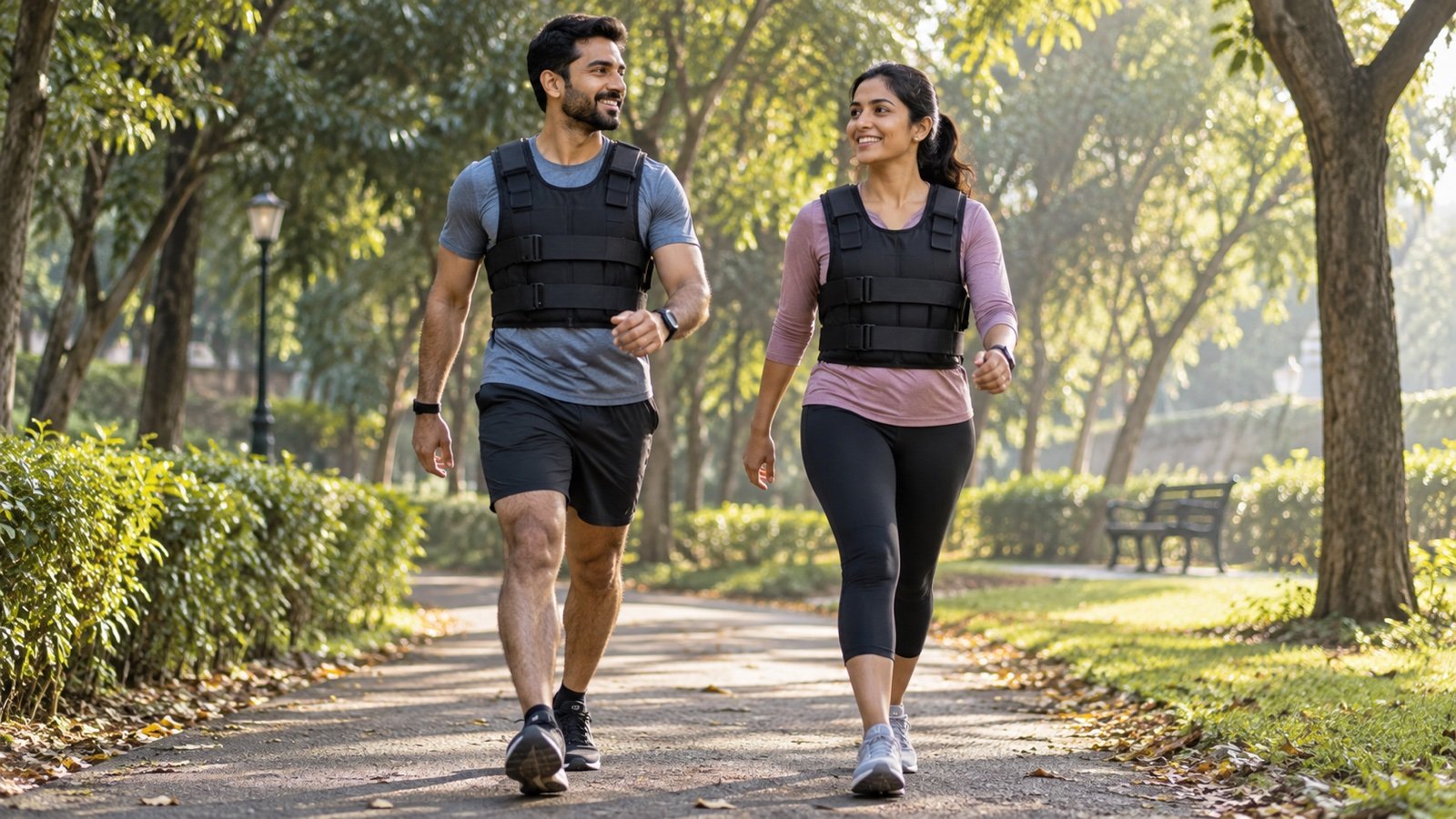
Weighted vest walking means walking with a snug, evenly loaded vest, and for most healthy beginners a sensible starting load is about 5% of body weight (3.5 kg for a 70 kg person), worn for shorter walks than usual and increased gradually toward roughly 10%. It makes a walk modestly harder. One small treadmill study found about 12% more calories burned with a vest of 15% of body weight. It has not been shown to protect bone on its own. Treat it as a way to make an existing walking habit a little more demanding, not as a shortcut to fat loss or stronger bones.
This guide covers what the research actually shows, how heavy to go, who should skip the vest, and a four-week beginner plan you can follow on the road, a track or an incline.
What weighted vest walking actually does
Adding load means your legs, hips and trunk have to move and stabilize more total mass with every step. Researchers who study load carriage, mostly in soldiers, use prediction equations to estimate the energy cost of carrying weight. The best known is the Pandolf equation, published in 1977, which estimates metabolic cost from body mass, load, walking speed, slope and a terrain factor (sand and soft ground cost more than a paved road). The broad idea is simple: the more total mass you move, the faster you go, and the steeper or softer the ground, the more energy you spend.
These equations are approximations. A 2020 study of 39 infantry soldiers compared five equations against measured energy cost during load carriage of 25–70 kg. Pandolf was the only equation that predicted accurately, and only at moderate loads and speeds; it underpredicted at slow speeds and overpredicted at the heaviest loads. The authors advised caution. In practice, any calorie number a fitness app gives you for a vest walk is an estimate.
How many extra calories does a weighted vest burn?
Less than many marketing claims suggest. In a study commissioned by the American Council on Exercise (ACE), 13 untrained women walked at 2.5 mph (about 4 km/h) at different treadmill grades with no vest or with a vest of 10% or 15% of body weight.
| Condition | Result versus no vest | Practical meaning |
|---|---|---|
| Flat (0% grade), 10% body weight vest | No significant increase in oxygen use | A light vest on flat ground at a slow pace may change very little |
| Flat (0% grade), 15% body weight vest | About 12% more calories burned | On the flat, a noticeable effect needed a heavier vest |
| 5% or 10% grade, 10% body weight vest | About 13% more calories burned | A lighter vest plus a gentle incline worked well |
| 5% or 10% grade, 15% body weight vest | No significant additional benefit over 10% | Heavier is not automatically better on a hill |
The study was small, included only women, and was commissioned by ACE, so treat the exact percentages as a rough guide. A worked example puts the numbers in perspective: if a 30-minute brisk walk burns about 120 kcal for you, an extra 12% is roughly 14 kcal, about one teaspoon of sugar. The vest is a useful way to raise effort, but daily movement and diet matter far more for weight. If you are still deciding how much walking to do overall, our guide to 7,000 vs 10,000 daily steps is a better starting point than the vest.
Does a weighted vest improve bone density?
This is the claim behind much of the recent hype, and the best evidence is sobering. The INVEST in Bone Health trial from Wake Forest, published in JAMA Network Open in 2025, randomized 150 older adults with obesity (average age 66, about three-quarters women) to 12 months of diet-based weight loss alone, weight loss plus a weighted vest, or weight loss plus supervised resistance training.
- The vest protocol: participants wore it for about 8 hours a day, adding weight weekly to replace the body weight they lost, up to 10% of starting weight. They averaged 7.1 hours a day.
- The main result: all three groups lost hip bone density. Total hip trabecular bone density fell about 1.9% with weight loss alone, 1.2% with the vest and 1.4% with resistance training. The difference between the vest and weight loss alone was not statistically significant.
- Some signals: a marker of bone formation rose in both exercise groups and fell with diet alone, and the vest was judged noninferior to resistance training. Only resistance training improved knee strength.
- The authors' conclusion: neither a vest nor resistance training prevented weight-loss-related hip bone loss, and other strategies are needed.
This trial tested all-day wear during weight loss, not 30-minute vest walks, so it does not tell us everything. But it is a clear warning against claims that a vest "builds bone." A UCLA Health orthopedic surgeon made the same point in 2025: the extent of any bone benefit is not yet known. If bone health is your goal, pair walking with progressive strength work. Our minimum effective strength training plan shows how to start with two short sessions a week.
How heavy should a weighted vest be for walking?
Start at about 5% of your body weight, which is the starting point UCLA Health suggests, and build toward roughly 10% over weeks rather than days. The ACE findings support staying around 10% if you also use inclines, because 15% added little extra on a slope.
| Body weight | 5% (start) | 7.5% | 10% (typical upper target) |
|---|---|---|---|
| 50 kg | 2.5 kg | 3.75 kg | 5 kg |
| 60 kg | 3 kg | 4.5 kg | 6 kg |
| 70 kg | 3.5 kg | 5.25 kg | 7 kg |
| 80 kg | 4 kg | 6 kg | 8 kg |
| 90 kg | 4.5 kg | 6.75 kg | 9 kg |
Round down to the nearest plate your vest allows. If you are carrying significant excess body weight, you are already walking with extra load, so a lighter vest, or no vest yet, may be wiser.
Who should be careful or avoid a weighted vest?
A vest adds load to your spine, hips, knees and feet, and makes your heart work harder. Speak with a doctor or physiotherapist first if any of these apply:
- Back or neck injury, disc problems or ongoing back pain (UCLA advises being very cautious).
- Arthritis or pain in the hips, knees or ankles, which added weight may aggravate.
- Osteoporosis, especially with a previous fracture; the ACE guidance lists severe osteoporosis as a possible reason to avoid vests.
- Heart disease, uncontrolled blood pressure or lung conditions such as COPD.
- Pregnancy, or recent childbirth or abdominal surgery.
- Balance problems or a history of falls.
If you are new to exercise, UCLA suggests walking without a vest for several weeks first, then keeping your first weighted walks to less than half the length of your usual walk.
A 4-week weighted vest walking plan for beginners
Before you start, you should be able to walk 30 minutes comfortably, three or more times a week, without a vest. Keep every vest walk at a pace where you can still speak in full sentences, the same effort described in our guide to zone 2 cardio without a heart rate monitor. Keep your other walks vest-free.
| Week | Vest walks per week | Duration | Vest load | Terrain |
|---|---|---|---|---|
| 1 | 2–3, non-consecutive days | 15–20 min | 5% (3.5 kg) | Flat, even ground; a short loop near home |
| 2 | 3 | 20–25 min | 5% (3.5 kg) | Flat |
| 3 | 3 | 25–30 min | 7.5% (about 5 kg) | Mostly flat, a few gentle slopes |
| 4 | 3 | 30–40 min | Up to 10% (7 kg), or stay at 7.5% | Include gentle inclines or 3–5% treadmill grade |
Change only one thing at a time: if you add weight, do not also add time or steepness that week. Repeat a week if you feel joint pain, unusual soreness the next day, or your posture slips in the final minutes. Choose a loop rather than an out-and-back route for early sessions, as UCLA recommends, so you are never far from home if you tire.
How to progress after week 4
- Add incline before weight. In the ACE study, a 10% vest on a gentle grade matched or beat a heavier vest.
- Add time in 5-minute steps up to 45–60 minutes, then hold.
- Increase load slowly, by about 1 kg at a time, and rarely above 10–15% of body weight for regular walking.
- Keep some walks unloaded. Short easy walks, like a 10-minute walk after meals, do not need a vest.
How should a weighted vest fit, and what posture should you use?
The vest should sit high and snug on your torso so it does not bounce or shift when you walk briskly. Weight should be spread evenly front and back. Walk tall, with your shoulders relaxed and back, ribs stacked over your pelvis, and a natural arm swing. If you notice yourself leaning forward, shrugging or shortening your stride, the vest is too heavy or the walk is too long. Our guide to improving your posture covers the basics of a neutral stance.
Weighted vest vs rucking vs ankle weights vs incline walking
| Method | Where the load sits | Best for | Watch out for |
|---|---|---|---|
| Weighted vest | Spread evenly around the torso | Adding effort to normal walks with stable posture | Poor fit, heat build-up, too much weight too soon |
| Rucking (weighted backpack) | On the back, shifting your center of gravity | Hiking, outdoor endurance, carrying heavier loads | Forward lean; UCLA suggests a vest if balance or your back is a concern |
| Ankle weights | At the end of the leg | Seated or lying leg exercises | Not recommended by us for walking: load at the ankle may alter your gait and stress the knees and hips |
| Incline walking | No added load | Raising intensity with no extra equipment | Calf and Achilles tightness if you increase steepness quickly |
Common weighted vest mistakes
- Too heavy, too soon. UCLA notes that going too far or too heavy raises injury risk. Start at 5%.
- Running in the vest. Running multiplies impact forces. We suggest keeping the vest for walking unless you are an experienced runner progressing under guidance.
- Wearing it for every walk. Two to four vest sessions a week is plenty; easy, unloaded walking still counts.
- Ignoring the heat. A vest traps heat against your torso (more on this below).
- Overloading a walking pad. Your body weight plus the vest must stay within the machine's user weight limit. Check the manual before following our walking pad beginner routine with a vest.
Weighted vest walking in Indian heat
In much of India, a vest walk at noon from April to June is a bad idea. A vest covers your torso and reduces the skin area available for sweat to evaporate. The CDC's heat guidance for active people recommends exercising earlier or later in the day when it is cooler, drinking more water than usual without waiting for thirst, starting slowly, and wearing loose, light-colored clothing. It also notes that muscle cramps can be an early sign of heat illness. If you feel faint or weak, stop and move somewhere cool.
- Walk before about 8 a.m. or after sunset in summer, or use an indoor track or treadmill.
- Reduce vest weight or duration on very hot or humid days; in monsoon humidity, sweat evaporates poorly.
- Carry water; for longer, sweaty walks, plain water with a pinch of salt and lemon, or nimbu pani, can replace some lost salts.
- Skip the vest entirely during a heat wave alert.
Weighted vest buying checklist
- Adjustable: removable plates or sand bags in small steps (about 0.5–1 kg) so you can start at 5% and progress.
- Snug fit: side straps or a cross-strap that stops bounce; try a brisk walk before you commit.
- Even distribution: weight spread front and back, not hanging low on the belly.
- Breathable: mesh panels or a short, open design for hot climates.
- Comfort points: padded shoulders, no rubbing at the neck or armpits.
- Washable: removable weights so the vest can be cleaned after sweaty walks.
Common questions
Is a weighted vest walk better than a normal walk?
Not necessarily better, just harder. It can raise heart rate and calorie burn modestly, but the same goal can be reached by walking a bit faster, longer or uphill.
How long should I wear a weighted vest when walking?
Start with 15–20 minutes, or less than half your usual walk, and build toward 30–45 minutes over several weeks. All-day wear, as tested in the INVEST trial, is a different use and did not prevent hip bone loss.
Can a weighted vest help with weight loss?
Only slightly. Expect perhaps a 10–15% increase in calories for the same walk in favorable conditions. Your overall activity and eating pattern matter much more.
Is it safe to wear a weighted vest every day?
Many healthy adults can, but daily loaded walking leaves little recovery time for joints. Two to four sessions a week, with unloaded walks in between, is a more cautious default.
Sources and evidence notes
Evidence checked on October 11, 2026. This article is an editorial synthesis, not a systematic review. The four-week plan and loading table are our suggested application of the guidance below, not a protocol tested in a trial. General information for healthy adults; seek individual advice if you have a medical condition.
- Weighted Vest Use or Resistance Exercise to Offset Weight Loss–Associated Bone Loss in Older Adults (JAMA Network Open, 2025) — Randomized trial of 150 older adults; the vest did not prevent hip bone loss during weight loss.
- ACE: Improve Walking Workouts With Weighted Vests — Small ACE-commissioned treadmill study in 13 untrained women; source of the calorie percentages.
- UCLA Health: Should you walk with a weighted vest? (2025) — Clinician guidance on 5% starting load, progression, fit, rucking and cautions.
- Accuracy of Metabolic Cost Predictive Equations During Military Load Carriage (J Strength Cond Res, 2020) — Tests the Pandolf and other equations in 39 soldiers; estimates are approximate.
- CDC: Heat and Athletes — Public guidance on timing, hydration, clothing and warning signs when exercising in heat.