

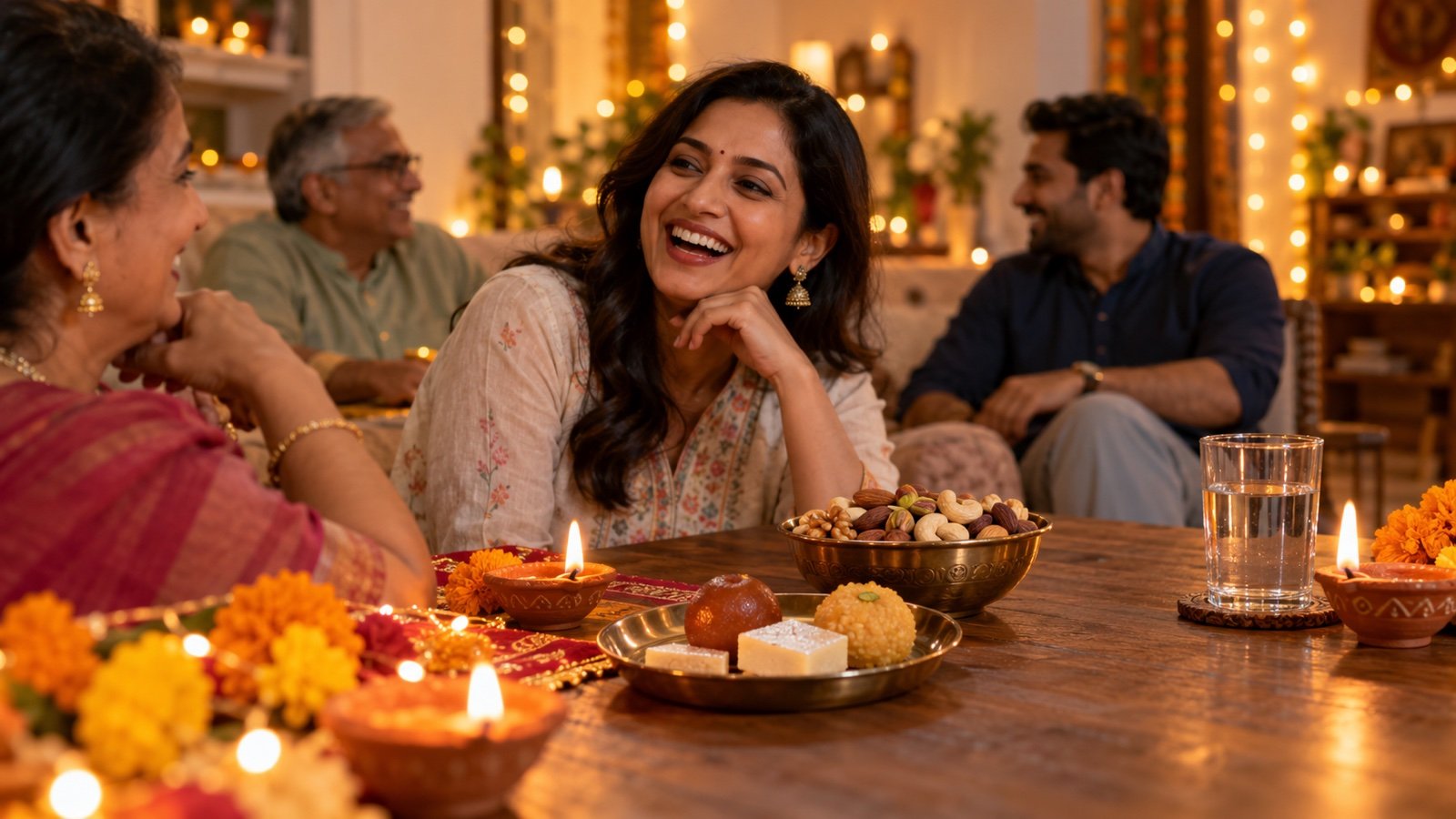
A healthy Diwali does not mean skipping sweets. It means deciding which ones you actually love, eating them on purpose, and keeping your everyday anchors in place: a protein-rich breakfast, a 10–15 minute walk soon after big meals, short workouts, and normal sleep. Most single pieces of mithai land around 40–190 kcal; the real issue is unplanned grazing across five festive days.
Diwali (Lakshmi Puja) falls on Sunday, November 8, 2026 in most Indian calendars. With Dhanteras before and Bhai Dooj after, the festive stretch usually runs about five days (check your local panchang). Below: approximate calories, portion rules, a festival-day plan and a five-day mini plan, with no guilt required.
How many calories are in Diwali sweets?
Recipes and piece sizes vary widely, and food-composition tables report energy per 100 g, not per piece. So we took per-100 g values from two published databases: the Indian Nutrient Databank (INDB), which builds recipes mainly from ICMR-NIN's Indian Food Composition Tables, and the UK's McCance and Widdowson's CoFID dataset, which includes several South Asian sweets. We multiplied each by a typical piece weight (our estimate), so treat every figure as a range.
| Item | Energy per 100 g (source) | Assumed piece or portion | Approx. kcal per piece or portion |
|---|---|---|---|
| Kaju katli | 422 kcal (INDB) | 1 piece, 10–15 g | 40–65 |
| Gulab jamun, with syrup | 273–306 kcal (CoFID, homemade vs retail) | 1 piece, 40–60 g | 110–185 |
| Rasgulla, with syrup | 119 kcal (INDB) | 1 piece, 40–60 g | 50–70 (more if you drink the syrup) |
| Jalebi | 369 kcal (CoFID) | 1 coil, 20–30 g | 75–110 |
| Besan ladoo | 477 kcal (INDB) | 1 ladoo, 30–40 g | 145–190 |
| Plain khoya burfi | 408 kcal (INDB) | 1 piece, 25–30 g | 100–120 |
| Soan papdi | Not listed in either database | Check the pack | Multiply the label's per-100 g figure by the piece weight |
| Chakli / murukku | 594 kcal (INDB, rice murukku) | 1 piece, 15–20 g | 90–120 |
| Namkeen mix / chivda | 487–503 kcal (CoFID chevda and Bombay mix) | 1 small bowl, 30 g | 145–150 |
| Plain cashews or almonds | 554–573 kcal (CoFID) | A small handful, 15 g (about 10 nuts) | 83–86 |
| Raisins or dried dates | 235–256 kcal (CoFID) | 15 g | 35–40 |
Databases disagree: INDB's khoya gulab jamun recipe is about 586 kcal per 100 g, roughly double CoFID's, likely because it assumes more fat. A rich halwai jamun may sit above our range. For packaged sweets, the product's own label beats any table.
What does that mean for sugar and for your week?
The WHO healthy-diet guidance recommends keeping free sugars below 10% of daily energy. On a 2,000 kcal day, that is about 50 g. It also notes that going below 5% may give further benefit. Here is a worked example using INDB's free-sugar values and CoFID's total-sugar figure for gulab jamun:
- 2 pieces of kaju katli (25 g, about 31 g free sugar per 100 g): about 8 g
- 1 besan ladoo (35 g, about 38 g free sugar per 100 g): about 13 g
- 1 gulab jamun (50 g, about 36 g total sugar per 100 g): about 18 g
That comes to roughly 39 g of sugar from four sweets, before any chai, sharbat or cold drinks. One festive day can fit this; five in a row is where it adds up. Hence: choose your sweets rather than avoid them all.
Healthy Diwali portion rules for the festive table
- The "favourite three" rule. Pick the two or three sweets you would really miss, eat them slowly, and skip the ones you only eat because they are there.
- Halve, then decide. Share a ladoo or burfi; if you still want the other half after 10 minutes, have it.
- Use a small plate, and stay away from the snack table. Serve once instead of picking from open boxes.
- Squeeze the syrup. Leave extra syrup in the bowl; pressing a rasgulla lightly removes some sugar.
- Portion namkeen into a bowl. Fried mixes are calorie-dense; one small bowl is a clear stopping point, the packet is not. For lighter savoury options, see our healthy snack ideas.
- Treat dry-fruit gift boxes as food, not a garnish. Plain nuts beat fried namkeen but are about 85 kcal per small handful. See the health benefits of nuts for why they still earn a place.
Why a protein-forward breakfast helps on festival days
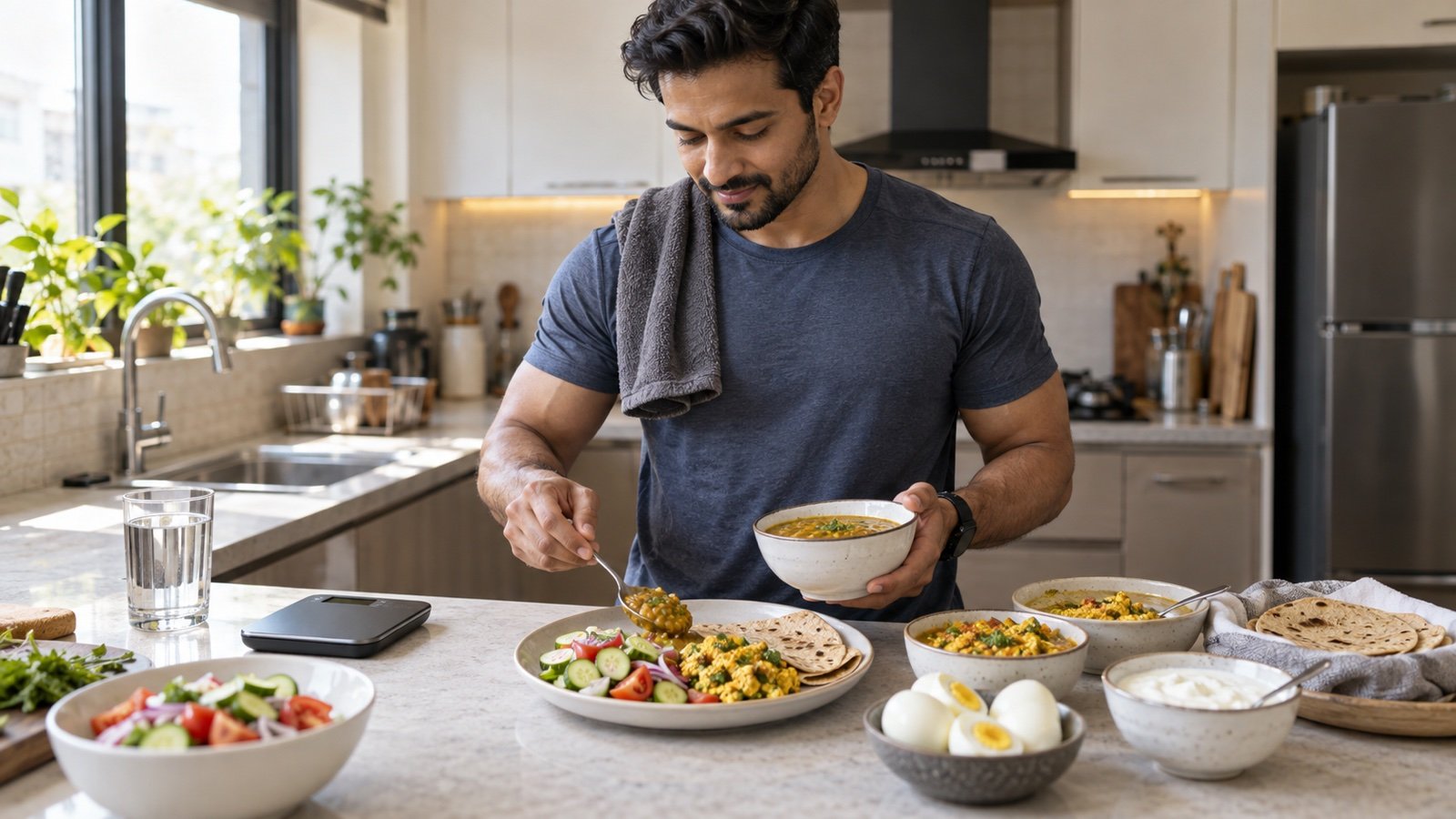
Skipping breakfast to "save" calories usually means arriving at the puja hungry. A filling, protein-rich breakfast with some fibre makes the day easier. Good Indian options include moong dal or besan chilla with paneer, eggs with whole-wheat toast, curd with fruit and seeds, or sprouts chaat. For more ideas, see our 100 g protein Indian vegetarian meal plan and how to increase fibre in an Indian diet.
Does walking after meals really help?
Yes, for blood sugar after a meal, and timing matters. A 2023 systematic review and meta-analysis pooled eight small crossover trials (116 participants, some with type 2 diabetes). Exercise, mostly walking, done after eating reduced post-meal glucose rises compared with doing nothing. Exercise done before the meal did not. The sooner the activity started after eating, the bigger the effect. The trials were small and rated at high risk of bias, so take this as a useful habit, not a fix for overeating. A post-dinner family walk to see the diyas is an easy tradition. Compare options in our 10-minute walk after meals vs 30-minute walk comparison.
How long would you need to walk to burn off a sweet?
The Adult Compendium of Physical Activities lists level walking at 2.8–3.4 mph (about 4.5–5.5 km/h, a moderate pace) as 3.8 METs. Using the standard estimate of 1 MET ≈ 1 kcal per kg of body weight per hour, a 60 kg person burns about 3.8 kcal per minute and a 70 kg person about 4.4 kcal per minute. These are gross figures; the extra energy above resting is roughly a quarter less, so real minutes are longer.
| Item (mid-range estimate) | 60 kg person | 70 kg person |
|---|---|---|
| Kaju katli, 1 piece (about 50 kcal) | about 13 min | about 11 min |
| Jalebi, 1 coil (about 90 kcal) | about 24 min | about 20 min |
| Gulab jamun, 1 piece (about 150 kcal) | about 40 min | about 34 min |
| Besan ladoo, 1 piece (about 165 kcal) | about 43 min | about 37 min |
This is not about "earning" sweets: extra pieces are quick to eat and slow to walk off, so portions matter more than out-exercising the festival.
Keep training through the festive week
Rather than skipping hour-long sessions, plan two or three short ones:
- Strength (20–25 min): squats or goblet squats, push-ups, rows, hip hinges, and a plank, 2–3 rounds at a comfortable effort.
- Walk or cycle (20–30 min): ideally after your largest meal.
- Mobility (10 min): on the days you are cleaning, decorating and travelling.
The goal is keeping the habit, not burning calories. If you do drift for weeks, our plan for returning to the gym after a long break shows how to ease back in without excessive soreness.
Alcohol, late nights and sleep
In its 2023 statement, it says no level of alcohol consumption can be called safe for health and that alcohol causes at least seven types of cancer. If you drink, less is better: set a limit beforehand, alternate with water and choose low-sugar mixers.
Late nights often mean more snacking and skipped workouts next day, so protect your usual wake time and return to normal sleep quickly.
Healthier homemade swaps (and one simple recipe)
- Roasted makhana or chana instead of a second bowl of fried namkeen.
- Baked or air-fried chakli and mathri instead of deep-fried, if you make them at home.
- Hung-curd shrikhand with less sugar, topped with fruit and pistachios.
Simple date-and-nut ladoo (makes about 16): Blend 200 g deseeded dates with 100 g chopped almonds and cashews (lightly roasted), a pinch of cardamom, and a spoon of desiccated coconut if you like. Using CoFID values for dates (235 kcal per 100 g) and nuts (about 560 kcal per 100 g on average), the batch contains roughly 1,030 kcal before any coconut, or about 65 kcal per ladoo. There is no added sugar, but dates are still very sugary (about 58 g of sugar per 100 g), so these are a better sweet, not a free food.
Sample festive-day eating plan
- Morning: water or tea with less sugar, then a protein-forward breakfast such as paneer-stuffed besan chilla and curd, or eggs with toast and fruit.
- Mid-morning: if you are busy cleaning or shopping, fruit or a small handful of plain nuts.
- Lunch: a normal home thali with dal or rajma, sabzi, salad, and roti or rice.
- Afternoon: a 20–30 minute walk or short workout, and one planned sweet if you want it.
- Puja and evening: prasad and your "favourite three" sweets, eaten slowly, with one small bowl of namkeen at most.
- Dinner: fill half the plate with vegetables and dal before the rich dishes, then take a 10–15 minute walk soon after eating.
A five-day festive week mini plan
| Day | Food focus | Movement |
|---|---|---|
| Day 1 (Dhanteras) | Normal meals; sort gift boxes into "keep" and "pass on" | 20–25 min strength session |
| Day 2 | Protein breakfast; prepare homemade swaps | Walk after dinner; mobility while cleaning |
| Day 3 (Diwali) | Follow the festive-day plan; enjoy your favourites | Short morning workout or brisk walk; walk after dinner |
| Day 4 | Lighter meals with plenty of dal and vegetables; leftover sweets portioned, not grazed | 20–30 min walk or cycle |
| Day 5 (Bhai Dooj) | One planned treat; drink water; regular sleep | 20–25 min strength session |
Afterwards, return to your normal routine; no "detox" or crash diet, which often triggers another overeating cycle.
Who should be more careful?
People with diabetes or prediabetes should plan festival eating with their doctor or dietitian, especially if they take insulin or other glucose-lowering medicines. Skipping or shifting meals can make glucose harder to manage, and "sugar-free" mithai can still be energy-dense from khoya, nuts and ghee. Post-meal walks help but do not replace medical advice.
People with kidney disease, heart conditions, food allergies (cashews and other nuts are common in mithai), or a history of disordered eating may also need individual guidance. If counting calories makes you anxious, skip the numbers and use the plate and portion rules instead.
Food safety: adulterated khoya and how to buy sweets
FSSAI's guidance note on traditional milk products notes that milk-based sweets have a short shelf life of about 1–4 days and spoil easily. Its 2019 festive-season survey of 1,041 Delhi-NCR samples found mainly quality and hygiene problems rather than safety failures, and these were more common in loose products than packed ones. Practical steps:
- Buy from licensed shops that display their FSSAI licence or registration. Prefer packed products, or loose sweets with a "best before" date shown on the tray.
- Respect shelf life. The note's examples: kalakand on the same day; rasgulla, rasmalai and sandesh refrigerated and eaten within 2 days; khoya burfi, peda and boondi ladoo within 4 days; kaju katli and dry-fruit ladoo within about 7 days.
- Use your senses. Avoid sweets that smell sour, look slimy, have burnt particles, or have an unusually bright colour.
- Quick home starch test for khoya, chhena or paneer: boil a small amount with water, let it cool, and add a few drops of iodine solution. A blue colour suggests added starch.
Common questions
Which Diwali sweet has the fewest calories?
Per piece, a small kaju katli (about 40–65 kcal) or a rasgulla with the syrup squeezed out (about 50–70 kcal) usually comes in lowest among the sweets in our table. Ghee-rich ladoos and large gulab jamuns tend to be the highest. Size matters more than the name of the sweet.
Can I eat sweets during Diwali and still lose weight?
Over a few weeks, yes. Fat loss depends on your overall intake over time, not on a single evening. Planning your favourites, keeping portions small, and staying active through the week usually keeps the festival from undoing your progress. Expect the scale to go up a little after salty, carb-heavy meals. Some of that is likely water and food volume, which often settles within a few days of normal eating.
Is jaggery mithai healthier than sugar mithai?
Not by much in terms of calories. Jaggery and sugar are both concentrated sugars, so treat jaggery sweets as sweets and use the same portion rules.
Are dry fruits a healthy Diwali gift?
Plain, unsalted nuts are a better choice than fried snacks and contain useful fats and fibre, but they are calorie-dense. Coated, honey-roasted or heavily salted versions are closer to namkeen.
Sources and evidence notes
Evidence checked on October 11, 2026. Calorie figures are our estimates: per-100 g database values multiplied by assumed piece weights. Walking-time figures use gross MET values and a simple formula. The festive-day and five-day plans are practical suggestions, not protocols tested in trials. This is general information for adults; individual medical needs differ.
- Development of an Indian Food Composition Database (Indian Nutrient Databank, 2024). Open-access recipe database built mainly on ICMR-NIN IFCT data; source of per-100 g values for kaju katli, besan ladoo, burfi, rasgulla and murukku.
- McCance and Widdowson's Composition of Foods Integrated Dataset (CoFID, 2021). UK reference database; source of values for gulab jamun, jalebi, chevda, Bombay mix, nuts and dried fruit.
- After Dinner Rest a While, After Supper Walk a Mile? (Sports Medicine, 2023). Meta-analysis of eight small crossover trials; post-meal exercise lowered glucose rises and timing mattered.
- Adult Compendium of Physical Activities: Walking. MET values used for the walking-time estimates.
- WHO: Healthy diet fact sheet. Free-sugar limit of under 10% of energy, with further benefit below 5%.
- WHO/Europe: No level of alcohol consumption is safe for our health (2023). Position on alcohol and cancer risk.
- FSSAI Guidance Note on Safety and Quality of Traditional Milk Products (2020). Shelf-life categories, festive-season survey findings, and quick home tests, including the starch test for khoya.