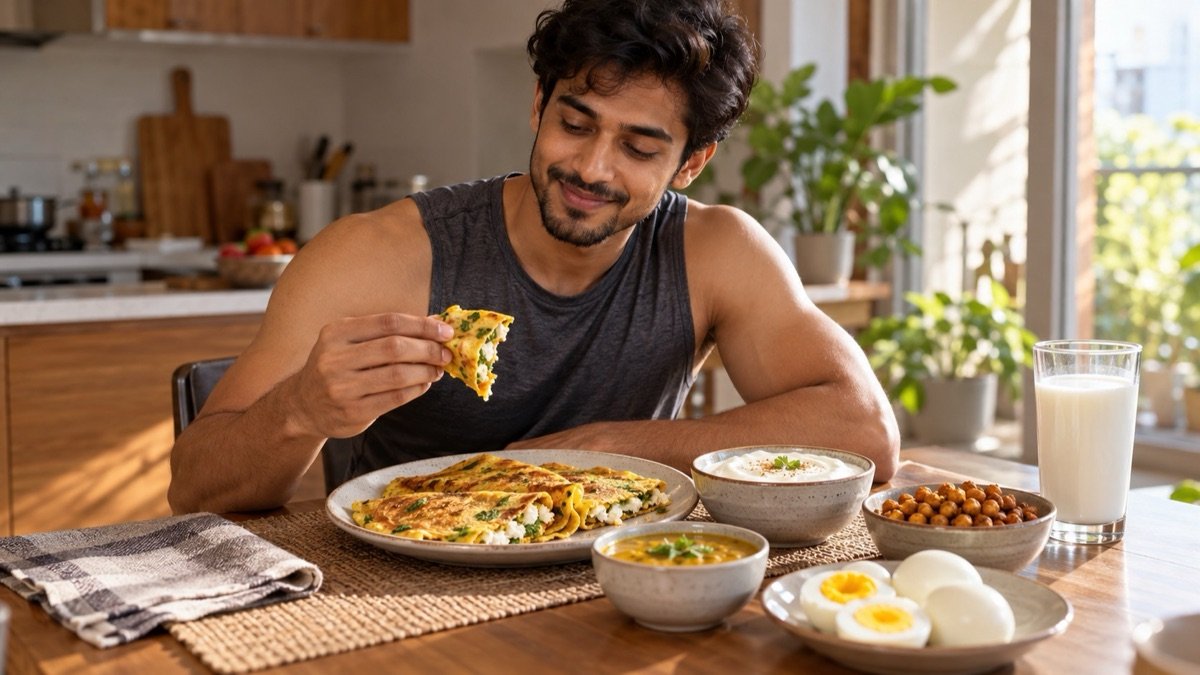


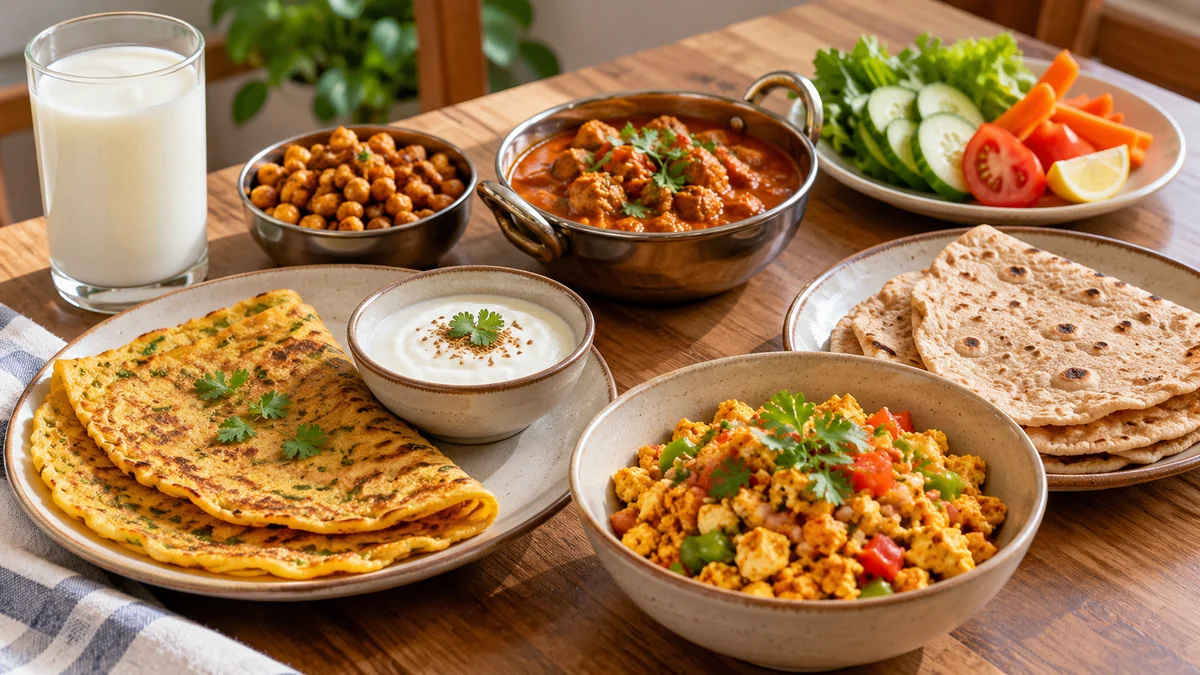
You can build an approximately 100g-protein Indian vegetarian day without protein powder by combining dal, soya chunks, paneer, milk, curd, and whole-wheat rotis. The sample below provides about 102g from its counted ingredients, using the stated nutrition assumptions. Your own total will depend on the foods and portions you actually use.
This is an egg-free, lacto-vegetarian meal plan: it includes dairy and soy. It is designed to make the calculation understandable, with dry weights for pulses, soya chunks, and flour. It is not a claim that everyone needs 100g of protein or a personalized weight-loss diet.
First, decide whether 100g is the right target
Protein needs depend on body size, activity, age, and health. The Mersey Care NHS protein guidance gives about 0.75g per kilogram of body weight daily as a general adult reference. That is about 45g for a 60kg adult; it is not an athlete's training target.
The International Society of Sports Nutrition's position stand describes 1.4–2.0g/kg/day as sufficient for most healthy exercising people aiming to build or maintain muscle. For a 60kg exercising adult, that range works out to 84–120g; for 80kg, it is 112–160g.
Those examples show why a round 100g target can fit one person and miss another person's needs. If you have kidney disease, a prescribed diet, or another condition affecting nutrition, set your target with your clinician or dietitian. This adult example is not intended for children or as a pregnancy meal plan.
For a foundation before changing your meals, see our explanation of protein and its different food sources.
A one-day Indian vegetarian meal plan with about 102g protein
Weigh the key ingredients before cooking. The two rotis in each main meal use 60g total dry atta; their cooked weight will vary with water and cooking. Paneer, curd, and roasted chana are weighed as eaten, and milk is measured in millilitres.
| Meal | Counted ingredients | Estimated protein |
|---|---|---|
| Breakfast: paneer-stuffed moong dal chilla with curd | 60g dry moong dal: 14.3g; 50g paneer: 10g; 100g plain curd: 3.5g | 27.8g |
| Lunch: soya-chunk curry with two rotis | 50g dry soya chunks: 26g; rotis from 60g dry atta: 6.3g | 32.3g |
| Snack: roasted chana and milk | 40g roasted chana: 8g; 250ml toned milk: 7.5g | 15.5g |
| Dinner: paneer bhurji with two rotis | 100g paneer: 20g; rotis from 60g dry atta: 6.3g | 26.3g |
| Daily total | Counted ingredients only | About 102g |
Add vegetables to the chilla, curry, and bhurji; include a salad or cooked vegetable side and fruit during the day. These additions matter for a balanced diet even though their protein is not included in the table. A high-protein day should still contain enough food, variety, and fibre to meet your broader needs.
Where these protein numbers come from
The calculations use 23.88g protein per 100g dry moong dal and 10.57g per 100g dry atta from the ICMR–National Institute of Nutrition's Indian Food Composition Tables 2017. The Nutrela manufacturer page lists 52% protein for its dry soya chunks, while Dudhsagar Dairy's Amul Fresh Paneer information lists 20g per 100g.
For the other foods, the example assumes 20g/100g for roasted chana, 3g/100ml for toned milk, and 3.5g/100g for plain curd. These are planning assumptions, not verified values for every brand or homemade batch. Check your packet and substitute its numbers. Greek yogurt, ordinary dahi, homemade paneer, and different milks are not nutritionally identical.
Formula: portion protein = portion weight ÷ 100 × protein per 100g. For milk labelled per 100ml, use volume instead of weight. If your paneer contains 18g/100g rather than 20g, the day's 150g paneer supplies 27g rather than 30g. Your estimated daily total drops by 3g.
How to prepare each meal
Breakfast: moong dal chilla with paneer and curd
Rinse 60g dry split moong dal and soak it until soft, following the packet's directions. Drain and blend with ginger, cumin, and enough fresh water for a pourable batter. Add chopped coriander or finely chopped vegetables if you like.
Cook the batter as two or three chilla, depending on pan size, using a measured amount of oil. Fill with 50g crumbled paneer and serve with 100g plain curd. The count of chilla does not determine the protein; the total ingredients do. Splitting one batter into four smaller chilla leaves its protein total unchanged.
Lunch: soya-chunk curry and rotis
Weigh 50g soya chunks while dry, then cook, drain, and squeeze them according to the packet instructions. Simmer in an onion-and-tomato base with spices and vegetables. Use 60g atta to make two rotis, adding water as needed.
A fully hydrated serving weighs more because it has absorbed water. It does not acquire extra protein from that water. If the full 50g dry portion makes more food than you want at lunch, split the prepared curry between lunch and dinner and count each portion once.
Snack: roasted chana and toned milk
Measure 40g ready-to-eat roasted chana and 250ml milk. Keep the snack simple; a handful measured by eye can differ substantially between people. Choose unsweetened milk and check added salt on packaged chana if that matters for your diet.
If you do not tolerate regular milk, use an appropriate alternative and recalculate its protein. Almond, oat, and soy drinks can differ considerably; the word “milk” on the front of a carton is not a protein guarantee.
Dinner: paneer bhurji and rotis
Crumble 100g paneer into a cooked onion, tomato, and spice mixture. Add peas, capsicum, or another vegetable you enjoy. Serve with two rotis made from 60g atta and a vegetable side.
Across the day, this plan contains 150g regular paneer. Its energy and saturated fat can be substantial, so do not keep adding paneer simply to push the protein number higher. A lower-fat paneer or suitable tofu may fit your needs better; use its own label when making the swap.
How many calories does this meal plan contain?
A responsible calorie total requires the actual labels, oil, vegetables, fruit, and serving sizes. This is not a verified 1,500-calorie or weight-loss menu. Paneer, roti flour, milk, and cooking fat all contribute energy even when the focus is protein.
For context, the cited dairy page lists 312 kcal per 100g of its regular paneer. At that value, the day's 150g supplies about 468 kcal from paneer alone. Your brand may differ. Oil supplies roughly 9 kcal per gram, so 20g spread across the day's cooking adds about 180 kcal.
To calculate your day, use the same portion formula with calories instead of protein, then include oil, sides, fruit, chutneys, and drinks. Do not omit them because they add little protein. Our guide to calories and energy needs explains how that total fits into a broader eating plan.
Affordable swaps without losing track of protein
Keep the structure—one clear protein source at each meal—but change the food when price, access, or preference demands it. A swap should use matched protein amounts rather than equal food weights.
| If you change this | How to calculate the replacement | What else changes |
|---|---|---|
| 100g paneer counted as 20g protein | If tofu has 12g/100g, about 167g provides 20g | Texture, energy, calcium, and serving size depend on the product |
| 250ml milk counted as 7.5g protein | If a soy drink has 3g/100ml, 250ml also provides 7.5g | Choose an appropriate fortified option; check added sugar and other nutrients |
| 100g curd counted as 3.5g protein | If a plain yogurt has 8g/100g, 100g adds 8g; update the total | A higher-protein yogurt is not necessarily the cheapest option |
| 50g dry soya chunks counted as 26g protein | If cooked lentils provide 8g/100g, about 325g provides 26g | The cooked portion is larger; calories and fibre differ |
The replacement values in this table are conditional examples, not universal food-composition claims. A fully vegan version also needs the curd, milk, and both paneer portions replaced. It will have a different nutrient profile; it is not automatically balanced just because its protein total matches.
For other ingredients, browse our vegetarian protein food guide and plant-based grocery list.
Compare cost per 20g protein
Use local prices instead of a fixed “daily budget” that may be wrong in your city. Suppose a 200g paneer pack costs ₹100 and its label lists 20g protein per 100g. The pack contains 40g protein, so the cost per 20g protein is ₹50.
Cost per 20g protein = pack price ÷ total protein in the pack × 20. This hypothetical calculation can help compare soya chunks, paneer, tofu, dal, and yogurt. It does not mean the cheapest protein food should replace the rest of a balanced diet.
A shopping and preparation checklist
For the counted ingredients in one day, buy or portion: 60g dry moong dal, 50g dry soya chunks, 120g atta, 150g paneer, 100g plain curd, 40g roasted chana, and 250ml toned milk. Add your chosen vegetables, fruit, spices, and a measured quantity of cooking oil.
Prepare the curry base ahead and portion the paneer before cooking. For a family batch, multiply the dry ingredients by the number of servings, then divide the finished dish fairly. If a four-serving curry uses 200g dry soya chunks, each equal serving represents 50g dry chunks—not 200g.
Keep dairy chilled and refrigerate cooked food promptly. The FDA's safe-handling guidance advises refrigerating perishables within two hours, or one hour in temperatures above 32°C/90°F, and using shallow containers for quicker cooling. Do not leave soaked dal or prepared dairy meals sitting in a hot kitchen for the day.
Common mistakes with vegetarian protein totals
- Applying dry-food values to cooked weight. Fifty grams of cooked dal is not nutritionally the same as 50g dry dal.
- Counting a whole recipe as one serving. Divide the ingredient total by the portions actually served.
- Assuming ordinary curd is high-protein Greek yogurt. Check the label instead of copying an app entry.
- Adding nuts and seeds without checking portions. They can contribute useful nutrients, but also substantial energy.
- Ignoring digestive tolerance. If your normal diet contains few pulses, introduce larger portions gradually rather than forcing this entire menu immediately.
- Thinking powder is essential—or inherently bad. This plan demonstrates a food-based option. A supplement can be convenient for some people; it is not a prerequisite for this menu.
Frequently asked questions
Can I get 100g protein without eggs or whey?
Yes. Under the stated assumptions, this egg-free menu reaches about 102g using dairy, soy, pulses, and atta. That is an estimated intake, not a guarantee about every product or a requirement for every adult.
Are 50g dry soya chunks and 50g cooked soya chunks the same?
No. Hydration increases the weight. For this plan, weigh 50g before cooking, then eat that prepared portion or divide it and track the shares. Do not multiply its hydrated weight by the dry label's protein concentration.
Can I follow this for fat loss?
Only if the full menu fits your individual energy needs and circumstances. The protein number alone does not make it a fat-loss diet. Calculate the whole day and adjust portions with suitable professional support where needed.
Do I need all the protein immediately after exercise?
No. This plan spreads protein through meals. For practical food ideas around training, see our post-workout meal guide. A consistent daily routine is easier to use than trying to consume the whole target in one sitting.
Sources and nutrition notes
Checked October 5, 2026. This menu is an editorial food-planning example, not a dietitian-prescribed plan. Protein totals are estimated from composition data, manufacturer information, and explicitly stated assumptions; they do not describe exactly how much protein your body absorbs.
- ICMR–NIN: Indian Food Composition Tables 2017 — dry moong dal and atta composition.
- Nutrela: soya chunks — manufacturer protein information.
- Dudhsagar Dairy: Amul Fresh Paneer — an example of regular paneer's protein and energy values.
- Mersey Care NHS: protein guidance — general adult requirements.
- ISSN: protein and exercise position stand (2017) — exercise-related requirements and food-based intake; DOI: 10.1186/s12970-017-0177-8.
- FDA: safe food handling — cooling and refrigeration advice.