

Move your workout indoors when the US Air Quality Index (AQI) reaches the level where you, or someone you train with, is told to cut back. For people in sensitive groups, that is 101 (Unhealthy for Sensitive Groups). For everyone else, long or intense outdoor sessions are worth moving inside from 151 (Unhealthy), and all outdoor exercise is best avoided at 301+ (Hazardous). Bad air doesn't mean you should stop moving. It means you should change where you exercise and how hard you push.
This guide uses the EPA's AirNow activity guidance and published research, checked on 12 October 2026. It covers wildfire smoke and summer ozone days, explains how to make an indoor space cleaner, and gives nine indoor workouts with a short sample session for each. It is general information, not medical advice.
When to move exercise indoors: the AQI-to-activity table
The US AQI runs from 0 to 500 in six color-coded categories. AirNow publishes separate activity guides for particle pollution (the main problem in wildfire smoke) and ground-level ozone. The table below condenses that guidance and adds our suggestions for which workouts in this article fit each level.
| US AQI | Most healthy adults | Sensitive groups* | Good fits from this list |
|---|---|---|---|
| Good (0–50) | A great day to be active outside | A great day to be active outside | Any workout, indoors or out |
| Moderate (51–100) | A good day to be active outside | If you are unusually sensitive, make outdoor sessions shorter and less intense, and watch for coughing or shortness of breath | Outdoors, or any of the nine |
| Unhealthy for Sensitive Groups (101–150) | Fine to train outside. On ozone days, consider shorter, easier sessions | Make outdoor activity shorter and less intense and take more breaks. If you have asthma, follow your action plan | Sensitive groups: any of the nine indoors |
| Unhealthy (151–200) | Cut back on long or intense outdoor activity and take more breaks | Avoid long or intense outdoor activity and consider moving indoors | Move runs, rides and intervals inside (workouts 1–8) |
| Very Unhealthy (201–300) | Avoid long or intense outdoor activity and consider moving indoors | Avoid all physical activity outdoors | Indoor strength, treadmill walking, yoga, mobility. Save hard intervals for a filtered room |
| Hazardous (301–500) | Avoid all physical activity outdoors | Stay indoors and keep activity levels low | Yoga, mobility and light strength in your cleanest room |
*AirNow's sensitive groups include people with heart or lung disease (including asthma and COPD), older adults, children and teenagers, pregnant people (listed for particle pollution), outdoor workers, and, for ozone, anyone who is active outdoors.
Check the right number. The official US AQI for your ZIP code is on AirNow and its free app. During wildfire season, the AirNow Fire and Smoke Map also shows sensor readings, which help because smoke can change from hour to hour. Some third-party apps use their own scales or blend in other data, so if a number looks strange, compare it with AirNow.
Smoke vs ozone timing. According to AirNow, ozone is usually worse in the afternoon and early evening on hot, sunny days, so early-morning outdoor sessions are the standard workaround. Wildfire smoke doesn't follow a reliable daily pattern. Check the current reading instead of assuming mornings are clean.
Heat warning. AirNow notes that staying inside with the windows closed can be dangerous in very hot weather if you have no air conditioning. On a smoky heatwave day, keep indoor workouts light, or exercise somewhere air-conditioned, such as a gym, mall or community cooling center.
Is exercising in polluted air worse than not exercising?
For long-term health, regular exercise usually still comes out ahead, but polluted air reduces the benefit. The research also strongly favors moving hard sessions away from heavy pollution.
- Tainio et al., 2016, Preventive Medicine. This modeling study weighed the inhaled PM2.5 dose against the benefits of cycling and walking. At the global urban average for PM2.5, the benefits kept growing until about 7 hours of cycling or 16 hours of walking a day. For half an hour of daily cycling, fewer than 1% of cities in the WHO database had pollution high enough to reach the point where more activity stops adding benefit. The model used long-term average pollution, not short-term spikes such as a smoke event.
- Sinharay et al., 2018, The Lancet. In this randomized crossover study, 119 adults aged 60 and over (healthy, with COPD, or with ischemic heart disease) each did a 2-hour walk in London's Hyde Park and another along busy, diesel-heavy Oxford Street. The park walk improved lung function and arterial stiffness. On the street those benefits were blunted or reversed, and participants with COPD reported more wheeze and sputum. Where you exercise matters.
- Ku et al., 2025, BMC Medicine (23:647). This meta-analysis and pooled cohort analysis of about 1.5 million adults found that meeting recommended leisure-time activity was linked to roughly 30% lower all-cause mortality where long-term PM2.5 was below 25 µg/m³. Above that level the reduction was only about 12–15%. The benefit shrank but did not disappear.
What this means in practice: keep exercising, but on bad-air days move long or hard sessions indoors, avoid busy roads, and lower the intensity when you can't avoid the exposure. Hard exercise increases the amount of air you breathe each minute, and much of it goes in through your mouth. That raises the dose of whatever is in the air.
Make your indoor workout space cleaner
Indoor air is better than outdoor air on a smoke day, but it isn't automatically clean. The EPA says that with windows and doors closed and no air cleaner running, indoor PM2.5 is typically around 55–60% of outdoor levels, and it can range from about 30% to 100% depending on the home (EPA: Strategies to Reduce Exposure Indoors).
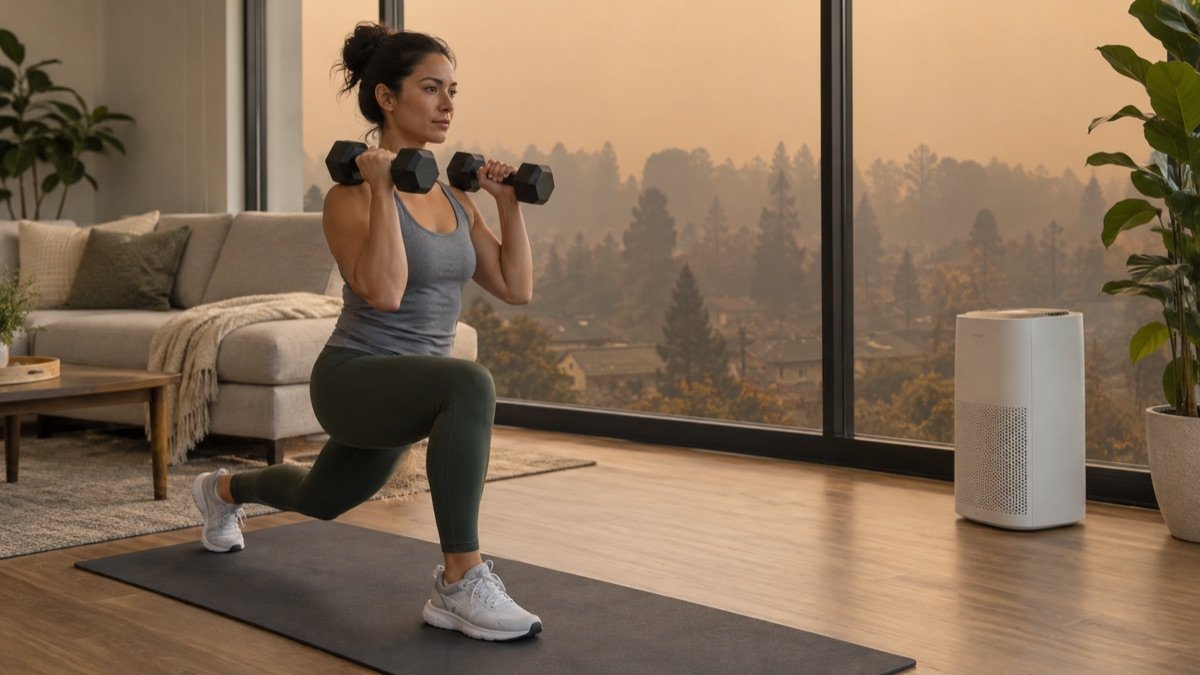
- Set up a "clean room." Follow the EPA's clean-room steps: pick one room you can close off, shut its windows and doors, and run a portable air cleaner on its highest setting. If there's space, use that room for your workout.
- Size the air cleaner to the room. The EPA's air-cleaner guide lists a minimum smoke CADR (clean air delivery rate) of about 65 cfm for a 100 sq ft room, 130 for 200 sq ft and 390 for 600 sq ft, assuming 8-foot ceilings. That's roughly two-thirds of the floor area. Choose a higher CADR for taller ceilings. Many units reach high CADRs with HEPA filters. Avoid devices that deliberately produce ozone. Start the cleaner 20–30 minutes before you work out.
- Consider a DIY box-fan filter if you don't have a purifier. In EPA lab tests, a 20-inch box fan with a single 1-inch MERV 13 filter delivered a smoke CADR of 111. Adding a cardboard shroud raised it to 156, and a four-filter "Corsi-Rosenthal" cube with a shroud reached 401. The EPA advises using box fans made in 2012 or later (with fused plugs and thermal cutoffs) that carry a UL or ETL mark, avoiding extension cords, and replacing filters once they turn dark gray or brown. The CDC says never to leave a DIY unit running unattended.
- Use your HVAC system wisely. If you have central air, use MERV 13 or higher filters if the system can handle them, and set it to recirculate or close the outdoor-air intake.
- Don't create indoor pollution while you train. The EPA and CDC advise avoiding candles, incense, smoking or vaping, gas or wood stoves, frying or broiling, aerosol sprays, and vacuuming without a HEPA filter during smoke events.
Do masks help if you exercise outside?
A well-fitted respirator can cut your smoke exposure for short trips outside. It doesn't make a hard outdoor workout safe on an Unhealthy or worse day.
- Use a respirator, not a cloth mask. The CDC recommends a NIOSH-approved N95 or P100 respirator that fits tightly if you have to go outside in smoke. It says dust masks, surgical masks, bandanas and wet cloths won't protect children from smoke (CDC: wildfire smoke and chronic conditions).
- Fit is the weak point. In a 2018 Occupational and Environmental Medicine study, total inward leakage for four masks worn by volunteers ranged from 3% to 68% while seated and 7% to 66% during activity. Only one mask type averaged under 10% leakage. The authors concluded that poor facial fit was the main problem.
- Hard efforts feel harder. In a 2021 randomized crossover trial in JAMA Network Open, 20 healthy adults ran treadmill tests to exhaustion. Wearing an N95 slightly shortened average exercise time and made breathing feel much harder, though no one had to stop for safety reasons.
Respirators make breathing harder. If you have heart or lung disease, ask your clinician before wearing one during exertion.
9 indoor workouts for bad air quality days
US Physical Activity Guidelines for Americans recommend at least 150 minutes a week of moderate aerobic activity (or 75 minutes vigorous) plus muscle-strengthening activity on two or more days. The list below lets you meet those targets without going outside. As a rule of thumb, you can talk but not sing during moderate effort, and you can only manage a few words at a time during vigorous effort. Unless your room air is filtered, favor moderate intensity on Very Unhealthy or Hazardous days.
1. No-equipment bodyweight circuit
Who it suits: anyone who needs a strength day with no gear and little space. Sample session (about 20 minutes): 3–4 rounds of 40 seconds work and 20 seconds rest: squats, push-ups (use a counter or sofa arm for an easier incline version), reverse lunges, glute bridges, plank and dead bugs. More ideas: 10 home workouts that need no equipment.
2. Stair climbing in an indoor stairwell
Who it suits: apartment and office dwellers who want a cardio boost in a few minutes. In a McMaster University study published in 2019, sedentary young adults who did vigorous climbs up three flights, three times a day, three days a week for six weeks improved their cardiorespiratory fitness compared with a control group. Sample session: march in place for 3 minutes, then do 6–10 climbs of 2–4 floors, walking down to recover each time. On a busy day, do three "stair snacks" spread across the day instead. Use enclosed interior stairwells, not stairs open to the outside, and go slowly if you have knee or heart problems.
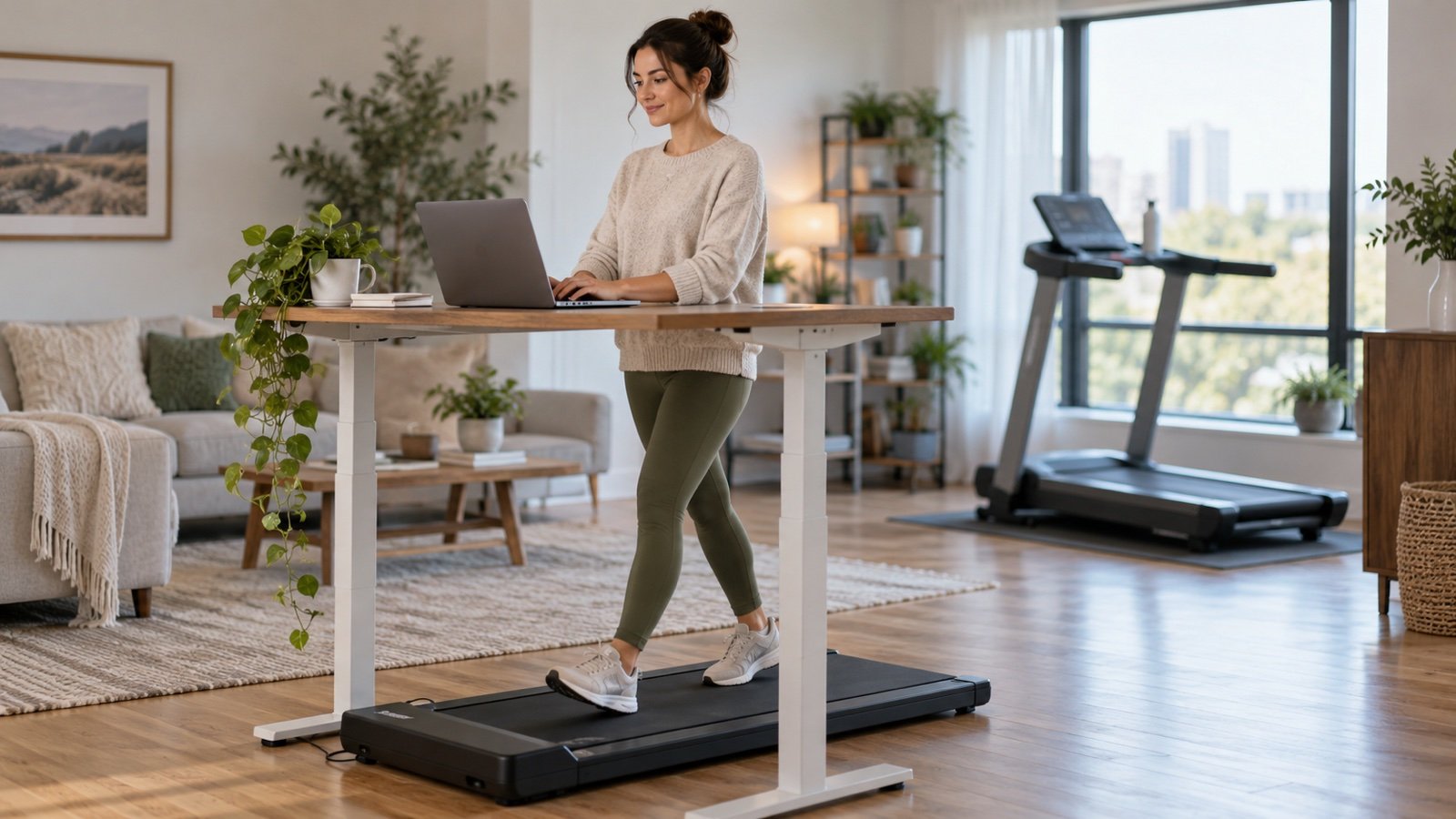
3. Treadmill or walking-pad walking
Who it suits: walkers, beginners, older adults and anyone who would normally walk outdoors. It gives you steady moderate-intensity minutes without breathing traffic or smoke. Sample session: 5 minutes easy, 25–35 minutes brisk enough that talking takes some effort, then 5 minutes easy. Alternatively, do three 10-minute walks after meals. See our walking pad beginner routine and how to judge Zone 2 effort without a heart-rate monitor.
4. Jump rope
Who it suits: fit adults who want vigorous cardio in a small space. Sample session: 10 rounds of 30 seconds skipping and 30 seconds rest, building up to 1 minute on. Jumping rope makes you breathe hard, so save it for your filtered room or for days at Unhealthy for Sensitive Groups or better. It isn't a good choice for people with knee or pelvic-floor problems, or in later pregnancy. Background: benefits of skipping every day.
5. Yoga flow with gentle breathing
Who it suits: everyone, especially on Hazardous days and for older adults who need balance work. It asks little of your lungs. Sample session (20–30 minutes): 4–6 slow sun salutations, then mountain, tree, warrior II, bridge and cobra poses, finishing with a few minutes lying still. Breathe gently through your nose. Skip forceful breathing techniques if you have asthma or feel unwell. There's no good evidence that breathing exercises protect your lungs from pollution. Related: what 30 days of yoga can change.
6. Resistance-band strength
Who it suits: beginners, travelers and anyone who wants joint-friendly strength work. Sample session: 2–3 sets of 10–15 reps of band rows, chest presses, squats, lateral walks, overhead presses and pull-aparts. A full plan: resistance band workouts for beginners.
7. Dumbbell strength session
Who it suits: anyone building muscle and bone who wants to keep progressing while outdoor training is off. Sample session: 3 sets of 8–12 goblet squats, Romanian deadlifts, one-arm rows, floor presses and split squats, then 30–40-second farmer's carries. Strength work keeps your breathing moderate between sets, which makes it a good choice on smoky days. See our beginner dumbbell workout at home and minimum effective strength training.
8. Shadow boxing or home HIIT
Who it suits: people who get bored easily and want a fun, intense session. Sample session: 6–8 rounds of 2 minutes (jab-cross, hooks, slips and footwork) with 1 minute of rest. Alternatively, do a 20-minute interval session of jumping jacks, high knees and squats. Like jumping rope, keep the most intense versions for clean indoor air. Learn the format: what HIIT is and how it works.
9. Mobility and balance session
Who it suits: sensitive groups, Hazardous-AQI days, recovery days and anyone stuck at a desk while smoke keeps them inside. Sample session (15–20 minutes): cat-cow, world's greatest stretch, 90/90 hip switches, thoracic rotations, ankle rocks, 30-second single-leg stands on each side, and heel-to-toe walking along a hallway.
A sample week when the air stays bad
- Strength (2–3 days): workouts 1, 6 or 7.
- Cardio (2–3 days, 30+ minutes): workouts 2 or 3. Use 4 or 8 only in a filtered room.
- Recovery (1–2 days): workouts 5 or 9.
Together, that adds up to the 150+ weekly minutes the guidelines recommend. If you live in an apartment and worry about noise, choose low-impact versions: see walking pad noise in apartments and our wider home workout guide.
Safety first: who should be extra careful
- Asthma or COPD: the CDC advises following your clinician's advice and your asthma action plan, and planning ahead for smoke season. Keep your quick-relief inhaler with you, even indoors.
- Heart disease: AirNow and the CDC say to contact your healthcare provider if you have palpitations, unusual tiredness or shortness of breath.
- Pregnancy: the CDC says pregnant people should be especially careful about smoke. Stay indoors in clean air and check with your prenatal care provider about exercise intensity.
- Children and teens: they breathe more air per pound of body weight than adults (AirNow). Move recess-style play and sports practice indoors when the AQI is high.
- Older adults: keep sessions moderate, and include balance work (workout 9).
Stop exercising if you get chest pain or tightness, unusual breathlessness, wheezing, dizziness or palpitations. Rest and use your reliever if one has been prescribed. Call your clinician if symptoms persist, and call 911 if they are severe or don't settle.
Common questions
At what AQI should I stop running outside?
Under AirNow's guidance, people in sensitive groups should shorten and ease off from 101 and avoid long or intense outdoor efforts from 151. Healthy adults should cut long or hard outdoor sessions from 151 and consider moving indoors from 201. At 301+, everyone should avoid outdoor exercise.
Is indoor air safe during wildfire smoke?
It's safer, but not clean. With windows closed and no filtration, indoor particle levels can still be more than half of outdoor levels. A properly sized portable air cleaner or a DIY box-fan filter in a closed room makes a big difference.
Should I wear an N95 to exercise outside?
An N95 that fits well reduces exposure during brief, light activity outside. It doesn't make hard outdoor exercise on an Unhealthy or worse day a good idea. If you have heart or lung disease, ask your clinician first.
Can I just exercise early in the morning?
On ozone days, yes. AirNow says ozone is lower in the morning. Smoke doesn't follow that pattern, so check the current AQI before you head out.
This article is general information, not medical advice. It is not a hands-on product test, and the author is not medically qualified. AQI changes hourly, so check AirNow before you train.
Sources
- AirNow/EPA: Air Quality Guide for Particle Pollution (2023): activity guidance and sensitive groups.
- AirNow/EPA: Air Quality Guide for Ozone (2023): ozone guidance and morning timing.
- AirNow: AQI Basics and Fire and Smoke Map.
- CDC: Safety Guidelines for Wildfires and Wildfire Smoke.
- CDC: Wildfire Smoke and People with Chronic Conditions.
- EPA: Strategies to Reduce Exposure Indoors.
- EPA: Create a Clean Room.
- EPA: Guide to Air Cleaners in the Home.
- EPA: Research on DIY Air Cleaners.
- Tainio et al., 2016, Preventive Medicine.
- Sinharay et al., 2018, The Lancet.
- Ku et al., 2025, BMC Medicine 23:647.
- Cherrie et al., 2018, Occupational and Environmental Medicine.
- N95 and cloth masks at peak exercise, 2021, JAMA Network Open.
- ODPHP: Physical Activity Guidelines for Americans.
- McMaster University: stair-climbing "exercise snacks" study (2019).