

Resistance bands are one of the most effective, affordable, and joint-friendly training tools in fitness. Systematic research confirms that training with elastic bands produces comparable muscle growth and strength adaptations to traditional free weights and gym machines when sets are taken close to muscular fatigue.
Too often, resistance bands are dismissed as mere physical therapy accessories or emergency travel gear. But elastic resistance provides a unique biomechanical stimulus that free weights cannot replicate. Because bands do not rely on gravity, they allow you to apply continuous horizontal and diagonal tension across entire ranges of motion without placing jarring compression on your joints.
Whether you work out in a small apartment, want a gentle transition into strength training, or need a budget-friendly home gym setup, this comprehensive beginner guide covers band selection, elastic progressive overload, and an actionable full-body routine.
The physics of bands: how elastic resistance differs from iron
When you lift a dumbbell, the resistance remains constant (20 pounds is always 20 pounds), but the torque around your joints fluctuates depending on gravity's angle. In a dumbbell bicep curl, the load feels heavy in the middle of the curl, but almost weightless at the very top and bottom.
Elastic resistance operates on Hooke's Law: tension increases proportionally as the band stretches. This creates an ascending resistance curve:
- Gentle on joint initiation: At the start of a movement (such as the bottom of a squat or chest press), the band is minimally stretched, placing low shear stress on vulnerable ligaments.
- Peak tension at maximum contraction: As you press or pull into full muscle shortening, the band stretches further, demanding maximum muscular recruitment right where your muscles are primed to contract hardest.
- Variable angles of force: Free weights only resist downward gravity. Bands resist in any direction you anchor them—horizontal, rotational, or upward—making them unmatched for core stability and postural pulls.
The 3 essential types of resistance bands
| Band type | Design & Appearance | Best exercises | Beginner verdict |
|---|---|---|---|
| Tube Bands with Handles | Hollow elastic tubes with clip-on handles, ankle straps, and door anchors. | Chest presses, lat rows, bicep curls, shoulder raises, face pulls. | Must-have for home workouts: The door anchor turns any doorway into a cable machine. |
| 41-Inch Loop Power Bands | Thick, continuous flat rubber loops (half-inch to 2.5 inches wide). | Squats, deadlifts, good mornings, assisted pull-ups, overhead presses. | Best for lower-body power: Step inside the loop for compound barbell-style lifts. |
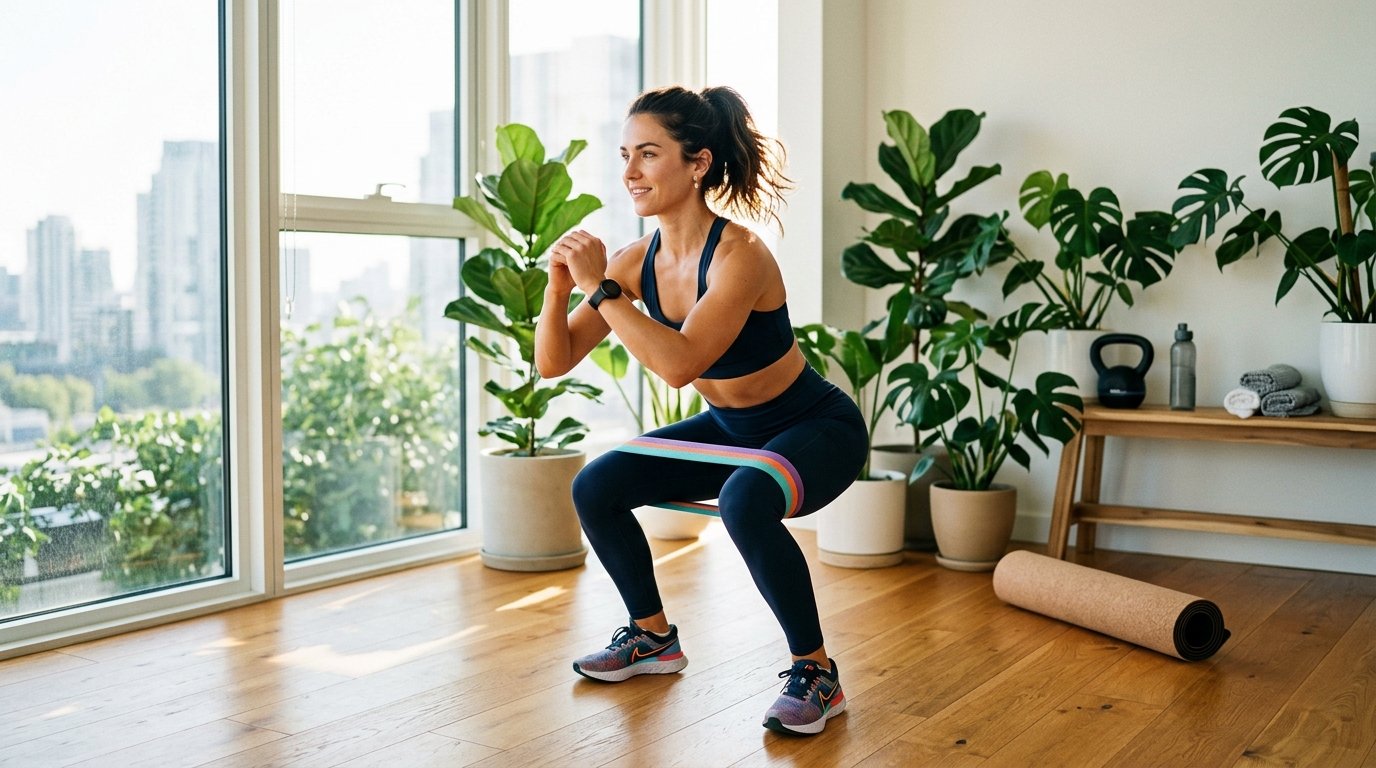
| Mini-Loop Fabric/Latex Bands | Small 9–12 inch loops placed around thighs, ankles, or wrists. | Glute bridges, lateral monster walks, clam shells, scapular retractions. | Essential for hips & posture: Activates gluteus medius and stabilizes knee tracking. |
Understanding band tension and colors
Unlike iron plates stamped with exact poundages, bands feature tension ranges (e.g., "15 to 30 lbs"). The resistance depends entirely on how far you stretch the band:
- Light (Yellow / Red — ~5 to 15 lbs): Ideal for smaller muscle groups (rotator cuff, lateral deltoids, triceps kickbacks) and warmup mobility.
- Medium (Green / Blue — ~20 to 35 lbs): The workhorse for beginner bicep curls, standing rows, chest presses, and assisted movement.
- Heavy (Black / Purple — ~40 to 60+ lbs): Perfect for compound lower body patterns: squats, deadlifts, and hip thrusts.
How to apply progressive overload with resistance bands
A common critique of bands is: "How do I progress when I don't have weight plates?" You apply progressive overload through five proven elastic techniques:
- Choking up on the band (Pre-tension): Grabbing the band 3 to 6 inches closer to the anchor eliminates slack at the start of the repetition, immediately multiplying the workload.
- Controlling the eccentric tempo: Elastic bands want to snap back quickly. By actively resisting the band for a slow 3-second negative, you stimulate intense muscle fiber recruitment.
- Adding an isometric peak hold: Pause for 1 to 2 seconds at the point of maximum band stretch (such as the finish of a row or top of a glute bridge) to maximize metabolic stress.
- Stepping farther from the anchor: In door-anchored rows or presses, taking half a step backward stretches the band further throughout the entire rep range.
- Band stacking: In tube-band sets, you can clip two or three bands into the same pair of handles (e.g., combining a 15 lb and 25 lb band for 40 lbs of combined resistance).
The full-body beginner resistance band routine
Perform this balanced routine 3 non-consecutive days per week (for example, Monday, Wednesday, and Friday). Rest 60 to 90 seconds between sets.
| Movement Pattern | Exercise | Sets & Reps | Setup & Form cue |
|---|---|---|---|
| Lower Body (Squat) | Banded Front Squat | 3 × 10–12 reps | Stand on a 41" loop band, bring the top of the loop up across your collarbone. Squat deep while keeping your chest tall. |
| Lower Body (Hinge) | Banded Romanian Deadlift | 3 × 10–12 reps | Stand on band loops with feet hip-width. Push hips back until hamstrings stretch; drive through heels to lock out. |
| Upper Body (Horizontal Pull) | Door-Anchored Standing Row | 3 × 12–15 reps | Anchor at chest height. Squeeze shoulder blades together, drive elbows back, and pause for 1 second at full contraction. |
| Upper Body (Horizontal Push) | Standing Band Chest Press | 3 × 12–15 reps | Anchor behind you at mid-chest. Stagger stance for stability. Press forward until arms extend without shrugging shoulders. |
| Upper Body (Vertical Push) | Banded Overhead Press | 2–3 × 10–12 reps | Stand on loop with one foot; press handles or band directly overhead while bracing your abdominals. |
| Core (Anti-Rotation) | Banded Pallof Press | 2 × 10 reps/side (3s hold) | Anchor at chest height; stand sideways. Hold band at sternum, press straight out, and resist the band's pull to twist you. |
| Arms Finisher (Superset) | Bicep Curl + Overhead Tricep Extension | 2 × 15 reps each | Stand on band for strict curls; immediately transition to overhead extension for triceps burn. |
Exercise setup details and coaching cues
1. Banded Front Squat
Step both feet inside a continuous loop band at shoulder-width, pointing toes slightly outward. Pull the other end of the band up over your shoulders, holding it with your hands near your collarbone like a barbell front squat. Inhale, brace your core, and squat down until your hips are parallel to the floor. Drive through your midfoot to stand tall against the escalating elastic tension.
2. Door-Anchored Row
Place your door anchor securely in the door jam at ribcage height. Clip your handles into the tube band and step back until there is moderate tension even with arms fully extended. Retract your shoulder blades first, then drive your elbows straight back past your torso. Avoid leaning backward or shrugging toward your ears.
3. The Pallof Press for bulletproof core stability
Named after physical therapist John Pallof, this anti-rotation movement trains your abdominal wall to resist rotational forces. Stand perpendicular to your door anchor with both hands clasped around the handle at your chest. Slowly press your hands straight forward. The band will try to twist your torso toward the door; your job is to keep your core completely rigid. Hold for 3 seconds before returning to your chest.
Resistance band safety checklist
While resistance bands have a stellar safety record, snapped latex can cause sudden injury if misused. Follow these four safety non-negotiables:
- Inspect before every session: Run your fingers along the band to feel for micro-tears, nicks, or fading discoloration. Discard damaged bands immediately.
- Always close the door toward you: When using a door anchor, ensure the door closes in the direction of the pull. If you pull away from an unlatched door, it could pop open under tension.
- Never anchor to sharp edges: Avoid rough concrete, metal bed frames, or splintered wood. Use door anchors or soft nylon attachment straps.
- Avoid stretching beyond 2.5× rest length: Over-stretching a band stresses the latex polymer chains and dramatically increases snapping risk. If you need more resistance, move up to a thicker band rather than over-stretching a thin one.
How to pair bands with your broader fitness journey
Resistance bands bridge the gap between bodyweight exercises and heavy gym equipment. If you enjoy training at home, you can easily combine band movements with our top 10 home workouts that require no equipment or our beginner dumbbell workout at home. And for setting realistic long-term milestones, see our complete guide to building strength and consistency.
Key takeaways for beginners
- Real muscle, real gains: Bands create full neuromuscular adaptation just like dumbbells when training close to failure.
- Respect the stretch: Focus on a slow 3-second lowering phase and a strong 1-second pause at peak contraction.
- Anchor safely: Always check your equipment and door anchors before beginning a set.
- Stay consistent: Complete this full-body routine three times a week for 4 to 6 weeks, systematically choking up on bands as you build strength.
Sources and further reading
Evidence reviewed on October 7, 2026. Always exercise within your physical comfort levels and consult a certified trainer if you have joint limitations.
- Lopes, J. S. S., et al. (2019) — Effects of training with elastic resistance versus conventional resistance and their combination on muscular strength and hypertrophy: A systematic review and meta-analysis. SAGE Open Medicine, 7, 2050312119831116.
- Soria-Gila, M. A., et al. (2015) — A comparison of elastic band and free-weight resistance training on muscle activation. Journal of Strength and Conditioning Research, 29(11), 3258–3265.
- American College of Sports Medicine (ACSM) — Position Stand: Alternative Modalities and Elastic Resistance in Progressive Strength Training (updated 2026 guidance).