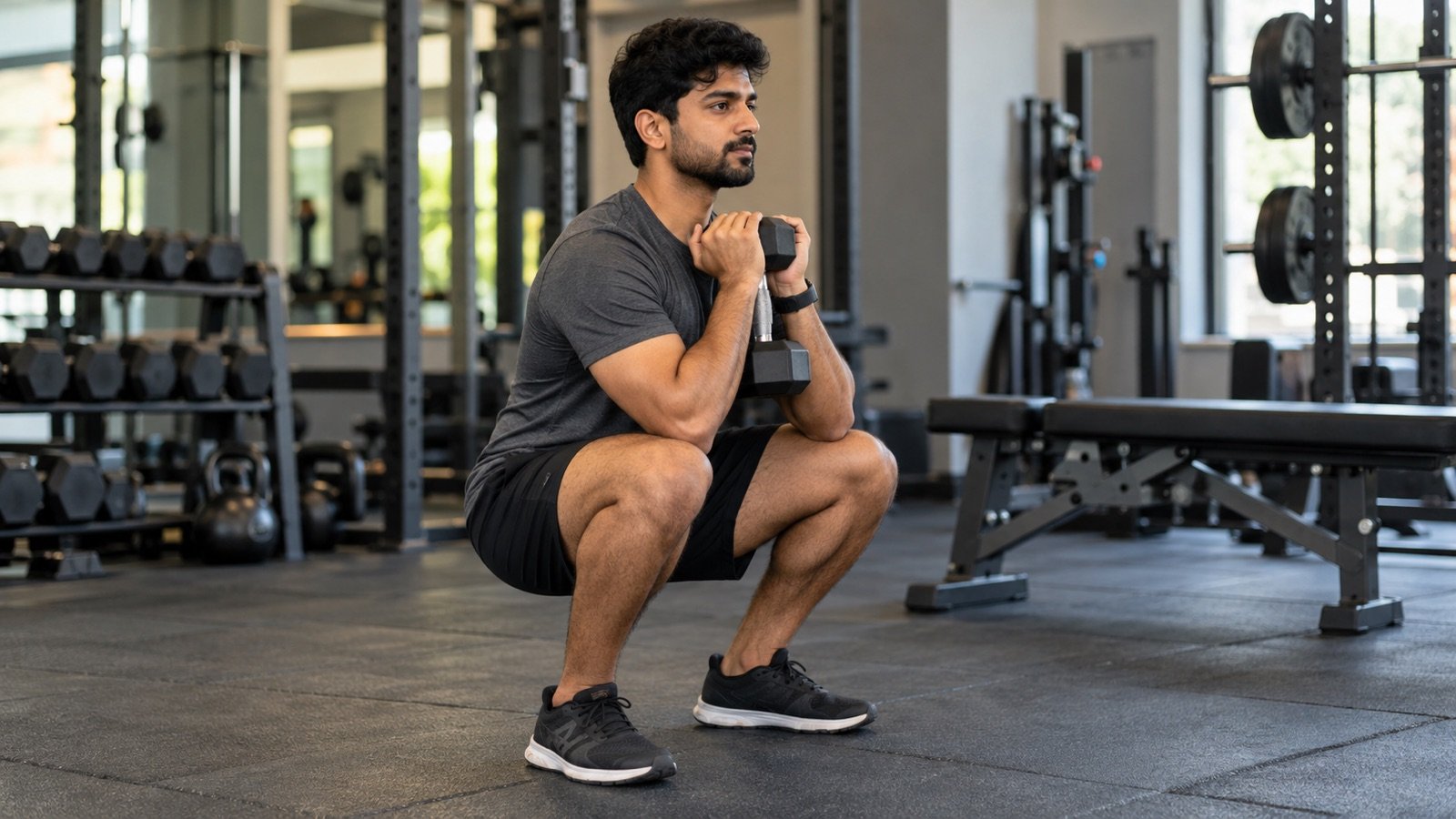



You can often exercise with mild post-workout soreness if you can move normally and symptoms do not worsen. If soreness changes your technique, limits ordinary movement, or comes with significant weakness, reduce the session or rest the affected muscles. Sharp pain, marked swelling, or dark urine need a different response.
The goal is to make a good decision about today's session, not to prove toughness. A sore muscle does not automatically need complete inactivity, but a workout is not useful simply because you managed to push through it.
What is delayed-onset muscle soreness?
Delayed-onset muscle soreness, or DOMS, is the aching and tenderness that can develop after unfamiliar or demanding exercise. It typically emerges later rather than as a sudden pain during a repetition, often becoming most noticeable over the following one to three days. New movements and demanding lengthening contractions can contribute.
A 2026 review of DOMS mechanisms describes soreness as a complex response rather than a direct measure of structural muscle damage. Timing and symptoms provide clues, but a web article cannot confirm that your pain is ordinary DOMS.
If something hurt sharply during a lift, do not label it DOMS just because it still hurts tomorrow. Injury and soreness can overlap. Seek individual assessment when the cause is uncertain, symptoms are worsening, or daily function is substantially affected.
A decision guide for your next workout
| What you notice | Practical response | Example |
|---|---|---|
| Mild ache; normal walking and comfortable range of motion | Try an easy warm-up, then a reduced session if movement remains controlled | Lighter familiar exercises, fewer sets, or another muscle group |
| Stiffness alters your squat, gait, or arm movement | Skip hard work for the affected area; use comfortable alternatives or rest | A gentle walk instead of a hard leg workout, if walking is comfortable |
| Sharp or localized pain, joint pain, marked swelling, or worsening symptoms | Stop the provoking movement and seek assessment as appropriate | Do not repeatedly “test” a painful lift with heavier loads |
| Severe pain or weakness, especially with tea- or cola-colored urine | Seek immediate medical attention | Possible rhabdomyolysis must not be managed as routine soreness |
This table is a conservative editorial decision aid, not a diagnostic scoring system. The CDC's rhabdomyolysis guidance identifies unexpectedly severe muscle pain, dark urine, and weakness or unusual tiredness as warning signs. You do not need all of them to seek urgent help, and normal-looking urine does not rule the condition out.
Use an easy warm-up to assess movement
If your symptoms are mild and there are no warning signs, begin with a few minutes of comfortable movement. Then try an unloaded version of the exercise you planned. Ask three questions: can I use my normal range, can I control the motion, and is discomfort staying mild rather than increasing?
Suppose your thighs ache after your first squat session. If normal walking is comfortable and an easy sit-to-stand looks normal, you might choose an upper-body workout or a lighter lower-body session. If you lean to one side or shorten the movement to avoid pain, use that as a reason to change the plan.
Feeling better during a warm-up is not proof that an injury is absent or that strength has fully recovered. Keep the first working set conservative. Stop if pain becomes sharper, increases, or changes your movement.
How to modify a session without guessing
- Reduce one or more demands. Use a lighter load, fewer working sets, or a less demanding familiar variation.
- Avoid repeating the novelty. Do not add another unfamiliar exercise merely because the first one made you sore.
- Keep technique recognizable. If you must compensate to finish a repetition, the chosen dose is too much for today.
- Consider another area. Upper-body work may be suitable when legs are sore, provided setup and movement are comfortable.
- Allow a rest day. Preserving the next good session can be more useful than completing today's planned number at any cost.
For instance, if your usual plan is three sets of squats, you might try one lighter set after a comfortable warm-up and reassess. That is an example, not a tested percentage reduction that applies to everyone. If you are new to training, our short beginner plan can reduce the temptation to do too much immediately.
Does soreness mean you are building more muscle?
No. It is not a dependable scoreboard for muscle growth. A small 2016 resistance-training study found that the relationship between muscle protein synthesis and growth became clearer after early muscle damage diminished. That study does not answer every soreness question, but it helps explain why damage and productive adaptation should not be treated as interchangeable.
Compare repetitions, loads, technique, and longer-term body measurements instead. Becoming less sore as you repeat a routine does not automatically mean it has stopped working. Our progressive-overload guide explains how to make a familiar movement more demanding without constantly changing it.
Likewise, a session that causes severe soreness may have been too novel or too large for your current readiness. It does not earn extra credit because the next two days are uncomfortable.
Which recovery methods are worth trying?
A 2018 systematic review and meta-analysis found that several approaches, including massage and active recovery, could reduce reported soreness. The studies varied, and improvement in pain does not necessarily mean complete restoration of strength or faster long-term muscle growth. Stretching did not show a clear soreness benefit in that analysis.
| Option | Useful way to approach it | Limit |
|---|---|---|
| Easy movement | Try a comfortable walk or gentle cycling if it feels better | Do not turn “active recovery” into another hard session |
| Massage | Use comfortable pressure if you find it helpful | Less soreness does not prove readiness for a heavy workout |
| Stretching | Use gentle mobility for comfort, without forcing painful positions | Do not expect it to erase DOMS |
| Sleep and ordinary meals | Keep your normal recovery habits consistent | No single meal or night's sleep guarantees that soreness disappears |
Expensive devices are optional. Start with an appropriate training dose, comfortable movement, sleep, and regular meals. Our post-workout meal guide gives food ideas. If a late stimulant habit is reducing sleep, use our caffeine and sleep guide to review dose and timing.
How to make the next session less disruptive
After a break, begin below the volume you remember doing. Keep a small set of familiar exercises, increase demands gradually, and avoid stacking several new movements into the same week. Our return-to-gym guide is a useful companion.
Record the workout and how you moved the following day. “Two sets of split squats; stairs uncomfortable for three days” is more actionable than “great leg day.” Next time, reduce the initial dose or choose a simpler variation and see whether normal daily activity is easier.
If discomfort is not steadily improving over several days, lasts about a week, or repeatedly interferes with ordinary movement, get assessed rather than repeatedly adjusting around it. Persistent pain deserves a clearer explanation.
Common questions
Should I wait exactly 48 hours?
There is no universal countdown that proves recovery. Time since exercise matters, but symptoms, movement quality, and the demands of the next session also matter.
Can I do cardio with sore legs?
A comfortable easy walk or cycle may be tolerable. Hard running, intervals, or hills are a different demand. Skip activities that change your gait or increase pain.
Should I take painkillers so I can train?
Do not use symptom suppression as a test of readiness. Ask a clinician or pharmacist about medicines for your situation, and avoid pushing through pain simply because a dose makes it less noticeable.
Sources and evidence notes
Evidence checked on October 8, 2026. This article draws on the studies and public guidance below; it is an editorial synthesis, not a new systematic review. Practical schedules and examples are our suggested applications, not protocols proven superior in a trial. General information for adults; individual medical needs may differ.
- Rethinking neurophysiology of delayed onset muscle soreness (2026) — Narrative review; soreness and structural damage are not interchangeable.
- Resistance training-induced changes in integrated myofibrillar protein synthesis (Damas and colleagues, 2016) — Small mechanistic training study; not a universal recovery rule.
- Choosing post-exercise recovery techniques (Dupuy and colleagues, 2018) — Systematic review and meta-analysis; soreness relief differs from readiness and long-term adaptation.
- CDC: Signs and Symptoms of Rhabdomyolysis — Urgent warning signs and advice to seek medical attention.