

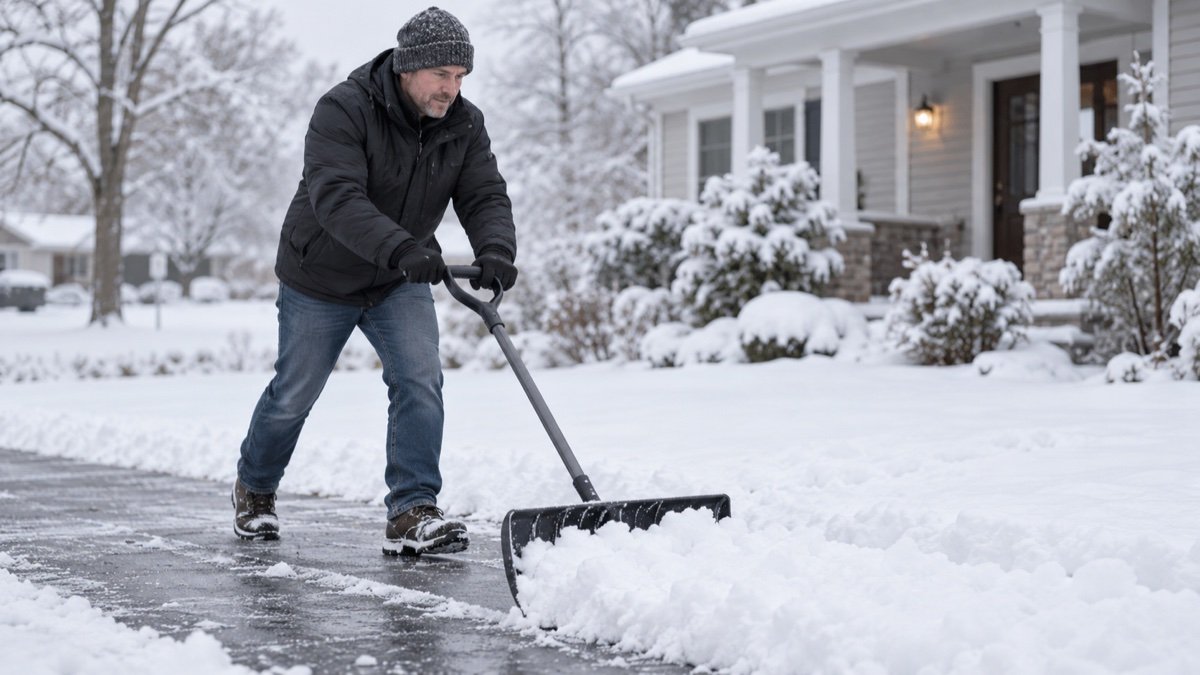
Shoveling snow by hand burns about 190 to 260 calories in 30 minutes for a 155-pound adult, and about 240 to 340 calories for a 200-pound adult, depending on how hard you work. Those estimates use the 2024 Adult Compendium of Physical Activities, which rates hand shoveling at 5.3 to 7.5 METs. That makes it moderate to vigorous exercise, and the federal Physical Activity Guidelines for Americans use shoveling snow as an example of vigorous activity.
That intensity is also the problem. Heavy shoveling can push heart rate and blood pressure to the levels of a maximal treadmill test, often in cold air and in people who rarely exercise. The American Heart Association (AHA) warns that it may raise the risk of a heart attack or sudden cardiac arrest. Its experts say people who have had a heart attack, bypass surgery or angioplasty should not shovel snow at all. If you have heart disease, risk factors or a sedentary lifestyle, have someone else clear the snow or talk to your doctor first.
How many calories does shoveling snow burn?
A MET (metabolic equivalent) compares an activity's energy cost with sitting quietly. The 2024 Adult Compendium of Physical Activities defines 1 MET as 1 kcal per kilogram of body weight per hour, so:
Calories per minute = METs × body weight in kg ÷ 60
The Compendium's lawn and garden list has three entries for shoveling snow by hand and one for a walk-behind snow blower. The three shoveling values are backed by published measurements, not estimates, according to the Compendium's notation.
| Activity (Compendium code) | METs | 30 min, 155 lb | 30 min, 200 lb | 60 min, 155 lb | 60 min, 200 lb |
|---|---|---|---|---|---|
| Operating a snow blower, walking (08130) | 2.5 | 88 | 113 | 176 | 227 |
| Shoveling snow by hand, moderate effort (08195) | 5.3 | 186 | 240 | 373 | 481 |
| Shoveling snow by hand, general (08200) | 6.0 | 211 | 272 | 422 | 544 |
| Shoveling snow by hand, vigorous effort (08202) | 7.5 | 264 | 340 | 527 | 680 |
Worked example, 155 lb: 155 lb is 70.3 kg. At the general value of 6.0 METs, 6.0 × 70.3 ÷ 60 = 7.0 calories per minute, or about 211 calories in 30 minutes.
Worked example, 200 lb: 200 lb is 90.7 kg. At the vigorous value of 7.5 METs, 7.5 × 90.7 ÷ 60 = 11.3 calories per minute, or about 340 calories in 30 minutes.
We used 155 lb because it is the middle weight in Harvard Health's calories-burned table, and 200 lb because it is close to the average weight of U.S. men (199.0 lb in CDC data for 2021–2023). As a cross-check, Harvard lists 216 calories for 30 minutes of shoveling snow by hand at 155 lb. Our 6.0-MET figure is 211.
What these numbers do and don't tell you
- They are standard values, not measurements of you. Real effort depends on snow depth, how wet and heavy it is, your pace, your fitness and how long you rest between loads. The 2024 Adult Compendium is also built from data on adults aged 19 to 59; the same team publishes a separate Older Adult Compendium for people 60 and older.
- The totals include what you'd burn anyway. MET calories count your resting metabolism too. The extra calories above sitting still are a little lower: about 176 instead of 211 for 30 minutes at 155 lb and 6.0 METs.
- Your wearable may disagree. Fitness trackers estimate calories their own way, so expect a different figure from the one in the table.
- A snow blower burns less than half as much. At 2.5 METs, walking behind one is light activity by the federal definition. Harvard's older table gives a higher figure for it (162 calories in 30 minutes at 155 lb), so treat the snow blower row as a rough guide. (The Compendium also lists riding a snow blower at 3.0 METs, but that value is an estimate.)
Our Halloween candy walking math uses the same formula.
Does snow shoveling count as exercise?
Yes. The Physical Activity Guidelines for Americans, 2nd edition (HHS) define vigorous-intensity activity as 6.0 METs or more and list shoveling snow as an example. They also list shoveling snow among muscle-strengthening activities, alongside lifting weights and carrying heavy loads.
The same guidelines carry a warning. The risk of a cardiac event rises "when a person suddenly becomes much more active than usual," and "the greatest risk occurs when an adult who is usually inactive engages in vigorous-intensity activity (such as shoveling heavy snow)." For people who are just starting to be active, they advise avoiding relatively vigorous activity "such as shoveling heavy snow or running." People who are regularly active have the lowest risk.
So shoveling counts toward your weekly activity, but it's a poor way to start exercising. Regular training before winter makes it safer; our guide to minimum effective strength training for beginners is a low-time place to start.
Why shoveling snow raises heart attack risk
The AHA's January 2024 news release lists several reasons shoveling is harder on the heart than its MET value suggests:
- It is mostly arm work. Arm exercise is more taxing on the heart than leg exercise at the same effort.
- Breath-holding while straining. Lifting heavy loads can make people hold their breath without noticing (the Valsalva maneuver), which sharply raises heart rate and blood pressure.
- Static effort. Much of shoveling is isometric, meaning the muscles contract without much joint movement. Standing still also lets blood pool in the legs, so less returns to the heart.
- Cold air. Cold constricts blood vessels, including the coronary arteries, and raises blood pressure.
Barry Franklin, PhD, the AHA volunteer expert quoted in the release and lead author of the AHA's 2020 scientific statement on exercise-related cardiac events, estimates that "hundreds of people die during or just after snow removal in the U.S. each year." That is an expert estimate, not a counted national statistic.
What the research shows
| Study | What was studied | Main finding | Limits |
|---|---|---|---|
| Franklin et al., JAMA 1995 | 10 healthy, untrained men (average age 32) cleared heavy, wet snow at about 36°F, by shovel and by electric snow thrower | Heart rate averaged 154 bpm after 2 minutes of shoveling and 173 bpm after 10 minutes (86% and 97% of maximum). Systolic blood pressure reached 198 mm Hg, above their maximal treadmill test. Responses were lower with the snow thrower. | Very small sample of young men; one session of heavy, wet snow |
| Auger et al., CMAJ 2017 | 128,073 hospital admissions and 68,155 deaths from heart attack in Quebec, November–April, 1981–2014 | Compared with no snow, 20 cm (about 8 inches) of snowfall was linked to 16% higher odds of hospital admission and 34% higher odds of death from heart attack the next day in men. There was no clear increase in women. | Observational, so it shows an association, not cause. Shoveling itself was not measured. |
| Nichols et al., Clinical Research in Cardiology 2012 | Chart review of 500 acute coronary syndrome cases over two winters at one Ontario hospital | 35 cases (7%) happened after shoveling. Those patients were 4.8 times more likely to be male and 3.6 times more likely to have a family history of premature heart disease. | Single hospital; relies on what was recorded in charts |
| Watson et al., American Journal of Emergency Medicine 2011 | U.S. emergency department visits linked to snow shovels, 1990–2006 (national injury surveillance data) | About 11,500 visits a year. Cardiac problems were 6.7% of cases but accounted for all 1,647 deaths in the study period. | Data are now 20 to 35 years old; covers only ED visits linked to shovels |
Together, these studies show the heart working near its limit during heavy shoveling and more heart attacks after big snowfalls, especially in men. None can say how much any one person's risk rises, and the Quebec study could not separate shoveling from other effects of a storm.
Who should not shovel snow
The AHA's guidance, voiced by Franklin, is direct: people who have had a heart attack or stroke, bypass surgery or coronary angioplasty "simply should not be shoveling snow." The AHA says people with known or suspected heart disease, or with risk factors, should have someone else do it. It names these risk factors:
- A sedentary lifestyle or low fitness ("The impact is hardest on those people who are least fit")
- Obesity
- Being a current or former smoker
- Diabetes
- High cholesterol
- High blood pressure
The American Academy of Orthopaedic Surgeons (AAOS) adds that if you have a medical condition or don't exercise regularly, you should talk to your doctor before shoveling or snow blowing. A family history of early heart disease, linked to shoveling-related events in the Ontario study, is another reason to ask.
Warning signs: when to stop and call 911
The AHA says to stop immediately if you feel chest pain or pressure, lightheadedness, heart palpitations or an irregular heartbeat, and to call 911 if the symptoms don't go away shortly after you stop. The CDC's list of major heart attack symptoms also includes:
- Chest pain or discomfort, usually in the center or left side of the chest
- Feeling weak, light-headed or faint, sometimes with a cold sweat
- Pain or discomfort in the jaw, neck or back
- Pain or discomfort in one or both arms or shoulders
- Shortness of breath
The CDC's advice for heart attack symptoms is to call 911 immediately. Don't try to push through and finish the driveway. If someone collapses and is unresponsive with no pulse, the AHA says to call for help and start Hands-Only CPR.
How to shovel snow safely
Before you start: warm up
AAOS recommends warming up your muscles for 10 minutes with light exercise before clearing snow. That could be marching or walking in place, easy arm circles, and a few slow bodyweight squats or hip hinges, done indoors where it's warm. The AHA advises starting gradually and pacing yourself.
Dress in layers, with a hat and gloves, and cover your mouth and nose (AHA). AAOS recommends light, layered, water-repellent clothing and boots with slip-resistant soles. Our guide to what to wear running in cold weather covers the same layering principles.
Technique that protects your back
In the U.S. emergency department study, 34% of shovel-related injuries involved the lower back, and acute strain from exertion was the most common cause of injury overall. AAOS gives these technique rules:
- Push the snow instead of lifting it whenever you can. The AHA notes that pushing is physically easier than lifting and throwing.
- Pick a shovel that fits you. It shouldn't be too heavy or too long for your height and strength. Space your hands apart on the handle for more leverage.
- Squat to lift. Keep your legs apart, knees bent and back straight, and lift with your legs. Don't bend at the waist.
- Take small scoops and walk to where you want to dump the snow. Holding a full shovel with your arms stretched out puts too much weight on your spine.
- Don't twist. Don't throw snow over your shoulder or to the side. Turn your feet and walk instead.
- Remove deep snow in layers, a few inches at a time, especially when it's heavy and wet.
- Pace yourself. Take frequent breaks and drink fluids. Stop and seek emergency care if you have chest pain, shortness of breath or other heart attack signs.
Bent-shaft shovels are sold as back-friendly. In one small lab study of 8 healthy adults lifting simulated snow, a bent-shaft shovel reduced forward bending by 13% and lower-back loading by about 12% to 17% compared with a straight shaft (Lewinson et al., Applied Ergonomics 2014). That's promising, but one small study isn't proof the design prevents injuries.
Timing
AAOS suggests clearing snow "early and often," starting when there is only a light layer on the ground, rather than waiting for a storm to finish and moving it all at once. Several short sessions are easier on the heart and back than one long one. The AHA also advises extra care on windy days, because wind makes the cold feel more intense.
Alternatives to shoveling
- Use a snow blower. The AHA says a snow blower raises heart rate to around 120 beats per minute, compared with around 170 for shoveling, and Franklin's 1995 study found lower heart rate and blood pressure with a snow thrower. It isn't risk-free: the AHA notes some studies link snow blower use to heart attacks too, and AAOS lists machine-safety rules, such as never clearing a jammed chute with your hands. Turn off the engine, wait, and use a solid object instead.
- Push, don't lift. A wide pusher-style shovel lets you move snow to the edge of the driveway without lifting it. The AHA also suggests sweeping light snow instead.
- Get help. If you are in a higher-risk group, the AHA advises having someone else clear the snow. That could be a family member, a neighbor or a paid service.
Frequently asked questions
Is shoveling dangerous for younger people?
In Franklin's 1995 study, even healthy men in their early 30s reached 97% of their maximum heart rate within 10 minutes. The least fit men had the highest relative heart rates. Healthy young adults are at much lower risk of a heart attack, but back strains, slips and falls happen at any age.
Why are men at higher risk than women?
The Quebec study found the increase only in men, and in the Ontario study, patients whose heart event followed shoveling were 4.8 times more likely to be male. Neither study measured who actually shoveled or how hard, so the reason for the difference isn't established. Women with heart disease or risk factors should follow the same precautions.
This article is general information, not medical advice. Calorie figures are estimates based on Compendium averages and the stated body weights. If you have heart disease, risk factors or symptoms, ask your doctor before shoveling snow.
Sources
- 2024 Adult Compendium of Physical Activities: lawn and garden: codes 08130 (2.5 METs), 08195 (5.3), 08200 (6.0) and 08202 (7.5).
- 2024 Adult Compendium of Physical Activities: winter activities: snow shoveling codes 19252 and 19254, and snow blower code 19260.
- Adult Compendium of Physical Activities: MET definition (1 kcal/kg/hour).
- Herrmann et al., 2024 Adult Compendium of Physical Activities, Journal of Sport and Health Science 2024.
- U.S. Department of Health and Human Services: Physical Activity Guidelines for Americans, 2nd edition (PDF).
- American Heart Association: Snow shoveling, cold temperatures combine for perfect storm of heart health hazards (January 11, 2024).
- American Heart Association: Snow shoveling can be hazardous to your heart (December 15, 2022).
- Franklin et al., Exercise-Related Acute Cardiovascular Events and Potential Deleterious Adaptations Following Long-Term Exercise Training: A Scientific Statement From the American Heart Association, Circulation 2020.
- Franklin et al., Cardiac demands of heavy snow shoveling, JAMA 1995.
- Auger et al., Association between quantity and duration of snowfall and risk of myocardial infarction, CMAJ 2017.
- Nichols et al., Snow-shoveling and the risk of acute coronary syndromes, Clinical Research in Cardiology 2012.
- Watson et al., Snow shovel-related injuries and medical emergencies treated in US EDs, 1990 to 2006, American Journal of Emergency Medicine 2011.
- Lewinson et al., Influence of snow shovel shaft configuration on lumbosacral biomechanics during a load-lifting task, Applied Ergonomics 2014.
- American Academy of Orthopaedic Surgeons (OrthoInfo): Prevent Snow Shoveling and Snowblowing Injuries.
- CDC: About Heart Attack Symptoms, Risk, and Recovery.
- Harvard Health: Calories burned in 30 minutes for people of three different weights.
- CDC FastStats: Body measurements: average adult weights, 2021–2023.