


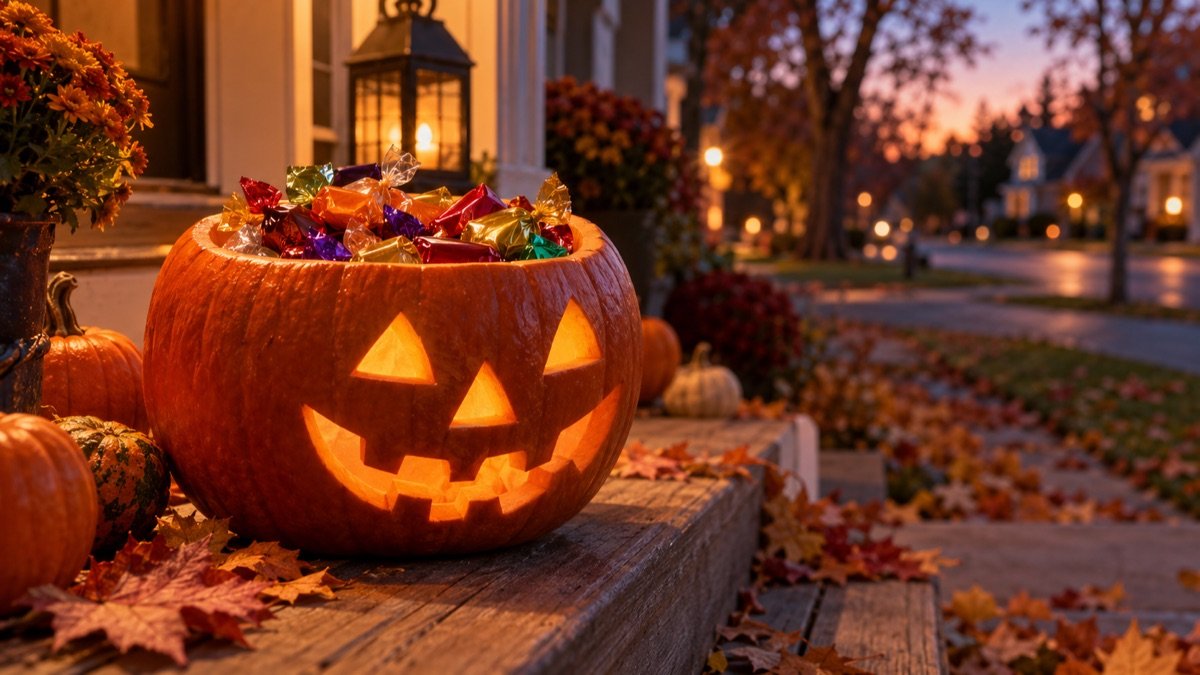
Most fun-size and snack-size chocolate bars have 65 to 85 calories each. A fun-size Snickers, Twix or Milky Way and a snack-size Reese's Peanut Butter Cup are 80 calories each, a snack-size Kit Kat is 70, and a fun-size pack of M&M's is about 65. Non-chocolate candy is usually smaller: a fun-size pack of Skittles or a Tootsie Pop is 60, a mini box of Nerds is 45, a Haribo Goldbears mini bag is 40, and a single Starburst is 20. Every calorie and sugar figure below comes from the manufacturers' own Nutrition Facts labels, as recorded in USDA FoodData Central.
In walking terms, one fun-size Snickers equals about 18 minutes of moderate walking for a 155-pound adult, or 14 minutes for a 200-pound adult. That's a way to picture the energy in a piece of candy, not a to-do list. Halloween falls on Saturday, October 31, 2026.
How we counted the candy
Each candy comes from the Branded Foods data in USDA FoodData Central (2026-04-30 release), which holds the label information manufacturers supply. When a label serving covered several pieces, such as "2 pieces (31g)" for Reese's snack size, we divided it to get one piece. For candy corn we kept Brach's 15-piece label serving.
"Fun size" and "snack size" are marketing terms, not standard sizes: a snack-size Kit Kat weighs about 14 g and a fun-size Butterfinger about 18.5 g. Recipes and pack sizes also change, so if your bag's label differs from our table, go by the package.
Halloween candy calories, piece by piece
Walking minutes assume a moderate 2.8–3.4 mph on level ground (3.8 METs); the formula is below.
| Candy | One piece (weight) | Calories | Total sugars (g) | Added sugars (g) | Walking minutes, 155 lb | Walking minutes, 200 lb |
|---|---|---|---|---|---|---|
| Snickers | 1 fun-size bar (17 g) | 80 | 9 | 8 | 18 | 14 |
| Reese's Peanut Butter Cup | 1 snack-size cup (15.5 g) | 80 | 8 | 7.5 | 18 | 14 |
| Twix | 1 fun-size cookie bar (16 g) | 80 | 8 | 7 | 18 | 14 |
| Milky Way | 1 fun-size bar (17 g) | 80 | 10.5 | not listed | 18 | 14 |
| Butterfinger | 1 fun-size bar (18.5 g) | 85 | 7.5 | 7 | 19 | 15 |
| Kit Kat | 1 snack-size bar (14 g) | 70 | 7.5 | 7 | 16 | 12 |
| M&M's Milk Chocolate | 1 fun-size pack (13.5 g) | 65 | 8.5 | 8 | 15 | 11 |
| Hershey's Kisses | 1 Kiss (4.6 g) | 23 | 2.6 | 2.3 | 5 | 4 |
| Brach's Classic Candy Corn | 15 pieces (31 g) | 110 | 23 | 23 | 25 | 19 |
| Skittles Original | 1 fun-size pack (15 g) | 60 | 11 | 11 | 13 | 10 |
| Tootsie Pop | 1 pop (17 g) | 60 | 11 | 11 | 13 | 10 |
| Nerds | 1 mini box (12 g) | 45 | 11 | 11 | 10 | 8 |
| Haribo Goldbears | 1 mini bag (11.7 g) | 40 | 5.3 | 5.3 | 9 | 7 |
| Tootsie Roll Midgee | 1 piece (6.6 g) | 24 | 3.4 | 3.2 | 5 | 4 |
| Starburst Original | 1 piece (4.8 g) | 20 | 2.7 | 2.7 | 4 | 3 |
FoodData Central IDs, so you can check each label yourself: Snickers fun size 2161171; Reese's snack size 2563624; Twix 2673411 (added sugars from 2564538, same 16 g cookie bar); Milky Way fun size 2564536; Butterfinger fun size 2571801; Kit Kat 2671691; M&M's Milk Chocolate 2673385; Hershey's Kisses 2668372; Brach's Classic Candy Corn 2674043; Skittles Original 2523028; Tootsie Pop 2541109; Nerds 2505431; Haribo Goldbears 2642057; Tootsie Roll Midgees 2568839; Starburst Original 2542465. The Milky Way record doesn't report added sugars separately.
What the numbers show
- Fun-size chocolate bars sit in a narrow range. Every chocolate bar, cup and pack in the table falls between 65 and 85 calories (a single Hershey's Kiss is the exception), so for calories it hardly matters which one you pick. Choose the one you like.
- Size matters more than brand. The Butterfinger has the most calories of any single piece because it is also the heaviest. Per gram, the chocolate items are similar, at about 4.6 to 5.2 calories.
- Candy corn adds up by the handful. Brach's 15-piece serving is 110 calories and 23 g of sugar, about 7 calories a kernel. Fifteen pieces is a small handful.
- Fruity and sour candies are mostly sugar. A mini box of Nerds has only 45 calories, but 11 g of those 12 g are sugar. Chocolate bars carry more of their calories as fat, so they are higher in calories but not always higher in sugar.
How the walking minutes were calculated
We used the same method as our Thanksgiving dinner calorie count. A MET (metabolic equivalent) compares an activity's energy cost with sitting quietly, and the 2024 Adult Compendium of Physical Activities defines 1 MET as 1 kcal per kilogram of body weight per hour. So:
Calories per minute = METs × body weight in kg ÷ 60
Minutes = candy calories ÷ calories per minute
Two walking values from the Compendium's walking list:
- Moderate, 2.8–3.4 mph on level ground (code 17190): 3.8 METs. That works out to 4.45 calories per minute at 155 lb (70.3 kg) and 5.75 at 200 lb (90.7 kg).
- Brisk, 3.5–3.9 mph, walking for exercise (code 17200): 4.8 METs. That works out to 5.62 and 7.26 calories per minute.
Worked example: a fun-size Snickers (80 calories) ÷ 4.45 calories per minute = about 18 minutes for a 155-pound adult at a moderate pace.
We picked 155 pounds because it is the middle weight in Harvard Health's calories-burned table, and 200 pounds because it is close to the average weight of U.S. men (199.0 lb in CDC data for 2021–2023). As a cross-check, Harvard lists 133 calories for 30 minutes of walking at 3.5 mph for a 155-pound person, and our moderate-pace formula gives 134.
Two illustrative examples
These are worked examples using the table above, not measurements of what anyone typically eats.
A few from the bowl while handing out candy: one each of Snickers, Reese's, Kit Kat and M&M's comes to 295 calories and 30.5 g of added sugars. At a moderate pace, that is about 66 minutes of walking at 155 lb or 51 minutes at 200 lb.
An illustrative trick-or-treat haul of 33 pieces: 3 Snickers, 3 Reese's cups, 3 packs of M&M's, 3 Hershey's Kisses, 2 each of Kit Kat, Twix, Skittles, Nerds, Haribo mini bags and Tootsie Pops, 4 Starburst, 4 Tootsie Roll Midgees and 1 Butterfinger. Together that is 1,715 calories and about 212 g of added sugars, enough for several days of treats rather than one evening.
| Example | Calories | Moderate, 155 lb | Moderate, 200 lb | Brisk, 155 lb | Brisk, 200 lb |
|---|---|---|---|---|---|
| Four pieces from the bowl | 295 | 66 min | 51 min | 52 min | 41 min |
| 33-piece haul | 1,715 | 6 h 25 min | 4 h 58 min | 5 h 5 min | 3 h 56 min |
Why "walking off" candy oversimplifies things
MET math includes the calories you'd burn sitting still. Counting only the extra calories from walking (2.8 METs), the four-piece example takes about 90 minutes at 155 lb, not 66. METs are also averages: your own burn depends on fitness, body size, terrain and pace, and the 2024 adult Compendium covers ages 19–59, so these minutes don't apply to children. Most of all, your body balances energy over days and weeks. One evening of candy matters less than what happens to the leftover bag.
Added sugars: what the official guidance says
- FDA Daily Value: 50 g. The FDA sets the Daily Value for added sugars at 50 grams a day, based on a 2,000-calorie diet. A fun-size Snickers (8 g) is 16% of it, and a fun-size pack of Skittles (11 g) is 22%.
- Dietary Guidelines for Americans, 2025–2030. The current Guidelines are stricter than earlier editions. They list "chips, cookies, and candy that have added sugars" among the highly processed foods to avoid. They also state that "no amount of added sugars or non-nutritive sweeteners is recommended or considered part of a healthy or nutritious diet," and that one meal should contain no more than 10 grams of added sugars. The RealFood.gov summary calls this "a flexible framework meant to guide better choices, not dictate exact meals."
In short, candy is a treat rather than an everyday food, and one night of trick-or-treating isn't the issue. The weeks of leftovers are where a plan helps.
Kids and Halloween candy
Children's guidance on added sugars is lower than adults':
- The American Heart Association's scientific statement on added sugars in children (2017) recommends that children have no more than 25 g of added sugars a day (about 6 teaspoons, or 100 calories), and none before age 2. By our table, that is roughly three fun-size Snickers.
- The Dietary Guidelines for Americans, 2025–2030 say to avoid added sugars during infancy and early childhood, and that for ages 5–10 "no amount of added sugars is recommended."
The American Academy of Pediatrics' Halloween tips on HealthyChildren.org are practical:
- Feed kids a good meal before trick-or-treating so they're less tempted to snack on the way.
- Sort and check treats at home before eating. Throw away anything spoiled, unwrapped or suspicious.
- Mind the little ones. Babies and toddlers should not have hard candies, caramel apples, popcorn, gum, small candies such as jellybeans, gummy candy, pumpkin seeds or anything with whole nuts. Wrappers and small toys can also be choking hazards.
- Ration treats for the days and weeks after Halloween. Keep candy rules realistic, consistent and positive, and make the plan together so everyone knows what to expect.
- Think about food allergies. Candy made in a facility that handles an allergen can still cause a reaction. Non-food treats such as glow sticks, stickers or bubbles let every child join in.
And the trick-or-treat route is a family walk in itself.
Practical, guilt-free ways to enjoy the candy
- Pick your favorites and share the rest. Most fun-size bars are similar in calories, so choose the ones you really like.
- Check the serving line on your bag. Label servings are often two or more pieces.
- Have candy with or after a meal instead of grazing from the bowl all evening, and keep water nearby.
- Take a short walk after dinner. A 2022 meta-analysis in Sports Medicine found that light walking breaks lowered blood sugar and insulin after meals compared with sitting the whole time. Our comparison of 10-minute walks after meals vs one 30-minute walk covers the research. Daylight saving time ends the next morning, November 1; our time-change guide helps you keep your routine.
- Go back to your usual routine the next day. No skipped meals or punishing workouts needed. If counting calories or exercise minutes makes you anxious, talk with your doctor or a registered dietitian.
For background on what a calorie measures, see our guide to calories.
Frequently asked questions
How many calories are in a fun-size candy bar?
Most fun-size and snack-size chocolate bars have 65 to 85 calories. By manufacturers' label data, Snickers, Twix and Milky Way are 80 each, a Reese's snack-size cup is 80, a Kit Kat snack-size bar is 70 and a Butterfinger fun-size bar is 85.
How many calories are in candy corn?
Brach's Classic Candy Corn lists 110 calories and 23 g of sugar for a 15-piece serving (31 g), or about 7 calories a piece.
How much Halloween candy can a child have in a day?
The American Heart Association recommends no more than 25 g of added sugars a day for children aged 2 and older, which is about three fun-size Snickers or two fun-size packs of Skittles. The 2025–2030 Dietary Guidelines go further and say no amount of added sugars is recommended for children up to age 10. The AAP suggests rationing Halloween candy over the following days and weeks, with rules that are realistic, consistent and positive.
Do I need to walk off Halloween candy?
No. The walking minutes make the numbers easier to picture. A short walk after dinner is a good habit for other reasons, but you don't owe anyone exercise for a treat.
This article is general information, not medical or dietary advice. The calorie and walking figures are estimates based on label serving sizes and the stated body weights. Always check the label on your own package.
Sources
- USDA FoodData Central: Branded Foods (manufacturer label data), 2026-04-30 release. FDC IDs are listed under the candy table.
- 2024 Adult Compendium of Physical Activities: walking: codes 17190 (3.8 METs) and 17200 (4.8 METs).
- Adult Compendium of Physical Activities: MET definition (1 kcal/kg/hour).
- Herrmann et al., 2024 Adult Compendium of Physical Activities, Journal of Sport and Health Science 2024.
- Harvard Health: Calories burned in 30 minutes for people of three different weights.
- CDC FastStats: Body measurements: average adult weights, 2021–2023.
- FDA: Added Sugars on the Nutrition Facts Label.
- Dietary Guidelines for Americans, 2025–2030 (PDF), via DietaryGuidelines.gov.
- RealFood.gov: summary and FAQ for the 2025–2030 Guidelines.
- Vos et al., Added Sugars and Cardiovascular Disease Risk in Children: A Scientific Statement From the American Heart Association, Circulation 2017.
- American Academy of Pediatrics (HealthyChildren.org): Halloween Fun & Safety Tips for Kids of All Ages.
- Buffey et al., Sports Medicine 2022: light walking breaks and blood sugar after meals.