

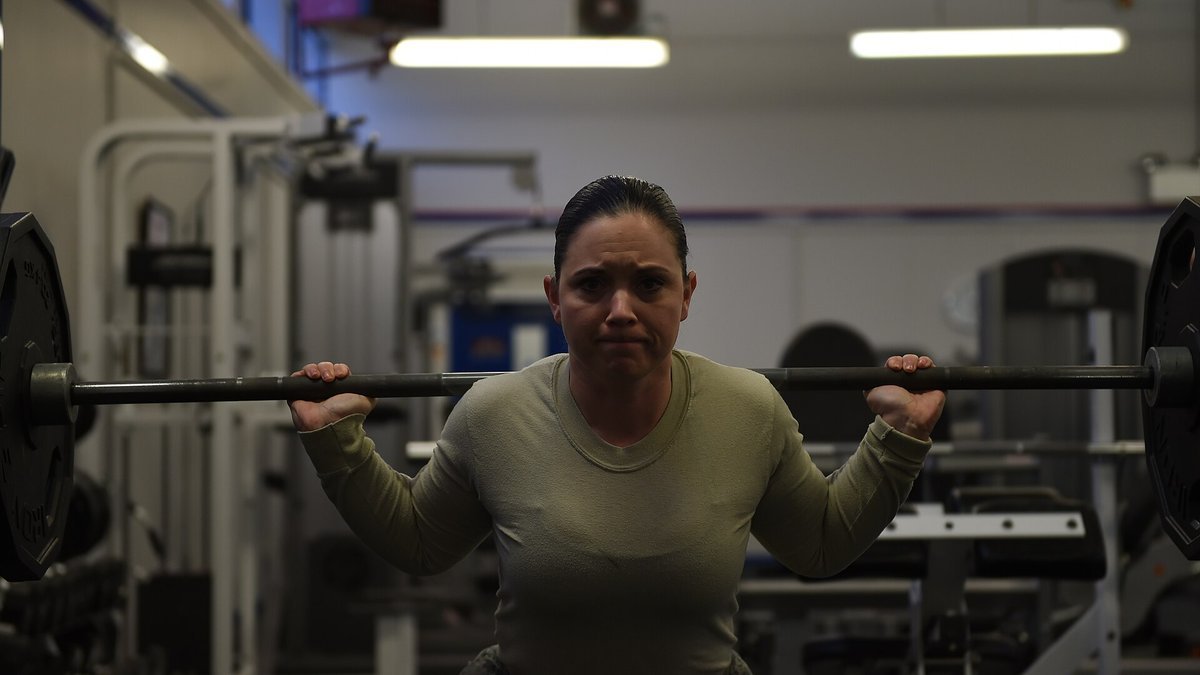
Short "exercise snacks" can build strength. In a new 8-week trial, three 1-minute bouts of squats spread across the day worked about as well as doing the same squats in one session. The randomized trial was published online in the Journal of Exercise Science & Fitness in September 2026 (October issue). Researchers at Tongji University in Shanghai gave 45 young men who already lifted weights one of three programs. One group split 60 squats into three 20-rep "snacks" a day, one did 3 sets of 20 in a single session, and one kept to their usual routine. Both squat groups gained more strength and muscular endurance than the control group. The difference between the two squat groups was not statistically significant, and the snack group rated its training as more enjoyable.
The study was small, every volunteer was a young man with lifting experience, all squats were done on a supervised Smith machine, and the single-session group's average gains were a bit larger. Still, the practical message holds: if you can't fit in a full workout, a few hard minutes of strength work scattered through the day count. Below is what the study showed, how it fits with other research and US guidelines, and a 6-minute-a-day plan for home or work.
What the squat-snack study did
The registered trial, by Rongxuan Zhai, Lejun Wang and colleagues at Tongji University's Physical Education Department, compared two ways of doing exactly the same amount of squatting.
- Who took part: 45 male university students aged 18 to 25 (average about 19 to 20), 15 per group, all with at least six months of lower-body resistance training at least twice a week.
- "Snack" group (fragmented training): three separate bouts a day, each a single set of 20 squats, at least 1 hour apart, in morning, afternoon and evening windows. Each bout lasted about 1 minute, after a brief warm-up.
- Single-session group (traditional training): 3 sets of 20 squats in one session, with 3 minutes of rest between sets.
- Control group: kept up their usual activities, including any training they already did.
- Schedule and load: Monday, Wednesday and Friday for 8 weeks (24 training days), 60 squats per training day in both squat groups. The load started at 40% of each man's one-rep max (1RM) and rose 5 percentage points every two weeks to 55%. Effort was kept moderate, at 10 to 14 on the Borg perceived-exertion scale.
- Technique: Smith-machine squats to thighs parallel with the floor, at a metronome-paced 2 seconds down and 2 seconds up. Every bout was supervised.
- Measurements: 1RM squat, maximal isometric squat force, squats completed at 40% of current 1RM (muscular endurance), and enjoyment on the Physical Activity Enjoyment Scale. Assessors didn't know who was in which group.
What it found
Nobody dropped out, attendance was 92.8% in the snack group and 91.5% in the single-session group, and no adverse events were reported. The table shows each group's average change after the researchers adjusted for starting values.
| Outcome | Snacks: 3 × 1 set a day | One session: 3 sets | Control |
|---|---|---|---|
| 1-rep max squat | +32.7 kg (about +72 lb) | +41.1 kg (about +91 lb) | +12.2 kg (about +27 lb) |
| Isometric squat force | +40.2 kgf (about +89 lb of force) | +47.5 kgf (about +105 lb of force) | +12.3 kgf (about +27 lb of force) |
| Squats at 40% of 1RM (endurance) | +6.2 reps | +10.4 reps | −3.8 reps |
| Enjoyment score (median, 1–7 scale) | 5.94 | 5.50 | Not measured |
Compared with the control group, the snack group gained about 20.6 kg (45 lb) more on its 1RM squat and the single-session group about 28.9 kg (64 lb) more. Both also beat the control group on isometric force and endurance. The single-session group improved more on average on every strength and endurance measure (by about 7.4 kg, or 16 lb, on the 1RM), but none of the differences between the two squat groups was statistically significant (p = 0.164 for 1RM, 0.353 for isometric force and 0.320 for endurance).
The snack group enjoyed its training more (p = 0.034). The authors suggest shorter bouts feel less daunting and give people more control over when they train. They also note that the Smith machine was on the ground floor of the participants' dorm and each snack needed no change of clothes, which made snacking unusually convenient.
How much should you trust it?
It is a well-designed randomized trial, but one small study:
- Small groups. With 15 men per group, the study could miss a modest real advantage. "No significant difference" doesn't prove the formats are equal, and the single-session averages were consistently higher.
- A narrow group of people. Everyone was a young, trained, healthy-weight male student. The authors say the results may not apply to women, older adults, untrained people or people with health conditions.
- One supervised exercise. Only Smith-machine squats at 40% to 55% of 1RM were tested, not whole-body programs, bodyweight moves or unsupervised home training.
- The control group also improved. Its 1RM rose by about 12 kg (27 lb), possibly because the men got used to the test or kept training on their own. Both squat groups still did clearly better.
- Enjoyment was measured once, at the end, so pre-existing preferences can't be ruled out. The authors caution that the findings don't show snacks improve long-term adherence.
- No muscle-size data. Only strength and endurance were measured.
The study was funded by the National Natural Science Foundation of China, and the authors declared no commercial conflicts of interest.
How it fits with other exercise-snack research
"Exercise snacks" usually means bouts of a minute or a few minutes, repeated several times a day. The authors note that most earlier snack research focused on aerobic exercise like stair climbing and brisk walking. The new trial adds a controlled test for strength.
Stair-climbing snacks
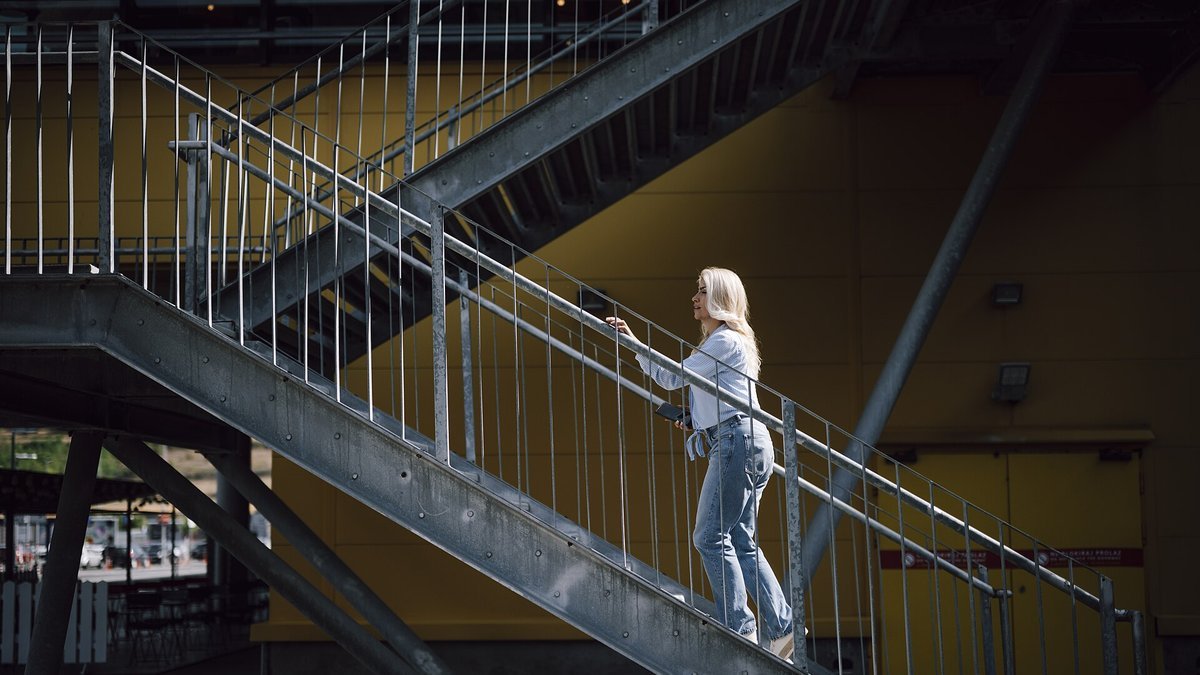
In a 2019 McMaster University study, sedentary young adults vigorously climbed a 60-step, three-flight stairwell three times a day, 1 to 4 hours apart, 3 days a week for 6 weeks. Compared with a control group (12 people in each group), their peak oxygen uptake, a standard measure of aerobic fitness, was higher after the program. The authors noted that the absolute increase was modest.
Resistance snacks for older adults
Two small pilot studies tested home strength snacks in people around age 70. In a UK study of 20 older adults, five 1-minute leg exercises (including chair sit-to-stands and calf raises) twice a day for 28 days improved 60-second sit-to-stand scores by 31%, with no change in controls. In an Australian trial of 38 older adults, 9-minute snacks done one to three times a day for 4 weeks were safe and well liked: adherence was 81% to 97%, with two adverse events in 1,317 sessions. But function improved about as much in the control group.
Snack breaks at work
A University of Iowa trial asked US office workers and students to do 3-minute bodyweight resistance breaks during the workday. When asked for 4, 8 or 16 breaks a day, they averaged 3.2, 6.2 and 9.2. Four a day was acceptable to 88% of participants, eight to 40% and sixteen to 9%. A few breaks a day is realistic; hourly breaks mostly aren't.
What the reviews say
A 2026 meta-analysis of 11 randomized trials (472 participants) found that exercise snacks improved aerobic fitness and added about 4.4 repetitions to the 60-second sit-to-stand test. Another 2026 review of 9 studies in insufficiently active adults found a small overall benefit for strength, power and function, but rated the certainty of the evidence as low. Its estimates for strength alone were imprecise. An earlier review of "minimal-dose" strength training concluded that lighter loads done more often with little or no equipment can improve strength and function in younger and older adults.
Everyday bursts of activity (VILPA)
"Vigorous intermittent lifestyle physical activity" (VILPA) means short, hard bursts in daily life, such as very fast walking or carrying heavy shopping bags. In 25,241 UK adults who didn't exercise, a median of three 1- to 2-minute bursts a day was linked with a 38% to 40% lower risk of death from any cause and from cancer, and a 48% to 49% lower risk of cardiovascular death, over about 7 years. A 2026 study of 3,293 non-exercising US adults (NHANES data) linked about 5 bursts a day with a 44% lower risk of death, but the link weakened when people with heart disease or cancer were excluded, and the authors say reverse causation may play a part. Its senior author consults for and holds equity in a VILPA-related company. These studies are observational, can't prove cause and effect, and measured vigorous movement, not strength training.
Do exercise snacks count toward the US guidelines?
Yes, if they meet the strength standard. The Physical Activity Guidelines for Americans ask adults to do muscle-strengthening activities of at least moderate intensity that work all major muscle groups (legs, hips, back, abdomen, chest, shoulders and arms) on 2 or more days a week. The guidelines set no minimum time for strength work. What matters is effort: work to the point where it would be difficult to do another repetition. One set of 8 to 12 repetitions of each exercise is effective, although 2 or 3 sets may be more effective. Bodyweight moves such as push-ups and planks count.
The second edition also dropped the old rule that only bouts of at least 10 minutes counted. The squat study trained only the legs, so to meet the guideline with snacks, spread different exercises across the day. HHS is working on an update; see our explainer on the 2027 guidelines update.
A realistic exercise-snack strength plan for home or the office
This is our suggested plan; the trial didn't test it. It borrows the trial's structure (three snacks a day at least an hour apart, about a minute per move, Monday, Wednesday and Friday) and uses bodyweight moves to cover every major muscle group. Each snack takes about 2 minutes, so about 6 minutes a day.
| Snack | When | Moves (about 1 minute each) | Muscles worked |
|---|---|---|---|
| 1 | Morning, such as after your first coffee | Squats or chair sit-to-stands, 15–20 reps; then push-ups (wall, desk or floor), 8–15 reps | Legs, hips, chest, shoulders, arms |
| 2 | Midday, at least 1 hour later | Reverse lunges or split squats, 8–12 per leg; then backpack rows, 10–15 per arm | Legs, hips, back, arms |
| 3 | Afternoon or evening | Glute bridges, 15–20 reps; then a plank, 20–40 seconds | Hips, abdomen, lower back |
How hard? The trial's sets were moderate, not all-out. HHS says strengthening exercise should reach the point where another repetition would be difficult. A workable middle ground is to stop each set when you could do only about two more clean reps. If you can do 20 easily, move to a harder variation (see the progression table).
Not a trained lifter? Start with one snack a day for the first week or two, then add the others. Our guide to how little strength training is enough covers the minimum dose for beginners.
Form cues that matter
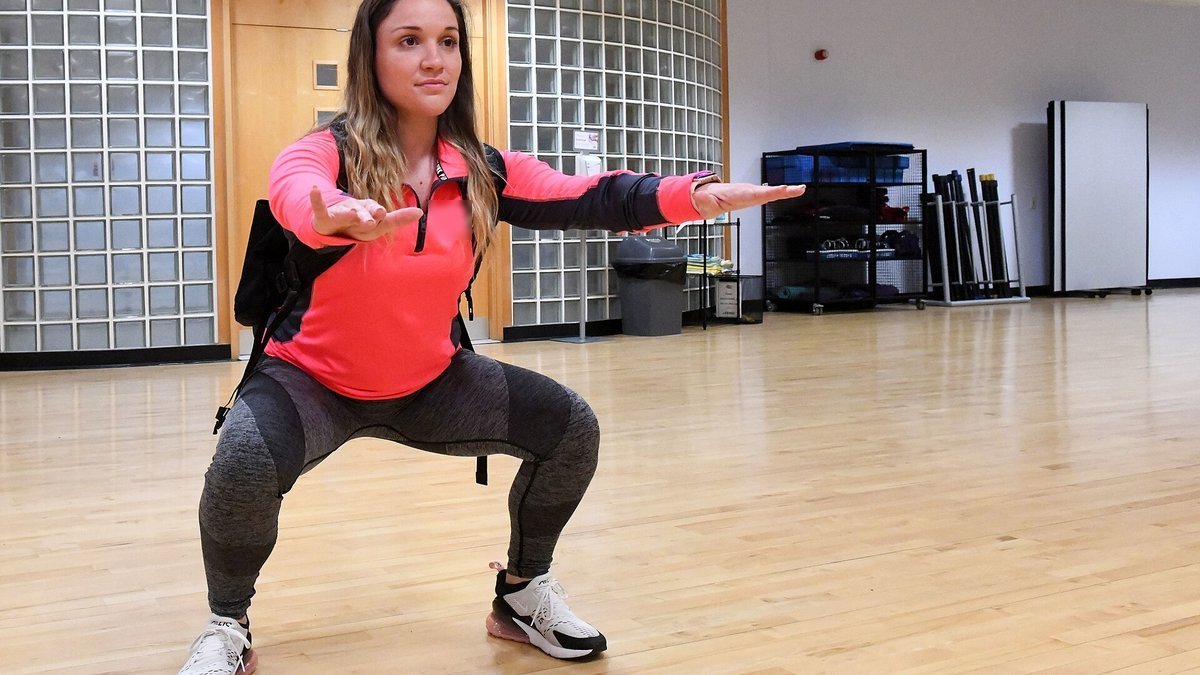
- Squat: feet about shoulder-width apart, sit your hips back and down, keep your chest up and your knees in line with your toes, and go as low as you can control, aiming for thighs parallel to the floor like the trial. Push through the whole foot to stand.
- Push-up: hands a little wider than your shoulders, and your body in one straight line from head to heels. Lower until your chest nearly touches the wall, desk edge or floor. For desk push-ups, use a heavy, stable desk, never a rolling chair.
- Backpack row: put a few books or water bottles in a backpack, brace one hand on a sturdy desk or chair, keep your back flat, and pull the bag toward your hip.
- Reverse lunge or split squat: step back, lower your back knee toward the floor, and keep your front knee over your foot. Hold a wall or desk for balance if you need to.
- Glute bridge and plank: squeeze your glutes and keep your lower back from sagging. In the plank, breathe steadily and don't hold your breath.
Office and stair tips
In work clothes, pick low-sweat moves: chair sit-to-stands, wall or desk push-ups and split squats. Tie each snack to something you already do, like a coffee refill or the end of a meeting. If there are stairs, two or three brisk flights make a good aerobic snack, as in the stair studies, but they don't work your upper body.
How to progress
The trial raised its load every two weeks. HHS says gradual increases in weight, sets, repetitions or training days make muscles stronger. With bodyweight snacks, you mostly progress by moving to a harder variation, adding reps, or adding a snack or a training day.
| Move | Easier | Standard | Harder |
|---|---|---|---|
| Squat | Chair sit-to-stand | Bodyweight squat | Backpack squat, slow 3-second lowering, or split squat |
| Push-up | Wall push-up | Desk or counter push-up | Floor push-up, then feet raised |
| Row | Light backpack | Heavier backpack | Heavier backpack, 2-second squeeze at the top |
| Glute bridge | Two-leg bridge | Two-leg bridge with a pause | Single-leg bridge |
| Plank | Hands on a desk | Forearms on the floor | Longer hold |
A bodyweight squat is much lighter than the trial's Smith-machine squats, which added 40% to 55% of each man's max on top of his body weight. If you already lift, you'll likely need the harder versions, or real weights, for a similar challenge. Our guide to progressive overload for beginners explains when to add reps, sets or load.
Who exercise snacks suit, and who needs more
- A good fit: people who can't fit a 30- to 60-minute workout into their day, such as shift workers, parents and desk workers, anyone who finds long sessions off-putting, and lifters keeping up the habit through a busy stretch.
- Promising but less proven: beginners and older adults. Small pilot studies show snacks are feasible and safe, but large, long trials are lacking.
- Probably not enough on their own: anyone chasing maximal strength or muscle size, or training for a strength sport. Heavier loads and structured sessions still matter there.
Talk to your doctor first if…
You have heart disease, chest pain or dizziness with exertion, uncontrolled high blood pressure, recent surgery or injury, joint pain that worsens with squats or push-ups, or you're pregnant. HHS advises that adults with chronic conditions or symptoms be under a health care provider's care, and a physical therapist can help you adapt moves. Stop any exercise that causes sharp pain.
FAQ
Are exercise snacks as good as a full workout for strength?
In this trial, three squat snacks a day built strength and endurance about as well as one session with the same total reps. The difference wasn't statistically significant, although the single-session group's averages were higher. The trial was small and included only young trained men, so the answer for other groups is still uncertain.
How many exercise snacks a day do I need?
The trial used three a day on three days a week. HHS asks for strength work on at least 2 days a week, covering all major muscle groups, so plan enough snacks to work your legs, hips, back, abdomen, chest, shoulders and arms on those days.
Do I need equipment?
No. The trial used a Smith machine, but bodyweight moves such as squats, push-ups and planks count as strengthening activity under the US guidelines. A backpack with books makes a handy weight for rows and squats.
This article is general information, not medical advice. It isn't a substitute for advice from a doctor or other qualified health professional.
Sources
- Zhai R, Yang K, Dai H, Wang Y, Jiang Y, Wu X, Wang L. Fragmented versus traditional resistance training: a randomized controlled trial on muscular strength, endurance, and enjoyment in recreationally trained young adults, Journal of Exercise Science & Fitness 2026;24(4):200521 (full text).
- Jenkins EM et al. Do stair climbing exercise "snacks" improve cardiorespiratory fitness? Applied Physiology, Nutrition, and Metabolism 2019.
- Perkin OJ, McGuigan PM, Stokes KA. Exercise snacking to improve muscle function in healthy older adults: a pilot study, Journal of Aging Research 2019.
- Fyfe JJ et al. Feasibility and acceptability of a remotely delivered, home-based, pragmatic resistance 'exercise snacking' intervention in community-dwelling older adults: a pilot randomised controlled trial, BMC Geriatrics 2022.
- Rogers EM et al. Acceptability of performing resistance exercise breaks in the workplace to break up prolonged sedentary time: a randomized control trial in U.S. office workers and students, Workplace Health & Safety 2024.
- Zhang D et al. Effectiveness of exercise snacks on physical function: a systematic review with meta-analysis of randomized controlled trials, Journal of Nutrition, Health and Aging 2026.
- Wang Y et al. Effects of exercise snacking on neuromuscular performance in insufficiently active adults: a systematic review and meta-analysis, Complementary Therapies in Medicine 2026.
- Fyfe JJ, Hamilton DL, Daly RM. Minimal-dose resistance training for improving muscle mass, strength, and function: a narrative review of current evidence and practical considerations, Sports Medicine 2022.
- Stamatakis E et al. Association of wearable device-measured vigorous intermittent lifestyle physical activity with mortality, Nature Medicine 2022.
- Koemel NA et al. Vigorous intermittent lifestyle physical activity (VILPA) and mortality risk among US adults: a wearables-based national cohort study, International Journal of Behavioral Nutrition and Physical Activity 2026.
- US Department of Health and Human Services: Physical Activity Guidelines for Americans, 2nd edition (PDF).
- HHS Office of Disease Prevention and Health Promotion: Top 10 Things to Know About the Second Edition of the Physical Activity Guidelines for Americans.
- Banner photo: Make time 170112-F-CI489-017.jpg by Airman 1st Class Zachary Bumpus, U.S. Air Force, public domain, via Wikimedia Commons (cropped).
- Photo: Woman walking up stairs in a modern building with a yellow wall on a sunny day.jpg by Shixart1985, CC BY 2.0, via Wikimedia Commons (cropped).
- Photo: Stay fit anywhere, anytime (6186146).jpg by Senior Airman Christopher Sparks, U.S. Air Force, public domain, via Wikimedia Commons (cropped; clothing logo obscured).