

On average, yes. In a Swedish study that tested the same people from age 16 to 63, aerobic fitness and muscular endurance peaked between the mid-20s and mid-30s, began to decline around age 35, and then fell faster with each decade. The study, published in the Journal of Cachexia, Sarcopenia and Muscle, found the same pattern in men and women. From peak to age 63, the tested capacities fell by 30% to 48%. The encouraging part: people who were physically active, including those who only became active as adults, performed better on every test.
The study doesn't mean your body falls apart at 35. Losses in the first decade after the peak were under 1% a year. What it does show is that the slide starts long before most people notice, and that the 30s and 40s are a good time to build the habits that matter most later. Below we explain what the researchers measured, what "decline" means in numbers, where the study has limits, and what to do at each stage of adult life, based on the federal Physical Activity Guidelines for Americans.
What the 47-year study did
The research comes from the Swedish Physical Activity and Fitness (SPAF) cohort, run by researchers at Karolinska Institutet in Stockholm. Lead author Maria Westerståhl and colleagues published the main results in the December 2025 issue of the journal. It drew fresh news coverage in October 2026, including a ScienceDaily report headlined "A 47-year study reveals the age when your body starts losing strength."
| Detail | What the paper reports |
|---|---|
| Who | 427 people (222 male, 205 female) born in 1958, randomly selected in 1974 as a representative sample of Swedish 16-year-olds in upper secondary school |
| When tested | Ages 16, 27, 34, 52 and 63 (1974 to 2021) |
| Aerobic fitness | Estimated maximal aerobic capacity from a submaximal cycle test (Åstrand test); a 9-minute run at age 16 |
| Muscular endurance | Bench press repetitions at a set pace of 25 per minute, using 20 kg (about 44 lb) for men and 12 kg (about 26 lb) for women |
| Muscle power | Vertical (Sargent) jump height |
| Activity question | A simple yes/no question about leisure-time physical activity |
| Analysis | Linear mixed models that included all original participants, to estimate average curves by age and sex |
Most aging research compares younger and older people at one point in time. Following the same individuals instead, the authors found that such cross-sectional studies appear to underestimate how much capacity people actually lose.
What it found: peak in the 30s, then a speeding-up decline
Aerobic capacity and muscular endurance peaked between ages 26 and 36, depending on the measure and sex. After the peak, the average yearly loss started small and grew. In the first decade after the peak it was under 1% a year, and by the early 60s it was more than 2% a year. Averaged across tests and sexes, people had lost 37% of their peak capacity by age 63, with a range of 30% to 48%.
| Test | Peak age | Yearly change at 40 | At 50 | At 60 | Total drop, peak to 63 |
|---|---|---|---|---|---|
| Aerobic capacity (absolute, L/min) | 35 / 36 | −0.6% / −0.5% | −1.6% / −1.4% | −2.1% / −2.0% | 33% / 30% |
| Aerobic capacity per kg of body weight | 26 / 31 | −1.2% / −1.0% | −1.8% / −1.8% | −2.1% / −2.2% | 40% / 37% |
| Muscular endurance (bench press reps) | 36 / 34 | −0.6% / −0.6% | −1.7% / −1.5% | −2.4% / −2.0% | 35% / 32% |
| Leg power (vertical jump) | 27 / 19 | −1.2% / −1.6% | −1.9% / −2.0% | −2.2% / −2.2% | 41% / 48% |
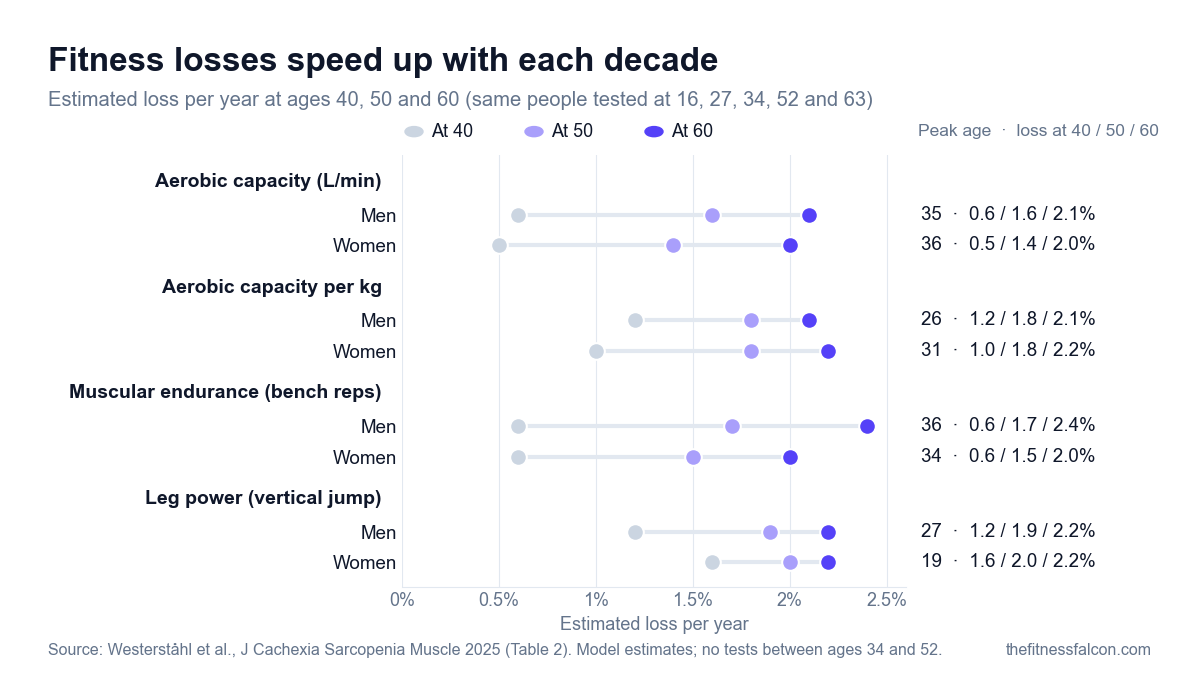
In concrete terms, the model's average man went from about 53 bench press reps at his peak to about 34 at 63. The average woman's jump height fell from about 33 cm (13 inches) to about 17 cm (7 inches). Fitness relative to body weight peaked earlier than absolute fitness, in step with rising body weight (BMI climbed mainly between 16 and 50).
Three other findings stand out:
- No sex difference in the rate of decline. Men and women started from different levels, but the yearly rates of loss after the peak were similar.
- People grow more different with age. The spread between the fittest and least-fit participants grew 3- to 25-fold between 16 and 63, depending on the test. Average curves describe the group, not your personal destiny.
- Most were not frail at 63. On the grip strength and chair-stand tests used to screen for sarcopenia (age-related loss of muscle strength and mass), no men and only four women tested at 63 scored below the European (EWGSOP2) cut-offs. For most, the decline at 63 meant less physical reserve rather than clinically low strength.
Note: this was not a test of maximum strength
News headlines say "strength," but the study didn't measure one-rep maximum lifts. Bench press reps with a light, fixed weight measure muscular endurance. The vertical jump measures leg power, which is how quickly you can produce force. Both matter for daily life, but they aren't the same as how much you can lift once.
Why does decline start so early?
The study wasn't designed to answer that. The authors cite earlier research pointing to mitochondrial changes as a possible early driver in the 30s, with changes to connective tissue, nerve-muscle connections and muscle size following later. These are hypotheses. Elite athletes who keep training also tend to peak before about 35, which suggests some of this timing is built into human biology.
Does staying active still matter? Yes, with caveats
Activity didn't stop the decline. But it was linked to a better level of fitness at every age:
- People who did leisure-time sports at 16 had higher aerobic capacity, muscular endurance and leg power throughout adulthood.
- Switching from inactive to active was associated with about 6–7% higher aerobic capacity, 11% more bench press reps and 4% higher jumps. The authors write that taking up activity "at any age significantly improves performance" and that early inactivity doesn't permanently lock in poor fitness.
- As the authors note, master athletes keep more than 80% of their peak endurance performance at this age, against about 65% in this general-population group. Those figures come from other studies and aren't a direct comparison, but they suggest that lifelong training preserves much more.
"It is never too late to start moving," Westerståhl said in the Karolinska Institutet press release, adding that "physical activity can slow the decline in performance, even if it cannot completely stop it."
One honest nuance. In this dataset, active people performed at a higher level at every age, but the statistical models didn't show a separate, slower rate of decline for them. The view that activity slows the decline draws on the master-athlete comparisons and earlier research. Because this was an observational study using a yes/no activity question, it also can't prove that activity caused the differences. Healthier people may simply have found it easier to stay active.
Limitations to keep in mind
- The "age 35" peak is a model estimate. Tests happened at 16, 27, 34, 52 and 63, with no testing between 34 and 52. The exact peak ages and yearly rates come from curves fitted between those visits.
- One birth cohort, one country. Everyone was born in 1958 in Sweden, so results may not fully apply to Americans or to people born later.
- Estimated, not directly measured, aerobic capacity. A submaximal cycle test estimates VO2 max rather than measuring it to exhaustion.
- A crude activity measure. The authors say they lacked data on how hard, how long and how consistently people exercised.
- Limited test battery. Maximum strength, balance and walking speed across the lifespan weren't tracked.
- Dropout. Participants with a university degree or who were active at 16 were more likely to keep coming back. The authors modeled the full original cohort to reduce this bias.
The cohort is due to be tested again at 68, according to Karolinska Institutet.
What to do in your 30s, 40s, 50s and beyond
The study doesn't prescribe a program, so the practical advice here comes from the Physical Activity Guidelines for Americans, 2nd edition (HHS, 2018) and research on age-related muscle loss. The baseline is the same for every adult:
- Aerobic: 150 to 300 minutes a week of moderate-intensity activity (such as brisk walking), or 75 to 150 minutes of vigorous activity, or a mix. Spread it across the week.
- Muscle-strengthening: at least 2 days a week, working all major muscle groups (legs, hips, back, abdomen, chest, shoulders and arms) at moderate or greater intensity.
- Move more, sit less: HHS says some physical activity is better than none.
For strength work, HHS says to work until another repetition would be difficult. One set of 8 to 12 repetitions per exercise is effective, and 2 or 3 sets may be more effective. Strength builds when you gradually increase weight, reps, sets or training days. (HHS is also reviewing evidence for a 2027 update that adds step-count and strength guidance.)
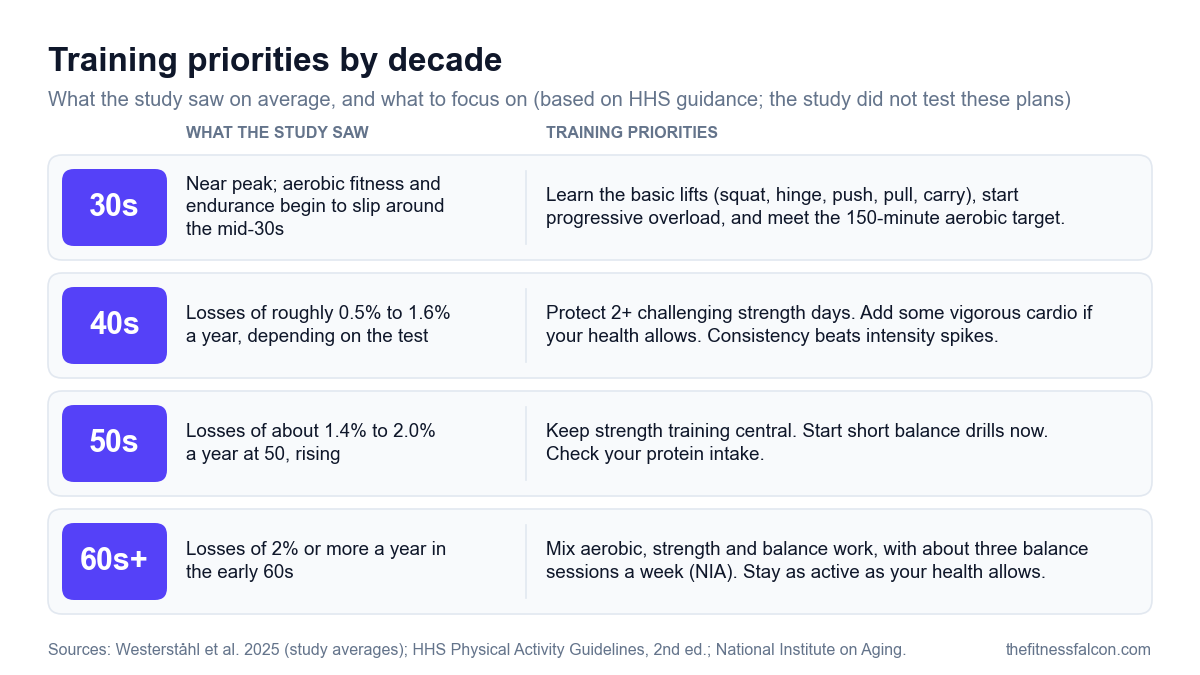
| Age | What the study saw on average | Training priorities |
|---|---|---|
| 30s | Near peak for aerobic fitness and endurance, which begin to slip around the mid-30s; jump height was already falling, especially in women | Build the habit while gains come easily. Learn basic lifts (squat, hinge, push, pull, carry) and start progressive overload. Meet the 150-minute aerobic target. |
| 40s | Losses of roughly 0.5% to 1.6% a year, depending on the test | Protect 2+ strength days that are actually challenging. Include some vigorous cardio if your health allows (each vigorous minute counts as about two moderate minutes). Consistency beats intensity spikes. |
| 50s | Losses of about 1.4% to 2.0% a year at 50, rising through the decade | Keep strength training central. Start short balance drills now, since HHS recommends balance training for older adults and it's easier to build the habit early. Check protein intake. |
| 60s and up | Losses of 2% or more a year in the early 60s | Do multicomponent activity: aerobic, strength and balance. NIA suggests about three balance sessions a week. Set effort by how hard it feels to you, and stay as active as your abilities and health conditions allow. |
Why strength training is the priority as you age
Resistance training works in older adults. A meta-analysis of 47 studies of adults aged 50 and older found strength gains of about 24% to 33% across common lifts, with bigger improvements at higher training intensities. A small classic trial found that 9 frail nursing-home residents averaging 90 years old more than doubled their leg strength after 8 weeks of high-intensity training. International clinical guidelines on sarcopenia strongly recommend resistance-based training as treatment, with a conditional recommendation for protein-rich diets or protein supplements.
If you're starting from zero, our guide to the minimum effective dose of strength training shows how two short full-body sessions a week can get you going. For protein targets by age, see how much protein you need per day.
Add balance before you need it
For older adults, HHS recommends multicomponent activity that includes balance training. In studies HHS reviewed, fall-prevention programs generally included about three sessions a week. Simple options from the National Institute on Aging include standing on one foot, the heel-to-toe walk, walking sideways or backward, and practicing standing up from a seated position. Tai chi and yoga also count. Keep a sturdy chair, a wall or another person within reach.
A sample week that meets the guidelines
| Day | Activity |
|---|---|
| Monday | Strength A (30–40 min): goblet squat, push-up (incline if needed), dumbbell or band row, hip bridge, farmer's carry. 1–3 sets of 8–12 reps, stopping when another rep would be hard. Finish with 5 minutes of balance. |
| Tuesday | Brisk walk, 30 minutes |
| Wednesday | Strength B (30–40 min): split squat or step-up, overhead press, dumbbell Romanian deadlift, band pull-apart, plank. Finish with 5 minutes of balance. |
| Thursday | Brisk walk or easy cycling, 30 minutes |
| Friday | Rest or an easy stroll |
| Saturday | Longer activity, 60 minutes: hike, bike ride, dance class or a sport |
| Sunday | Walk, 30 minutes, plus 5–10 minutes of balance practice |
Moderate intensity means you can talk but not sing. If you want to build aerobic fitness without a heart rate monitor, our zone 2 cardio guide explains how to judge effort. Strength and cardio work best alongside sleep, diet and the other habits linked to healthy aging.
If you have heart disease, diabetes, joint problems or another chronic condition, HHS advises understanding how your condition affects what you can do safely. A doctor or physical therapist can help you adjust.
FAQ
Is it too late to start exercising at 50 or 60?
No. In the SPAF study, becoming active as an adult was linked to better performance on every test, and resistance-training trials in adults over 50, and even in people in their 90s, show meaningful strength gains. Start at a level that feels manageable and build gradually.
Is 35 a hard cutoff?
No. It's an average peak estimated from a statistical model, with tests at 34 and then not until 52. Peak ages ranged from 19 (women's jump height) to 36, and individuals varied widely, especially later in life.
Did women lose fitness faster than men?
The yearly rates of decline after the peak were similar for both sexes. Women's jump height peaked earlier (at 19), so its total decline to age 63 covered more years.
This article is general information, not medical advice. Talk to a qualified health professional before starting a new exercise program if you have a health condition or haven't been active.
Sources
- Westerståhl M, Jörnåker G, Jansson E, et al. Rise and Fall of Physical Capacity in a General Population: A 47-Year Longitudinal Study. Journal of Cachexia, Sarcopenia and Muscle 2025;16(6):e70134 (full text; doi:10.1002/jcsm.70134).
- Karolinska Institutet: Long-term study reveals physical ability peaks at age 35 (press release, December 16, 2025).
- ScienceDaily: A 47-year study reveals the age when your body starts losing strength (October 14, 2026).
- U.S. Department of Health and Human Services: Physical Activity Guidelines for Americans, 2nd edition (2018).
- HHS Office of Disease Prevention and Health Promotion: Top 10 Things to Know About the Second Edition of the Physical Activity Guidelines for Americans.
- National Institute on Aging: Three Types of Exercise Can Improve Your Health and Physical Ability (reviewed January 14, 2025).
- Dent E, et al. International Clinical Practice Guidelines for Sarcopenia (ICFSR): Screening, Diagnosis and Management. Journal of Nutrition, Health and Aging 2018.
- Cruz-Jentoft AJ, et al. Sarcopenia: revised European consensus on definition and diagnosis. Age and Ageing 2019.
- Peterson MD, et al. Resistance exercise for muscular strength in older adults: a meta-analysis. Ageing Research Reviews 2010.
- Fiatarone MA, et al. High-intensity strength training in nonagenarians: effects on skeletal muscle. JAMA 1990.
- Banner photo: Woman jogging in the park during daytime with trees in the background.jpg by Shixart1985, CC BY 2.0, via Wikimedia Commons (cropped).