


Wall sits and other isometric "hold" exercises can lower resting blood pressure, and the effect in trials is larger than many people expect. In a UK trial published on September 29, 2026 in BMJ Open Sport & Exercise Medicine, 100 adults whose systolic blood pressure was 120 to 140 mm Hg did four 2-minute wall sits three times a week. After 4 weeks, their systolic pressure (the top number) had fallen by about 9.5 mm Hg compared with a control group. A large 2023 review in the British Journal of Sports Medicine ranked isometric exercise as the most effective exercise type for lowering resting blood pressure.
The holds are hard, and they briefly push your blood pressure up while you do them. The new trial was short and excluded anyone who had taken blood pressure medication. Treat wall sits as one tool alongside regular activity and your clinician's advice, not as a replacement for medication.
What the new wall-sit study found
The trial was run by Harry Swift and colleagues at Canterbury Christ Church University and three other UK universities. It asked how often you need to keep doing wall sits once they have lowered your blood pressure.
- Who took part: 100 adults (45% women, average age 37) with systolic blood pressure of 120 to 140 mm Hg who were not regularly active. Smokers, heavier drinkers and anyone who had ever taken blood pressure medication were excluded.
- Weeks 1 to 4: 80 people did home wall-sit training: 4 holds separated by 2 minutes of seated rest, 3 times a week, with 48 hours between sessions. The other 20 kept their usual routine as controls.
- Weeks 5 to 8: the 80 trainees were split into four groups that trained 3, 2, 1 or 0 times a week.
- Measurement: in a lab, after 15 minutes of seated rest, at the start, week 4 and week 8.
| Group (weeks 5–8) | Start | Week 4 | Week 8 | Change from start |
|---|---|---|---|---|
| Wall sits 3×/week | 131.2 | 122.4 | 117.5 | −13.7 |
| Wall sits 2×/week | 129.4 | 118.8 | 122.5 | −7.0 |
| Wall sits 1×/week | 129.9 | 118.9 | 123.3 | −6.6 |
| Stopped after week 4 | 131.5 | 124.1 | 127.7 | −3.9 (not significantly different from control) |
| Control (no wall sits) | 127.8 | 127.0 | 128.6 | +0.8 |
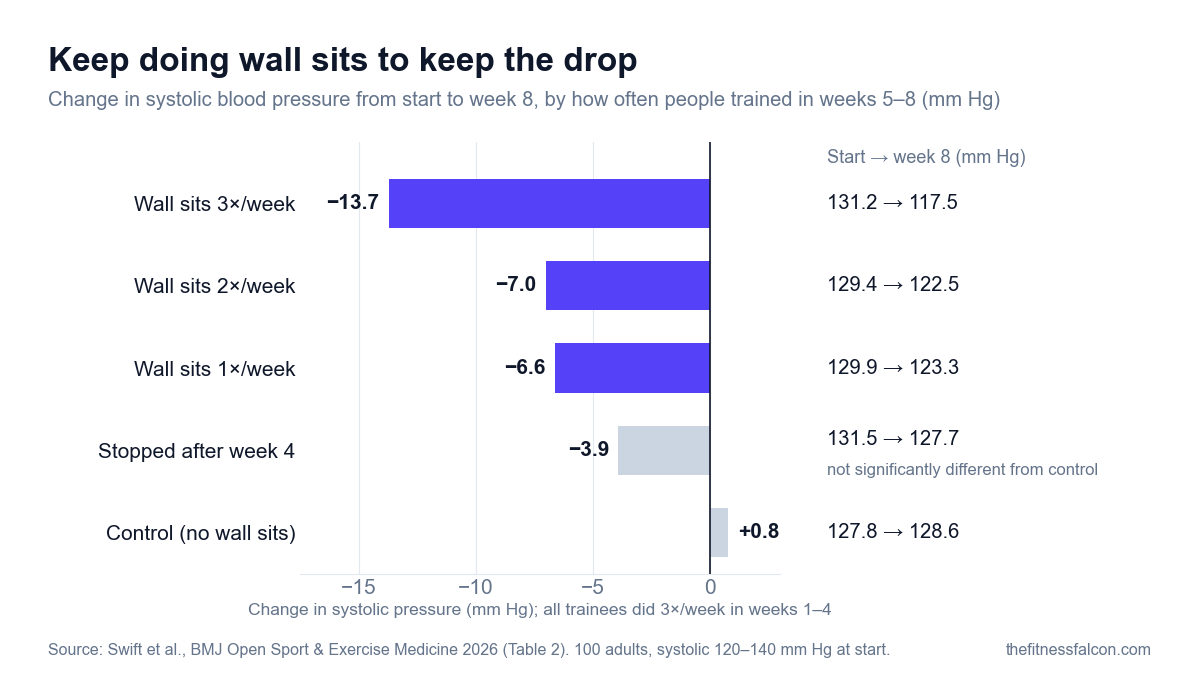
After the first 4 weeks, the 80 trainees' systolic pressure was 9.45 mm Hg lower than the control group's, and diastolic pressure (the bottom number) was 5.47 mm Hg lower. In the second month:
- 3 times a week kept lowering systolic pressure, to 13.7 mm Hg below the start.
- Once or twice a week kept part of the drop (still significantly below control), with no meaningful difference between the two and early signs of drift back up.
- Stopping let pressure return to levels not significantly different from control within 4 weeks.
The authors conclude that one session a week can help during a short lapse in training, but 3 sessions a week gave the largest benefit.
What this study can't tell you
- It was short. The maintenance phase lasted only 4 weeks, which the authors call their main limitation.
- Intensity was set in a lab. Each person's wall-sit depth was chosen with a heart rate test so the holds reached about 95% of their peak heart rate. Participants then checked it with a chest strap at home.
- No one was on blood pressure medication.
- It wasn't blinded. Participants and researchers knew who was training, and the groups differed somewhat in how active they were outside the study.
Why isometric exercise is getting attention
Isometric exercise means holding a muscle contraction without moving, as in a wall sit, handgrip squeeze or plank. The new trial builds on a 2023 network meta-analysis by Edwards and colleagues in the British Journal of Sports Medicine. It pooled 270 randomized controlled trials with 15,827 participants and compared each exercise type with no-exercise control groups.
| Exercise type | Systolic (mm Hg) | Diastolic (mm Hg) |
|---|---|---|
| Isometric exercise | −8.24 | −4.00 |
| Combined aerobic + resistance | −6.04 | −2.54 |
| Dynamic resistance (weights) | −4.55 | −3.04 |
| Aerobic (walking, running, cycling) | −4.49 | −2.53 |
| High-intensity interval training | −4.08 | −2.50 |
Isometric training ranked first for lowering systolic pressure, and the wall squat (wall sit) was the most effective single exercise for systolic pressure. Every exercise type lowered blood pressure, though, and aerobic and strength training bring benefits a wall sit doesn't.
A 2024 expert review in Sports Medicine (Edwards and 19 co-authors) calls isometric training a possible add-on tool in blood pressure care that is still rarely prescribed. The likely mechanisms are lower resistance in the blood vessels and shifts in nervous-system control of blood pressure, which the 2026 trial's measurements also pointed to.
Where your numbers fit: US blood pressure categories
The 2025 AHA/ACC high blood pressure guideline kept the same categories as the 2017 guideline. Hypertension still starts at 130/80 mm Hg. The CDC lists them this way:
| Category | Systolic (top number) | Diastolic (bottom number) | |
|---|---|---|---|
| Normal | Less than 120 | and | Less than 80 |
| Elevated | 120–129 | and | Less than 80 |
| Stage 1 hypertension | 130–139 | or | 80–89 |
| Stage 2 hypertension | 140 or higher | or | 90 or higher |
| Severe hypertension | Higher than 180 | and/or | Higher than 120 |
The CDC says to call your health care professional about a reading above 180/120 with no symptoms. Call 911 if that reading comes with chest pain, shortness of breath, back pain, numbness, weakness, vision changes or difficulty speaking.
The trial called its volunteers "normal to high-normal," which is European-style wording. Their average starting readings (about 128–132 over 81–85) would count as stage 1 hypertension under US categories, because a diastolic reading of 80–89 is enough on its own. The guideline recommends medication for everyone with stage 2 hypertension. For some lower-risk adults with stage 1, it recommends 3 to 6 months of lifestyle changes before deciding on medication. Wall sits could be part of that plan, agreed with your clinician.
The wall-sit protocol used in the trials
The same research group has used essentially one home program since a 2017 trial by Wiles and colleagues:
| Element | What the trials used |
|---|---|
| Holds per session | 4 |
| Length of each hold | 2 minutes |
| Rest between holds | 2 minutes (seated in the 2026 trial) |
| Sessions per week | 3, with about 48 hours between sessions |
| Program length | 4 weeks in these trials |
| Intensity | A knee angle set to reach about 95% of peak heart rate (lab test), or a height chosen by rating of effort (Lea 2023) |
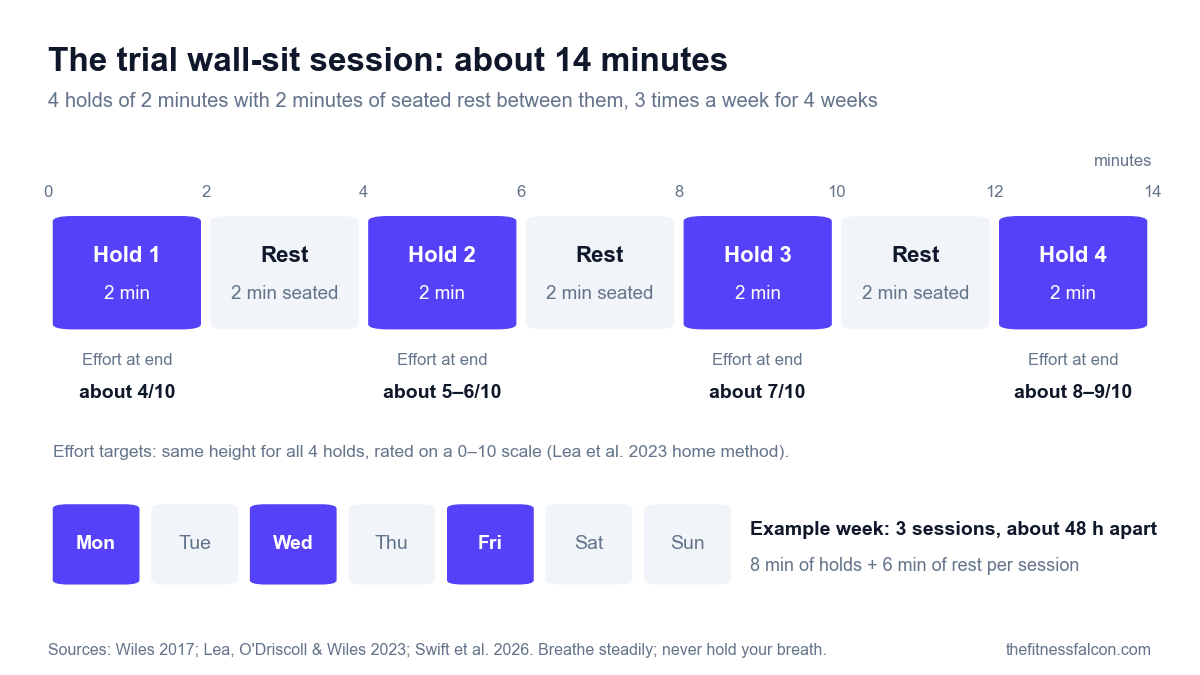
| Time per session | About 14 minutes (8 minutes of holds, 6 minutes of rest) |
How to find your wall-sit depth at home
Most people can't do a lab heart rate test. A 2023 pilot study by Lea, O'Driscoll and Wiles tested a way to set wall-sit depth by how hard it feels, using a 0 to 10 effort scale where 10 is maximal. Over 4 weeks, the 10 people who trained this way lowered their resting systolic pressure by 9 mm Hg on average. That was similar to the heart rate method, but the study was very small. Their method, adapted for home use:
- Set up. Find a sturdy, smooth wall and wear shoes with grip on a non-slip floor. Have a chair nearby for your rests and a timer.
- Get into position. Stand with your back against the wall and slide down while walking your feet forward. Keep your lower legs vertical, so your knees stay over your ankles, not past your toes. Keep your back flat against the wall and your feet about hip-width apart.
- Start shallow. The trials worked with knee angles between about 135 degrees (a shallow bend) and 95 degrees (thighs close to parallel with the floor). The tests didn't go deeper than 95 degrees, so there's no need to sink below thighs parallel.
- Breathe the whole time. Breathe steadily throughout every hold. Never hold your breath or strain (see safety below).
- Rate the first hold. At the end of the first 2-minute hold, your effort should feel about 4 out of 10. In the study, the target rose to about 5 to 6 after the second hold, about 7 after the third and about 8 to 9 after the fourth, at the same height, because fatigue builds.
- Adjust in small steps. If the ratings land outside those zones, change the height by 1 to 2 cm (under an inch) at a time, moving your feet to keep your shins vertical.
- Mark it. Participants used a squat-height marker on the wall; painter's tape works, and noting your heel-to-wall distance helps you repeat the position.
- Rest seated for 2 minutes between holds, and leave a day between sessions.
A burning feeling in the thighs is common during holds and fades soon after you stand up, according to the 2024 review. If you can't hold for 2 minutes, raise your position rather than cutting the hold short. If you are new to strength work, our guide to how little strength training is enough for beginners covers the rest of a simple routine.
What about handgrip and planks?
Handgrip is the most-studied isometric exercise for blood pressure, usually 2-minute squeezes at about 30% of maximum grip, set with a grip dynamometer. Lower-body holds may lower blood pressure a little more, but handgrip causes a smaller spike during the hold, so the 2024 review suggests it may suit people at higher risk.
Planks are isometric too, but the training trials in these reviews used wall squats, handgrip and leg-extension holds. Planks build core strength; there isn't comparable trial evidence that they lower blood pressure.
Safety: what to know before you start
Isometric exercise raises blood pressure sharply during the hold. A meta-analysis cited in the 2024 review found average systolic increases of about 46 mm Hg during squat holds and 33 mm Hg during handgrip. Afterward, pressure tends to dip below its resting level for a while. The 2026 trial reported no harms, and the review cites expert consensus that isometric training appears safe for healthy people, those with high-normal blood pressure or stage 1 hypertension, and some heart conditions. Still:
- Don't hold your breath. People tend to hold their breath during a hard hold without realizing it. Straining with a closed throat (the Valsalva maneuver) adds a further sharp rise in blood pressure. The same breath-holding is one reason snow shoveling is hard on the heart. Breathe steadily, and count out loud if it helps.
- Talk to your clinician first if you have diagnosed high blood pressure, take blood pressure medication, have heart disease or a heart rhythm problem, or regularly see readings in the stage 2 range. The review lists connective tissue disorders such as Marfan syndrome and thoracic aortic disease as conditions where isometric training is strongly advised against. Ask about knee or hip problems too.
- Stop if you feel chest pain, dizziness, unusual shortness of breath or palpitations. Call 911 if symptoms are severe or don't go away.
- Don't stop or change medication because your home readings improve. Talk to the clinician who prescribed it.
How to track your blood pressure at home correctly
Home readings show whether wall sits are helping you. The CDC's checklist:
- Don't eat or drink anything for 30 minutes before a reading, and empty your bladder first.
- Sit in a chair with your back supported for at least 5 minutes before measuring.
- Keep both feet flat on the floor and your legs uncrossed.
- Rest your arm on a table so the cuff is at chest height.
- Put the cuff on your bare upper arm, snug, and don't talk during the reading.
- Take at least two readings, 1 or 2 minutes apart, at the same time each day, and record them in a log.
Two additions for this plan:
- Don't measure straight after your wall sits. Blood pressure can stay below its usual resting level for a while after isometric exercise, so a reading taken then may look better than it is. Measure on a rest day or before training.
- Get a baseline first. Record a week of readings before you start, then compare weekly averages after 4 weeks. One-off readings vary too much to judge.
If you aren't sure your cuff fits or your monitor is accurate, a member of your health care team can check it and show you how to use it.
Fitting wall sits into your week
Federal guidelines still recommend at least 150 minutes a week of moderate aerobic activity plus muscle-strengthening work on 2 or more days. A realistic week: three 14-minute wall-sit sessions (say Monday, Wednesday and Friday) plus brisk walks on most days.
- For easy aerobic minutes, see Zone 2 cardio without a heart rate monitor or 10-minute walks after meals.
- For where US activity advice is heading, see what the 2027 Physical Activity Guidelines update means for you.
- In a busy week, one session beats none, then return to three when you can.
FAQ
How long should I hold a wall sit to lower blood pressure?
The trials used four 2-minute holds with 2 minutes of rest, three times a week. The 30- to 45-second wall sits common in circuit workouts are a much smaller dose.
How quickly do wall sits lower blood pressure?
The trials measured reductions after 4 weeks of training three times a week. In the 2026 trial, the benefit faded within 4 weeks for people who stopped.
Can I do wall sits every day?
The trials used 3 sessions a week with about 48 hours between them. Daily training wasn't tested, so there is no evidence it works better.
Can wall sits replace blood pressure medication?
No. The 2026 trial excluded anyone who had taken blood pressure medication, and the studies were short. The guideline recommends medication for stage 2 hypertension. Use wall sits alongside your treatment and talk to your clinician before changing anything.
This article is general information, not medical advice. It isn't a substitute for advice from a doctor or other qualified health professional, especially if you have high blood pressure, take medication or have a heart condition.
Sources
- Swift HT, Pedlar C, Coleman DA, Buckley JP, Wiles JD. Isometric exercise training and blood pressure control: exploring the dose-response to training frequency in a randomised controlled trial, BMJ Open Sport & Exercise Medicine 2026;12(3):e003172 (full text).
- BMJ Group press release: A weekly session of isometric exercise training may maintain lower blood pressure (September 29, 2026).
- Edwards JJ et al. Exercise training and resting blood pressure: a large-scale pairwise and network meta-analysis of randomised controlled trials, British Journal of Sports Medicine 2023.
- Edwards JJ et al. Isometric Exercise Training and Arterial Hypertension: An Updated Review, Sports Medicine 2024.
- Wiles JD, Goldring N, Coleman D. Home-based isometric exercise training induced reductions resting blood pressure, European Journal of Applied Physiology 2017.
- Lea JWD, O'Driscoll JM, Wiles JD. The implementation of a home-based isometric wall squat intervention using ratings of perceived exertion to select and control exercise intensity, European Journal of Applied Physiology 2024 (online 2023).
- Jones DW et al. 2025 AHA/ACC/AANP/AAPA/ABC/ACCP/ACPM/AGS/AMA/ASPC/NMA/PCNA/SGIM Guideline for the Prevention, Detection, Evaluation and Management of High Blood Pressure in Adults, Circulation 2025.
- Implementing the 2025 Guideline for the Prevention, Detection, Evaluation, and Management of High Blood Pressure in Adults, Hypertension 2025.
- CDC: About High Blood Pressure (blood pressure categories).
- CDC: Measuring Your Blood Pressure.
- HHS Office of Disease Prevention and Health Promotion: Top 10 Things to Know About the Second Edition of the Physical Activity Guidelines for Americans.
- Banner photo: Doctor takes blood pressure.jpg by Bill Branson, National Cancer Institute, public domain, via Wikimedia Commons.