


The viral creatine study is real, but it shows less than the headlines suggested. In a 12-week Texas A&M trial published in the Journal of the International Society of Sports Nutrition, sedentary adults aged 45 to 65 took 10 grams of creatine monohydrate a day without joining an exercise program. They gained about 1.1 kg (2.4 lb) of lean tissue and did better on some strength tests than a placebo group. But only 13 people were in each of those two groups, and "lean tissue" on a DXA scan isn't the same thing as new muscle. Earlier research, including a review co-written by this study's senior author, found that creatine without training usually does little for muscle or strength in older adults.
The best-supported way to use creatine is still alongside resistance training.
What the Texas A&M creatine study did
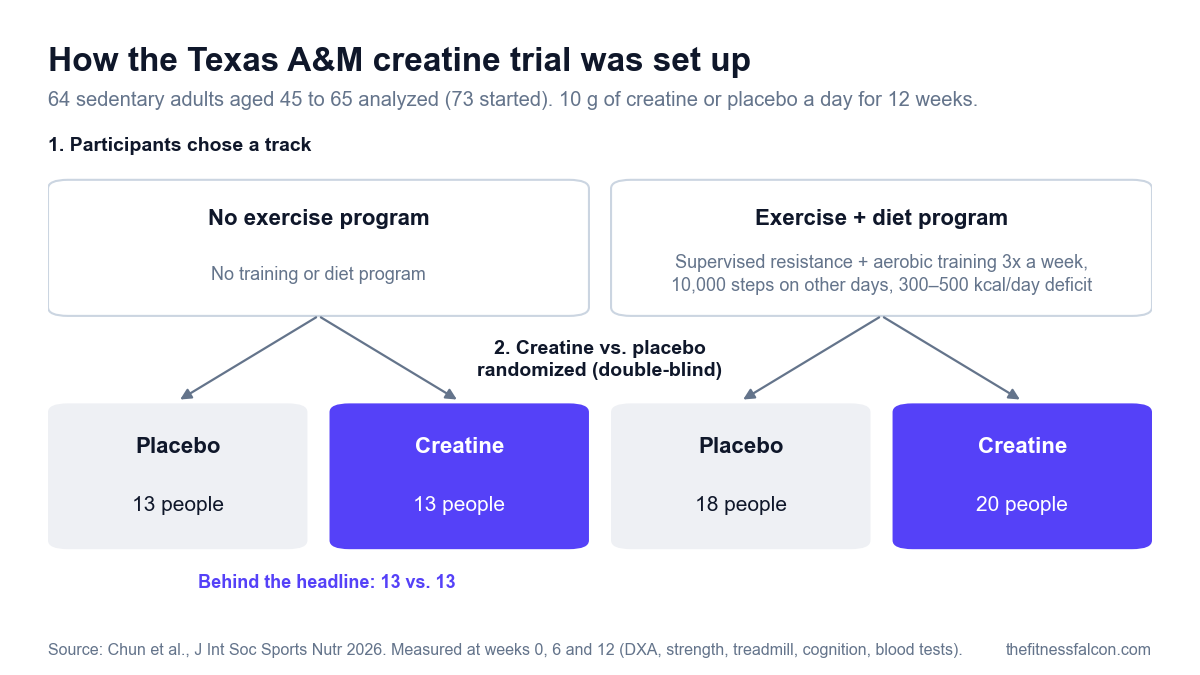
The paper is Chun and colleagues, "Effects of creatine supplementation with and without exercise and diet intervention on body composition, cognitive function, and markers of health in middle-aged and older adults." The senior author is Richard Kreider, who directs Texas A&M's Exercise & Sport Nutrition Lab. It was published online on August 11, 2026, and Texas A&M announced it on September 18.
How it was set up:
- Who took part: 73 healthy, sedentary adults aged 45 to 65 started, and 64 finished and were analyzed. That was 40 women and 24 men, with an average age of 54.5 and an average BMI of about 30.
- Participants picked their own track. One option was a supervised program: resistance and aerobic training three times a week, 10,000 steps on other days, and a diet about 300–500 calories a day below their needs. The other was no exercise program.
- The supplement was randomized. Within each track, people were randomly assigned to creatine monohydrate or a maltodextrin placebo, and neither they nor the researchers knew who got which (double-blind). The dose was 5 grams twice a day (10 g/day) for 12 weeks, dissolved in water or another drink.
- Final group sizes: 13 in no exercise + placebo, 13 in no exercise + creatine, 18 in exercise + placebo and 20 in exercise + creatine.
- Measurements at weeks 0, 6 and 12 included DXA body composition, bench-press and leg-press strength, a treadmill test, computerized thinking tests, questionnaires and blood tests.
What it found and what it didn't show
| Question | What the study found | What it didn't show |
|---|---|---|
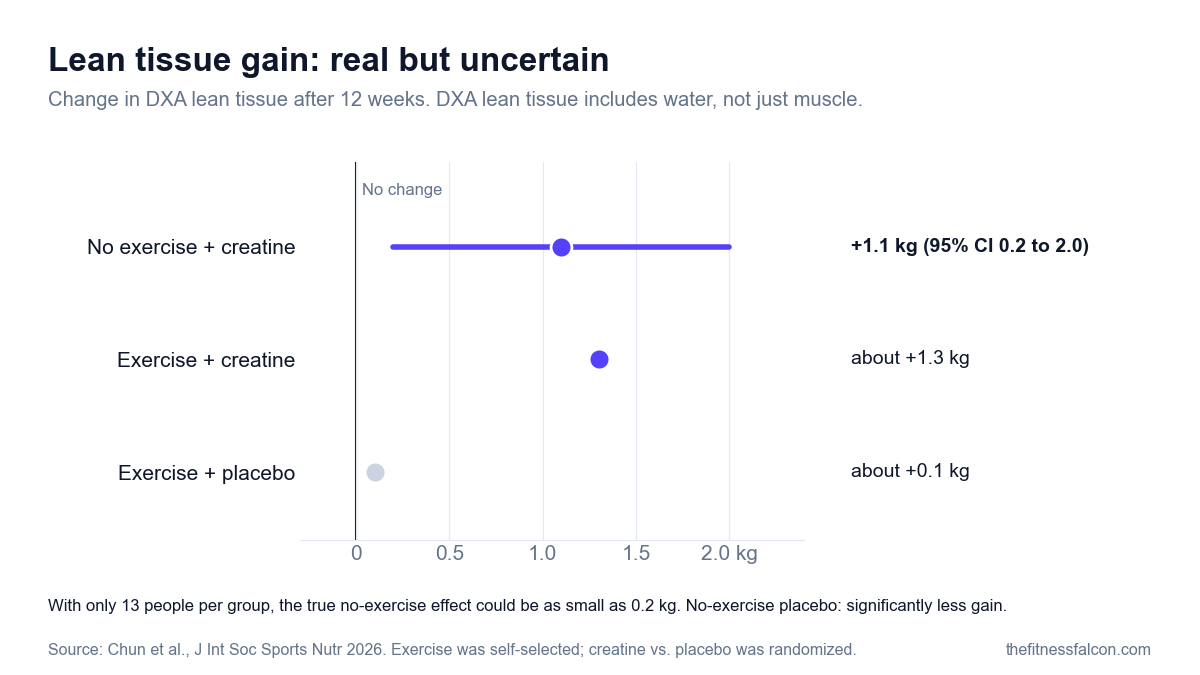
| Lean tissue without exercise | The no-exercise creatine group gained about 1.1 kg (2.4 lb) of DXA lean tissue by week 12 (95% confidence interval 0.2 to 2.0 kg). That was significantly more than either placebo group. | That the gain was new muscle. DXA "lean tissue" includes water, and creatine pulls water into muscle cells. Muscle size and muscle protein weren't measured directly. |
| Strength without exercise | Bench-press one-rep max improved more than with placebo. The authors also report leg-press gains. | Better everyday function, such as walking speed, rising from a chair, balance or falls, because none of these was tested. There was also no effect on aerobic capacity. |
| Creatine plus exercise and diet | Lean tissue rose about 1.3 kg with creatine vs about 0.1 kg with placebo. Body fat fell by 3.2 percentage points vs 1.9. Leg-press and bench-press strength and time to exhaustion on the treadmill improved more. | Whether the usual 3–5 g/day would do the same, since only 10 g/day was tested. |
| Memory and thinking | Some tests favored creatine. For example, delayed word recall was better at week 6 in the no-exercise creatine group. | A consistent benefit. Several tests showed no effect, some measures moved the wrong way, and the authors call the individual findings exploratory. |
| Blood markers | Some blood fats and HbA1c (a long-term blood sugar marker) changed favorably in the no-exercise creatine group. | A confirmed metabolic benefit. The paper labels these results exploratory, and the overall test of the lipid panel found no significant difference between the groups. |
| Safety | Side effects were infrequent, mild and similar to placebo. No one dropped out because of the supplement. | Whether 10 g/day is safe in this age group beyond 12 weeks. |
What the headlines overstated
The coverage we reviewed mostly got the numbers right. The problem was framing such as "builds muscle without exercise" or "boosts memory." The paper itself is more cautious:
- Lean tissue isn't the same as muscle. DXA counts everything that isn't fat or bone, including water, and creatine draws water into muscle. The result fits with more muscle but doesn't prove it.
- The groups were very small. The main finding compares 13 people on creatine with 13 on placebo. The confidence interval for the lean-tissue gain runs from 0.2 to 2.0 kg, so the true effect could be small.
- Exercise wasn't randomized. People chose whether to train. Creatine vs placebo was randomized within each track, so that comparison holds up, but exercisers can't be cleanly compared with non-exercisers.
- Diets differed. The paper reports that the no-exercise creatine group ate significantly more calories and carbohydrate than the other groups. That's a possible confounder in exactly the group behind the headline.
- The memory results came from many tests. The researchers analyzed a large number of cognitive outcomes without adjusting for multiple comparisons. With that many tests, some positive results can turn up by chance, which is why the authors say each needs confirming.
- The dose was high. 10 g/day is about twice the common daily maintenance dose. The study doesn't tell you what a typical 3–5 g/day would do.
- The participants were healthy and middle-aged. Results don't automatically apply to people in their 70s or 80s or to those with significant muscle loss (sarcopenia).
- Funding and ties. The study was funded by an unrestricted gift from the WoodNext Foundation to the Texas A&M Foundation. Alzchem, a creatine manufacturer, supplied the creatine and paid for the homocysteine blood tests. The paper says sponsors had no role in data collection or analysis. Kreider chairs Alzchem's scientific advisory board and co-founded the International Society of Sports Nutrition (ISSN), whose journal published the study. The trial was registered after enrollment began (July 2024 start, April 2025 registry submission). None of this makes the results wrong, but it's a good reason to wait for independent replication.
How it fits with earlier creatine research
Creatine is one of the most-studied supplements. In older adults, most of the evidence comes from studies that combined it with resistance training.
- With strength training, the results are fairly consistent. Devries and Phillips's 2014 meta-analysis covered 357 older adults who trained for about 12 weeks on average. Creatine plus resistance training increased fat-free mass, chest-press and leg-press strength, and 30-second chair-stand performance more than training alone. A 2017 meta-analysis by Chilibeck and colleagues covered 22 trials with 721 participants whose average ages ranged from 57 to 70. It found an extra 1.37 kg of lean tissue on average, plus modestly larger gains in chest-press and leg-press strength.
- Without training, earlier results were mostly negative. A 2021 expert review co-authored by Kreider concluded that, in older adults, creatine alone "is unlikely to result in substantial gains in muscle strength and functional performance." It also found that most studies lasting 30 days or more showed no lean-mass benefit. One trial it cites found that 3 g/day for two years didn't increase lean mass in postmenopausal women. The reviewers recommended pairing creatine with resistance training.
- The new trial goes against that pattern. One small study at a higher dose doesn't overturn earlier findings, but it justifies larger, independent trials that measure muscle directly and test everyday function.
The ISSN's 2017 position stand says that creatine use of up to 30 g/day for 5 years has been safe and well tolerated in healthy people. The ISSN is a sports-nutrition society, and Kreider was the stand's lead author.
Creatine and memory: where the brain claims stand
Creatine for the brain is an active research area, but the evidence is unsettled:
- A 2023 meta-analysis in Nutrition Reviews pooled 8 trials in healthy people. It found a small overall improvement in memory, a larger one in adults aged 66 to 76, and wide variation between studies.
- A 2024 meta-analysis in Frontiers in Nutrition pooled 16 trials with 492 participants. It found benefits for memory, rated as moderate-certainty evidence, but no significant effect on overall cognitive function or executive function.
- In 2024, the European Food Safety Authority (EFSA) reviewed a health-claim application from Alzchem. It concluded that a cause-and-effect relationship between creatine and improved cognitive function "has not been established."
The Texas A&M trial adds mixed, exploratory results. Participants had normal memory at the start, and it doesn't show that creatine prevents cognitive decline or dementia.
Safety basics
Dosing, loading and the common side-effect myths are covered in our creatine for beginners guide and creatine for women guide. The points most relevant to this study:
- Side effects in trials are similar to placebo. A 2025 analysis from Kreider's lab looked at 685 creatine trials. Side effects were reported in 13.7% of the studies' creatine groups and 13.2% of their placebo groups. Slightly more studies reported stomach upset and cramping with creatine, but not when participant numbers were considered.
- It can change a kidney blood test. Creatine breaks down into creatinine. In this trial, blood creatinine rose (about 16–18% in the exercise + creatine group) and creatinine-based eGFR fell, though values stayed in normal ranges; more specific kidney tests weren't done. Tell your clinician you take creatine before blood work.
- Check first if it applies to you. Talk with a clinician before starting if you have kidney disease, are pregnant or breastfeeding, have a chronic health condition, or take prescription medicines.
- Supplements aren't FDA-approved. The FDA doesn't approve dietary supplements for safety or effectiveness before they're sold. Manufacturers and distributors are responsible for making sure their products are safe and properly labeled.
What this means for you
If you're in your 40s, 50s or 60s and wondering whether this study is a reason to start creatine:
- Start with strength training. Resistance training is the best-established way to build and keep muscle as you age. The Physical Activity Guidelines for Americans call for muscle-strengthening activity on at least 2 days a week plus 150–300 minutes of moderate aerobic activity. HHS is also working on updated step and strength guidance for 2027. Two short full-body sessions a week are a realistic start; see how little strength training is enough.
- Treat creatine as an add-on. In older adults, the strongest evidence is for creatine taken alongside resistance training. This trial hints at a benefit without training, but that hasn't been confirmed.
- Don't copy the 10 g dose by default. The study tested 10 g/day. Typical daily doses are 3–5 g, as explained in the beginners guide. If you're considering more, discuss it with a clinician.
- Get enough protein. Participants averaged about 0.94 g of protein per kg of body weight a day, which the authors called relatively low for people doing resistance training. See how much protein you need per day.
Frequently asked questions
Can creatine build muscle without exercise?
Possibly a little, but the evidence is thin: one small trial found about 1.1 kg more DXA lean tissue (which includes water) at 10 g/day, while earlier studies of creatine alone in older adults mostly found no lean-mass benefit. The evidence is much stronger when creatine is combined with resistance training.
Is 10 grams of creatine a day safe?
Healthy adults aged 45 to 65 tolerated it well for 12 weeks in this trial, and the ISSN reports doses up to 30 g/day for five years have been well tolerated in healthy people. Most people use 3–5 g/day, and long-term data on higher doses in older adults are limited. If you have kidney disease or another health condition, ask a clinician first.
Should people over 50 take creatine?
It's optional. For people who already lift, meta-analyses suggest a modest extra gain in lean mass and strength. If you don't train yet, a strength routine is the better first step.
This article is general information, not medical advice. It summarizes published research and doesn't replace guidance from a qualified health professional.
Sources
- Chun et al., Effects of creatine supplementation with and without exercise and diet intervention on body composition, cognitive function, and markers of health in middle-aged and older adults, Journal of the International Society of Sports Nutrition 2026 (full text).
- Texas A&M Today: Study finds creatine's benefits extend beyond the gym (September 18, 2026).
- Devries and Phillips, Creatine supplementation during resistance training in older adults: a meta-analysis, Medicine & Science in Sports & Exercise 2014.
- Chilibeck et al., Effect of creatine supplementation during resistance training on lean tissue mass and muscular strength in older adults: a meta-analysis, Open Access Journal of Sports Medicine 2017.
- Antonio et al., Common questions and misconceptions about creatine supplementation, Journal of the International Society of Sports Nutrition 2021.
- Kreider et al., International Society of Sports Nutrition position stand: safety and efficacy of creatine supplementation in exercise, sport, and medicine, 2017.
- Prokopidis et al., Effects of creatine supplementation on memory in healthy individuals: a systematic review and meta-analysis, Nutrition Reviews 2023.
- Xu et al., The effects of creatine supplementation on cognitive function in adults: a systematic review and meta-analysis, Frontiers in Nutrition 2024.
- EFSA Panel on Nutrition, Novel Foods and Food Allergens, Creatine and improvement in cognitive function: evaluation of a health claim, EFSA Journal 2024.
- Kreider et al., Safety of creatine supplementation: analysis of the prevalence of reported side effects in clinical trials and adverse event reports, Journal of the International Society of Sports Nutrition 2025.
- U.S. Food and Drug Administration: Questions and Answers on Dietary Supplements.
- HHS Office of Disease Prevention and Health Promotion: Top 10 Things to Know About the Second Edition of the Physical Activity Guidelines for Americans.
- Banner photo: Woman exercising with a dumbbell at home while sitting on a couch in a living room.jpg by Shixart1985, CC BY 2.0, via Wikimedia Commons (cropped).