

Most adults gain about a pound between Thanksgiving and New Year's, not the 5 pounds often quoted. In the best-known U.S. study, adults gained 0.37 kg (about 0.8 lb) on average over the holiday period. The catch is that most of them didn't lose it again in spring or summer. Two randomized trials found that a simple routine prevented the gain: weighing yourself regularly and looking at the trend, with a clear target of not gaining. Staying active, keeping track of drinks and protecting your sleep also help, though the evidence for them is less direct.
Below: what the research found, its limits, and a plan for Thanksgiving (Thursday, November 26, 2026) through New Year's Day.
How much weight do people gain over the holidays?
The "5 pounds" figure was never based on much data. In 2000, researchers at the National Institutes of Health tested it by weighing 195 adults four times between the fall and the following spring. The results were published in the New England Journal of Medicine. In NIH's summary, fewer than 10% of participants gained more than 5 pounds over the holidays. Participants overestimated their holiday gain by slightly more than 3 pounds. Later studies found similar, modest averages:
| Study | Who and when | Average change |
|---|---|---|
| Yanovski et al., NEJM 2000 | 195 adults near NIH in Bethesda, Maryland; mid-November to early or mid-January | +0.37 kg (about 0.8 lb) |
| Stevenson et al., Eur J Clin Nutr 2013 | 148 adults aged 18 to 65 (Texas Tech University); mid-November to early January | +0.78 kg (about 1.7 lb) |
| Helander et al., NEJM 2016 (research letter) | About 2,900 smart-scale users in the U.S., Germany and Japan | Weight rose around Christmas and New Year's in all three countries; U.S. users gained about 0.2% of body weight at Thanksgiving and 0.4% at Christmas, according to Cornell's summary |
| Díaz-Zavala et al., narrative review, 2017 | Studies of adults over the holiday season | +0.4 to 0.9 kg (about 0.9 to 2 lb) |
| Zorbas et al., systematic scoping review, 2020 | 23 observational studies of festive periods | 70% found a significant gain; mean 0.7 kg (about 1.5 lb) |
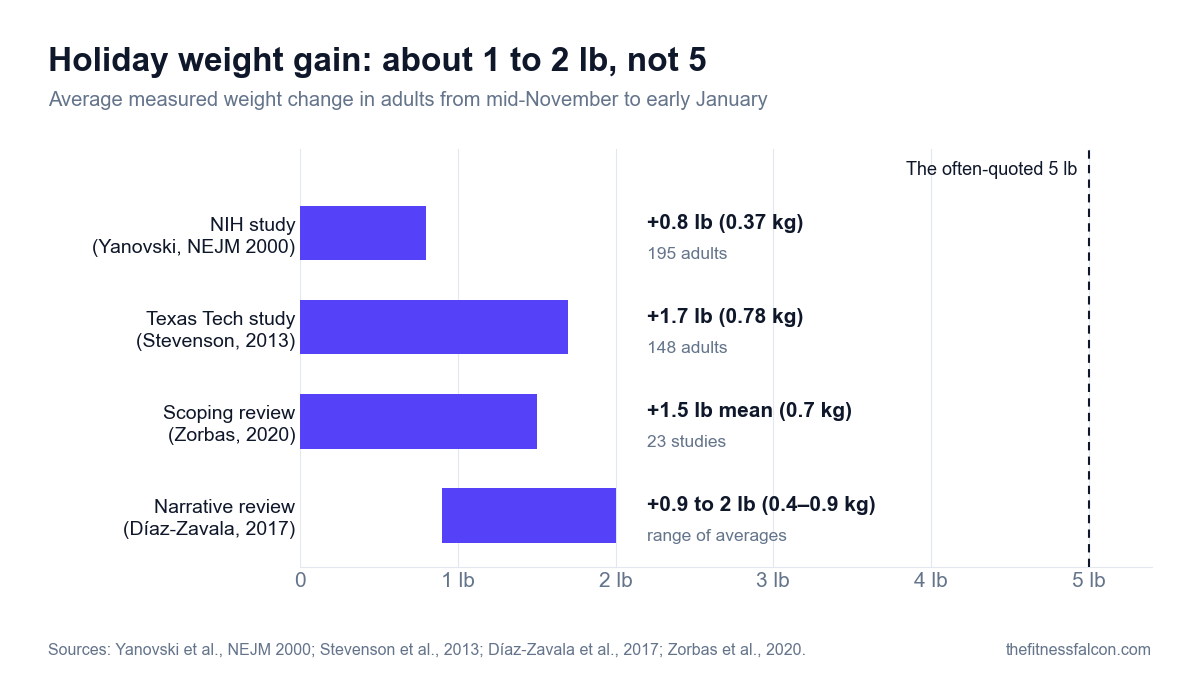
Averages hide a wide spread. Some people gain several pounds, and others lose weight. In the NIH study, people with overweight or obesity were more likely to gain 5 pounds. Less activity and more hunger, both self-reported, were linked to bigger gains. A 2014 review by Dale Schoeller also found that people who were already heavier tended to gain more.
Why a small gain still matters
A pound isn't much on its own. What matters is what happens next. In the NIH study, the holiday gain wasn't reversed after the holidays. Participants were about 0.48 kg (about 1 lb) heavier in late winter than in early fall, and they didn't lose it by the following September. Schoeller's review found that, in studies that measured weight across the whole year, the holiday gain was the main contributor to adults' yearly weight gain. The authors of a 2018 BMJ trial note that tracking studies show adults gaining about 0.4 to 1 kg a year on average, which they calculated would add up to 5 to 10 kg (11 to 22 lb) over a decade.
So the goal isn't a crash diet in January. It's to keep the holidays from leaving a lasting mark while you still enjoy them.
What helps: the trial evidence
Only a few randomized trials have tested ways to prevent holiday weight gain. The two most relevant ones both used regular self-weighing:
| Trial | What the intervention group did | Result |
|---|---|---|
| Winter Weight Watch (Mason et al., BMJ 2018), 272 adults, Birmingham, UK | Weighed themselves at least twice a week (ideally daily) and wrote it down; reflected on the trend; got 10 weight-management tips; saw pictures showing how much activity it takes to burn off festive foods and drinks. Goal: gain no more than 0.5 kg (about 1 lb). | −0.13 kg vs +0.37 kg in the comparison group, which got a healthy-living leaflet. Adjusted difference: 0.49 kg (about 1.1 lb). |
| Kaviani et al., Obesity 2019, 111 adults, University of Georgia | Weighed themselves daily on Wi-Fi scales, saw their weight as a graph, and were asked not to go above their starting weight | No change (−0.13 kg) vs +2.65 kg in the control group. Fourteen weeks later, the control group still had 57% of its gain. |
Winter Weight Watch tested a package, so its authors can't say which part did the work. Follow-up was short, and 78% of participants were women.
The wider evidence is less certain. A 2025 systematic review in Obesity Reviews pooled five adult studies of festive-period interventions. Its estimate favored the interventions (−0.99 kg), but the confidence interval included zero, the results varied a lot between studies, and the certainty of the evidence was rated very low. The 2020 Zorbas review found that all six intervention studies it included reduced gain, using self-weighing or self-monitoring, or intermittent fasting. Taken together, a simple self-monitoring approach is a reasonable thing to try, but it isn't guaranteed to work for everyone.
Is regular weighing right for you?
For many adults it seems to be fine. A meta-analysis of 29 tests found that self-weighing wasn't linked to anxiety, depression, negative body attitudes or disordered eating, although it was linked to slightly worse psychological functioning, such as self-esteem. An earlier review found some negative associations, especially among women and younger people.
Skip the scale if it makes you anxious, or if you have a history of an eating disorder or are recovering from one. The National Institute of Mental Health describes eating disorders as serious and potentially life-threatening illnesses. Your energy is better spent on the non-weight habits below, or on the other ways to track progress without relying on the scale. If you are struggling, see the help options at the end of this article.
A Thanksgiving-to-New Year's plan
This plan follows what the trials did, adjusted for the 2026 calendar. Christmas and New Year's Day both fall on a Friday this year.
| When | What to do |
|---|---|
| Week of Nov 16–25 | Decide whether you'll use the scale. If you will, weigh on two or three mornings and note your starting weight and a ceiling about 1 lb (0.5 kg) above it. Put your workouts for the next six weeks in your calendar. |
| Thanksgiving, Nov 26 | Enjoy the meal. Take a walk afterward or run a local turkey trot. There's no need to "save up" calories or make up for the meal the next day. |
| Nov 27–Dec 23 | Weigh at least twice a week, at the same time of day, wearing similar clothing. Record it and look at the trend. If you're above your ceiling for several weigh-ins in a row, make one or two small changes, such as one drink fewer at the next party, a smaller dessert or an extra walk. |
| Dec 24–Jan 1 | Travel and parties pile up. Do short workouts wherever you are, count your drinks and keep a regular bedtime. |
| Jan 2 onward | Compare with your starting weight and go back to your usual routine. If you've gained a little, the habits above will help more than a crash diet. |
Weigh in the way the trials did
Weigh at the same time of day in similar or no clothing, and write the number down or use an app that charts it. Look at the trend over a week, not any single day. Weight naturally varies, which is why the Winter Weight Watch target allowed about 0.5 kg of leeway. The point is to notice early and adjust a little, not to punish yourself for one heavy morning.
Keep moving, for more than calories
Federal guidelines recommend 150 to 300 minutes of moderate activity a week, such as brisk walking, plus muscle-strengthening activity on at least 2 days. The guidelines also say any amount of activity has some health benefits. On its own, though, activity doesn't reliably prevent holiday gain. People in the NIH study who said they were more active gained the least, but in the 2013 Texas Tech study, self-reported exercise (nearly 5 hours a week on average) didn't protect against gain. Keep exercising for your health and mood, not as a way to cancel out food.
Ideas that fit the season: a 4-week turkey trot training plan, a 20-minute no-equipment hotel room workout for travel days, and short walks after big meals. Our comparison of 10-minute walks after meals vs one 30-minute walk covers what short post-meal walks can do for blood sugar.
Count drinks, not just plates
Drinks are easy to overlook: a cup of eggnog has about as many calories as two light beers (see the table below). The Winter Weight Watch authors suggested that future holiday programs should focus more on alcohol because it can add a lot of calories. The current Dietary Guidelines for Americans, 2025–2030 say to "consume less alcohol for better overall health." A U.S. standard drink contains about 14 grams of pure alcohol: 12 oz of regular beer, 5 oz of wine or 1.5 oz of 80-proof spirits, according to the National Institute on Alcohol Abuse and Alcoholism (NIAAA). Before a party, decide how many drinks you'll have, and drink water or a zero-calorie drink in between.
Protect your sleep
The CDC recommends 7 or more hours of sleep a night for adults aged 18 to 60. Late nights can affect your weight. In a 2017 meta-analysis of short controlled studies, people who were partially sleep-deprived ate about 385 more calories the next day, and they didn't burn more energy. These were mostly short lab studies, so they don't show what happens over a whole holiday season. Still, keeping a regular bedtime is a good habit to hold onto.
Holiday treats in activity minutes
Part of the Winter Weight Watch intervention was showing participants how much activity it takes to burn the calories in festive foods. In the UK version, one mince pie took 21 minutes of running. We worked out U.S. equivalents for drinks and treats. Our Thanksgiving dinner calorie count covers the main meal.
| Item | Serving | Calories | Brisk walk, 155 lb | Brisk walk, 200 lb | Run at 5 mph, 155 lb |
|---|---|---|---|---|---|
| Eggnog, alcoholic | 8 fl oz | 271 | 48 min | 37 min | 27 min |
| Hot chocolate, made with whole or 2% milk | 1 cup | 226 | 40 min | 31 min | 23 min |
| Eggnog, nonalcoholic | 1 cup | 225 | 40 min | 31 min | 23 min |
| Beer, regular | 12 fl oz | 155 | 28 min | 21 min | 16 min |
| Sugar cookie | 1 medium (30 g) | 139 | 25 min | 19 min | 14 min |
| White wine | 5 fl oz | 123 | 22 min | 17 min | 12 min |
| Chocolate fudge | 1 piece (30 g) | 119 | 21 min | 16 min | 12 min |
| Beer, light | 12 fl oz | 104 | 18 min | 14 min | 10 min |
| Whiskey or vodka, 80 proof | 1.5 fl oz | 97 | 17 min | 13 min | 10 min |
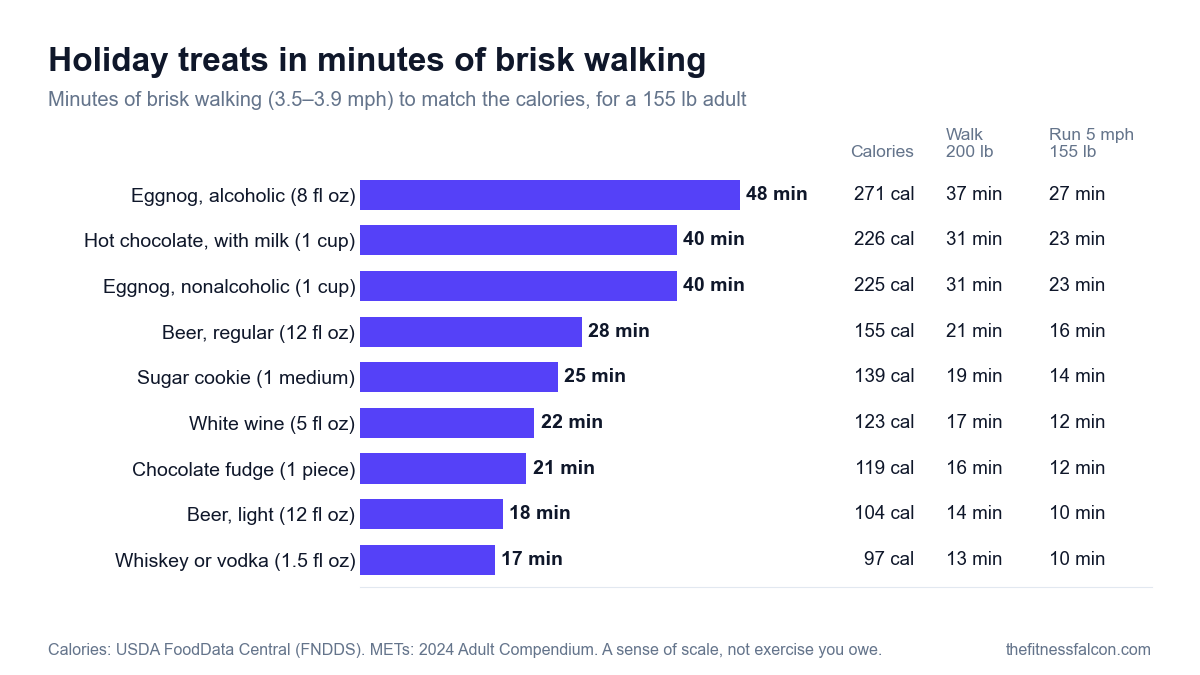
How we calculated it. Calories come from the USDA's FNDDS survey foods in FoodData Central (2024-10-31 release): energy per 100 g multiplied by the serving weight USDA lists. For example, eggnog has 88 calories per 100 g, and USDA lists 1 cup as 256 g, so a cup has 225 calories. For drinks, we used USDA's gram weight per fluid ounce. Activity values come from the 2024 Adult Compendium of Physical Activities, which defines 1 MET as 1 calorie per kilogram of body weight per hour. Brisk walking at 3.5–3.9 mph is 4.8 METs, and running at 5.0–5.2 mph is 8.5 METs. Calories per minute = METs × weight in kg ÷ 60, which gives 5.6 calories per minute for brisk walking at 155 lb, 7.3 at 200 lb, and 10.0 for running at 155 lb. Minutes are rounded to the nearest whole number.
Treat these numbers as a sense of scale, not as exercise you owe. They include the calories you'd burn at rest anyway, recipes and pour sizes vary, and individual energy use differs. The Winter Weight Watch authors also say activity-equivalent information on its own needs more research.
What the research can't tell you
- Small, specific samples. The NIH study used a convenience sample near Bethesda, the 2016 letter studied people who had bought smart scales, and most Winter Weight Watch participants were women.
- Short follow-up. No prevention trial has shown that the prevented pound stays off for years.
- Inconsistent results. The University of Georgia control group gained far more (2.65 kg) than other studies found, and the pooled estimate is rated very low certainty.
- Packages, not single habits. The successful trials combined self-weighing with goals, feedback or tips.
FAQ
Does the average person gain 5 pounds over the holidays?
No. Measured studies of adults put the average holiday gain at about 0.4 to 0.9 kg (roughly 1 to 2 lb). In the NIH study, fewer than 10% of people gained more than 5 pounds.
Will the weight come off in January?
Often not by itself. In the NIH study, the average holiday gain was still there the following fall. In the University of Georgia trial, the control group still had more than half of its gain 14 weeks after New Year's.
How often should I weigh myself over the holidays?
The successful trials used at least twice a week (Winter Weight Watch, ideally daily) or daily (the University of Georgia trial). Weigh at the same time of day, record the number and watch the trend. If weighing makes you anxious, or you have a history of disordered eating, don't use the scale.
This article is general information, not medical or nutrition advice. If you have a medical condition, are pregnant, or are working on recovery from an eating disorder, talk with your health care provider before changing how you eat, exercise or weigh yourself. If you're struggling with eating or weight concerns, the NIMH lists ways to find help. In a crisis, call or text 988 to reach the 988 Suicide & Crisis Lifeline.
Sources
- Yanovski et al., A prospective study of holiday weight gain, New England Journal of Medicine 2000.
- NICHD news release: Holiday Weight Gain Slight, But May Last a Lifetime (March 22, 2000).
- Helander, Wansink and Chieh, Weight gain over the holidays in three countries, New England Journal of Medicine 2016 (research letter), and Cornell Chronicle summary.
- Schoeller, The effect of holiday weight gain on body weight, Physiology & Behavior 2014.
- Stevenson et al., Effects of exercise during the holiday season on changes in body weight, body composition and blood pressure, European Journal of Clinical Nutrition 2013.
- Díaz-Zavala et al., Effect of the holiday season on weight gain: a narrative review, Journal of Obesity 2017.
- Zorbas et al., The relationship between feasting periods and weight gain: a systematic scoping review, Current Obesity Reports 2020.
- Mason et al., Effectiveness of a brief behavioural intervention to prevent weight gain over the Christmas holiday period: randomised controlled trial, BMJ 2018 (full text).
- Kaviani, vanDellen and Cooper, Daily self-weighing to prevent holiday-associated weight gain in adults, Obesity 2019.
- Guerrero-Magaña et al., Interventions for the prevention of weight gain during festive and holiday periods in children and adults: a systematic review, Obesity Reviews 2025.
- Benn et al., What is the psychological impact of self-weighing? A meta-analysis, Health Psychology Review 2016.
- Pacanowski, Linde and Neumark-Sztainer, Self-weighing: helpful or harmful for psychological well-being? Current Obesity Reports 2015.
- National Institute of Mental Health: Eating Disorders.
- Al Khatib et al., The effects of partial sleep deprivation on energy balance: a systematic review and meta-analysis, European Journal of Clinical Nutrition 2017.
- CDC: About Sleep (recommended hours).
- HHS Office of Disease Prevention and Health Promotion: Top 10 Things to Know About the Second Edition of the Physical Activity Guidelines for Americans.
- USDA and HHS: Dietary Guidelines for Americans, 2025–2030.
- NIAAA: What Is a Standard Drink?
- USDA FoodData Central (FNDDS survey foods, 2024-10-31 release; FDC IDs 2710684, 2705473, 2705502, 2710616, 2707970, 2710689, 2710340, 2710617, 2710700).
- 2024 Adult Compendium of Physical Activities (walking code 17200; running code 12030).
- Banner photo: Yellowstone Forever Guide Corrie chats with people on the Mammoth Hot Springs Boardwalks (49266006728).jpg by Jacob W. Frank, National Park Service, public domain, via Wikimedia Commons.