

If you take Wegovy (semaglutide) or Zepbound (tirzepatide) for weight loss, strength training and enough protein are the two habits most likely to help you keep muscle while the scale goes down. In the main clinical trials, roughly a quarter to nearly two-fifths of the weight people lost was lean mass, not fat. A 2025 joint advisory from four US obesity and nutrition organizations recommends pairing these drugs with a structured exercise program that includes regular strength training. It also stresses that extra protein alone is unlikely to protect muscle without the training.
Below: what the trials measured, what experts recommend, a beginner plan, protein tips for a small appetite, and when to call your prescriber. This is general information, not medical advice, and it doesn't cover medication dosing.
How much muscle do people lose on Wegovy and Zepbound?
In each drug's main trial, a subgroup had DXA scans, an X-ray method that splits body weight into fat mass and lean mass.
| STEP 1: semaglutide (Wegovy) | SURMOUNT-1: tirzepatide (Zepbound) | |
|---|---|---|
| Length | 68 weeks | 72 weeks |
| Average weight lost (DXA group) | About 13.6 kg (30 lb) | 21.3% of body weight |
| Fat mass lost | About 8.3 kg (18 lb) | 15.9 kg (35 lb), or 33.9% of starting fat mass |
| Lean mass lost | About 5.3 kg (12 lb) | 5.6 kg (12 lb), or 10.9% of starting lean mass |
| Share of weight lost that was lean mass | About 38% | About 26% (25% in the placebo group) |
| Source | Wilding et al., NEJM 2021, as summarized in the 2025 joint advisory | Look et al., Diabetes, Obesity and Metabolism 2025 (160 participants with DXA scans) |
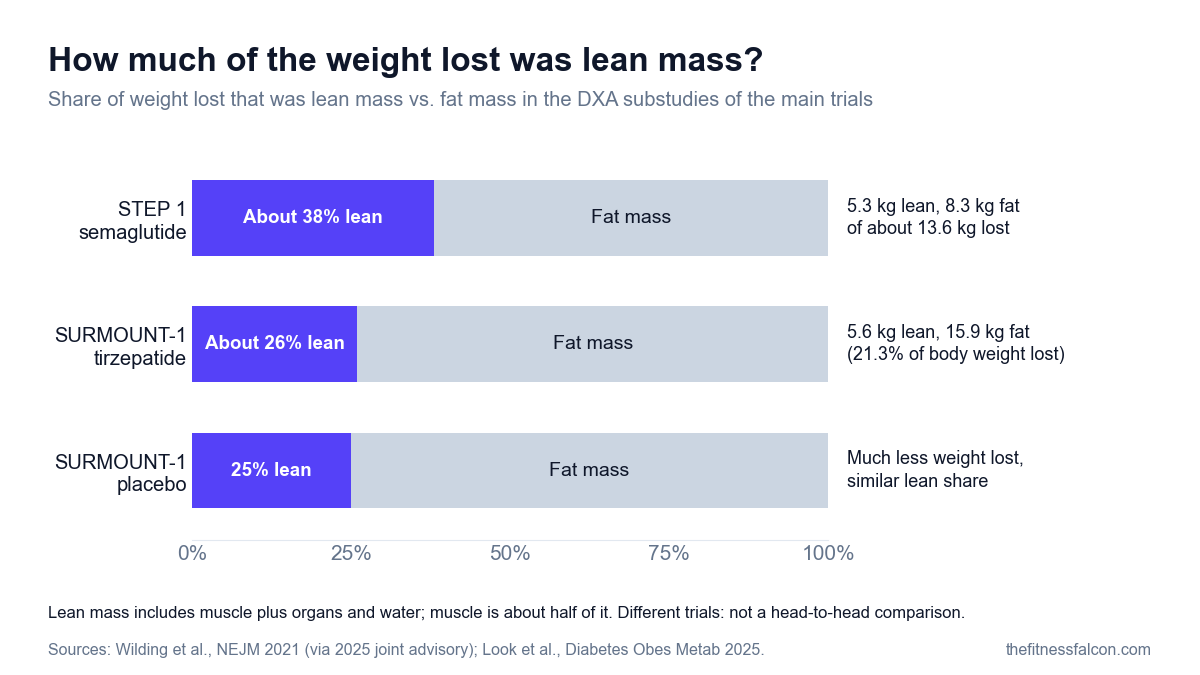
- Lean mass isn't the same as muscle. DXA lean mass includes muscle plus organs, water and other non-fat tissue. The joint advisory notes that muscle makes up about half of lean mass, so in STEP 1 roughly 20% of the weight lost was likely muscle.
- Some lean loss happens with any large weight loss. In SURMOUNT-1, people on placebo lost much less weight, but about the same share of it (25%) was lean mass. The advisory says the losses are similar to those seen after bariatric surgery or very low-calorie diets, and that they track how much weight is lost.
- Don't use these numbers to compare the two drugs. They come from different trials, populations and analyses, not a head-to-head study.
- The FDA labels for both medicines say the drug "lowers body weight with greater fat mass loss than lean mass loss." Tirzepatide users in SURMOUNT-1 also reported better physical function despite losing some lean mass.
It still matters. The advisory links low muscle and bone mass to disability, falls, fractures and lower quality of life. Risk is higher with older age, perimenopause or menopause, lower testosterone, a sedentary routine, no strength training, or low protein intake from a suppressed appetite. Fast, substantial weight loss can also reduce bone density.
What the experts recommend
The 2025 joint advisory from the American College of Lifestyle Medicine, the American Society for Nutrition, the Obesity Medicine Association and The Obesity Society says:
- GLP-1 medicines should be prescribed together with a structured exercise program, aiming for strength training at least 3 times a week plus at least 150 minutes of moderate aerobic exercise a week.
- Strength training, or strength plus aerobic training, is "well established" to help preserve lean mass during weight loss. Aerobic exercise alone has a smaller effect.
- More protein alone is likely not enough to preserve muscle without structured resistance training.
- An exercise physiologist or strength trainer may help many people set up a program and track strength over time. One-rep-max testing isn't recommended unless you are highly trained.
The federal Physical Activity Guidelines for Americans set a lower floor for all adults: muscle-strengthening activities of moderate or greater intensity that work all major muscle groups on 2 or more days a week, plus 150 to 300 minutes of moderate aerobic activity. The guidelines say one set of 8 to 12 repetitions per exercise is effective, though 2 or 3 sets may be more effective. Each set should go to the point where another repetition would be hard. Older adults should also include balance training.
One caveat: neither STEP 1 nor SURMOUNT-1 tested a structured strength program. Participants got diet and activity counseling (at least 150 minutes a week, per the FDA labels). The advice draws on wider weight-loss research, and the advisory notes that studies of muscle quality and function on these drugs are still underway.
A beginner strength plan for 2 to 3 days a week
This plan is a full-body routine you repeat on each training day, with at least one rest day in between. It works at home with a pair of dumbbells or a resistance band, or in a gym. Two days a week meets the federal minimum. Add a third day once two feel manageable, which brings you in line with the joint advisory.
| Exercise | Easier option | Sets × reps | Form cue |
|---|---|---|---|
| Goblet squat (hold one dumbbell at your chest) | Sit-to-stand from a sturdy chair | 1–2 × 8–12 | Heels down, knees in line with toes, chest up |
| Dumbbell Romanian deadlift | Glute bridge on the floor | 1–2 × 8–12 | Push hips back with a flat back; weights stay close to your legs |
| Incline push-up (hands on a counter or bench) | Wall push-up | 1–2 × 8–12 | Body in a straight line from head to heels |
| One-arm dumbbell row (free hand on a bench or chair) | Resistance band row | 1–2 × 8–12 each side | Pull your elbow toward your hip without twisting |
| Seated dumbbell shoulder press | Lighter dumbbells or a band | 1–2 × 8–12 | Ribs down; don't arch your lower back |
| Farmer's carry (walk holding a weight in each hand) | Carry lighter weights, or stand and hold them | 2 × 20–30 seconds | Stand tall and take short, steady steps |
How hard? Pick a weight where the last few reps feel hard, but you could still manage 1 or 2 more with good form. Start with one set of each exercise for the first couple of weeks, then add a second set. Rest about 1 to 2 minutes between sets, or longer if you feel lightheaded.
How to progress: once you can do 12 good reps on every set for two sessions in a row, move to the next weight up and start again at 8 reps. Our guide to progressive overload for beginners explains this double-progression method step by step. If you're short on time, see how little strength training is enough.
A sample week:
- Monday: strength routine, then a 10-minute easy walk
- Tuesday: 30-minute brisk walk
- Wednesday: strength routine
- Thursday: 30-minute brisk walk
- Friday: optional third strength session, or a 30-minute walk
- Saturday: 40 to 60 minutes of walking, cycling or swimming
- Sunday: rest, or gentle stretching and balance work
That's about 150 minutes of moderate activity. No equipment yet? Start with our beginner dumbbell workout at home or a resistance band routine.
Protein on a GLP-1: how much and how to fit it in
The joint advisory doesn't give a single protein number for everyone on these drugs. Instead, it lays out a range of reference points:
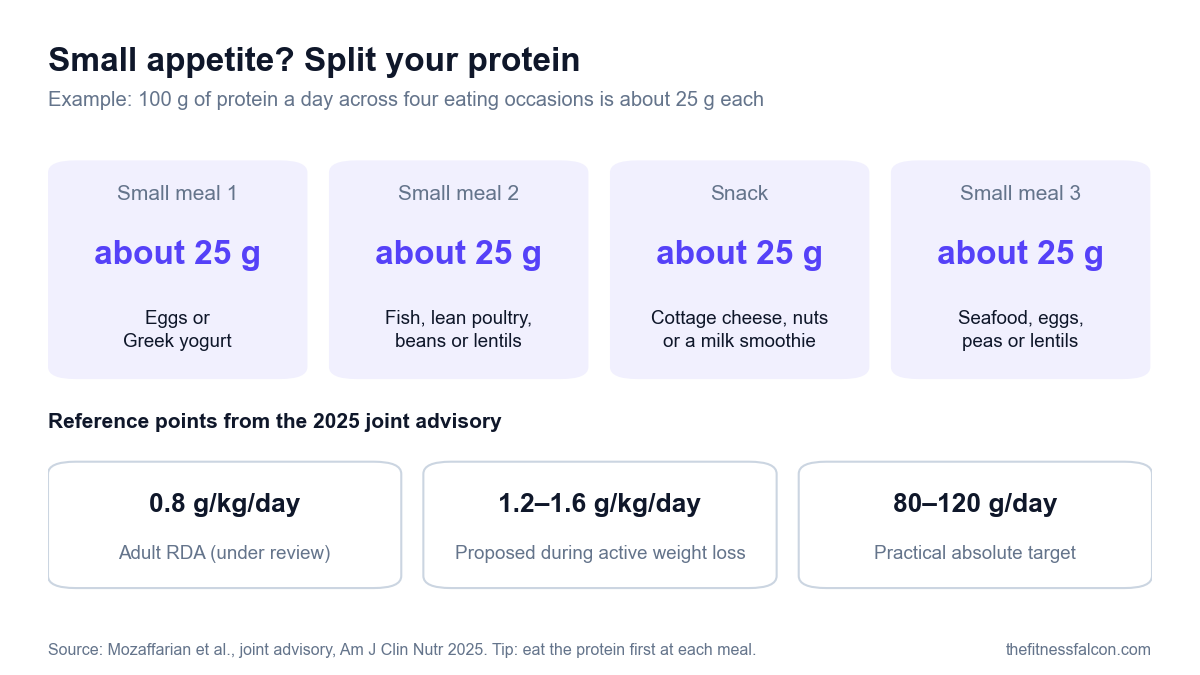
- The recommended dietary allowance for adults is 0.8 g per kg of body weight per day. The National Academies are currently reviewing this figure.
- Higher targets of 1.2 to 1.6 g/kg/day have been proposed during active weight loss.
- For people with obesity, basing the target on current body weight can overestimate needs. A practical alternative in the advisory is an absolute target of 80 to 120 g of protein a day (16% to 24% of calories on a 2,000-calorie diet).
- Intake shouldn't fall below 0.4 to 0.5 g/kg/day, and long-term intake at or above 2 g/kg/day should be avoided.
If you have kidney disease or another condition that affects protein needs, ask your clinician or a registered dietitian for a personal target. For general targets by age and goal, see our guide to how much protein you need per day.
A per-meal approach for a small appetite
A big daily number is easier to hit in pieces. As simple arithmetic, 100 g a day split across four eating occasions is about 25 g each. Three small meals and one snack, or four mini-meals, may feel more realistic than three full plates. The advisory's practical tips:
- Eat the protein first at each meal, so it's eaten before you feel full.
- Choose compact, protein-dense foods such as fish, eggs, Greek yogurt, cottage cheese, and nuts or seeds (including peanut or almond butter).
- Include plant proteins, dairy, seafood, eggs and lean poultry such as beans, peas and lentils. The advisory suggests limiting red and processed meats.
- Use drinks and soft foods on low-appetite days. Smoothies or protein drinks made with milk or yogurt, cottage cheese and soups are often easier than heavy meats or hard cheeses. Some people use high-protein shakes or bars to close the gap.
Training when your appetite is low or you feel queasy
Nausea is the most common digestive side effect of these medicines. The joint advisory notes that it often shows up in the morning or after long stretches without food, and that vomiting is more likely after large meals. These steps can make training days easier:
- Don't train on an empty stomach or a full one. The advisory suggests a small breakfast and then small meals every 3 to 4 hours. In practice, a small protein-containing snack an hour or two before you lift tends to work better than a large meal.
- Drink fluids through the day. Both FDA labels warn that diarrhea, nausea and vomiting can cause dehydration, which can lead to kidney problems.
- Swap in an easy day when you feel unwell. On a rough day, do one set of each exercise or go for a gentle walk. If you are vomiting or have diarrhea, skip the workout and focus on fluids.
- Plan lighter weeks around dose increases. The advisory notes that nausea can need extra management while people adjust to treatment and during dose increases. Don't change your dose yourself to fit training; that's a decision for your prescriber.
- Go easy on greasy food and alcohol. The advisory suggests avoiding fatty foods in the first days of treatment to ease symptoms, and says alcohol can worsen nausea and reflux. That's worth remembering before a workout, too.
- If you have diabetes and also take insulin or a sulfonylurea, the labels warn of a higher risk of low blood sugar. Ask your care team how to plan around exercise.
Midlife women, older adults and the menopause question
The joint advisory lists older age and perimenopausal or menopausal status among the factors that raise the risk of muscle loss, especially when protein intake is low. If either applies to you, strength training and protein matter even more. The federal guidelines also add balance training for older adults.
A study presented at The Menopause Society's 2026 Annual Meeting (October 20–24) has drawn attention to menopause hormone therapy (HT). Mayo Clinic Florida researchers looked back at records of women over 45: nearly 2,400 taking semaglutide and nearly 1,500 taking tirzepatide. Women using HT lost significantly more weight on semaglutide. With tirzepatide, HT users lost more early on, but the difference at the end wasn't statistically significant. This was an observational conference presentation, not a randomized trial or a journal paper. The lead author said the findings need to be confirmed and that "weight loss is not an indication for menopause hormone therapy." The press release reports weight only, not muscle or body composition.
When to talk to your prescriber
Check in with the clinician who prescribes your medication, or another member of your care team, if any of the following applies:
- You're new to exercise and have heart disease, diabetes, joint problems or another chronic condition. The federal guidelines advise people with chronic conditions to get advice on the right type and amount of activity.
- Nausea, vomiting or diarrhea won't go away, or you feel dizzy or lightheaded or have signs of dehydration.
- You can't eat enough to reach a basic protein intake, or you notice possible signs of nutrient problems that the advisory lists: fatigue beyond what you'd expect, excessive hair loss, muscle weakness, poor wound healing or unusual bruising.
- You're getting noticeably weaker, or everyday tasks like climbing stairs or carrying groceries feel harder.
- You'd like your body composition, strength or bone health checked, or a referral to a registered dietitian or exercise professional.
Get urgent care for chest pain, fainting or severe shortness of breath during exercise. The labels say to call your provider right away if you have severe stomach pain that won't go away, with or without vomiting.
Frequently asked questions
Do Wegovy and Zepbound cause muscle loss?
They cause weight loss, and some of that weight is lean mass, which includes muscle. In the trials, lean mass made up about 26% (tirzepatide) to about 38% (semaglutide) of the weight lost. Both labels say fat loss is greater than lean loss. Strength training and enough protein are the recommended ways to limit the muscle part.
Can I just eat more protein instead of lifting?
Probably not. The joint advisory says increased protein alone is likely inadequate to preserve muscle without structured strength training. Protein and lifting work together.
What happens to my muscle if I stop the medication?
The advisory warns that weight regain and repeated cycles of loss and regain can make muscle and bone loss worse when there's no structured nutrition and exercise plan. Keeping your strength routine and protein habits gives you something to fall back on if your treatment changes.
This article is general information for adults and isn't medical advice. It doesn't replace guidance from the clinician who prescribes your medication. The Fitness Falcon doesn't recommend any specific drug, brand or dose.
Sources
- Mozaffarian et al., Nutritional priorities to support GLP-1 therapy for obesity: a joint Advisory from the American College of Lifestyle Medicine, the American Society for Nutrition, the Obesity Medicine Association, and The Obesity Society, American Journal of Clinical Nutrition 2025 (full text).
- Wilding et al., Once-weekly semaglutide in adults with overweight or obesity (STEP 1), New England Journal of Medicine 2021.
- ClinicalTrials.gov: STEP 1 (NCT03548935) results, including DXA body-composition outcomes.
- Jastreboff et al., Tirzepatide once weekly for the treatment of obesity (SURMOUNT-1), New England Journal of Medicine 2022.
- Look et al., Body composition changes during weight reduction with tirzepatide in the SURMOUNT-1 study of adults with obesity or overweight, Diabetes, Obesity and Metabolism 2025.
- DailyMed: Wegovy (semaglutide) prescribing information and patient information.
- DailyMed: Zepbound (tirzepatide) prescribing information and patient information.
- US Department of Health and Human Services: Physical Activity Guidelines for Americans, 2nd edition.
- HHS Office of Disease Prevention and Health Promotion: Top 10 Things to Know About the Second Edition of the Physical Activity Guidelines for Americans.
- The Menopause Society: Hormone Therapy May Increase Weight Loss Effectiveness of GLP-1s (press release on the 2026 Annual Meeting presentation).
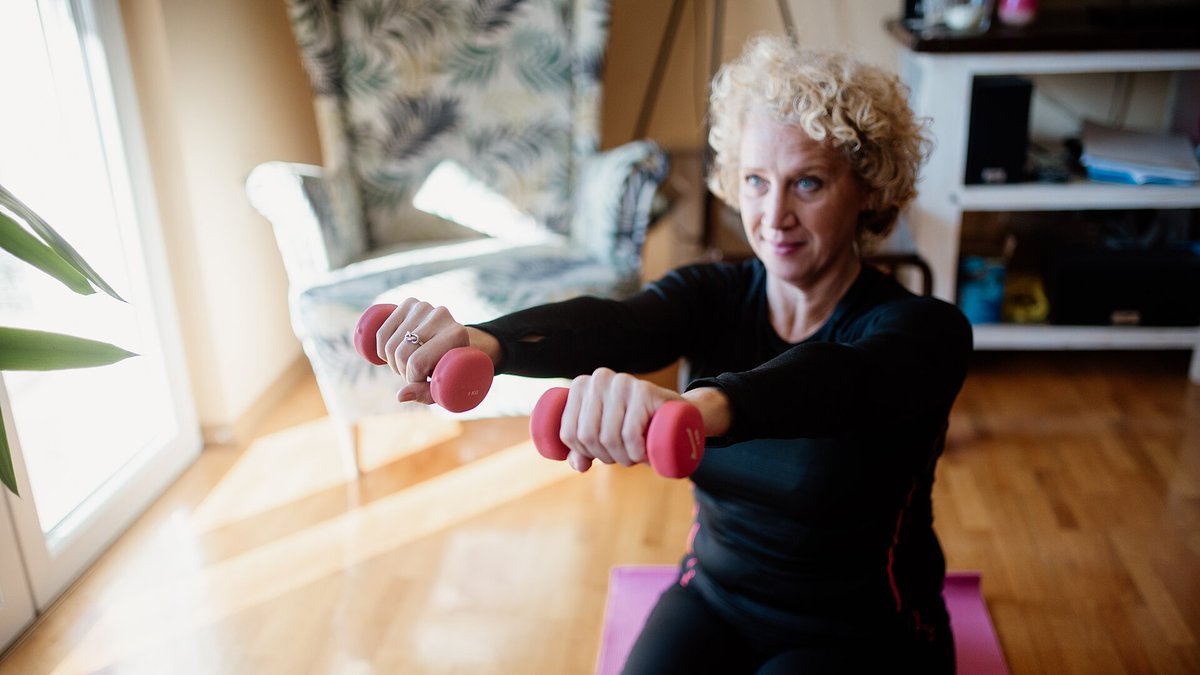
- Banner photo: Senior woman exercises with dumbbells on mat in living room.jpg by Shixart1985, CC BY 2.0, via Wikimedia Commons (cropped).