

Rucking is walking with a weighted backpack, and for most healthy beginners the safest start is light: an empty pack or about 5 to 10 pounds, two sessions a week, adding weight or time slowly. It makes a normal walk harder, but less than many people expect. Using the US Army's 2022 load-carriage equation, a 170-pound person walking at 3 mph with a 20-pound pack burns roughly 22 extra calories an hour. Walking up a 5% grade with no pack adds far more, about 120 calories an hour.
So treat rucking as a way to add some strength-endurance challenge to your walks, not as a fat-burning shortcut. This guide explains what the research shows about energy cost and injury risk, how to set up a backpack, who should check with a clinician first, and a cautious 6-week plan.
What is rucking?
The word comes from the rucksack. In the US Army, "ruck marches," "road marches" and "loaded marches" are standard training, with loads that typically range from 40 to more than 100 pounds over 2 to 12 miles, according to the Defense Centers for Public Health–Aberdeen. Civilian rucking borrows the idea at a much smaller scale: a sturdy backpack, a few plates, sandbags or water bottles, and a walk around your neighborhood, a park or an easy trail.
Almost all the hard data on load carriage comes from soldiers carrying far more than any beginner should. It still shows what drives energy cost and injuries, but the numbers need translating to civilian loads.
Rucking vs a weighted vest: which one?
Both add weight to your walk. The difference is where the weight sits. Army reviews of load carriage found that the closer a load sits to your body's center of mass, the lower its energy cost and the more upright you stay. A "double pack," with half the load in front and half behind, cost less energy and changed normal walking less than a backpack. However, a backpack is more versatile (Knapik and colleagues, 1996; Knapik and colleagues, 2004).
- Backpack (rucking): uses gear many people already own, carries water and layers, and can take heavier loads with a hip belt. It pulls you into a forward lean as the load rises.
- Weighted vest: spreads weight around the torso, so posture changes less. It's harder to carry extras, and a vest can trap heat.
If balance or your back is your main concern, a vest may suit you better. Our weighted vest walking guide covers vest loads, the research on vests and bone density, and its own 4-week plan.
How many calories does rucking burn?
Fewer extra calories than many people expect, at least at beginner loads.
The classic tool is the Pandolf equation, published in 1977, which estimates energy cost from body weight, load, speed, grade and terrain. Later studies found it underestimates modern loads: in a 2017 study of 16 men carrying about 50 and 85 pounds, Pandolf's predictions were 12% to 33% too low. In 2022, researchers at the US Army Research Institute of Environmental Medicine published a newer model, the Load Carriage Decision Aid (LCDA) backpacking equation. It was built from 30 active adults walking at about 1 to 4.4 mph with backpacks of up to 66% of body weight, and was more accurate than Pandolf in both its own data and seven earlier data sets.
One finding matters for beginners: the extra cost of a pack is nonlinear. In the authors' words, "light loads causing small increases and heavier loads incurring disproportionately greater costs."
We used the LCDA equation to estimate how many calories rucking burns at beginner loads:
| Body weight | No pack | 10 lb pack | 20 lb pack | 30 lb pack |
|---|---|---|---|---|
| 150 lb (68 kg) | 186 kcal | 195 kcal (+9) | 209 kcal (+24) | 227 kcal (+41) |
| 170 lb (77 kg) | 211 kcal | 219 kcal (+9) | 233 kcal (+22) | 250 kcal (+39) |
| 200 lb (91 kg) | 248 kcal | 256 kcal (+8) | 269 kcal (+21) | 285 kcal (+37) |
| 170 lb on a 5% grade | 332 kcal | – | 367 kcal | – |
Assumptions: steady walking at 3.0 mph (1.34 m/s) for 60 minutes on pavement or a treadmill (terrain factor 1.0); figures are calories above your resting burn, because the equation's resting term needs lean body mass, which most people don't know. Your total burn is higher by your resting rate. We converted watts to calories at 4.184 kJ per kcal. The hill row combines the equation with the LCDA graded-walking term, which the authors say can be "readily incorporated" but did not separately test with loads, so treat it as a rougher estimate.
Uncertainty: the equation is accurate on average, but individual errors in the validation study had a standard deviation of about 0.6 watts per kilogram. For a 170-pound person, that's roughly ±40 calories an hour, about the same size as the effect of a 30-pound pack. It was built from young, active, mostly male volunteers in short treadmill bouts, and the authors note fatigue, heat and cold can push real costs higher.
The practical lesson: a light pack adds a modest number of calories, and hills, a brisker pace and more total walking time change your burn more than a few extra pounds do. If you want to compare loaded hiking with other cardio, see our article on trekking vs running for calorie burn.
What are the real benefits of rucking?
There are no long-term trials of rucking in the general public that measure health outcomes such as heart disease, body weight or bone density. Our PubMed search for "rucking" turned up rugby studies, not loaded-walking trials. What the research does show:
- It counts as aerobic activity. A brisk loaded walk can help you reach the 150 to 300 minutes of moderate activity a week recommended by the Physical Activity Guidelines for Americans.
- Your body adapts. A US Army review found that walking with backpack loads over several weeks lowers the energy cost of carrying them (Knapik, 1996). In other words, the same ruck gets easier, which is also why calorie burn per session drops as you get fitter.
- Load carriage plus strength training works best for carrying loads. A 2012 systematic review of 10 studies found the largest gains in load-carriage performance when progressive loaded marching was part of the program; aerobic or resistance training alone had smaller, more variable effects.
- Small civilian studies show fitness gains. In a 10-week study of 15 young civilian men, resistance training plus weighted walking improved push-ups, sit-ups, squat-jump force and estimated aerobic fitness, and a loaded walk felt easier afterward. The study had no comparison group, so it cannot show how much rucking itself contributed.
Rucking is not a substitute for strength training. The guidelines call for muscle-strengthening work on 2 or more days a week; our minimum effective strength training plan shows how to fit that in.
How heavy should a beginner's rucking pack be?
We found no credible source that sets a starting load as a percentage of body weight for civilians, so we don't give one. The guidance that does exist points to a light, absolute starting load:
- A Cleveland Clinic sports medicine physician, Matthew Kampert, DO, suggests beginning with an empty pack or about 5 pounds, then changing one thing at a time (weight, distance or duration) by about 10% a week (Cleveland Clinic).
- The US Army's public health guidance gives an example for military trainees that starts at 10 to 20 pounds, raises load and distance on separate days by about 10% at a time, and allows 2 to 6 months to reach maximum loads (DCPH-Aberdeen). It also says the evidence isn't yet strong enough to set an Army-wide progression.
Keep in mind that the same pack is a bigger burden for a smaller person, which is how the LCDA equation models it. A 20-pound pack is 10% of body weight for a 200-pound adult but about 17% for a 120-pound adult. If you're lighter, stay at the low end of every step.
A 6-week rucking plan for beginners
This plan is our conservative example built on the principles above, not a tested program. Before starting, you should be able to walk 30 minutes comfortably, three times a week, without a pack. Ruck on non-consecutive days and keep your other walks unloaded.
| Week | Pack weight | Time per ruck | What changes |
|---|---|---|---|
| 1 | Empty pack to 5 lb (2.3 kg) | 20 min | Learn the fit; walk your usual route |
| 2 | 5 lb (2.3 kg) | 25 min | Time only |
| 3 | 10 lb (4.5 kg) | 25 min | Weight only |
| 4 | 10 lb (4.5 kg) | 30–35 min | Time only |
| 5 | 15 lb (6.8 kg) | 30–35 min | Weight only (stay at 10 lb if under about 130 lb body weight) |
| 6 | 15 lb (6.8 kg) | 40 min, or 30–35 min with gentle hills | Time or terrain, not both |
How to use it:
- Fine-tune with water. A liter of water weighs about 2.2 pounds (1 kg), so bottles let you make smaller jumps than 5-pound plates. A jump from 5 to 10 pounds doubles the load, so repeat a week whenever it feels like a big step.
- Walk at a conversational pace. You should be able to talk in full sentences, the effort described in our guide to zone 2 cardio without a heart rate monitor. Don't run with the pack; the Army doesn't recommend loaded marching faster than 4 mph even for soldiers.
- Repeat a week if you have joint pain, blisters, numbness or soreness lasting into the next day, or if your posture sags in the last few minutes.
- After week 6, keep adding one thing at a time. For many people, 15 to 20 pounds is plenty for fitness walking; hills and time add challenge with less extra stress on the feet and spine than heavier loads.
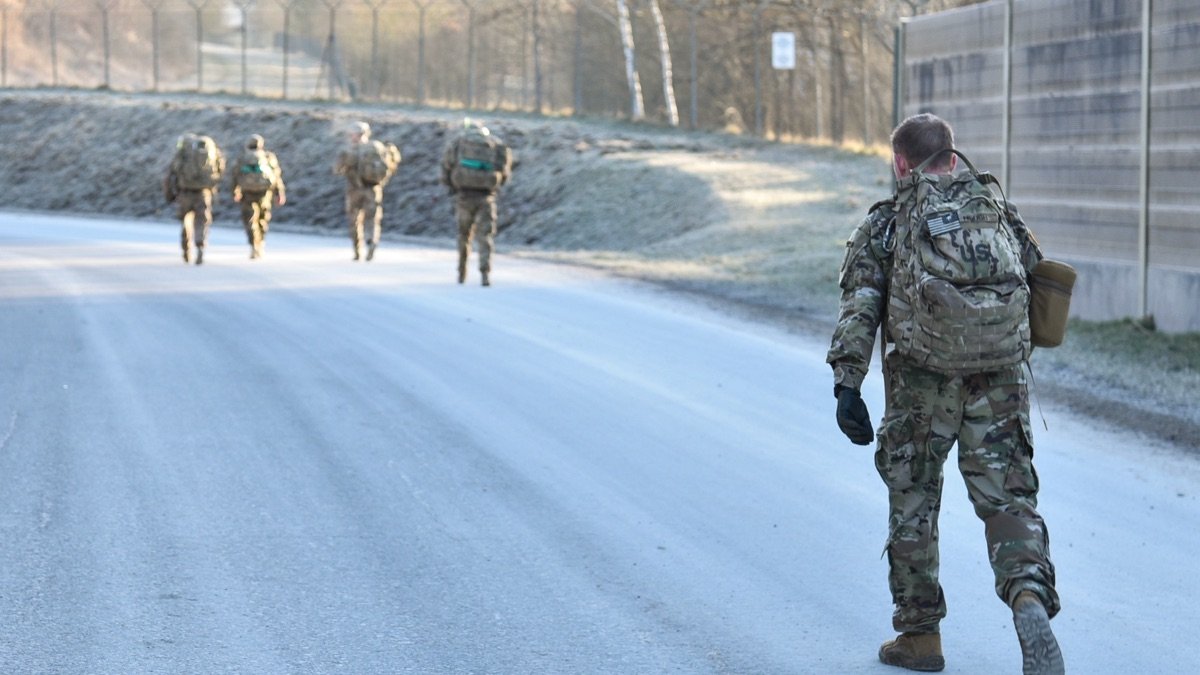
How to pack and fit a rucking backpack
Most of the Army's practical advice transfers directly to a civilian backpack:
- Keep the weight high and tight against your back on pavement and even ground. The Army suggests heavy items high in the pack on even terrain and a more even spread on rough trails (Knapik, 2004). Wrap plates or bricks in a towel so they don't shift or dig in.
- Use a hip belt if your pack has one. A properly adjusted hip strap can take about 30% of the load off your back, and packs with frames and hip belts reduce shoulder strain and "rucksack palsy," a nerve injury caused by shoulder straps (DCPH-Aberdeen; Knapik, 1996).
- Pick wide, padded shoulder straps and use the sternum strap. Snug straps stop the pack from bouncing and spread pressure across your shoulders.
- Lift it properly. Raise the pack onto a bench or your thigh first, then slip your arms in. The Army notes injuries can occur when a pack is put on badly.
- Walk tall. Some forward lean is normal with a backpack, but if you are hunched over or shortening your stride, the pack is too heavy or the walk is too long.
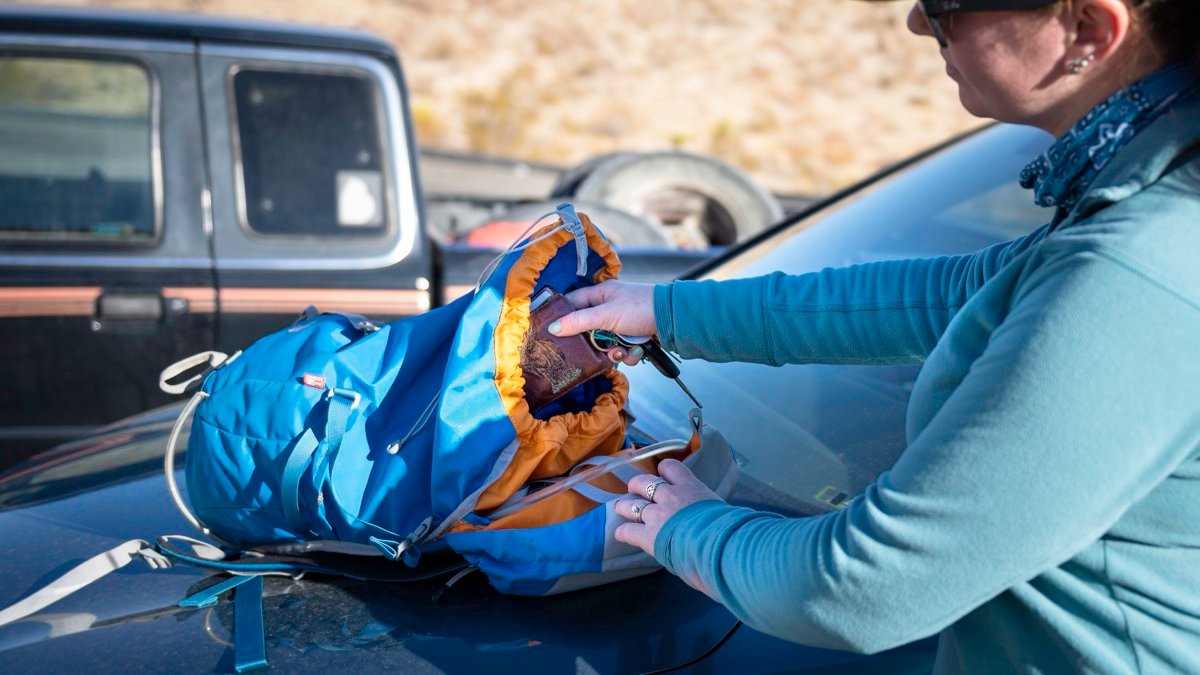
Rucking injury risks: feet, knees and back
Military research is clear that carrying loads mainly stresses the lower body. A review of soldier load-carriage injuries found the legs and feet are the most common site: blisters, stress fractures, knee and foot pain, and nerve problems, with back injuries and shoulder nerve injuries "not uncommon." At the extreme, in a 100-mile, 5-day march with packs averaging 47 kg (about 104 pounds), 36% of 218 soldiers were injured, and 8% couldn't finish because of injuries. Nearly half the injuries were blisters. Beginner rucking uses a small fraction of that load and distance, but the same injuries show up first when people do too much too soon.
Feet
Blisters are the most common problem on military marches. They can be prevented with properly sized footwear, gradual conditioning and socks that reduce friction and moisture (Knapik, 2014). Wear well-fitting shoes or boots, synthetic or wool socks rather than cotton, and stop to fix a hot spot before it becomes a blister. Numbness or tingling in the toes can come from nerve compression during load carriage; reduce load and distance and see a podiatrist or physical therapist if it persists (Knapik and colleagues, 2016).
Knees and bones
Heavier backpacks increase the force on the ground and how much your knees bend with each step (Knapik, 1996). The Army also notes that people of smaller build, often women, appear to be at greater risk of stress fractures, and that steep rocky hills, sand and snow add stress. Pain in a specific spot on a bone that worsens with walking needs a clinician's check, not more miles.
Back and shoulders
A backpack increases forward lean, which may raise back injury risk (DCPH-Aberdeen). Interestingly, the activity of the lower-back muscles is lower with a pack than without one until loads exceed about 30 to 40 kg (66 to 88 pounds), far beyond beginner loads (Knapik, 1996). For your shoulders, numbness, tingling or weakness in an arm can be an early sign of rucksack palsy. Stop, loosen the straps, use the hip belt and lighten the load (Knapik and colleagues, 2016). If symptoms don't settle, get them checked.
Leaving the house early or late in winter? Our tips on walking safely in the dark apply with or without a pack.
Who should avoid rucking or check with a clinician first?
The Physical Activity Guidelines say adults with chronic conditions or symptoms should be under the care of a health care provider, and pregnant women should ask their provider about adjusting activity. Cleveland Clinic's sports physician flags painful bone or joint problems as the main exception to rucking being generally safe. Talk to a doctor or physical therapist before you start if you have:
- Back or neck pain, a disc problem, or a past spinal injury or surgery.
- Arthritis or pain in your hips, knees, ankles or feet.
- Osteoporosis or a past stress fracture.
- Heart disease, high blood pressure that isn't controlled, or a lung condition.
- Balance problems or a history of falls.
- Pregnancy, recent childbirth, or recent surgery.
Stop and seek medical care right away for chest pain or pressure, severe shortness of breath, fainting or dizziness during a ruck.
Frequently asked questions
Can I ruck every day?
We don't recommend it as a beginner. The plan above uses two loaded sessions a week with unloaded walking on other days. Even with heavy military loads, the Army suggests spacing marches out and calls more than four a month potentially excessive, though civilian loads are much lighter.
Is rucking better than running?
Not better, just different. At 3 mph with a light pack, rucking is moderate-intensity walking with extra load on the legs and trunk. Running is a higher-intensity, higher-impact option. Choose the one you'll do consistently, and don't combine the two by running with a pack.
What can I use as rucking weight?
Weight plates made for rucking, sandbags, wrapped bricks or books, or water bottles. Whatever you use, pack it high and tight, pad it with a towel and make sure nothing shifts as you walk.
This article is general information, not medical advice. It isn't a substitute for advice from a doctor or other qualified health professional, especially if you have a medical condition, an injury or are pregnant.
Sources
- Looney DP, Lavoie EM, Vangala SV, et al. Modeling the Metabolic Costs of Heavy Military Backpacking, Medicine & Science in Sports & Exercise 2022;54(4):646–654 (full text).
- Pandolf KB, Givoni B, Goldman RF. Predicting energy expenditure with loads while standing or walking very slowly, Journal of Applied Physiology 1977;43(4):577–581.
- Drain JR, Aisbett B, Lewis M, Billing DC. The Pandolf equation under-predicts the metabolic rate of contemporary military load carriage, Journal of Science and Medicine in Sport 2017.
- Knapik J, Harman E, Reynolds K. Load carriage using packs: a review of physiological, biomechanical and medical aspects, Applied Ergonomics 1996.
- Knapik JJ, Reynolds KL, Harman E. Soldier load carriage: historical, physiological, biomechanical, and medical aspects, Military Medicine 2004.
- Knapik JJ, Harman EA, Steelman RA, Graham BS. A systematic review of the effects of physical training on load carriage performance, Journal of Strength and Conditioning Research 2012.
- Wills JA, Saxby DJ, Glassbrook DJ, Doyle TLA. Load-Carriage Conditioning Elicits Task-Specific Physical and Psychophysical Improvements in Males, Journal of Strength and Conditioning Research 2019.
- Orr RM, Pope R, Johnston V, Coyle J. Soldier occupational load carriage: a narrative review of associated injuries, International Journal of Injury Control and Safety Promotion 2014.
- Reynolds KL, White JS, Knapik JJ, et al. Injuries and risk factors in a 100-mile (161-km) infantry road march, Preventive Medicine 1999.
- Knapik JJ. Prevention of foot blisters, Journal of Special Operations Medicine 2014.
- Knapik JJ, Reynolds KL, Orr R, Pope R. Load Carriage-Related Paresthesias: Part 1: Rucksack Palsy and Digitalgia Paresthetica, Journal of Special Operations Medicine 2016.
- Defense Centers for Public Health–Aberdeen: Foot Marching and Load-Carriage Injuries (updated September 10, 2025).
- Cleveland Clinic: Should You Add Rucking to Your Workout? (January 8, 2024).
- US Department of Health and Human Services: Physical Activity Guidelines for Americans, 2nd edition.
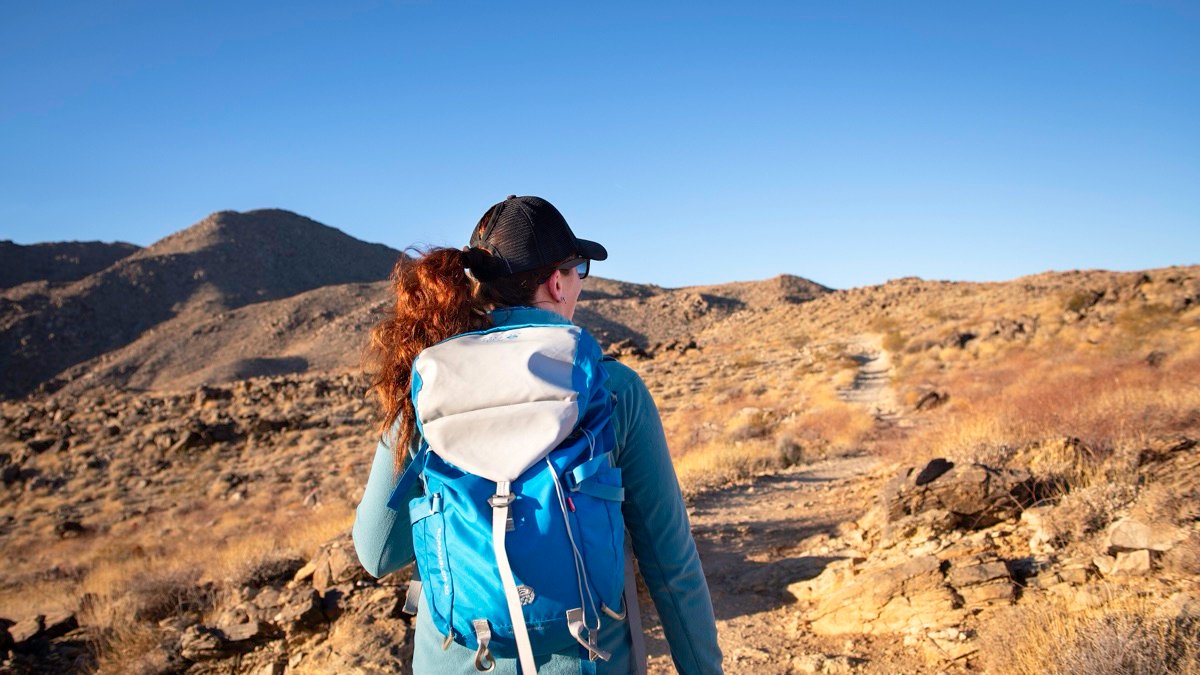
- Banner photo: Hiker on the Fortynine Palms Trail (50700412826).jpg by NPS / Emily Hassell, Joshua Tree National Park, public domain, via Wikimedia Commons (cropped).
- Photo: EIB Ruck March (5199231).jpg by U.S. Army / Spc. Emily Houdershieldt, public domain, via Wikimedia Commons (cropped).
- Photo: Woman packing backpack before a hike (50730228403).jpg by NPS / Emily Hassell, Joshua Tree National Park, public domain, via Wikimedia Commons (cropped).