

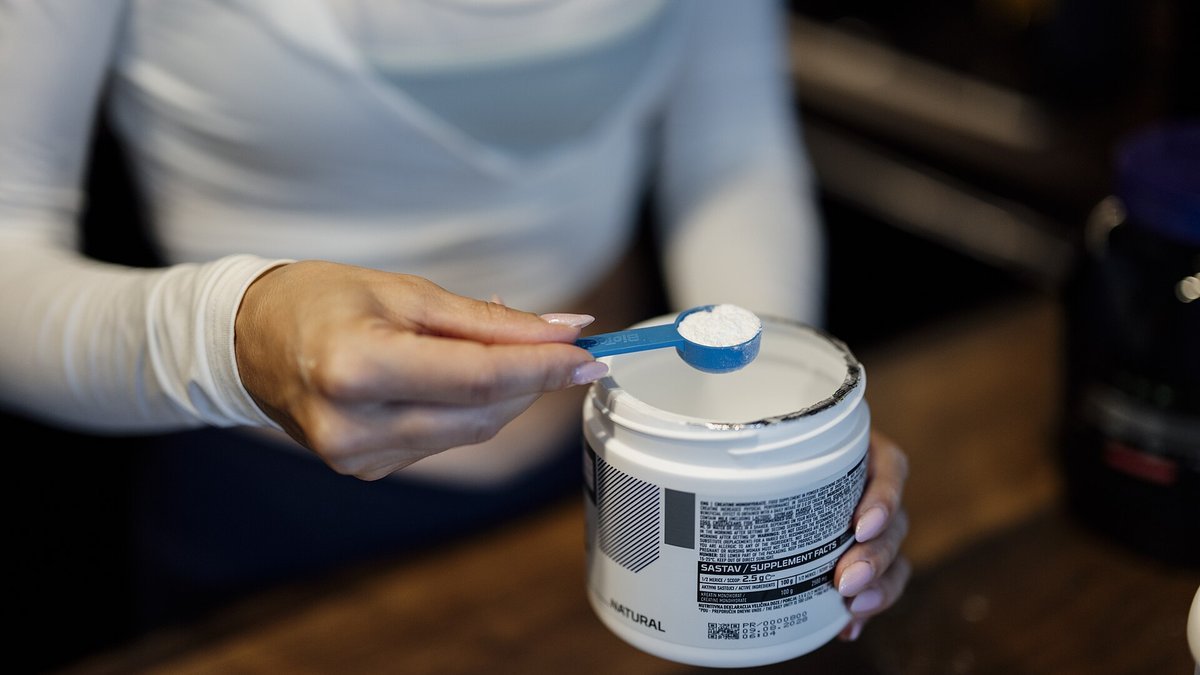
A good creatine label names "creatine monohydrate", states 3 to 5 grams of creatine per serving, hides nothing in a proprietary blend, and comes as a powder with a batch number and expiry date. That short list covers most of what separates a sound product from an overpriced or under-dosed one.
Creatine monohydrate is one of the most researched sports supplements in the world. The International Society of Sports Nutrition (ISSN) calls it the most effective nutritional supplement currently available to athletes for increasing high-intensity exercise capacity and lean body mass during training. But the research only applies to what is actually in the tub, and dietary supplements are not approved by the U.S. Food and Drug Administration (FDA) before they are sold. The label is your first line of defense.
This checklist shows what to look for on a creatine label, which red flags to avoid, and how to do the simple math that reveals whether a product is good value. If you are new to creatine, start with our creatine guide for beginners.
1. Check the form: "creatine monohydrate"
Creatine monohydrate is the form used in the vast majority of studies on performance and safety. A 2022 critical review concluded that it remains the only source of creatine with substantial evidence for bioavailability, efficacy and safety. Newer forms such as creatine ethyl ester, buffered creatine and creatine hydrochloride (HCl) are often sold at a higher price with claims of better absorption or fewer side effects. In a direct comparison, a buffered form did not raise muscle creatine or improve training results more than monohydrate.
"Micronized" creatine monohydrate is still monohydrate. It is ground into smaller particles so it mixes more easily in water; it is the same compound, not a different form.
- Look for: "creatine monohydrate" as the named ingredient.
- Be careful with: forms that claim to be "better than monohydrate" without published human trials to back it up.
2. Find the amount of creatine per serving
The ISSN position stand describes two evidence-based ways to take creatine:
- Loading: about 5 g four times a day (roughly 0.3 g per kg of body weight per day) for 5 to 7 days, then a daily maintenance dose.
- Steady daily dose: 3 to 5 g a day. This fills muscle stores more slowly, over about 3 to 4 weeks.
A good label states the grams of creatine per scoop clearly, for example "5 g creatine monohydrate per serving". If the scoop is 5 g but the creatine content is only 3 g, the other 2 g is something else, and you need to know what. Check the scoop size too: some single-ingredient tubs use a 2.5 g scoop, so a full 5 g dose is two scoops.
3. Avoid "proprietary blends" that hide the dose
Some pre-workouts and "creatine matrix" products list creatine inside a blend with several other ingredients and show only the total weight of the blend. That makes it impossible to know whether you are getting an effective amount of creatine. If you buy creatine for its research-backed benefits, a single-ingredient product with a clearly stated dose is the simplest option.
4. Do the servings math
This takes ten seconds and catches a lot of misleading labels.
- Servings = net weight ÷ grams per serving. A 300 g tub with a 5 g serving gives 60 servings. A 300 g tub that claims 100 servings is using a 3 g serving.
- Cost per serving = price ÷ servings. Compare products by the cost of one effective dose of creatine, not by the price of the tub.
| Tub | Serving on label | Servings | 5 g doses in the tub |
|---|---|---|---|
| 300 g | 5 g | 60 | 60 |
| 300 g | 3 g | 100 | 60 |
Both tubs hold the same 60 full doses. A tub with "more servings" is not better value if each serving is under-dosed. For a worked example of this calculation, including how to spot an under-dosed product, see this guide to creatine dosing and under-dosed creatine.
5. Choose powder, not ready-to-drink liquid
Creatine is stable as a dry powder but not in water. In solution it slowly converts into creatinine, a waste product with no performance benefit, and this happens faster in acidic and warm conditions. The ISSN position stand cites research showing that after 3 days at 25 °C (77 °F), 4% of creatine had degraded at pH 5.5, 12% at pH 4.5 and 21% at pH 3.5, and notes that this breakdown is the main reason creatine is sold in solid form. Ready-to-drink creatine liquids and "creatine shots" that sit on a shelf for months are therefore a poor choice. Mix your powder shortly before you drink it.
6. Look for quality and purity signals
Creatine monohydrate is made industrially, and the process can leave small amounts of by-products. When Italian researchers tested 33 creatine supplements from the market, creatinine was the main contaminant (44% of samples had more than 100 mg/kg), and about 15% of samples also had detectable dihydro-1,3,5-triazine and more than 50 mg/kg of dicyandiamide. High-grade creatine monohydrate is made to tight specifications: in a 2020 GRAS notice that the FDA reviewed, the manufacturer AlzChem specified about 99.9% creatine monohydrate, with set limits for creatinine, dicyandiamide and dihydrotriazine.
You cannot test purity at home, but you can look for:
- A clear manufacturer name and address, a batch (lot) number and an expiry date on the pack.
- A certificate of analysis (COA) available on request from the brand.
- Third-party testing programs such as NSF Certified for Sport or Informed Sport, which screen products for substances banned in sport. These matter most for tested athletes.
- Manufacturing to current Good Manufacturing Practice (cGMP), which U.S. supplement makers are required to follow.
7. Be suspicious of big claims
Creatine supports strength, power and training adaptations when combined with exercise. It is not a cure for any disease, and it does not build muscle on its own; see what the creatine-without-exercise study actually showed. Watch out for labels or ads that promise:
- "No water retention, ever". Creatine draws a small amount of water into muscle, especially during loading; our guide to creatine and water weight explains what to expect.
- Dramatic muscle gain in days without training.
- That a special form works at a fraction of the studied dose.
A 2021 review of common creatine questions found that many popular worries, such as hair loss, dehydration, cramping and kidney damage in healthy people, are not supported by the evidence. Honest labels do not need to exaggerate.
Who should talk to a doctor first
The ISSN reports that creatine is safe and well tolerated in healthy people at recommended doses, including in long-term studies. Even so, check with a healthcare professional before using creatine if you have kidney disease, are pregnant or breastfeeding, take regular medication, or are under 18.
Quick checklist
- Says "creatine monohydrate"
- Shows grams of creatine per serving (3 to 5 g)
- No proprietary blend hiding the dose
- Servings math adds up (net weight ÷ serving size)
- Sold as a powder
- Batch number, expiry date, manufacturer details, COA on request
- Realistic claims
This article is general information only and is not medical advice.
Sources
- Kreider RB, Kalman DS, Antonio J, et al. International Society of Sports Nutrition position stand: safety and efficacy of creatine supplementation in exercise, sport, and medicine, Journal of the International Society of Sports Nutrition 2017;14:18 (full text).
- U.S. Food and Drug Administration. Questions and Answers on Dietary Supplements.
- Kreider RB, Jäger R, Purpura M. Bioavailability, efficacy, safety, and regulatory status of creatine and related compounds: a critical review, Nutrients 2022;14(5):1035 (full text). The authors disclose ties to creatine manufacturers.
- Jagim AR, Oliver JM, Sanchez A, et al. A buffered form of creatine does not promote greater changes in muscle creatine content, body composition, or training adaptations than creatine monohydrate, Journal of the International Society of Sports Nutrition 2012;9:43.
- Moret S, Prevarin A, Tubaro F. Levels of creatine, organic contaminants and heavy metals in creatine dietary supplements, Food Chemistry 2011;126(3):1232-1238.
- U.S. Food and Drug Administration. GRAS Notice No. GRN 000931, creatine monohydrate (AlzChem), response letter (the corrected version of the November 12, 2020 letter).
- Antonio J, Candow DG, Forbes SC, et al. Common questions and misconceptions about creatine supplementation: what does the scientific evidence really show? Journal of the International Society of Sports Nutrition 2021;18:13 (full text).
- Banner photo: User measures a scoop of protein powder from a container in a kitchen.jpg by Shixart1985, CC BY 2.0, via Wikimedia Commons (cropped).
- Photo: Woman measures protein powder into a shaker cup… by Shixart1985, CC BY 2.0, via Wikimedia Commons (cropped).
- Photo: 2025 Skelton Gym Powerlifting Competition (9326219).jpg by Senior Airman Haiden Morris, U.S. Air Force, public domain, via Wikimedia Commons (cropped).